The Hawaiian word poke means to slice, and the original dish was exactly that: fishermen cubing the offcuts of their catch and seasoning them with sea salt, limu (seaweed), and crushed kukui nuts. Shoyu and sesame oil arrived with Japanese immigrants, ahi took over from reef fish, and the version we know settled in around the 1970s. Then poke went nationwide — Hawaiian restaurants tracked on Foursquare doubled from 342 to 700 between 2014 and mid-2016.
It deserved the boom. Raw fish, seaweed, edamame, avocado, a pile of vegetables — on paper this is one of the healthiest things you can order at a counter. So when we ran a representative build-your-own poke shop bowl through Eat Well Planner's Nutrition Score, we expected a high number.
It came back 55 out of 100 — and the reason is not the one you would guess. We rebuilt it to 90, and along the way two of the swaps everyone recommends turned out to be worth almost nothing, while one nobody talks about was worth 12 points on its own. Every number below is the real, verified score change.
The original: what's in it and how it scores
Here is the bowl we scored — a regular size from a build-your-own counter, with the toppings most people actually check off:
- About 1 3/4 cups (300 g) cooked white sushi rice, seasoned with 1 teaspoon sugar and 1 teaspoon rice vinegar
- 6 oz (170 g) raw ahi (yellowfin) tuna
- 2 tablespoons soy sauce and 1 tablespoon ponzu
- 1 teaspoon toasted sesame oil
- 2 tablespoons spicy mayo (mayonnaise plus sriracha), 1 tablespoon eel sauce
- Crispy fried onions (15 g) and wonton strips (20 g)
- 1/4 avocado, 1/4 cup edamame, 1/4 cup seaweed salad, 1/3 cup cucumber
- Sweet onion, green onion, 1 tablespoon masago, sesame seeds
Nutrition Score: 55/100. Start with what is genuinely excellent, because there is a lot of it. Six ounces of ahi makes this bowl an outstanding source of vitamin B12 (817% of the daily value), niacin (246%), omega-3 EPA and DHA (190%), and vitamin B6 (177%), with 67 g of protein, and it clears 100% DV for folate and iron. The fish is not the problem, and nothing below asks you to change it.
The problem is the counter, and it is almost entirely one thing:
- Sodium: 4,340 mg — 189% of the daily limit, in one lunch. The FDA sets the ceiling at less than 2,300 mg a day, about a teaspoon of salt, and notes most Americans already run around 3,400 mg. Soy sauce and ponzu stack on each other, then eel sauce, seaweed salad, and masago each add their own.
- Added sugar: 17.7 g — 67% of the daily limit, flagged very high. Eel sauce is essentially sweetened soy glaze, the sushi rice is seasoned with sugar, and the seaweed salad and sriracha bring more.
- 1,274 calories and 51 g of fat, most of it from two tablespoons of mayo and a handful of fried toppings.
- 9.8 g of fiber and 7 plant types. Not terrible — the vegetables are doing real work — but 300 g of white rice is over a third of the bowl's weight and contributes almost none of it.
Gut health scored 42 and longevity 48, both dragged down by the sodium and the refined base. So the plan is not to turn poke into a salad. It is to fix the sauce station and the rice, and leave everything that makes poke poke exactly where it is.
The upgrades
Five changes, in the order we applied them and in the order of what they are worth. The first is the one to make if you only make one — and it happens at the counter, not in the kitchen.
1. Fix the sauce station
- Swap: 2 tablespoons soy sauce + 1 tablespoon ponzu + 1 tablespoon eel sauce → 1 tablespoon reduced-sodium soy sauce + 1 tablespoon fresh lime juice, and skip the eel sauce
- Score impact: +12 points (55 → 67)
- What it changes: Sodium from 4,340 mg to 2,020 mg; added sugar from 17.7 g to 7.7 g
- What it costs you: The sweet-sticky eel sauce, which is the one real loss here. The lime more than covers the ponzu.
Poke shops let you pour, and sauce you pour is sauce you never measure — soy on the fish, ponzu on top, eel sauce drizzled over everything at the end. A measured tablespoon of reduced-sodium soy plus lime juice keeps the salty-citrus profile ponzu was there for, at a fraction of the sodium. Our soy sauce substitutes guide covers the rest of the range, including the one we test later on.
The eel sauce is the honest casualty — no low-sugar version tastes like it, and it was contributing roughly half the added sugar. If you love it, keep a teaspoon rather than a drizzle and spend the budget there.
2. Half brown rice, half greens
- Swap: 1 3/4 cups white rice → 3/4 cup (150 g) cooked brown rice on a bed of about 2 1/2 cups (80 g) mixed greens
- Score impact: +15 points (67 → 82)
- What it changes: Sodium down to 1,410 mg, fiber up to 11.2 g, calories down 137, plants from 8 to 9
- What it costs you: A chewier base, and the bowl no longer clumps the way sticky rice does
Refining grain strips out more than half of the B vitamins, 90% of the vitamin E, and virtually all the fiber, and Harvard's researchers estimate that swapping white rice for whole grains is associated with a 36% lower type 2 diabetes risk. Halving the rice and putting greens underneath scores twice: less refined carbohydrate, plus the volume to still fill the bowl.
The number worth pausing on is the 15. Applied to the untouched original, this exact swap was worth only +4 — sodium was so dominant that nothing else could move. Order matters: the biggest problem has to go first, or everything after it looks pointless. Our white rice substitutes guide has the half-and-half approach if all brown rice is a step too far.
3. Rebuild the spicy mayo on Greek yogurt
- Swap: 2 tablespoons mayonnaise → 3 tablespoons (45 g) plain Greek yogurt, same teaspoon of sriracha stirred in
- Score impact: +3 points (82 → 85)
- What it changes: 135 fewer calories, saturated fat from 8.1 g to 5.4 g, protein back up to 65 g
- What it costs you: Tang instead of richness — it is a genuinely different sauce, not an imitation
Here is the honest part. Tested on its own against the original bowl, this swap scored 54 — one point worse than doing nothing. Not because Greek yogurt is bad for you, but because a bowl carrying 4,340 mg of sodium does not care what your mayo is made of. It is only worth 3 points once the sauce and the rice are handled. Anyone who tells you the spicy mayo is what is wrong with your poke bowl has the diagnosis backwards.
Whisked with sriracha and a squeeze of lime, the yogurt drizzles like the real thing — brighter and tangier rather than rich, which in a bowl that already has lime and vinegar in it lands as a feature. Our mayonnaise substitutes guide covers cutting the two half and half if you want the richness back.
4. Lose the fried crunch
- Swap: Crispy fried onions and wonton strips → nothing (the cucumber, radish, and sesame do the work)
- Score impact: +1 point (85 → 86)
- What it changes: 185 fewer calories and saturated fat down to 3.5 g, for a single point
- What it costs you: Real crunch, which poke genuinely wants
Same pattern, more extreme: dropped from the original bowl on its own, losing the fried toppings scored 54 — again a point worse. It is the cheapest 185 calories you will ever cut, but it is not the hero swap it gets sold as. If crunch is what you come to poke for, skip this one and spend elsewhere: toasted macadamia nuts are the traditional answer, since the kukui nuts in original poke did exactly this job. (Transparency note — the ingredient database matched crispy fried onions to onion rings, the closest fried-allium entry, so treat this delta as the roughest number in the post.)
5. Actually load the vegetables
- Swap: Add shredded carrot, red cabbage, sliced radish, and diced mango; bump the cucumber and edamame to 1/2 cup and a generous 1/3 cup
- Score impact: +4 points (86 → 90)
- What it changes: Fiber from 10.4 g to 14.2 g, plant types from 9 to 13, vitamin A up to 90% DV
- What it costs you: Nothing. These are free at most counters.
Adults need 25 to 35 g of fiber a day and most Americans get about 15, so 14.2 g in one lunch is real work. The count that matters more is the plant count: the American Gut Project found that people eating more than 30 different plant types a week had measurably more diverse gut microbiomes than those eating 10 or fewer, and this bowl now covers 13 of the 30. That is the difference between gut health scoring 42 and scoring 91. Mango is the only one people hesitate over, and it cost the score nothing — fruit sugar in whole fruit, and it counts as a plant.
Take the Guesswork Out of Eating Well
Eat Well Planner helps you organize your favorite recipes, plan balanced meals, and automatically generate shopping lists — all in one place. Whether you're tracking macros, managing dietary restrictions, or just trying to stop asking "what's for dinner?", we've got you covered.
Our AI-powered tools can adapt any recipe to your dietary needs, help you discover new meals you'll love, and even log your nutrition effortlessly. It's meal planning made simple.
Start Organizing Your Meals — FreeWhat we kept, on purpose
The tuna never moved — six ounces of it is why the finished bowl still clears 189% DV for omega-3 EPA and DHA. Worth knowing: the FDA and EPA classify yellowfin as a Good Choice rather than a Best Choice because of moderate mercury. Fine as a regular meal, but if you are pregnant, breastfeeding, or feeding young children, that list caps at one serving a week and raw fish is off the table entirely. Salmon is a Best Choice and swaps in directly.
The avocado stayed, the sesame oil stayed, the masago stayed, the seaweed salad stayed, and the rice never went to zero. This still has to be a poke bowl at the end, and a poke bowl has rice in it.
How far you can push it
Two more changes tested well but shift the flavor enough that we left them out of the recipe. Both are verified:
- Coconut aminos instead of reduced-sodium soy: 90 → 97. Sodium falls from 1,130 mg to 600 mg. The cost is real: coconut aminos are noticeably sweeter and much less savory than shoyu, and poke is a shoyu dish.
- Plain nori instead of dressed seaweed salad: 90 → 93. Commercial seaweed salad is sesame-dressed and sweetened; 5 g of torn nori instead cuts added sugar to 5.2 g and sodium to 970 mg. You lose the sweet chewy tangle a lot of people order poke for.
The healthier version: full recipe
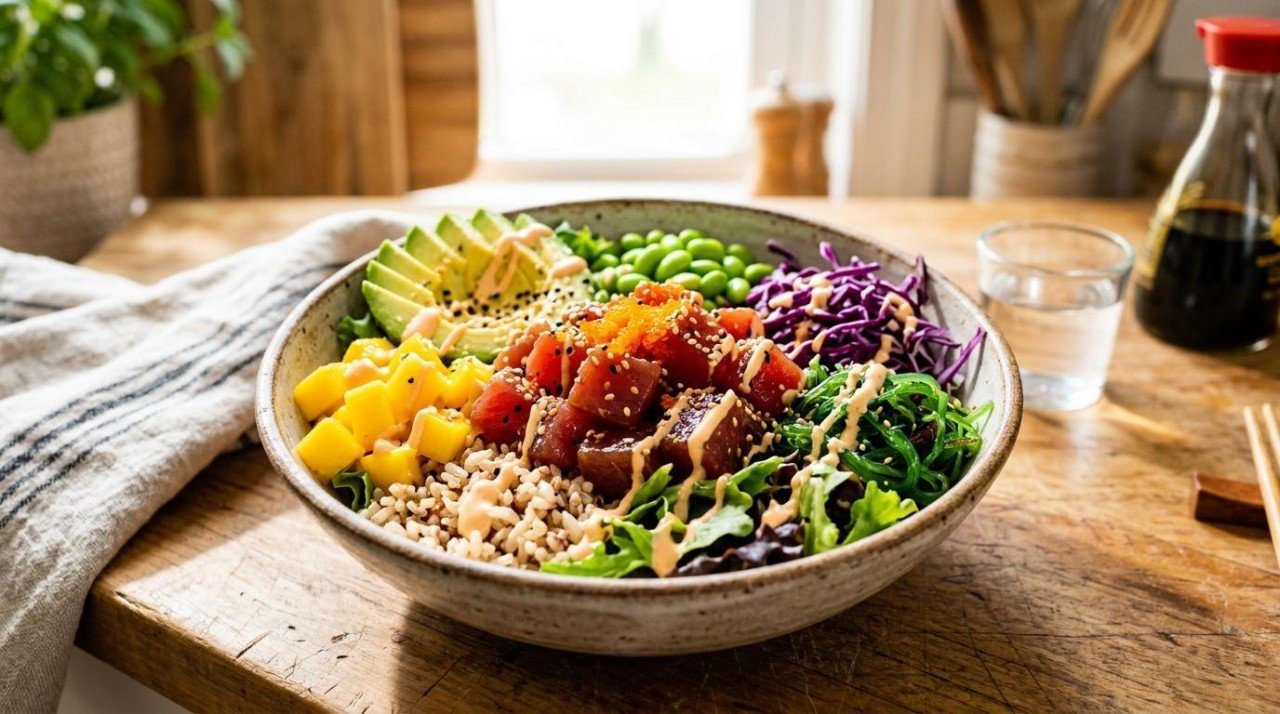
Nutrition Score: 90/100. Makes 1 bowl.
- 3/4 cup (150 g) cooked brown rice, tossed with 1 teaspoon rice vinegar and 1 teaspoon sugar
- About 2 1/2 cups (80 g) mixed salad greens
- 6 oz (170 g) sushi-grade ahi tuna, cut into 3/4-inch cubes
- 1 tablespoon reduced-sodium soy sauce
- 1 tablespoon fresh lime juice
- 1 teaspoon toasted sesame oil
- 3 tablespoons (45 g) plain Greek yogurt
- 1 teaspoon sriracha
- A generous 1/3 cup (60 g) shelled edamame
- 1/2 cup (60 g) sliced cucumber
- 1/3 cup (40 g) shredded carrot
- 1/3 cup (30 g) shredded red cabbage
- 4 or 5 radishes (25 g), thinly sliced
- 1/4 cup (40 g) diced mango
- 1/4 avocado (50 g), sliced
- 1/4 cup (40 g) seaweed salad
- 2 tablespoons (20 g) sweet onion, sliced paper thin
- 2 tablespoons (10 g) sliced green onion
- 1 tablespoon (15 g) masago
- 2 teaspoons (5 g) toasted sesame seeds
- Toss the warm brown rice with the rice vinegar and sugar, spread it out, and let it cool to room temperature. Cold rice under cold fish is the whole point.
- Combine the soy sauce, lime juice, and sesame oil. Add the cubed tuna and the sliced sweet onion, toss gently, and refrigerate for 10 to 15 minutes. Do not marinate longer — the acid will start to cure the fish and turn it opaque.
- Stir the Greek yogurt and sriracha together with a small squeeze of lime until it is thin enough to drizzle.
- Put the greens in the bottom of a wide bowl and spoon the rice over one side of them.
- Arrange the marinated tuna over the rice, then the edamame, cucumber, carrot, cabbage, radish, mango, avocado, and seaweed salad around it in sections.
- Drizzle the spicy yogurt over the top. Finish with the green onion, masago, and sesame seeds, then toss it together at the table.
Per bowl, original versus improved:
- Nutrition Score: 55 → 90
- Calories: 1,274 → 793
- Sodium: 4,340 mg → 1,130 mg (189% DV → 49%)
- Added sugar: 17.7 g → 7.5 g
- Fiber: 9.8 g → 14.2 g
- Protein: 67 g → 66 g
- Total fat: 51 g → 23 g; saturated fat 8.0 g → 3.7 g
- Plant types: 7 → 13
- Gut health dimension: 42 → 91
Swaps we tested and skipped
Cauliflower rice instead of brown rice: 90 → 84. It cuts 149 calories and pushes fiber to 15.7 g, and still scores six points worse — the bowl loses the grain that gives it staying power, and it stops being poke. Easy no.
Skipping the avocado to cut fat: 90 → 86. Four points down for 80 calories saved, plus a plant point gone. The fat in avocado is doing useful work and the score says so.
And as covered above, the two swaps everyone assumes are the fix — ditching the spicy mayo, skipping the crunchy toppings — each scored one point worse than the original when tested alone.
Make it fit other diets
Each of these is a single change. Gluten-free: reduced-sodium tamari in place of the soy sauce, and check the seaweed salad label. No raw fish: cooked flaked salmon or poached shrimp keeps almost all of the nutrition. Vegan: pressed marinated tofu for the tuna, a tahini-sriracha drizzle for the yogurt sauce, and drop the masago. In Eat Well Planner, Recipe Variations rewrites the whole recipe for any of these in one step.
The takeaway
Poke earns its reputation. A 55 for a bowl of raw fish and vegetables is not an indictment of the dish — it is an indictment of the sauce ladle, and the fix costs you one topping you can live without. The bigger lesson is the order: the rice change was worth 4 points before the sauce fix and 15 points after it.
You can run this on any recipe you own. Import it into Eat Well Planner from a URL, an Instagram reel, or a YouTube video, get its Nutrition Score, then let Make It Healthier propose swaps — each one checked against the nutrition calculator before you see it, so the gain is verified rather than guessed. Or open the Recipe Playground, keep the eel sauce, and watch exactly what it costs.