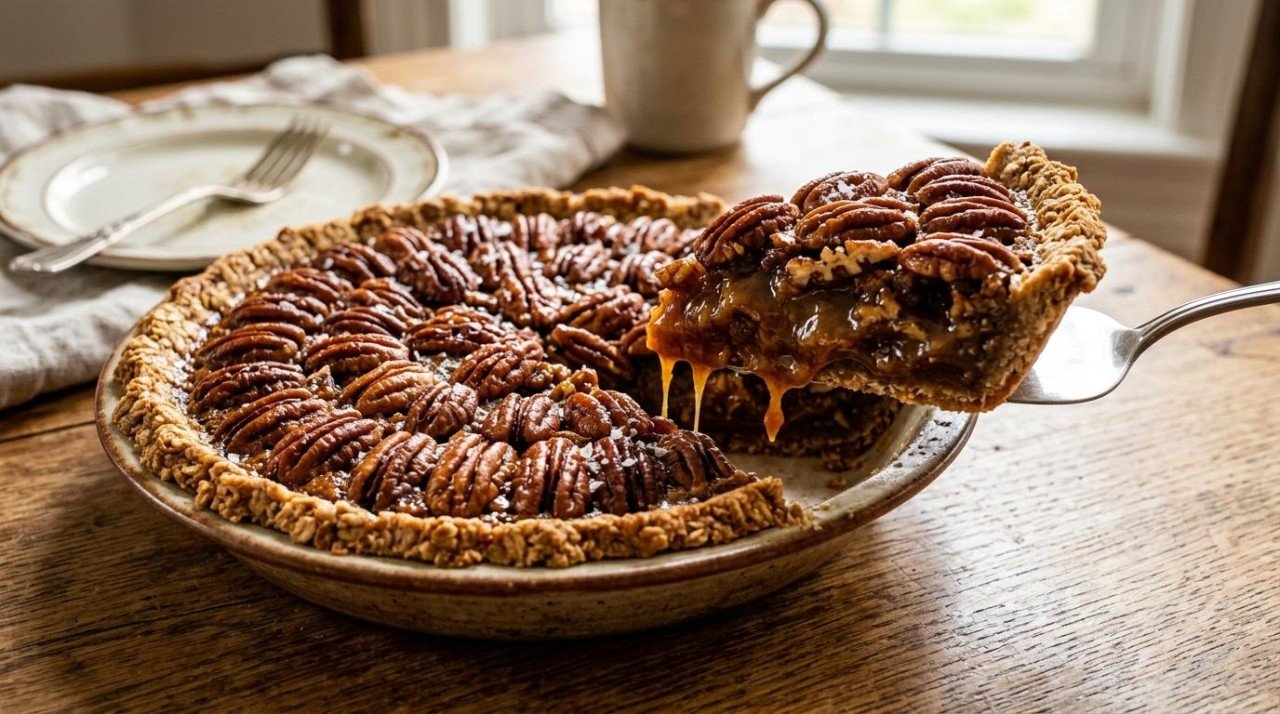
Pecan pie is the dessert that ends the meal at a lot of American holiday tables, and it earns the spot. A good one is almost obscenely rich - a dark, gooey, slightly chewy filling under a crown of toasted pecans, best cut thin and eaten with something cold. Nobody has ever mistaken it for health food, and nobody has ever cared.
Still, we wanted to know exactly how far off it was. So we scored a standard pecan pie in Eat Well Planner and it came back at 16 out of 100 - the lowest opening number of any pie we have put through this series. One slice carries about 58 grams of added sugar, which is more than double the American Heart Association's daily limit for women.
Then we rebuilt it, one swap at a time, scoring every step against live nutrition data. The finished pie scores 58. It is still a pecan pie: same gooey set, same toasted top, same reason for existing. And the biggest surprise was that the change we were most confident about - loading in far more pecans - actually made the score worse. Here is the whole thing, receipts included.
The original: what is in it and how it scores
The version we scored is the one most families make, and roughly the one printed on the corn syrup bottle. For a 9-inch pie cut into 8 slices: a single all-butter pastry crust (1 1/4 cups all-purpose flour, 1/2 cup butter, salt), and a filling of 1 cup light corn syrup, 1 cup granulated sugar, 3 eggs, 2 tablespoons melted butter, 1 teaspoon vanilla, and 1 1/2 cups pecans. Popular published versions vary a little - Sally's Baking Addiction, for instance, uses dark corn syrup with brown sugar and more pecans - but the shape is the same: a syrup-and-sugar custard with nuts on top.
At 8 slices, here is what one slice looks like:
- Nutrition Score: 16/100
- Calories: 617
- Added sugar: 57.6 g - flagged very high
- Saturated fat: 10.1 g - flagged high
- Fiber: 1.8 g
- Protein: 7.2 g
- Plant points: 1
The diagnosis is unusually simple, because one number does almost all the damage. Between the corn syrup and the cup of granulated sugar, the filling is basically sweetener held together by egg. For context, the American Heart Association suggests a daily ceiling of about 24 grams of added sugar for women and 36 grams for men. A single slice is 58 grams.
What is not the problem: the pecans. Nothing in this pie is ultra-processed, the eggs contribute real protein and choline, and even the original scrapes together an excellent-source rating for thiamine, biotin, and iron. The fat number looks alarming on the label, but most of it is the monounsaturated fat in the nuts - the saturated fat comes from the butter, not the pecans. The 1.8 grams of fiber is the real tell: 1 1/2 cups of pecans across 8 slices is not much nut per slice once you spread it over half a pound of sugar.
Which pointed straight at a hypothesis we were confident about: flip the ratio. Less sugar custard, far more pecans. We tested it first, on the original recipe, before changing anything else. Pushing the pecans from 1 1/2 cups to 2 3/4 cups - nearly doubling them - moved the score from 16 to 17. One point. You cannot out-nut a corn syrup filling. The filling had to go first.
The upgrades
Every delta below was measured by applying the swaps cumulatively, in this order, and re-scoring after each one.
1. Replace the corn syrup and sugar with dates and maple syrup
- Swap: 1 cup corn syrup + 1 cup granulated sugar → 250 g pitted Medjool dates, blended, + 1/3 cup pure maple syrup
- Score impact: +14 points (16 → 30)
- What it changes: Added sugar per slice falls from 57.6 g to 7.6 g; fiber more than doubles and potassium triples
- What it costs you: The filling turns a shade darker and tastes more caramel-and-toffee than clean sweet. It also sets softer.
This is the swap that carries the post. Dates are not a magic sugar - they are roughly half sugar by weight - but that sugar comes packaged with 6.5 to 11.5 percent dietary fiber plus minerals and polyphenols, and the app counts it as fruit rather than added sugar. Blended into a thick paste with hot water, dates also do the one structural job corn syrup was there for: bulk and body.
Corn syrup is not in the recipe by accident, though. It is a glucose syrup, and those extra single sugars physically get in the way of sucrose crystals forming, which is why the filling stays smooth and gooey instead of grainy - and thinner syrups like maple famously make a softer-set pie. The date paste is what buys that back, because it is far thicker than corn syrup, so the filling still slices. If you want to go further down this road, our white sugar substitutes guide and maple syrup guide cover the trade-offs ingredient by ingredient.
2. Trade the pastry crust for a pressed oat crust
- Swap: All-butter pastry crust → 1 1/2 cups rolled oats, 3 tablespoons butter, 1 egg white, pressed into the pan
- Score impact: +11 points (30 → 41)
- What it changes: Refined flour out, whole grain in; saturated fat drops sharply; adds a plant point
- What it costs you: Nothing flakes. You get a toasty, slightly crumbly, granola-ish base instead - which frankly suits pecans better than pastry does.
The pastry crust was carrying half a cup of butter and 1 1/4 cups of refined flour while contributing no nutrients worth counting. An oat press-in crust replaces both, and it is easier: no rolling, no chilling, no pie weights. Whole grains are also one of the better-supported swaps in nutrition - people eating about 70 grams a day show 22 percent lower total mortality than people eating little or none. If you would rather keep pastry, the all-purpose flour substitutes guide covers which flours actually behave in a pie dough.
3. Put ground flaxseed in the crust
- Swap: Add 2 tablespoons ground flaxseed to the oat crust
- Score impact: +5 points (41 → 46)
- What it changes: Omega-3 ALA goes from a flagged weakness to an excellent source; another plant point
- What it costs you: Almost nothing. It reads as extra nuttiness in the crust.
Pecans are heavy on monounsaturated fat and light on omega-3 ALA, so the pie kept getting dinged for it. Two tablespoons of ground flaxseed in the crust fixes that line item outright, and it helps the crust hold together. Buy it already ground or grind it yourself - whole flaxseed passes through mostly intact.
4. Take the butter out of the filling
- Swap: Drop the 2 tablespoons of melted butter from the filling
- Score impact: +5 points (46 → 51)
- What it changes: Saturated fat per slice down another notch, with no loss of structure
- What it costs you: Genuinely hard to detect. The date paste is already doing the mouthfeel work.
In a corn syrup pie, that melted butter is a lot of what makes the filling taste rich. In a date-based filling it is redundant - the dates bring their own body and a caramel note that the butter was previously faking. Five points for deleting a line is the best rate of return in the whole build. The butter substitutes guide has the options if you want to keep some richness in another form.
5. Cut the maple syrup back to 2 tablespoons
- Swap: 1/3 cup pure maple syrup → 2 tablespoons
- Score impact: +10 points (51 → 61)
- What it changes: Added sugar per slice goes from 7.6 g to 3.0 g, and the added-sugar warning disappears completely
- What it costs you: The pie is noticeably less sweet than the one you grew up on. Most people read it as more grown-up; some will want a scoop of something cold on the side.
This is the same threshold effect we found in the apple pie makeover, and it is the most useful thing to understand about sugar and scores. Nutrition labeling works in thresholds, not gradients - the FDA treats 20 percent of the added-sugar Daily Value per serving as the line above which a food counts as high - and the score works the same way. The first sugar cut, the big dramatic one in swap 1, took the slice from 57.6 g down to 7.6 g and was worth 14 points, but it was still over the line and still flagged. This far smaller cut, another 4.6 g, is what crossed it, and it paid 10. If you remember one thing from this post: cutting sugar most of the way is worth much less than cutting it the last bit past the threshold.
Take the Guesswork Out of Eating Well
Eat Well Planner helps you organize your favorite recipes, plan balanced meals, and automatically generate shopping lists — all in one place. Whether you're tracking macros, managing dietary restrictions, or just trying to stop asking "what's for dinner?", we've got you covered.
Our AI-powered tools can adapt any recipe to your dietary needs, help you discover new meals you'll love, and even log your nutrition effortlessly. It's meal planning made simple.
Start Organizing Your Meals — FreeThe pecan question: why we paid 3 points to add pecans back
At this point the pie scores 61 with the original 1 1/2 cups of pecans, and here is where the numbers argued with us. We added the pecans anyway, and it cost us:
- 1 1/2 cups (180 g) pecans: 61/100, 416 calories per slice
- 2 cups (240 g) pecans: 58/100, 472 calories per slice - the version we recommend
- 2 3/4 cups (320 g) pecans: 55/100, 547 calories per slice
The score is partly a density measure, and pecans are the most calorie-dense thing in the pan, so every extra cup pulls the number down even though the pecans are the best ingredient in the recipe. We went with 2 cups and accepted 58 for two reasons. The first is practical: cutting the sweetener this hard shrinks the filling by roughly a third, and without more nuts a 9-inch pie comes out shallow and sad. The second is that the human evidence points the other way. In a 4-week randomized trial of 102 adults with excess weight or dyslipidemia, about 45 grams of pecans a day lowered total cholesterol by 13.3 mg/dL and LDL by 12.7 mg/dL, with a higher dose doing no better. More broadly, people who eat an ounce of nuts five or more times a week show 14 percent lower cardiovascular disease risk and 20 percent lower coronary heart disease risk, across more than 210,000 people followed for up to 32 years.
So if you want the highest number, use 1 1/2 cups and take your 61. We think the better pie is the one with 30 grams of pecans in every slice. Both are honest answers, and the app will show you either one.
What we kept on purpose
The 3 tablespoons of butter in the crust stay, and this one is worth explaining because the numbers say we could have had it either way. Swapping that butter for 3 tablespoons of olive oil scores 58 - exactly the same - while dropping saturated fat from 5.3 g to 3.6 g per slice, which clears the last remaining warning on the pie. Butter costs nothing on the score and buys a much better crust, so it stays. If a clean nutrition panel matters more to you than the flavor, the olive oil version is right there, and it is not a downgrade.
The eggs stay too, all three of them. They are the pie's structure - there is no version of this filling that sets without them - and a good part of why a slice of dessert carries 9 grams of protein.
And we stopped there. Past this point every remaining swap either breaks the dish (no eggs, no crust) or takes out the pecans, which is the whole reason anyone makes this pie. This is still dessert: 472 calories a slice, more than half of it fat. The claim is not that pecan pie is now good for you. The claim is that it went from 16 to 58, lost 95 percent of its added sugar, and more than tripled its fiber, without stopping being pecan pie.
The healthier pecan pie: full recipe
Nutrition Score: 58/100 (up from 16). Makes one 9-inch deep-dish pie, 8 slices.
For the crust:
- 1 1/2 cups (130 g) old-fashioned rolled oats
- 2 tablespoons (20 g) ground flaxseed
- 3 tablespoons (43 g) butter, melted
- 1 large egg white
- 1/4 teaspoon fine salt
For the filling:
- 250 g pitted Medjool dates (about 14 large dates)
- 1/2 cup (120 mL) boiling water
- 3 large eggs
- 2 tablespoons (40 g) pure maple syrup
- 1 teaspoon vanilla extract
- 1/2 teaspoon flaky sea salt, plus a pinch for the top
- 2 cups (240 g) pecan halves
- Cover the dates with the boiling water and leave them to soften for 15 minutes. Meanwhile, heat the oven to 350F and lightly butter a 9-inch deep-dish pie pan.
- Pulse the oats, flaxseed, and fine salt in a food processor until the mixture looks like coarse sand with some oat texture left in it. Add the melted butter and egg white and pulse until a squeezed handful holds together.
- Press the crust firmly up the sides of the pan first, then across the bottom, using the flat base of a measuring cup to even it out. Bake for 12 minutes, until it smells toasted and looks dry. Leave the oven on.
- Tip the dates and their soaking water into the food processor and blend to a completely smooth, thick paste, scraping down twice. Any lumps left now will be lumps in the finished pie.
- Add the eggs, maple syrup, vanilla, and flaky salt and blend just until combined and glossy, about 10 seconds. Do not leave the machine running or you will whip air into it.
- Scatter 1 1/2 cups of the pecans over the baked crust. Pour the filling over them - the nuts will float up. Arrange the remaining 1/2 cup of pecan halves on top, pressing them lightly into the surface, and sprinkle with a pinch of flaky salt.
- Bake for 45 to 55 minutes, until the outer 2 inches are set and a circle about 2 inches across still wobbles in the center. Tent the crust edge with foil if it darkens early.
- Cool completely on a rack, at least 3 hours, then refrigerate for 2 more before slicing. This filling sets softer than a corn syrup one, so the chill is not optional - cut it warm and you will get a puddle.
Per slice, original versus this version:
- Nutrition Score: 16 → 58
- Calories: 617 → 472
- Added sugar: 57.6 g → 3.0 g
- Fiber: 1.8 g → 6.1 g
- Protein: 7.2 g → 9.0 g
- Saturated fat: 10.1 g → 5.3 g
- Sodium: 390 mg → 250 mg
- Plant points: 1 → 4
The finished pie rates as an excellent source of biotin (47% DV), omega-3 ALA (33%), phosphorus (30%), iron (27%), thiamine (23%), fiber (21%), magnesium (20%), and zinc (20%). On the app's dimension breakdown, gut health went from 14 to 67 and heart health from 11 to 53. Most Americans get about 15 grams of fiber a day against a target of 25 to 35, so a dessert chipping in 6 grams is doing something unusual.
Swaps we tested and skipped
- Ditching the crust entirely. Baked as a crustless pecan custard, the same filling scores 58 - identical - at 367 calories a slice. Zero points for throwing away the crust, and you lose a plant point and the oats. If you want the lower calorie count it is a real option, but do not do it for the score.
- Dropping the last of the maple syrup. Taking out those final 2 tablespoons also scores 58. The last of the sweetener is free, so keep it - below the added-sugar threshold there is no more reward.
- More pecans still. 2 3/4 cups scored 55, three points below our version, for 75 more calories a slice.
- Flaky salt on top. Worth nothing at all on the score, and we did it anyway. It sharpens the date sweetness more than any ingredient swap in the recipe. Not every good decision is a nutrition decision.
Make it fit other diets
- Gluten-free: use certified gluten-free oats and the pie is already there. Nothing else in it contains wheat.
- Dairy-free: use the olive oil crust described above, which scores the same 58 and clears the saturated fat flag.
- Vegan: the crust works with olive oil and a flax egg, but the filling genuinely needs the eggs to set. A starch-set version (cornstarch whisked into the date paste) will hold, but it is a firmer, fudgier slice rather than a custard - a different dessert, honestly, and one we have not scored.
You can skip the guesswork on any of these in Eat Well Planner: ask for a vegan or dairy-free version of a saved recipe and Recipe Variations rewrites the whole thing with the substitutions worked in, then scores the result so you can see what the change actually cost.
Do this to any recipe you love
Nothing here required us to know anything about pecan pie in advance. We imported the recipe, read the score and the flags, and let Make It Healthier propose swaps - each one checked by a calculator before it is shown, so a suggestion that does not actually help never appears. Then we tested them in the Recipe Playground, which shows the score move live as you edit. That is how we caught that more pecans made things worse, and that a 2-tablespoon sugar cut at the end was worth almost as much as taking out two full cups of sweetener at the start.
That loop works on anything: import the recipe from a URL, an Instagram reel, or a YouTube video, look at what the score says is wrong, and take the swaps that are worth it. Your grandmother's pecan pie included. Especially your grandmother's pecan pie.