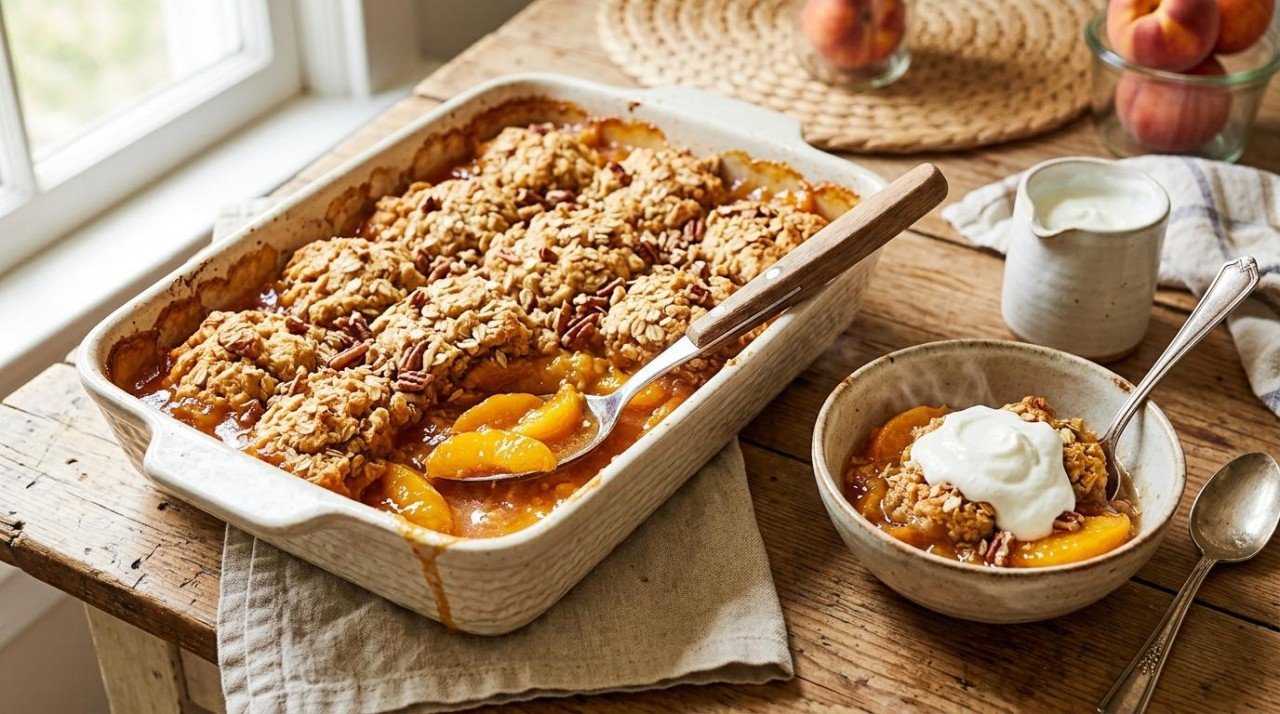
Peach cobbler is summer's most forgiving dessert. No rolling pin, no lattice, no blind baking - you put fruit in a dish, cover it with something, and bake it until the juices bubble up around the edges. It has been made that way since colonial cooks, for whom pies were hard to manage on an open hearth, put fruit in deep pots and covered it with biscuit dough, and the first published peach cobbler recipe turned up in Lettice Bryan's The Kentucky Housewife in 1839.
The version most of us grew up with, though, has drifted a long way from fruit with a lid on it. The popular melted-butter cobbler uses two cups of sugar, a stick of butter and a cake-like batter for one 9x13 dish. We built it in Eat Well Planner and ran it through the app's Nutrition Score, and it came back at 21 out of 100. Then we rebuilt it one verified swap at a time and got it to 73. It is still bubbling peaches under a golden, craggy topping. There is just twice as much fruit and almost none of the sugar.
This is the companion to our healthier apple pie, and the same lesson showed up again: the score has a sugar line, and nothing else pays much until you cross it. Cobbler adds a second lesson that pie did not have. The single most useful thing you can do to it is change what is in the pan - more fruit, less topping - and that move gets more valuable with every swap you make after it.
The original: what's in it and how it scores
We scored the classic Southern melted-butter cobbler: 1/2 cup butter melted in the pan; a batter of 1 cup all-purpose flour, 1 cup sugar, 1 tablespoon baking powder, a pinch of salt and 1 cup whole milk poured over the butter; and 4 cups of sliced peaches tossed with another cup of sugar and a tablespoon of lemon juice, spooned on top. The batter rises up around the fruit as it bakes. Eight servings. Every number below is per serving.
Nutrition Score: 21/100. Per serving: 414 calories, 3.5 g protein, 1.6 g fiber, 7.9 g saturated fat, and 50 g of added sugar - which the app flags as very high, at 189% of a day's reference. For scale, the American Heart Association suggests no more than about 24 g of added sugar a day for most women and 36 g for most men. One bowl of cobbler is two days' worth for many women. Saturated fat came in second at 34% of the daily ceiling, flagged high.
The bigger problem is easier to see if you weigh the pan instead of reading the label. The 4 cups of peaches come to about 600 g. The batter, butter and sugar add up to more than that. That makes it a sweet cake with some peaches in it, and the peaches are the only thing in the dish that brings fiber, potassium or a plant point. With a cup of sugar poured over them, even they are carrying added sugar.
To be fair to it: there is nothing ultra-processed here. It is flour, butter, sugar, milk and fruit. Sodium is moderate at 180 mg, and the enriched flour, milk and baking powder are why it registers as a good source of iron, calcium and folate. What holds it at 21 is sugar, saturated fat, and a ratio that puts the fruit in second place.
The upgrades
We applied these in order and re-scored after each one, so every delta is what that swap was worth at that point in the build. If you only have time for two changes, double the peaches and cut the sugar to 2 tablespoons total - that alone takes the classic batter version from 21 to 43. The rest of the list is how you get from 43 to 73.
1. Double the peaches
- Swap: 4 cups sliced peaches → 8 cups (about 1.2 kg, from 8 or 9 medium peaches)
- Score impact: +4 points (21 to 25)
- What it changes: Fiber from 1.6 g to 2.7 g, potassium from 170 mg to 260 mg
- What it costs you: More peaches to slice. The cobbler gets deeper and juicier, which most people count as a win.
Four points looks modest, and that is the most interesting thing about it. At this stage the fruit is still drowning in two cups of sugar, so adding more of it moves the needle only a little. Hold on to this one, though: at the end of the build we went back and cut the fruit back to the original 4 cups, and the finished cobbler dropped nine points. The fruit-to-topping ratio is worth more the cleaner the rest of the recipe gets.
Leave the skins on if you can. A study of peach varieties found the peel carried substantially more phenolics, flavonoids and antioxidant activity than the flesh, and in a cobbler, softened skins mostly disappear. King Arthur's own cobbler recipe lists the peaches as "peeled (or not)". The scoring data does not tell peeled and unpeeled peaches apart, so we have not claimed a point for it.
2. Stop sugaring the fruit
- Swap: 1 cup sugar on the peaches → none; add 2 tablespoons cornstarch, 1 teaspoon cinnamon and 1 teaspoon vanilla
- Score impact: +6 points (25 to 31)
- What it changes: Added sugar from 50 g to 25 g a serving; 91 fewer calories
- What it costs you: Nothing, if your peaches are ripe. Everything, if they are not.
Ripe peaches are sweet enough on their own, and in cobbler the sugar on them is doing a second job you can replace: it pulls juice out of the fruit, and then the batter or a thickener has to set that juice. Cornstarch does the setting without the sweetness. King Arthur's advice is to choose the amount of cornstarch based on how juicy your peaches are - their range runs from 2 to 5 tablespoons - and less gives you a looser, saucier cobbler. Two tablespoons is right for 8 cups of ripe fresh fruit; go to 3 if they are very juicy or frozen.
The cinnamon and vanilla are there to buy back perceived sweetness. In a study of 129 young adults, adding vanilla aroma made sweetened water taste sweeter, with the effect strongest in women. Keep the lemon juice, too: acid makes the peaches taste more like peaches. If you are out, our lemon juice substitutes guide has options, and the cornstarch guide covers arrowroot and tapioca if you prefer them.
One honest caveat: this swap is only as good as your peaches. A hard, out-of-season supermarket peach with no sugar on it will taste like a raw potato with a nice smell. If yours are underripe, let them sit on the counter for a few days, or use frozen, which the app's nutrition data treats the same as fresh.
3. Whole wheat pastry flour
- Swap: All-purpose flour → whole wheat pastry flour
- Score impact: +4 points (31 to 35)
- What it changes: Fiber from 2.9 g to 4.6 g, potassium up 40 mg, a full plant point added
- What it costs you: A slightly nuttier topping. Next to cinnamon and peaches, it reads as warmth.
Whole wheat pastry flour is milled from soft wheat, so it has less of the protein that makes baked goods tough. That makes it the right whole grain for a tender topping. That matters when adults need 25 to 35 g of fiber a day and most Americans get about 15. Our all-purpose flour substitutes guide covers the other options.
4. Trade the batter for an oat and pecan biscuit topping
- Swap: Melted-butter batter → drop-biscuit topping of whole wheat pastry flour, rolled oats, chopped pecans, Greek yogurt and 4 tablespoons of butter (down from 8)
- Score impact: +4 points (35 to 39)
- What it changes: Saturated fat from 7.9 g to 4.2 g, clearing the flag; protein from 4.0 g to 5.9 g; plant points from 2.25 to 4.25; sodium from 190 mg to 140 mg
- What it costs you: The cakey, buttery layer the batter makes as it rises around the fruit. You get craggy biscuits with crisp tops instead.
This is the swap that turns the dish back into a cobbler in the original sense: fruit with biscuit dough dropped on top, the "cobbled" look the dish is usually said to be named for. It also changes the ratio from the other direction. The topping now covers the fruit in mounds instead of encasing it, so every spoonful is mostly peach.
Each ingredient is doing a job. Oats bring beta-glucan, the soluble fiber the FDA allows food labels to link to reduced risk of coronary heart disease. Pecans are the classic Southern partner for peaches and add crunch and plant fat, and taking them out at the end cost two points. Greek yogurt replaces most of the milk and half the butter. It brings protein, keeps the dough tender, and its tang works with the fruit. Our butter substitutes guide and Greek yogurt guide go deeper on both.
We kept the full cup of sugar in this step so its number would be clean. Here is what the sugar is worth.
5. Cut the topping sugar from 1 cup to 2 tablespoons
- Swap: 1 cup sugar in the topping → 2 tablespoons, the only sugar left in the recipe
- Score impact: +24 points (39 to 63) - almost half the whole makeover in one move
- What it changes: Added sugar from 25 g to 3.1 g a serving, clearing the caution completely; 88 fewer calories
- What it costs you: The topping becomes a biscuit rather than a sugar cookie. With sweet fruit underneath, it tastes right.
This is the same thing that happened in the apple pie. Cutting sugar does not raise the score gradually. It does very little until you get under a line, and then it pays a lot all at once. On a nutrition label, 20% of the Daily Value or more of added sugar per serving is considered high, and the score respects that line. Above it, nothing the oats or the fruit add can outweigh the flag. Below it, they all count.
We tested both sides of the line on the finished recipe to make sure. Put one tablespoon of sugar back on the peaches and the score drops from 73 to 62 - eleven points for one tablespoon. Use 1/4 cup in the topping instead of 2 tablespoons and it falls to 50. Take out the last 2 tablespoons entirely and it stays at 73. There is no reward below the line, so keep the sugar that makes the biscuits brown.
The order of the build matters here too. Cut the sugar the same way with the original melted-butter batter still in place and the cobbler scores 47, because the saturated fat flag is still holding it back. The sugar cut pays most once the topping has been rebuilt. Our white sugar substitutes guide has alternatives, but honey, maple syrup and coconut sugar all count as added sugar, and the app scores them the same way.
6. Two tablespoons of ground flaxseed in the topping
- Swap: Nothing → 2 tablespoons ground flaxseed, stirred into the dry ingredients
- Score impact: +3 points (63 to 66)
- What it changes: A new omega-3 ALA highlight at 26% of a day's target; one more plant point
- What it costs you: Nothing you can taste under oats and pecans.
This is the same easy three points it was worth in the apple pie. Buy it pre-ground or grind it in a spice grinder, because whole flaxseed tends to pass through undigested.
7. One less tablespoon of butter, a little more yogurt
- Swap: 4 tablespoons butter → 3, and Greek yogurt from 1/2 cup to 2/3 cup
- Score impact: +7 points (66 to 73)
- What it changes: Saturated fat from 4.2 g to 3.4 g a serving
- What it costs you: A little richness. The biscuits are still tender because the yogurt keeps them moist.
Seven points for one tablespoon of butter surprised us. It is the sugar story again on a smaller scale. Once the added sugar flag was gone, saturated fat became the main thing the score was penalizing, so every gram of it counted for more. We stopped at three tablespoons because that is enough to make a dough that browns and tastes like butter. We did not go lower: three tablespoons is about the least that still gives you a dough that browns and tastes of butter.
Take the Guesswork Out of Eating Well
Eat Well Planner helps you organize your favorite recipes, plan balanced meals, and automatically generate shopping lists — all in one place. Whether you're tracking macros, managing dietary restrictions, or just trying to stop asking "what's for dinner?", we've got you covered.
Our AI-powered tools can adapt any recipe to your dietary needs, help you discover new meals you'll love, and even log your nutrition effortlessly. It's meal planning made simple.
Start Organizing Your Meals — FreeWhat we kept, and where we stopped
We kept 3 tablespoons of real butter. Rebuild the topping with olive oil instead and the cobbler scores 75, two points higher, with saturated fat down to 1.5 g. We did not take that trade, because butter is what makes a cobbler biscuit taste like a cobbler biscuit, and two points is a small reward for losing that. If you like an olive oil biscuit, you know the number now.
We also kept the pecans rather than switching to walnuts. Walnuts scored 74, one point higher thanks to more omega-3 ALA, but pecans are the nut that belongs with peaches. Either is a good choice.
And we kept a little sugar on top of the biscuits. Without it the score is the same and the cobbler is not as good, so it stays.
The healthier version: full recipe
Final Nutrition Score: 73/100. Serves 8. One 9x13-inch baking dish.
Peach filling
- 8 cups (about 1.2 kg) sliced ripe peaches, skins on or off - from 8 or 9 medium peaches, or about 2 1/2 lb frozen slices, thawed
- 1 tablespoon (15 g) lemon juice
- 2 tablespoons (16 g) cornstarch (3 tablespoons if the peaches are very juicy or frozen)
- 1 teaspoon ground cinnamon
- 1 teaspoon vanilla extract
Biscuit topping
- 1 cup (120 g) whole wheat pastry flour
- 1/2 cup (45 g) old-fashioned rolled oats
- 1/3 cup (35 g) pecans, chopped
- 2 tablespoons (14 g) ground flaxseed
- 2 tablespoons (25 g) granulated sugar, divided
- 2 teaspoons baking powder
- A pinch of salt
- 3 tablespoons (42 g) cold unsalted butter, cubed
- 2/3 cup (150 g) plain nonfat Greek yogurt
- 1/4 cup (60 ml) whole milk
- Heat the oven to 400°F with a rack in the center. Toss the peaches with the lemon juice, cornstarch, cinnamon and vanilla right in a 9x13-inch baking dish until no dry cornstarch remains. Spread them evenly and slide the dish into the oven for 10 minutes while you make the topping, so the fruit starts to heat and release its juice.
- In a bowl, whisk together the flour, oats, pecans, flaxseed, 1 1/2 tablespoons of the sugar, the baking powder and the salt. Rub in the cold butter with your fingertips until the largest pieces are the size of peas.
- Stir the Greek yogurt and milk together until smooth, then add them to the dry ingredients and stir with a fork just until a shaggy, sticky dough forms. Do not overmix.
- Take the dish out of the oven and stir the peaches once. Drop the dough on top in 8 rough mounds, leaving gaps between them so steam can escape. Sprinkle the remaining 1 1/2 teaspoons of sugar over the biscuits.
- Bake 25 to 30 minutes, until the biscuits are deep golden and the juices are bubbling thickly around them. The cornstarch only fully thickens once the filling has been bubbling for a few minutes, so do not pull it early.
- Let it rest at least 20 minutes before serving so the juices can set. Serve warm, ideally with a spoonful of plain Greek yogurt.
Per serving, original vs. improved:
- Nutrition Score: 21 → 73
- Calories: 414 → 261, with twice the fruit in the bowl
- Added sugar: 50 g (189% of a day's reference, flagged very high) → 3.1 g (no flag)
- Saturated fat: 7.9 g (34%, high) → 3.4 g (no flag)
- Fiber: 1.6 g → 5.7 g (19% DV, a good source)
- Protein: 3.5 g → 6.6 g
- Potassium: 170 mg → 340 mg
- Sodium: 180 mg → 140 mg
- Plant points: 1 → 5.25
The finished cobbler is an excellent source of iron and omega-3 ALA, and a good source of fiber, magnesium, zinc and several B vitamins. Its gut health dimension went from 18 to 81, and heart health from 19 to 66. It still has sugar, though: 8 cups of ripe peaches bring plenty of their own, and that natural fruit sugar is the reason the recipe does not need added sugar.
Swaps we tested and skipped
- Going back to 4 cups of peaches: 64, nine points down. The ratio is the foundation of this recipe.
- Olive oil instead of butter in the topping: 75, two points up. We kept the butter for flavor - see above.
- Walnuts instead of pecans: 74, one point up. Either works.
- Removing every last gram of sugar: 73, no change. There is no reward below the line.
- Canned peaches in juice instead of fresh: 71, two points down. Fine for winter: drain them well. Frozen peaches score the same as fresh.
- Keeping the classic melted-butter batter with all the fruit and sugar changes: 47. A big improvement on 21, and the easiest version to try first, but the topping is where the second half of the points come from.
One more test, about what goes in the bowl next to it. A half-cup scoop of vanilla ice cream on each serving takes the finished cobbler from 73 to 46, because the scoop brings back 14 g of added sugar and more than doubles the saturated fat, putting both flags back on. A 3-tablespoon spoonful (40 g) of plain Greek yogurt instead takes it to 78, adding 4 g of protein. The yogurt version is the one we would serve - warm cobbler and cold, tangy yogurt are a great pair. If it is a birthday, have the ice cream.
Make it fit other diets
For gluten-free, use a 1:1 gluten-free baking blend in place of the whole wheat pastry flour and make sure your oats are certified gluten-free. Drop biscuits have little gluten structure to lose, so they adapt well. For dairy-free or vegan, use cold refined coconut oil or a plant butter in the topping, and an unsweetened plain soy or coconut yogurt with a splash of soy milk. Just be aware that coconut oil will bring back saturated fat, so olive oil is the better choice for the score. In the app, the Recipe Variations feature rewrites the whole recipe for either diet in one step, amounts adjusted, and you can score the result before you bake.
Do this to your own recipes
None of this needed a nutritionist. We imported a recipe, looked at the score, found the biggest flag, and tested every idea instead of assuming it would help. That is what Make It Healthier in Eat Well Planner does for you: it suggests swaps for any recipe you have imported and runs each one through a calculator before showing it, so every suggestion actually improves the numbers.
The per-swap numbers in this post came from the Recipe Playground, where you can change one ingredient at a time and watch the score move. Import your family's cobbler - from a website, a video or a stained index card - and try doubling the fruit first. It gets more valuable with every change you make after it.