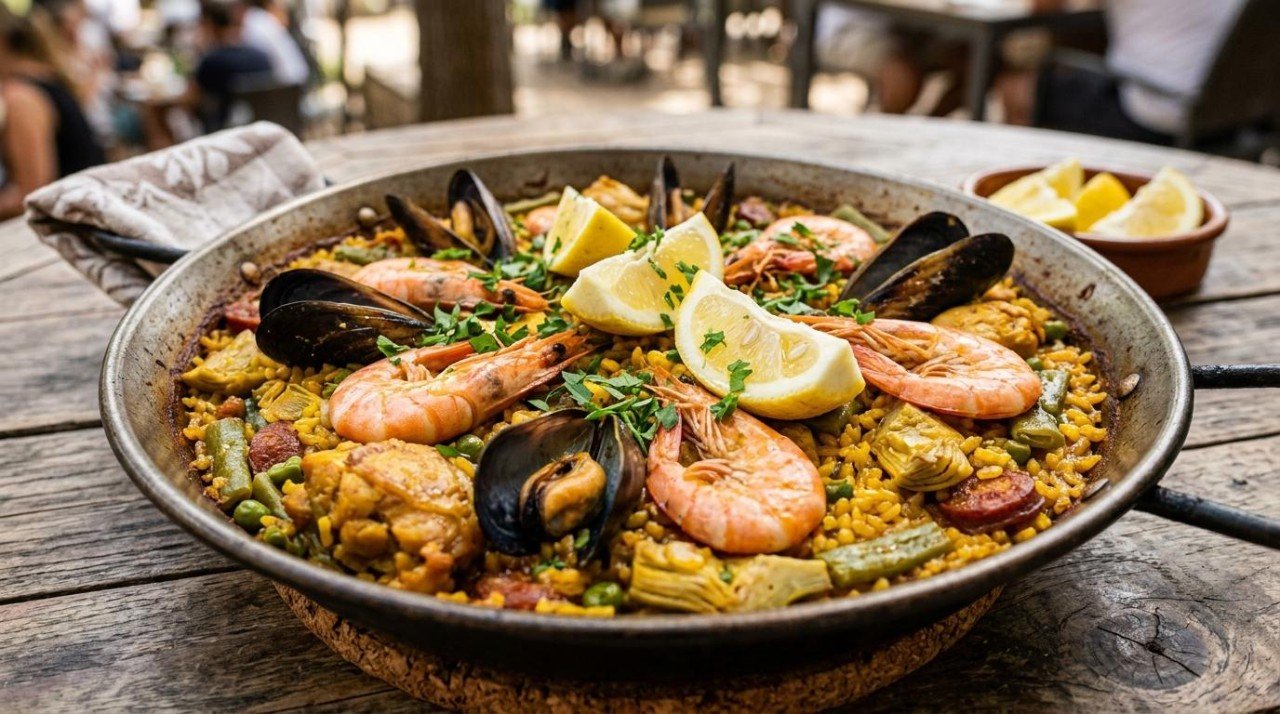
There is a moment near the end of cooking a paella when you turn the heat up, stop touching it, and listen. You are waiting for a faint crackle under the rice — the bottom layer caramelizing into socarrat, the scorched crust Valencians fight over. No other rice dish asks you to do that.
The dish comes from the rice paddies around the Albufera lagoon south of Valencia in the mid-19th century, where it started as a field lunch of rice, olive oil, saffron, green beans, and whatever meat was around. What most of us actually cook is a later, looser thing: shrimp, mussels, chicken thighs, and a ring of sliced chorizo. We ran that version through Eat Well Planner's Nutrition Score — the same number a visitor sees on any public recipe page — and it came back 52 out of 100. Higher than most people would guess, and for good reason.
We got it to 84, and the socarrat survived. But the route there was not the one we expected. The two biggest gains were seasoning decisions rather than ingredient swaps, the swap every healthy-recipe article recommends actually lost a point, and on the chorizo question, Spain turns out to have been right.
The original: what's in it and how it scores
Here is the standard mixed paella we scored, the shape you will find on most American recipe sites, for six people:
- 2 cups bomba (or other short-grain Spanish) rice
- 1/3 cup olive oil
- 8 oz Spanish chorizo, sliced into coins
- 12 oz boneless skinless chicken thighs, 12 oz raw shrimp, 8 oz mussels
- 1 onion, 1 red bell pepper, 4 cloves garlic, 3/4 cup canned tomatoes
- 4 cups regular chicken broth, 1/2 cup white wine
- A pinch of saffron, 1 teaspoon smoked paprika, 1 1/2 teaspoons salt
- 1/2 cup frozen peas
Nutrition Score: 52/100. Per serving: about 731 calories, 40.0 g protein, 6.5 g saturated fat, 1,750 mg sodium, 2.9 g fiber.
Start with what is already excellent, because it is a lot. One serving delivers 258% of a day's vitamin B12, 103% of the omega-3 EPA and DHA target, 71% of phosphorus, 57% of vitamin C, 56% of iron, and half a day's protein — the shellfish doing work almost nothing else on a weeknight menu does. Nobody needs to feel clever about improving this dish.
Two things hold it back:
- Sodium, flagged very high at 76% of a day's value — 1,750 mg, from salted broth, a teaspoon and a half of added salt, and cured chorizo, in that order of blame. Americans already average about 3,400 mg a day against a 2,300 mg limit, and in the long-term follow-up of the Trials of Hypertension Prevention, people who stayed under 2,300 mg had a 32% lower rate of cardiovascular disease than those eating 3,600 to 4,800 mg.
- Fiber, at 2.9 g — 10% of a day's value, from a dish containing five vegetables. Two cups of white rice is most of the pan by volume and contributes close to nothing. Harvard's Nutrition Source puts the target at 25 to 35 g a day, against the roughly 15 g most Americans manage.
Saturated fat is flagged high too, at 28% DV, but note the source: not the olive oil and not the seafood. Eight ounces of cured chorizo carries most of it. The 731 calories are a red herring — this is a whole dinner in one pan, and the score rates nutrient density per serving, not calories.
The upgrades
Four changes, scored cumulatively in this order, each built on the last. If you only make one, make the first. If you make two, make the first and third — together they are worth 18 of the 32 points.
1. Take the rice down to 1 1/2 cups and give the pan to vegetables
- Swap: Rice from 2 cups to 1 1/2; peas doubled to 1 cup; a larger bell pepper; plus 7 oz green beans, 5 oz artichoke hearts, and parsley and lemon at the end
- Score impact: +11 points (52 → 63)
- What it changes: Fiber from 2.9 g to 5.6 g, vitamin C to 89% DV, plant points from 5.75 to 8
- What it costs you: Nothing you will miss — and it is arguably more authentic than what you started with
This is the biggest lever in the dish and the easiest to sell, because the original was already built this way: the traditional Valencian version includes flat green beans and lima beans as core ingredients, not garnish. Somewhere between Valencia and the American internet, the vegetables got demoted to a half-cup of peas thrown in for color.
Keep the total liquid the same — the beans and artichokes bring their own moisture. Green beans go in with the stock; artichokes and peas go in late so they do not turn to mush. Our white rice substitutes guide covers where you can go further than this. Paella, as you will see, is not one of those places.
2. Use unsalted stock instead of regular chicken broth
- Swap: 4 cups regular chicken broth → 4 cups unsalted chicken or seafood stock
- Score impact: +8 points (63 → 71)
- What it changes: Sodium from about 1,770 mg to 1,220 mg per serving, with nothing else moving
- What it costs you: Nothing, as long as you do step 3 deliberately rather than by accident
Regular chicken broth runs around 370 mg of sodium per 100 g; unsalted stock about 30 mg. Across a six-serving pan that is roughly 3,300 mg you did not add, for the same volume and the same simmer. It matters especially here because paella is a dish where all the liquid ends up inside the rice — nothing is drained, so whatever is in that stock is seasoning you committed to before tasting anything. For more flavor at no sodium cost, simmer the shrimp shells in it for fifteen minutes first. Our chicken broth substitutes guide covers what unsalted stock does and does not change.
3. Cut the added salt from 1 1/2 teaspoons to 3/4
- Swap: 1 1/2 teaspoons salt → 3/4 teaspoon, added at the end after tasting
- Score impact: +7 points (71 → 78)
- What it changes: Sodium from 1,220 mg to about 900 mg per serving
- What it costs you: Genuinely something, for about two weeks
Yes, you will notice. Salt is not decoration in a rice dish; it is what makes the saffron read as saffron. Two things make it work anyway. You are no longer starting from salted broth, so 3/4 teaspoon in an unsalted pan lands closer to where 1 1/2 used to than the arithmetic suggests. And acid covers ground that salt used to: the lemon and the wine both read as seasoning, which is why a squeeze of lemon over an under-salted dish makes it taste finished rather than sour. Add the salt at the end, once you can taste what you actually have.
4. Demote the chorizo from base ingredient to accent
- Swap: 8 oz chorizo → 3 oz, plus an extra 1/2 teaspoon of smoked paprika
- Score impact: +6 points (78 → 84)
- What it changes: Saturated fat from 6.6 g to 4.6 g, sodium from about 900 mg to 720 mg
- What it costs you: Less than you fear, because the paprika covers for it
In October 2016 Jamie Oliver tweeted a paella recipe combining chicken thighs and chorizo and Spain lost its mind — an abomination, a Change.org petition, the London Paella School offering him a free lesson. (Jose Andres defended him, arguing it was a perfectly good Spanish rice dish that simply was not paella.) The historical record is less tidy than the outrage suggests. But on the nutrition, the traditionalists have the stronger case.
What chorizo actually contributes to a paella is smoked paprika and rendered orange fat, and both are available separately. Three ounces still stains the whole pan and still puts a few coins on each plate; the extra half teaspoon of paprika restores the depth the missing five ounces took with it. You lose the version where chorizo is a main character. You keep the reason you put it in.
Take the Guesswork Out of Eating Well
Eat Well Planner helps you organize your favorite recipes, plan balanced meals, and automatically generate shopping lists — all in one place. Whether you're tracking macros, managing dietary restrictions, or just trying to stop asking "what's for dinner?", we've got you covered.
Our AI-powered tools can adapt any recipe to your dietary needs, help you discover new meals you'll love, and even log your nutrition effortlessly. It's meal planning made simple.
Start Organizing Your Meals — FreeWhat we kept, and where we stopped
The bomba rice. Not brown, not cauliflower, not a reduced-carb anything. Bomba absorbs three times its volume in liquid where most rice absorbs twice, and expands in width rather than length, which is what lets the grains stay separate in an unstirred pan. Swap it and you do not have a healthier paella, you have a casserole.
The full 1/3 cup of olive oil. We tested cutting it and the score went down. More on that below.
The last 3 oz of chorizo. This is where we stopped, deliberately. Leaving it out entirely scores 87 — three points better, saturated fat down to 3.4 g and sodium to 600 mg, which drops the saturated-fat caution off the card entirely — and purists would tell you that is the more authentic dish anyway. We kept the three ounces because people searching for a healthier paella are searching for the paella they actually make, and an 84 you will cook beats an 87 you will skip. If you want the 87, leave it out and add another teaspoon of smoked paprika.
The healthier version: full recipe
Nutrition Score: 84/100. Serves 6.
- 4 cups unsalted chicken or seafood stock
- A generous pinch of saffron threads (about 1/4 teaspoon)
- 1/3 cup olive oil
- 12 oz boneless skinless chicken thighs, cut into 1-inch chunks
- 3 oz Spanish chorizo, sliced thin
- 1 onion, finely chopped
- 1 large red bell pepper, sliced
- 4 cloves garlic, minced
- 3/4 cup canned crushed tomatoes
- 1 1/2 teaspoons smoked paprika
- 1 1/2 cups bomba or other short-grain Spanish rice
- 1/2 cup dry white wine
- 7 oz green beans, trimmed and halved
- 3/4 teaspoon salt, plus more to taste at the end
- 5 oz artichoke hearts, drained and quartered
- 12 oz raw shrimp, peeled
- 8 oz mussels, scrubbed
- 1 cup frozen peas
- 1/2 cup chopped flat-leaf parsley, 2 tablespoons lemon juice, plus lemon wedges to serve
- Warm the stock in a saucepan and crumble the saffron into it. Keep it hot on a back burner — cold stock hitting the pan stalls the whole cook.
- Heat the olive oil in a 15-inch paella pan or 12-inch skillet over medium-high. Brown the chicken in a single layer, about 6 minutes, then move it to a plate. Add the chorizo and cook 2 minutes, until it releases its orange fat.
- Add the onion and bell pepper and cook 6 to 8 minutes, until soft. Stir in the garlic, tomatoes, and smoked paprika and cook another 5 minutes, until the mixture darkens and stops looking watery. This is the sofrito, and rushing it is the most common way to end up with a bland paella.
- Add the rice and stir 1 minute to coat every grain. Pour in the wine and let it bubble away, about 1 minute.
- Add the hot saffron stock, the green beans, the browned chicken, and the salt. Stir once to distribute, then shake the pan flat. From here on, do not stir again — stirring releases starch and costs you the socarrat.
- Simmer hard over medium-high for 10 minutes, then reduce to low and cook 8 minutes more.
- Nestle the shrimp and mussels into the rice, scatter the artichokes and peas over the top, and cook 6 to 8 minutes, until the shrimp are opaque and the mussels have opened. Discard any that stay shut.
- Turn the heat to high for 60 to 90 seconds. Listen for crackling and stop the moment you smell toast rather than smoke — that is the socarrat forming.
- Off the heat, squeeze over the lemon juice, cover loosely with a clean towel, and rest 5 minutes. Taste, and add a pinch more salt only if it needs it. Scatter the parsley and serve from the pan with lemon wedges.
Per serving, original versus improved:
- Nutrition Score: 52 → 84
- Calories: 731 → 654
- Protein: 40.0 g → 39.2 g
- Fiber: 2.9 g → 5.6 g
- Saturated fat: 6.5 g → 4.6 g
- Sodium: 1,750 mg (76% DV) → 720 mg (31% DV)
- Plant points: 5.75 → 8 of a weekly 30
The improved version is an excellent source of vitamin B12 (237% DV), omega-3 EPA and DHA (102%), vitamin C (89%), vitamin K (73%), phosphorus (72%), iron (60%), and niacin (52%). Under the hood, gut health moved from 40 to 77 and heart health from 41 to 82.
One weakness survives everything: vitamin D. That is not a failure of the recipe — very few foods naturally contain it, mainly fatty fish and fish liver oils, so swapping some shrimp for a salmon fillet or a few sardines is the only real fix. It is worth knowing which weaknesses are yours to solve and which are just how food works.
Swaps we tested and skipped
- Cutting the olive oil to 3 tablespoons: minus 1 point. The most-recommended paella lightening tip made the dish score worse. Dropping the oil took out monounsaturated fat and vitamin E along with the calories, and the score picked up a new low-omega-3 weakness it did not have before. The oil is doing nutritional work, not just lubrication — the OmniHeart trial found that shifting calories toward predominantly monounsaturated fat lowered blood pressure and improved lipid levels. Our olive oil substitutes guide covers when swapping it out is worth it.
- More seafood, less chicken: minus 1 point. We pushed the shrimp to 1 lb and mussels to 12 oz and cut the chicken back, expecting a clear win. Protein rose 3 g, but so did sodium — shellfish are naturally salty, mussels especially — and the score slipped. Do it if you want a more seafood-forward paella. It is a flavor decision, not a nutrition one.
- Brown rice: plus 3 points, and no. It scores 87 and it will not make a paella. Brown rice needs roughly 45 minutes and absorbs on a completely different schedule, so the shrimp are rubber by the time the grains are done — and there is no socarrat, because the bran layer will not caramelize the way bare starch does.
- Cauliflower rice for half the rice: plus 3 points, and definitely no. Same score, worse texture. Cauliflower releases water instead of absorbing it, so the pan never dries out, so the one sound you are cooking for never happens.
Make it fit other diets
- Vegetarian or vegan: drop the seafood, chicken, and chorizo and build on artichokes, butter beans, roasted red pepper, and seared mushrooms, with vegetable stock and an extra teaspoon of smoked paprika for the missing smoke. Score it before assuming it is an improvement — losing the shellfish costs you the B12 and omega-3 highlights.
- Gluten-free: it already is. Check the chorizo label, the only place gluten tends to sneak in.
- Alcohol-free: replace the wine with stock plus 2 teaspoons of sherry vinegar at the end — our white wine substitutes guide has the ratios.
In Eat Well Planner each of these is one message to the AI recipe chat with the full recipe already in context, or one tap of Recipe Variations to get the dish rewritten with the substitutions worked in.
Do this to your own recipes
Nothing here required guessing. Every score and delta came from the app's Nutrition Score run against production nutrition data, one swap at a time, in the order you just read — including the two that came back negative, which is exactly why we tested them.
Import a recipe from a URL, an Instagram reel, or a YouTube video and the app extracts the ingredients and scores it. Make It Healthier then proposes swaps with the gain verified by a calculator before you see the suggestion, so nothing is recommended on vibes. And when you want to argue with it — keep the chorizo, add salmon, see what half a cup less rice really costs — the Recipe Playground lets you edit ingredients and watch the score move with each change, which is exactly where the numbers on this page came from.
The paella you love was already a 52. Most beloved dishes are further along than people assume, and the fix is usually four decisions, not a different recipe.