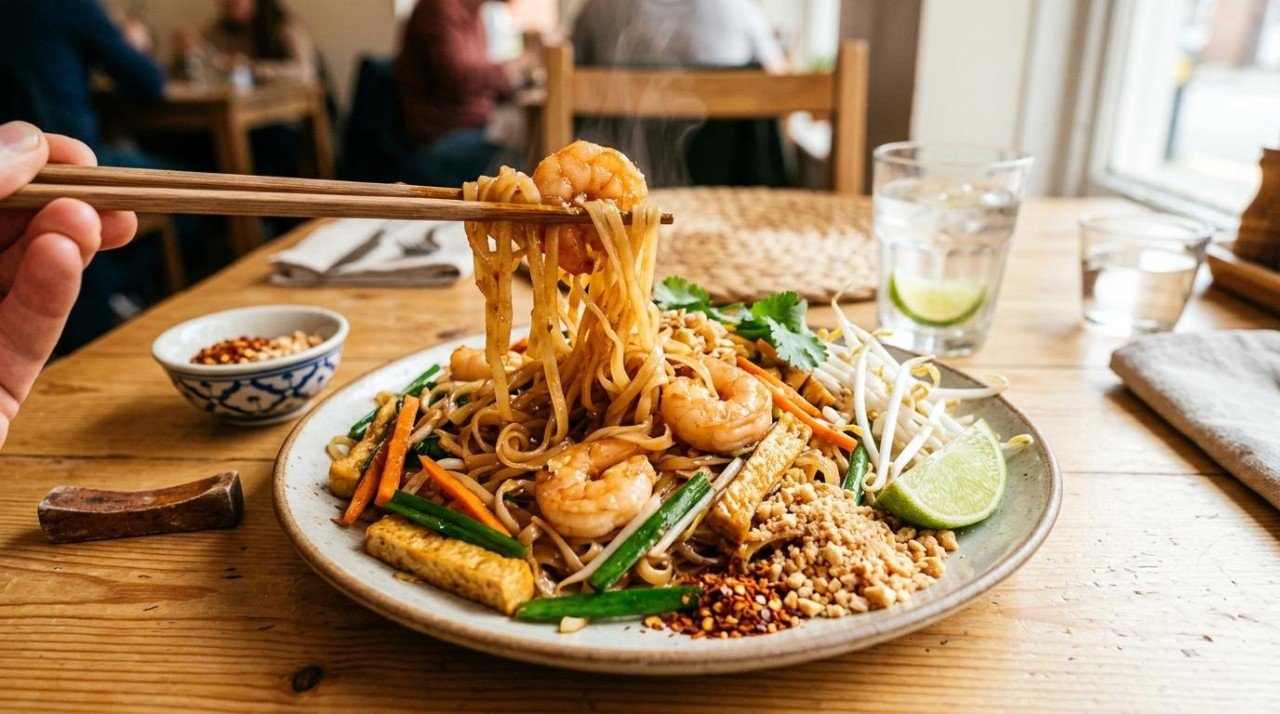
Pad thai is the dish that converts people to Thai food. Chewy rice noodles that have soaked up a sauce that hits sour, sweet, and salty in the same bite, a scramble of egg woven through, crushed peanuts and a hard squeeze of lime on top. It is also, quietly, a piece of state policy: Thailand's wartime prime minister Plaek Phibunsongkhram promoted noodles hard in the 1940s after a 1942 flood wrecked the rice paddies of the Chao Phraya delta, handing out free carts to anyone willing to sell them. Historians point out the name itself gives away the Chinese roots of the technique, and that the dish as we know it was only pinned down in print decades later.
So we built a standard takeout-style plate — the version most American restaurants serve, and most home cooks copy — and ran it through Eat Well Planner's Nutrition Score, the same number that shows on any public recipe page. It came back 44 out of 100.
Here is the promise: we kept all eight ounces of white rice noodles, kept the peanuts, kept the egg, kept the fish sauce, and still got it to 90 out of 100. That is a 46-point jump, and every swap below carries the real score change it earned — including one worth exactly zero points that we made anyway, and three popular swaps that made the score go down.
The original: what's in it and how it scores
Here is the version we scored, for four people:
- 8 oz dried flat rice noodles
- Sauce: 1/4 cup tamarind paste, 1/4 cup fish sauce, 1/3 cup palm sugar
- 3 tablespoons vegetable oil
- 8 oz shrimp and 2 eggs
- 1 cup bean sprouts, 4 scallions, 3 cloves garlic
- 1/4 cup roasted peanuts, 2 tablespoons lime juice, 1 teaspoon chili flakes
That is a restrained version, not a heavy one. The Woks of Life's authentic recipe, also for four, uses five tablespoons of oil to our three. We are not scoring a straw man.
Nutrition Score: 44/100. Now the diagnosis, because understanding why a recipe scores the way it does is the part that transfers to everything else you cook. Two things hold it down, and they are both in the sauce:
- Sodium, badly. 1,560 mg per serving — 68% of a day's value in one plate, flagged very high. A quarter cup of fish sauce carries roughly 4,700 mg of sodium by itself — about 1,180 mg of the 1,560 in every serving. Harvard's Nutrition Source puts the chronic-disease-reduction ceiling at 2,300 mg a day and notes Americans already average around 3,400 mg.
- Added sugar, worse than most people expect. 16.5 g per serving, 62% of the Daily Value, also flagged very high. That is two-thirds of the American Heart Association's entire daily limit for women (24 g) in a savory noodle dish.
- The vegetables are a garnish. One cup of bean sprouts and some scallions, against half a pound of dried noodles. Fiber lands at 3.6 g a serving against the 25 to 35 g a day Harvard says adults need, and plant variety comes in at 4.5 plant points against a weekly target of 30.
Now notice what is not on that list, because pad thai gets a surprising amount right. Saturated fat is 3.7 g a serving, which is genuinely fine for a fried noodle dish. Even at 8 oz of shrimp for four people, it already scores as an excellent source of phosphorus (52% DV), vitamin K (45%), long-chain omega-3s (39%), vitamin B12 (37%), and iron (30%). The peanuts and the oil are carrying plant-based omega-3 ALA at 47% DV. This is a sauce problem and a vegetable problem, not a fat problem — which is exactly the opposite of what most "healthy pad thai" recipes assume.
The upgrades
Five changes, applied in this order, each one scored on top of the last. If you only make one, make the first.
1. Cut the sugar and let the tamarind carry the sauce
- Swap: 1/3 cup palm sugar → 1 1/2 tablespoons; 1/4 cup fish sauce → 2 tablespoons; tamarind up from 1/4 cup to 1/3 cup; lime juice up to 3 tablespoons; garlic doubled to 6 cloves
- Score impact: +16 points (44 → 60)
- What it changes: Added sugar falls from 16.5 g to 5.0 g a serving and the added-sugar caution disappears entirely; sodium drops from 1,560 mg to 970 mg
- What it costs you: A noticeably sourer, sharper sauce. If you liked your pad thai on the candied side, this is the swap you will feel
Pad thai sauce is a three-way balance of sour, sweet, and salty, and the American restaurant version has drifted heavily toward sweet. Pulling two-thirds of the sugar out does not make the sauce taste thin — it makes it taste like tamarind, which is what it was supposed to taste like. The trick is to replace sweetness with more of the other two directions rather than less of everything: more tamarind, more lime, double the garlic. Our brown sugar guide covers what to use if you cannot find palm sugar (light brown sugar, equal weight), and the lime juice guide has the workarounds if you are out of limes.
One warning: tamarind sourness varies a lot by brand. Taste the sauce before it goes in the wok and adjust — if yours is mouth-puckering, pull it back a tablespoon; if it is mild, push it up.
2. Make the vegetables outweigh the noodles
- Swap: 1 cup bean sprouts → about 1 3/4 lb of vegetables: 10 1/2 oz bean sprouts, 7 oz shredded napa cabbage, 2 oz garlic chives, 1 large carrot, 2 shallots, plus the scallions already there
- Score impact: +19 points (60 → 79)
- What it changes: Fiber nearly doubles (3.9 g → 7.0 g), vitamin K goes from 45% to 106% of a day's value, vitamin C from 11% to 49%, vitamin A from 15% to 46%, and plant points from 4.5 to 7.75
- What it costs you: Ten minutes of knife work, and you have to cook in batches or the whole thing steams
This is the biggest single lever in the post, and half of it is not really an upgrade at all — it is a restoration. Garlic chives and a generous handful of bean sprouts are standard in a real Thai pad thai, tossed in at the end for crunch and freshness; the American takeout plate is the version that dropped them. The napa cabbage and carrot are our additions, and we will say so plainly: cabbage is there because it disappears into a noodle stir-fry while adding real bulk, and carrot is there for the vitamin A. Neither one changes what the dish tastes like.
The honest cost is technique. Nearly two pounds of vegetables will not fit in one wok, and The Woks of Life is blunt about why that matters: "Overcrowding a wok with too many ingredients cools it down severely, creating more of a slow-boiling stew than a stir-fry," with the rule that a stir-fry should occupy no more than a third of the wok's volume. Hard vegetables first, sprouts and chives in the last minute so they stay crisp. If your plant variety is the number you are chasing, this swap is where most of it lives — the reasoning behind the 30 plants a week target.
3. Double the protein, with tofu alongside the shrimp
- Swap: 8 oz shrimp → 12 oz shrimp plus 6 oz firm tofu
- Score impact: +3 points (79 → 82)
- What it changes: Protein goes from 22.9 g to 34.6 g a serving (43% DV), long-chain omega-3s from 39% to 56% DV, calcium to 47%, iron to 60%
- What it costs you: Nothing on the plate. About 100 calories a serving, and it briefly triggers a saturated fat flag that the next swap clears
Three points looks like a poor return for that much food, and it is worth saying why it is small: by this stage the recipe had already fixed its two flagged problems, so the protein is not rescuing anything — it is just making the dish into a meal rather than a side. Fried tofu strips are traditional here alongside another protein, so this is not a health-food intrusion. It also adds a plant point, which shrimp cannot.
Keeping shrimp rather than going all-tofu matters more than the three points suggest. Shrimp is what takes the finished dish to 56% of a day's EPA and DHA, and Harvard calls those two marine omega-3s precisely because they come from the sea — nothing else in this bowl can supply them. If shrimp is off the table, our shrimp substitution guide has the closest options.
4. Halve the oil (worth zero points, and we did it anyway)
- Swap: 3 tablespoons vegetable oil → 1 1/2 tablespoons
- Score impact: +0 points (82 → 82)
- What it changes: 46 calories off each serving, total fat from 27.7 g to 22.6 g, and the saturated fat caution introduced by the tofu clears
- What it costs you: You have to get the wok properly hot, or things stick
This is the most honest line in the post: the swap everybody assumes is the big one bought us nothing. The score does not reward it because pad thai's fat was never the problem, and the oil is doing real work — it carries the plant-based omega-3 ALA and the vitamin E that show up in the finished dish's strengths.
We kept the cut because 46 calories a serving for no flavor loss is still a good trade, and it clears a flag. The technique is the whole thing: the wok "should be very hot and lightly smoking before you add the oil." A properly preheated pan needs far less fat than a lukewarm one.
5. Take the fish sauce down one more notch
- Swap: 2 tablespoons fish sauce → 1 tablespoon
- Score impact: +8 points (82 → 90)
- What it changes: Sodium falls from 1,100 mg to 870 mg a serving — 48% of a day's value down to 38%
- What it costs you: This is the swap with the real flavor bill. One tablespoon is a big cut, and the dish tastes less funky and less savory. Compensate with an extra squeeze of lime, more chili, and a heavier hand with the peanuts
We did not expect this. We had already halved the fish sauce in swap 1 and assumed we were done. Going from two tablespoons to one — a difference of about 1,000 mg of sodium across the whole pan — was worth eight points, more than doubling the protein was. That is what a scoring threshold looks like: the last cut is the one that carries the dish out of a band, so it collects the points the earlier cuts set up.
In our nutrition data, fish sauce runs about 7,800 mg of sodium per 100 g, which makes it the densest source of salt in most Thai cooking. There is no way to keep the funk and lose the salt — it is fermented anchovies and salt, that is the whole product. Our fish sauce substitution guide covers what happens if you go further, and if you decide one tablespoon is too austere, going back to two costs you eight points and nothing else. That is a fair trade to make with your eyes open.
Take the Guesswork Out of Eating Well
Eat Well Planner helps you organize your favorite recipes, plan balanced meals, and automatically generate shopping lists — all in one place. Whether you're tracking macros, managing dietary restrictions, or just trying to stop asking "what's for dinner?", we've got you covered.
Our AI-powered tools can adapt any recipe to your dietary needs, help you discover new meals you'll love, and even log your nutrition effortlessly. It's meal planning made simple.
Start Organizing Your Meals — FreeWhat we kept (on purpose)
All eight ounces of white rice noodles. Every one of the peanuts. Both eggs. The fish sauce. The chili. The lime.
The peanuts especially — we tested taking them out and the score fell from 90 to 88. A quarter cup across four servings is doing real nutritional work, not just crunch. Same for the noodles: this is a noodle dish, and any version that treats the noodles as the enemy has already lost.
We stopped at 90 because the only two things the score still flags are sodium (38% DV) and vitamin D, and neither can be closed inside a pad thai. Sodium at this level is simply what a fish-sauce dish is. Vitamin D would require a different protein entirely.
The healthier version: full recipe
Nutrition Score: 90/100. Serves 4.
- 8 oz dried flat rice noodles
- 12 oz raw shrimp, peeled and deveined
- 6 oz firm tofu, cut into 1/2-inch strips and patted dry
- 2 large eggs
- 1 1/2 tablespoons vegetable oil, divided
- 1/3 cup tamarind paste
- 1 tablespoon fish sauce
- 1 1/2 tablespoons palm sugar or light brown sugar
- 3 tablespoons fresh lime juice, divided (about 2 limes)
- 6 cloves garlic, minced
- 2 shallots, thinly sliced
- 7 oz napa cabbage, shredded (about 3 cups)
- 1 large carrot, julienned (about 4 oz)
- 2 oz garlic chives, cut into 2-inch lengths (about 1 cup)
- 4 scallions, cut into 2-inch lengths
- 10 1/2 oz mung bean sprouts (about 3 1/2 cups)
- 1/4 cup roasted peanuts, roughly chopped
- 1 teaspoon crushed red pepper flakes
- Soak the rice noodles in hot water for about 20 minutes, until pliable but still firm, then drain. Do not boil them — they finish cooking in the sauce, and boiled noodles turn to paste in the wok.
- Whisk the tamarind paste, fish sauce, palm sugar, and 2 tablespoons of the lime juice together until the sugar dissolves. Taste it: it should be aggressively sour and salty on its own. Adjust the tamarind if your brand is unusually sharp or unusually mild.
- Heat 1/2 tablespoon of the oil in a wok over high heat until it is lightly smoking. Add the tofu in a single layer and leave it alone for 2 minutes, then turn and brown the other side. Transfer to a plate.
- Add another 1/2 tablespoon of oil, then the shrimp in a single layer. Cook about 1 minute per side, until just pink and opaque, and move them to the plate with the tofu.
- Add the last 1/2 tablespoon of oil, then the shallots and garlic. Stir for 30 seconds, until fragrant but not browned.
- Add the carrot and napa cabbage and stir-fry over high heat for 2 to 3 minutes, until the cabbage has wilted but still has bite. If your wok is more than a third full, do this in two batches.
- Push everything to one side, crack in the eggs, and scramble them in the clear space until just set, then fold them through the vegetables.
- Add the drained noodles and the sauce. Toss constantly for 2 to 3 minutes, lifting from the bottom, until the noodles have absorbed the sauce and turned glossy and orange-brown.
- Return the shrimp and tofu to the pan, then add the bean sprouts, garlic chives, and scallions. Toss for 1 minute — just long enough to heat through while the sprouts stay crunchy.
- Off the heat, scatter over the peanuts and chili flakes and finish with the remaining tablespoon of lime juice. Serve immediately, with extra lime wedges.
Per serving, original vs. improved:
- Nutrition Score: 44 → 90
- Calories: 597 → 669
- Protein: 19.9 g → 34.5 g
- Fiber: 3.6 g → 8.1 g (12% → 27% DV)
- Added sugar: 16.5 g → 4.9 g (62% DV and flagged → no flag)
- Sodium: 1,560 mg → 870 mg (68% → 38% DV)
- Saturated fat: 3.7 g → 4.0 g
- Plant points: 4.5 → 8.75
Yes, calories went up. That is not a rounding error and we are not hiding it: the improved plate is roughly 466 g of food per serving against the original's 256 g. Nearly double the food for 72 more calories, with 15 g more protein and 4.5 g more fiber in it. The finished dish is an excellent source of twenty-three nutrients, including vitamin K (104% DV), phosphorus (86%), iron (60%), EPA and DHA (56%), vitamin A (50%), and vitamin C (49%).
Swaps we tested and skipped
- Zucchini noodles instead of rice noodles: 90 → 87. The single most common "healthy pad thai" recipe online, and it scored three points worse — despite 180 fewer calories, less sodium, and an extra plant point. It also stops being pad thai. Easy call.
- Avocado oil instead of vegetable oil: 82 → 80. It cleared the omega-6 flag and the saturated fat flag, and still lost two points, because vegetable oil was supplying the plant-based omega-3 ALA that the dish counts as a strength.
- Coconut aminos to top the sauce back up after cutting the fish sauce: 90 → 90. No gain at all, and it put the added-sugar caution back at 21% DV. Coconut aminos are genuinely lower in sodium, but they are also sweet, which is the exact thing we just spent swap 1 fixing.
- Dropping the peanuts: 90 → 88. Tested for completeness. They stay.
- Brown rice noodles: 90 → 91. The one rejected swap that scored higher — and the single point is entirely the plant-variety point, since our data has brown and white rice noodles landing in essentially the same place nutritionally. Worth doing if you like them; not worth pretending it is a transformation.
Make it fit other diets
Vegan or vegetarian: drop the shrimp and eggs, take the tofu to a full pound, and swap the fish sauce for a soy-based vegan fish sauce or light soy plus a little seaweed. You will lose the EPA and DHA, which nothing plant-based fully replaces. Gluten-free: pad thai already is, as long as your fish sauce and tamarind have no wheat in them — check the labels. Peanut-free: toasted cashews or sunflower seeds give you the crunch, though the flavor moves.
In Eat Well Planner, you do not have to work any of these out by hand. Ask the AI recipe chat to make this dish vegan, or use Recipe Variations, and it rewrites the whole recipe with the substitutions already worked in — then scores the result so you can see what the change actually cost.
Do this to any recipe you love
Nothing here required guessing. Every number came from the same tools you have: import a recipe from a URL, an Instagram reel, or a YouTube video, and Eat Well Planner scores it. Run Make It Healthier and it proposes swaps like these, with the nutritional gain verified by a calculator before the suggestion ever reaches you. Then take it into the Recipe Playground and test your own ideas — put the two tablespoons of fish sauce back and watch what it costs, or try a protein we did not.
The pattern holds across dishes, too. We found almost exactly the same story in pho and in lo mein: the noodles were never the problem, the sauce was, and the vegetables were the biggest single lever nobody pulls. Keep the dish you love. Change the two things that actually matter.