Overnight oats are one of the few breakfast trends that deserved to win. You stir oats into something liquid, put a lid on it, and eight hours later breakfast exists whether or not you feel like being a person yet. No pan, no timer, no decisions at 7am.
The base is genuinely good, and we can prove it. We scored the plainest possible jar in Eat Well Planner - 1/2 cup rolled oats, 1/2 cup whole milk, a pinch of salt - and it came back at 68 out of 100. That is a solid breakfast with no help from anybody.
Then we scored the jar people actually build. Not a strawman, just the normal accumulation: the flavored yogurt for creaminess, the maple syrup because oats taste like wet cardboard without it, the peanut butter spooned in rather than measured, the handful of chocolate chips. That jar scored 38. The oats never changed. Everything around them did. Here is where the 30 points went, and how we got the jar back up to 90 without turning it into a punishment.
The loaded jar: what's in it and how it scores
This is what we scored, and if you make overnight oats regularly it will probably look familiar:
- 1/2 cup rolled oats (40 g)
- 1/2 cup whole milk (122 g)
- 1/2 cup vanilla yogurt (113 g)
- 2 tablespoons maple syrup (40 g)
- 3 tablespoons peanut butter (48 g)
- 2 tablespoons semisweet chocolate chips (30 g)
- A pinch of salt
Nutrition Score: 38/100. Per jar: 872 calories, 27 g protein, 8.7 g fiber, 40 g total fat, 13.3 g saturated fat, 560 mg sodium, and 52.5 g of added sugar. Plant points: 2.
Start with the fair part, because there is a lot of it. Twenty-seven grams of protein before 8am is genuinely good, and the scoring flagged the jar as an excellent source of phosphorus (92% of a day), biotin (83%), riboflavin (82%), magnesium (49%) and iron (45%). Most of that comes from the oats and the peanut butter. Nothing in this jar is junk.
The problem is arithmetic. The FDA sets the Daily Value for added sugars at 50 g on a 2,000-calorie diet, which is the Dietary Guidelines figure of less than 10% of total calories. This jar carries 52.5 g. One breakfast spends the entire day's allowance and then borrows. The American Heart Association's limit is stricter still - about 24 g a day for most women and 36 g for most men - so the jar is roughly two days of sugar by that measure.
The saturated fat is 13.3 g, two thirds of a day's 20 g Daily Value. And the fiber, in a breakfast built on oats, is only 8.7 g, because most of the calories came from things that carry no fiber at all.
The tell is the calorie count. At 872 calories this is not a breakfast, it is a meal and a half - and the plain base was 230 of those calories. Everything the jar gained in flavor, it paid for at a bad exchange rate.
The upgrades: 38 to 90, one swap at a time
We applied these in order and re-scored after each one, so every number below is the real movement at that point in the build. They are ordered by impact, so if you only make one change, make the first.
1. Let the fruit do the sweetening
- Swap: 2 tablespoons maple syrup out, 1/2 banana and 2/3 cup raspberries in
- Score impact: +9 points (38 to 47)
- What it changes: Added sugar drops from 52.5 g to 28.3 g, fiber jumps from 8.7 g to 14.6 g, plant points go from 2 to 4
- What it costs you: Almost nothing, if you mash the banana in rather than slicing it on top
This is the swap that does the most for the least. Mashed banana stirred in before the oats soak distributes sweetness through the whole jar the way syrup does, and it thickens the mixture instead of thinning it. The raspberries go on top and supply the sharp notes that keep the jar from tasting flat. Calories barely moved (872 to 869) - the point was never the calories, it was replacing sugar that brings nothing with sugar that arrives inside fiber.
If you want to keep a drizzle of the real thing, keep it small and put it on top where you taste it first. Our maple syrup substitutes guide covers the rest, though the honest answer for overnight oats is fruit.
2. Make the cocoa powder do the chocolate work
- Swap: 2 tablespoons chocolate chips out, 1 tablespoon unsweetened cocoa powder plus 2 teaspoons chips in
- Score impact: +3 points (47 to 50)
- What it changes: Added sugar falls to 17.6 g, saturated fat from 13.4 g to 10.7 g, and 90 calories come off
- What it costs you: Nothing, and it tastes more chocolatey, not less
Chocolate chips are mostly sugar and cocoa butter around a small amount of actual cocoa. Cocoa powder is the flavor without the payload. Stirring a tablespoon into the liquid gives you a jar that tastes chocolate all the way through, and the few remaining chips give you the pieces your teeth find. This is the rare swap where the upgrade is straightforwardly better food, not a compromise.
3. Add a tablespoon of chia
- Swap: Add 1 tablespoon chia seeds (12 g)
- Score impact: +4 points (50 to 54)
- What it changes: Fiber goes from 15.4 g to 19.6 g, protein from 28.4 g to 30.5 g, plant points from 4 to 5
- What it costs you: 59 calories, and a slightly puddingy texture some people love and some do not
Chia is the cheapest structural upgrade available to an overnight oat jar. It absorbs many times its weight in liquid, so it thickens the jar into something you eat with a spoon rather than drink, and it is the main reason the finished version registers as an excellent source of plant omega-3.
Note that this swap adds calories rather than removing them, and that is the point of scoring things: fiber and omega-3 are worth 59 calories, while 2 tablespoons of maple syrup were not worth 104. The score tells you which calories earn their keep. Most Americans have room here - average intake is about 16.2 g of fiber a day against targets of 25 g for women and 38 g for men, and roughly 95% of us fall short.
4. Plain Greek yogurt instead of vanilla
- Swap: 1/2 cup vanilla yogurt out, 1/2 cup plain Greek yogurt in
- Score impact: +20 points (54 to 74)
- What it changes: Added sugar drops from 17.6 g to 7.7 g, protein climbs from 30.5 g to 36.4 g
- What it costs you: Real tartness, which the banana and the cocoa mostly absorb
This is the biggest single jump in the whole build, and the interesting part is that it is only that big here. We tested the same swap on the original loaded jar, with the syrup and chips still in it, and it was worth 3 points. Twenty at this position, three at the start.
The reason is that added sugar is scored as a total, not per ingredient. With 52 g in the jar, removing 10 g of it changes almost nothing about what kind of food this is. With everything else already closed off, that last 10 g is the difference between a breakfast that is over the line and one that is comfortably under it. Sugar sources hide behind each other, and the last tap you close is the one that gets the credit.
Flavored yogurt is where this hides most often, because the container says yogurt and the ingredients say dessert - we went through how to read the label in Greek yogurt vs. regular. Greek also brings the protein, which matters beyond the score: in a crossover trial in 20 women, a 14 g protein yogurt snack delayed the next eating occasion by about 30 minutes compared with chocolate and led to roughly 100 fewer calories at dinner. If you need a swap for it, the Greek yogurt substitutes guide ranks the options.
5. Measure the nut butter
- Swap: 3 tablespoons peanut butter down to 1
- Score impact: +3 points (74 to 77)
- What it changes: 212 calories off, total fat from 40.2 g to 23.7 g, saturated fat from 11 g to 7.7 g
- What it costs you: 7 g of protein and some richness - swirl it on top rather than stirring it in and you will not miss it
Here is the finding that surprised us most. We also tested this swap first, on the original jar, before touching the sugar. It scored 37 - cutting two tablespoons of peanut butter out of the loaded jar made the score go down by a point, because you lose protein, fiber, magnesium and iron while every gram of added sugar stays exactly where it was.
Peanut butter is the ingredient people feel guilty about in this recipe, and it is the wrong one. It is a whole food bringing protein, healthy fats and minerals. Portioning it is worth doing - a heaped serving spoon is easily three tablespoons and about 285 calories - but do it after the sugar, not instead of it. The peanut butter substitutes guide covers almond and sunflower seed butter; nutritionally they are close enough that the portion matters more than the nut.
6. Rethink the milk
- Swap: 1/2 cup whole milk out, 1/2 cup unsweetened almond milk in
- Score impact: +13 points (77 to 90)
- What it changes: 56 calories off, saturated fat from 7.7 g to 5.6 g
- What it costs you: 3 g of protein, some creaminess, and about 30 mg more sodium
Whole milk carries 1.9 g of saturated fat per 100 g, and in a jar that already holds cocoa butter and peanut oil it is the last thing pushing the fat profile around. Swapping it drops the jar to 5.6 g saturated fat, a bit over a quarter of the 20 g Daily Value, and the gain shows up across the heart, brain and longevity dimensions of the score rather than in one place.
Same pattern as the yogurt: worth 4 points when we tested it on the original jar, 13 here. You will not miss the creaminess, because the Greek yogurt and the chia are already carrying it. If you would rather keep the protein, unsweetened soy milk scored 89 - one point behind almond, with 29.7 g of protein instead of 26 g. Either is a fine answer; our milk substitutes guide has the rest.
Take the Guesswork Out of Eating Well
Eat Well Planner helps you organize your favorite recipes, plan balanced meals, and automatically generate shopping lists — all in one place. Whether you're tracking macros, managing dietary restrictions, or just trying to stop asking "what's for dinner?", we've got you covered.
Our AI-powered tools can adapt any recipe to your dietary needs, help you discover new meals you'll love, and even log your nutrition effortlessly. It's meal planning made simple.
Start Organizing Your Meals — FreeWhat we kept on purpose
The chocolate chips stayed. We scored the jar without them and it came out at 91 - the last 2 teaspoons of chocolate cost exactly one point, and a single point is not a reason to remove the thing that makes a person finish their breakfast. The peanut butter stayed too, at a measured tablespoon, along with the banana, the oats and the pinch of salt. This is still the same breakfast, in the same jar, with the same thirty seconds of effort.
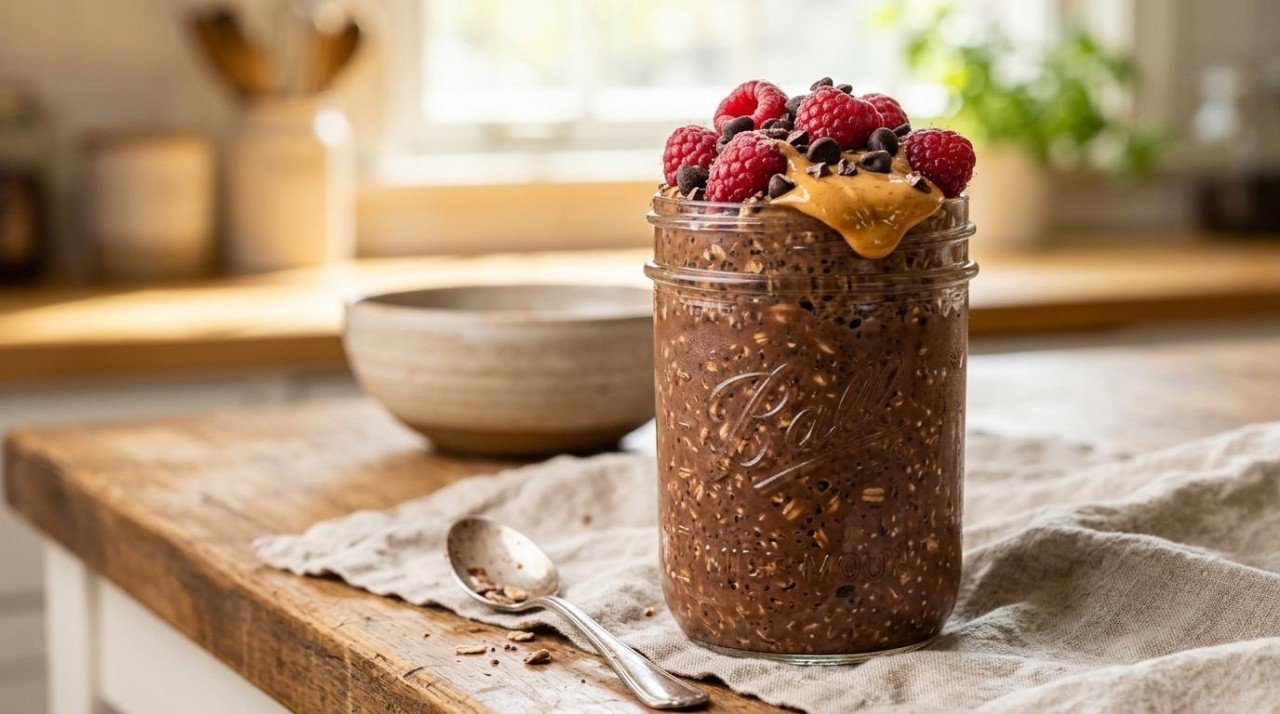
The healthier version: full recipe
Nutrition Score: 90/100. Makes 1 jar.
- 1/2 cup rolled oats (40 g)
- 1 tablespoon chia seeds (12 g)
- 1 tablespoon unsweetened cocoa powder
- A pinch of salt
- 1/2 cup unsweetened almond milk (or unsweetened soy milk)
- 1/2 cup plain Greek yogurt (113 g)
- 1/2 medium banana (60 g), mashed
- 1 tablespoon peanut butter (16 g)
- 2 teaspoons chocolate chips (about 10 g)
- 2/3 cup raspberries (75 g)
- Add the oats, chia seeds, cocoa powder and salt to a jar or container and stir them together dry. Mixing the cocoa in before the liquid is what stops it clumping.
- Mash the banana thoroughly with a fork, then stir it in along with the almond milk and Greek yogurt until the mixture is uniform and no dry cocoa remains.
- Swirl the peanut butter across the top rather than stirring it through, and scatter the chocolate chips over it.
- Cover and refrigerate for at least 6 hours, or overnight.
- Top with the raspberries just before eating, so they keep their texture. If the jar is thicker than you like, loosen it with a splash of milk.
Per jar, original versus improved:
- Nutrition Score: 38 to 90
- Calories: 872 to 570
- Added sugar: 52.5 g to 6.1 g
- Fiber: 8.7 g to 17.9 g (64% of the Daily Value)
- Protein: 27 g to 26 g - essentially unchanged, on 302 fewer calories
- Saturated fat: 13.3 g to 5.6 g
- Sodium: 560 mg to 420 mg
- Plant points: 2 to 5
The finished jar scores as an excellent source of plant omega-3 (141% of a day), phosphorus, fiber, iron, biotin, magnesium, vitamin B12, calcium, vitamin E and zinc. The oats were always going to do their part - 3 g a day of oat beta-glucan is the intake behind the FDA-authorized heart claim, associated with LDL cholesterol reductions of around 0.27 mmol/L - but they need a jar that does not undo them.
Swaps we tested and skipped
- Honey instead of maple syrup. The loaded jar went from 38 to 37. Honey is denser in sugar by weight, so a gram-for-gram swap raised added sugar from 52.5 g to 61.1 g. Swapping one sweetener for another sweetener is not a swap.
- Cutting the peanut butter first. 38 to 37, as covered above. Right change, wrong order.
- Instant oats instead of rolled. 90 to 91. On the label this is a wash, which matches what we found when we compared the oat cuts directly - the difference between the cuts is how fast they digest, not what is in them. We still say rolled, mostly on texture: instant oats are cut finer and rolled thinner, and after eight hours in liquid they go to paste. Rolled oats stay whole enough to chew.
- Removing the chocolate entirely. 90 to 91. One point. Not worth it.
Make it fit other diets
For a vegan jar, swap the Greek yogurt for a plain unsweetened soy yogurt - soy is the only common plant yogurt with comparable protein, and a coconut-based one will cost you close to 10 g of it. For gluten-free, use certified gluten-free rolled oats; oats are naturally gluten-free but are routinely cross-contaminated in milling. For nut-free, sunflower seed butter behaves almost identically at the same tablespoon. In Eat Well Planner you can ask the AI to rewrite the whole recipe for any of these in one step, then re-score it to see what the swap actually cost.
Do this to your own jar
Nothing about this process is specific to overnight oats. Every number in this post came from importing a recipe into Eat Well Planner and running it through the Nutrition Score, then using Make It Healthier, which proposes ingredient swaps and runs each one through a calculator before showing it to you - so what you see is a verified gain, not a guess. If you would rather drive it yourself, the Recipe Playground does exactly what we did here: change one ingredient, watch the score move by the amount that change is worth, decide whether you want to keep it.
That last part is the whole point. We kept the chocolate because one point was a bad trade. You might keep the whole milk, or all three tablespoons of peanut butter, and make it up somewhere else. The score does not tell you what to eat. It tells you what each decision is actually worth, which is the thing a recipe never says out loud.
If instant packets are more your morning, we ran the same process on those in Healthier Instant Oatmeal. Same oats, different trap.