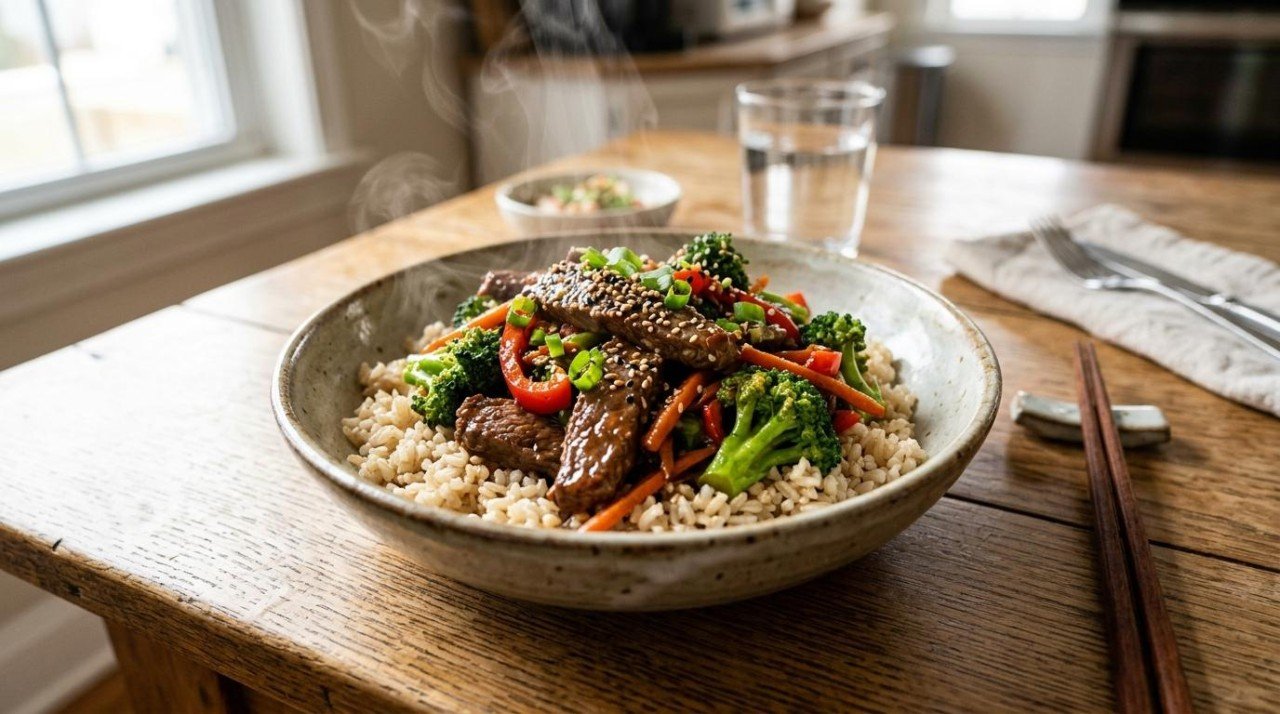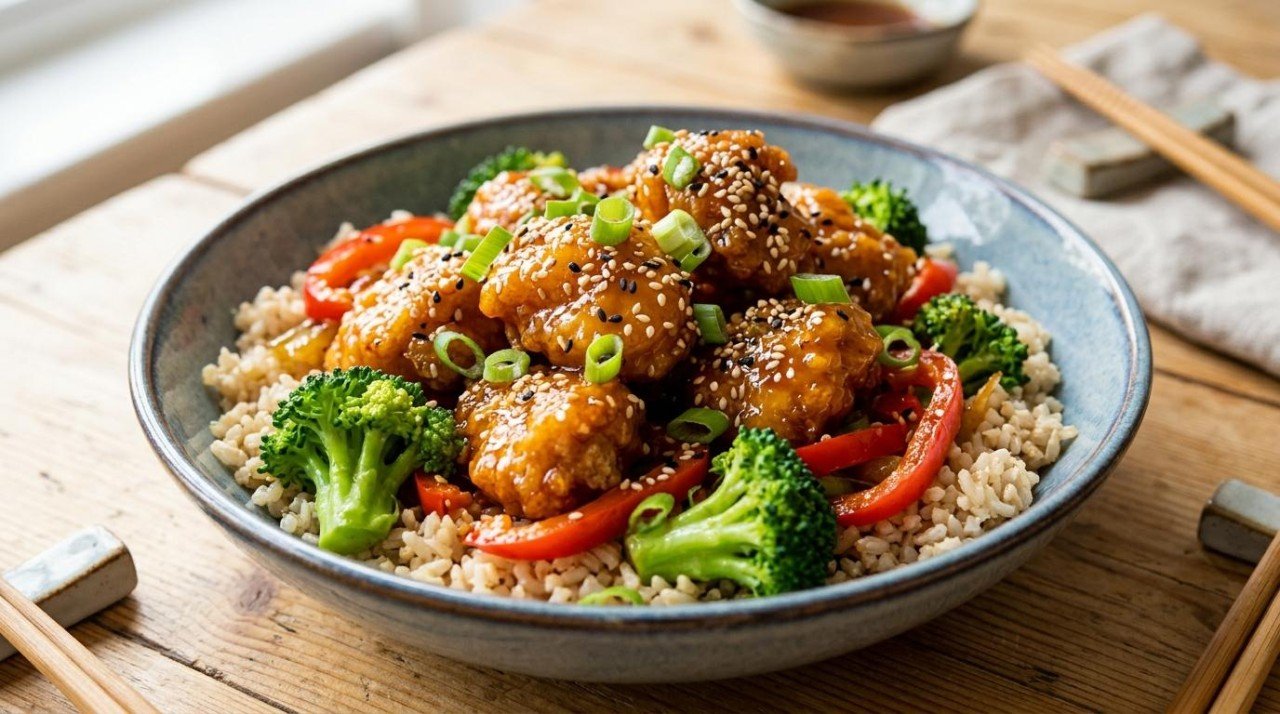
Orange chicken is the dish that made American Chinese takeout what it is. Crispy little nuggets of fried chicken tossed in a glossy, sticky-sweet orange glaze, piled over white rice - it is the best-selling item at Panda Express by a mile, and for a lot of people it is the whole reason to pull into the drive-through. It earns the love. That glaze is genuinely great.
It was invented in 1987 by Panda Express chef Andy Kao, around the opening of a location in Hawaii, who coated fried chicken in a sweet, tangy sauce built for American tastes. The "built for American tastes" part is exactly where the nutrition goes sideways: we built a standard takeout-style version in Eat Well Planner and ran it through the app's Nutrition Score. It came back at 31 out of 100 - one of the lowest-scoring dishes we have put through this series.
So we rebuilt it, one verified swap at a time, and landed at 67 - a 36-point jump - while keeping the crispy chicken and that signature sticky glaze. The surprising part is which change did the heavy lifting, because it is not the one everybody assumes. Here is every swap, exactly what it moved, and the honest trade-off on each.
The original: what's in it and how it scores
The version we scored is the one you picture - crispy battered chicken in orange glaze over a bed of white rice, serving four:
- 1 1/2 lb boneless skinless chicken thighs, coated in egg, cornstarch, and flour, then deep-fried
- A glaze of orange juice, 1/2 cup granulated sugar, 1/4 cup soy sauce, rice vinegar, ginger, and garlic
- Thickened with a cornstarch slurry
- 4 cups cooked white rice on the side
Nutrition Score: 31/100. Per serving, that is about 973 calories, 43 g protein, and the two numbers that sink it: about 25 g of added sugar and about 1,370 mg of sodium.
The added sugar is the headline. Twenty-five grams in one serving is essentially a full day's worth on its own - the American Heart Association's daily limit for added sugar is about 25 g for women and 36 g for men. Almost all of it comes from that half cup of sugar in the glaze, and the app flagged added sugar as "very high," the single biggest drag on the score. Sodium was flagged "very high" too, at 60% of a day's limit, mostly from a quarter cup of regular soy sauce.
Two more quiet problems round it out: the plate is almost entirely white rice and a little fried chicken, so it counts as barely half a plant, and its fiber is negligible at about 1.3 g. Low plant diversity and low fiber were the app's other two flagged weaknesses.
Here is what is not the main problem, and this is the part that surprised us: the frying. Saturated fat came in at about 6 g per serving (25% of a day) - flagged, but moderate, and mostly from the chicken itself, not the oil. Everyone assumes the deep fryer is what makes orange chicken unhealthy. The score says the sugar and the bare plate matter far more. That reframes the whole makeover.
The upgrades
We led with the swaps that move the score the most, and saved the one everybody expects - ditching the fryer - for last, because the numbers put it there. Two things stay non-negotiable from the start: the crispy cornstarch-coated chicken and the sticky-sweet glaze, because without both of those you have made a different dinner.
1. Rebuild the glaze: fresh orange juice, a fraction of the sugar
- Swap: 1/2 cup granulated sugar and a splash of juice → 1 cup fresh orange juice plus zest and just 2 tablespoons sugar
- Score impact: +16 points (31 to 47) - the biggest single jump by far
- What it changes: Cuts added sugar from about 25 g to about 6 g per serving
- What it costs you: A little of the candy-shop sweetness - the fresh version tastes brighter and more orange, less like pure syrup
This is the swap that matters, and it is the one people skip. Classic takeout glaze leans on a half cup of straight sugar for sweetness and shine. Replace most of it with a full cup of fresh orange juice reduced down with the zest, and you get real orange flavor doing the sweetening work, plus just enough sugar (about 2 tablespoons) to still caramelize into that glossy, clingy glaze. Added sugar drops by roughly three quarters, and the app's biggest red flag goes with it. Be honest with yourself about the trade: it is less flat-out sweet and more citrusy. In our tasting that is an upgrade, not a loss - but if you have a serious sweet tooth, this is the change to ease into. If you would rather sweeten with honey or maple, our guide to sugar substitutes covers how each one behaves in a sauce.
2. Give it a real plate: broccoli and bell pepper
- Swap: Chicken and rice alone → the same plus steamed broccoli and sliced red bell pepper
- Score impact: +10 points (47 to 57)
- What it changes: Nearly triples the fiber and takes vitamin C from a trace to over 150% of a day
- What it costs you: Nothing on the plate - it is more food, not less
Takeout orange chicken is chicken and rice and not much else, which is why the original counts as half a plant. Steam a head of broccoli and a sliced red bell pepper and fold them into the bowl, and two of the app's three weaknesses - low plant diversity and low fiber - start to close at once. The vitamin C jump is dramatic (broccoli and peppers are both loaded with it, and the fresh orange juice adds more), and every extra plant on the plate feeds your gut bacteria, which is what our 30-plants-a-week approach is built around. Broccoli is also the vegetable that belongs here - it catches glaze in its florets like it was designed to. This is the highest-value, lowest-effort change in the whole rebuild.
3. Brown rice instead of white
- Swap: White rice → brown rice
- Score impact: +8 points (57 to 65)
- What it changes: Adds fiber and minerals, and swaps a refined grain for a whole one
- What it costs you: A chewier, nuttier base - under all that glaze, most people stop noticing
White rice is refined, low in fiber, and here it makes up the bulk of the plate, so switching it to brown rice moves the needle more than you would expect - a clean 8 points. Whole grains keep the fiber and minerals that milling strips out of white rice, and in a saucy bowl the texture difference all but disappears under the glaze and vegetables. If brown rice is not your thing, the same logic applies to other whole grains - our white rice substitutes guide runs through the ones that work here, from quinoa to farro to riced cauliflower (more on that last one below).
4. Low-sodium soy sauce, and less of it
- Swap: 1/4 cup regular soy sauce → 3 tablespoons low-sodium soy sauce
- Score impact: +0 points (holds at 65)
- What it changes: Cuts sodium from about 1,000 mg to about 540 mg per serving at this point in the build
- What it costs you: Nothing - low-sodium soy tastes nearly identical in a sauce this bright
Here is a swap the score does not reward but your blood pressure will. By this point in the rebuild sodium had already come down enough that the app stopped counting it against us, so the score sat still at 65. But the actual sodium per serving still dropped by about 460 mg - and cutting roughly 1,000 mg of sodium a day is enough to measurably lower blood pressure. Low-sodium soy sauce has around 40% less sodium than regular and tastes almost the same once it is in a garlicky, gingery, citrusy glaze. We include this one because the number that matters to your body moved even when the score did not. (For the full range of options, see our soy sauce substitutes guide.)
5. Skip the deep fryer - but know what it is really worth
- Swap: Deep-fried → air-fried or oven-baked, same cornstarch coating
- Score impact: +2 points (65 to 67)
- What it changes: Cuts about 95 calories and a chunk of the frying oil per serving
- What it costs you: A little of the deep-fried richness - the cornstarch shell still crisps up genuinely crunchy
This is the change everyone reaches for first, so here is the honest truth: it is worth doing, but it is not the magic bullet you have been told it is. Air-frying the same cornstarch-coated chicken (or baking it on a wire rack at 425°F) gets you a genuinely crisp shell with a fraction of the oil, trimming roughly 95 calories a serving. But we tested it as the first change, applied to the original recipe, and the score actually dropped a point - from 31 to 30 - because frying was never what held orange chicken back. The sugar was. Air-frying is a nice calorie win and it makes leftovers reheat better, but if it is the only thing you change, you have skipped the part that actually counts. Do it - just do it alongside the sauce, not instead of it.
Take the Guesswork Out of Eating Well
Eat Well Planner helps you organize your favorite recipes, plan balanced meals, and automatically generate shopping lists — all in one place. Whether you're tracking macros, managing dietary restrictions, or just trying to stop asking "what's for dinner?", we've got you covered.
Our AI-powered tools can adapt any recipe to your dietary needs, help you discover new meals you'll love, and even log your nutrition effortlessly. It's meal planning made simple.
Start Organizing Your Meals — FreeWhat we kept (on purpose), and where we stopped
A makeover that guts the dish is a failed makeover, so we drew a clear line. The crispy cornstarch-coated chicken stays - we changed how it cooks, not what it is, and that crunchy shell catching the glaze is the entire appeal. The sticky-sweet glaze stays, real sugar and all, just less of it. And we kept the chicken thighs rather than switching to breast, because thighs stay juicy and the score barely cares.
We stopped at 67 because the next moves start dismantling the dish. The app no longer flags anything as "very high" - added sugar, sodium, and saturated fat all sit in the moderate band now, and that is an honest, sustainable place for a crispy-fried, glazed takeout favorite to land. There is one lever that pushes higher without much cost, though, if you want it: swapping the brown rice for riced cauliflower scored a 74 in our testing, seven points up, because it trades starch for another vegetable. It makes this more of a lower-carb stir-fry bowl than a rice plate, so we left it as your call rather than the main recipe - but it is a real, verified option, not a gimmick.
The healthier version: full recipe
Final Nutrition Score: 67/100. Serves 4.
For the chicken
- 1 1/2 lb boneless skinless chicken thighs, cut into 1-inch pieces
- 2 large eggs, beaten
- 1/2 cup cornstarch
- 1/4 cup all-purpose flour (or more cornstarch for gluten-free)
- 1/2 teaspoon salt and black pepper
- 1 tablespoon neutral oil, or cooking spray
For the glaze
- 1 cup fresh orange juice (about 3 oranges) plus the zest of 1 orange
- 2 tablespoons granulated sugar (or honey)
- 3 tablespoons low-sodium soy sauce
- 1/4 cup rice vinegar
- 1 tablespoon grated fresh ginger
- 3 cloves garlic, minced
- 1/4 teaspoon red pepper flakes (optional)
- 2 tablespoons cornstarch mixed with 2 tablespoons water
To serve
- 3 1/2 cups cooked brown rice
- 1 large head broccoli (about 3 cups florets), steamed
- 1 large red bell pepper, sliced and steamed or quickly stir-fried
- Sliced green onions and sesame seeds (optional)
- Start the brown rice cooking, and steam the broccoli and bell pepper until just tender-crisp.
- Season the chicken with salt and pepper. Dip each piece in the beaten egg, then toss in the cornstarch-and-flour mixture to coat well, shaking off the excess.
- Air-fry at 400°F for 15 to 18 minutes, shaking the basket halfway, until deep golden and crisp and cooked through (165°F). Or bake on an oiled wire rack set over a sheet pan at 425°F for 20 to 25 minutes, tossing once. Mist or toss with the tablespoon of oil for color.
- Make the glaze while the chicken cooks: combine the orange juice, zest, sugar, soy sauce, rice vinegar, ginger, garlic, and red pepper flakes in a skillet and bring to a simmer. Let it reduce for 4 to 5 minutes, then stir in the cornstarch slurry and cook 1 to 2 minutes more, until glossy and thick enough to coat a spoon.
- Add the crispy chicken to the skillet off the heat and toss quickly to coat - do it just before serving so the shell stays crisp.
- Serve over the brown rice with the broccoli and pepper alongside, topped with green onions and sesame seeds.
Per serving, original vs. improved:
- Nutrition Score: 31 → 67
- Calories: about 973 → about 843
- Added sugar: about 25 g → about 6 g
- Sodium: about 1,370 mg → about 540 mg
- Fiber: about 1.3 g → about 4.7 g
- Saturated fat: about 6 g → about 5 g
- Protein: about 43 g → about 45 g (still excellent)
- Vitamin C: about 11% of a day → over 150%
- Plant diversity: half a plant → more than 3
Swaps we tested and skipped
Two changes that sound healthier did not earn their place:
- Cutting the sugar to zero. Dropping the last 2 tablespoons of sugar entirely, letting orange juice do all the sweetening, scored a 68 - one single point higher. But without that little bit of sugar the glaze will not caramelize into a proper sticky coating; you get thin, sharp orange sauce instead. One point is not worth losing the glaze that makes it orange chicken.
- Skipping the crispy coating. Plain chicken thighs simmered in the sauce, no cornstarch shell, scored a 70 - three points up, and about 170 fewer calories. But at that point it is chicken in orange sauce, not orange chicken. That crunchy cornstarch shell catching the glaze is the entire point of the dish, and three points is not enough to give it up. This is where we drew the line.
Make it fit other diets
The two most-asked versions are easy. For gluten-free, coat the chicken in all cornstarch instead of the flour blend and use tamari or a certified gluten-free soy sauce in the glaze. For a lower-carb plate, swap the brown rice for the riced cauliflower mentioned above - it scored even higher and turns this into a stir-fry bowl. In Eat Well Planner you can ask the AI to rewrite this exact recipe as gluten-free, lower-carb, or anything else in one step, and it hands back a full version with the substitutions already worked in.
Do this to any recipe you love
Every number in this post came out of Eat Well Planner's Make It Healthier tool, not out of thin air. Import a recipe from any website, Instagram reel, or YouTube video - or the exact takeout copycat you have been cooking - and the app scores it, tells you plainly what is dragging the number down (for orange chicken it was the sugar, not the frying everyone blames), and proposes swaps like these, with a calculator verifying the real gain before you ever see the suggestion. You can test each change in the Recipe Playground and watch the score move in real time, then save the result as a new healthier version or keep the original.
Keep the dish you love. Just find out what it is really made of first, and fix the number that is actually holding it back - even when it is not the one you expected.