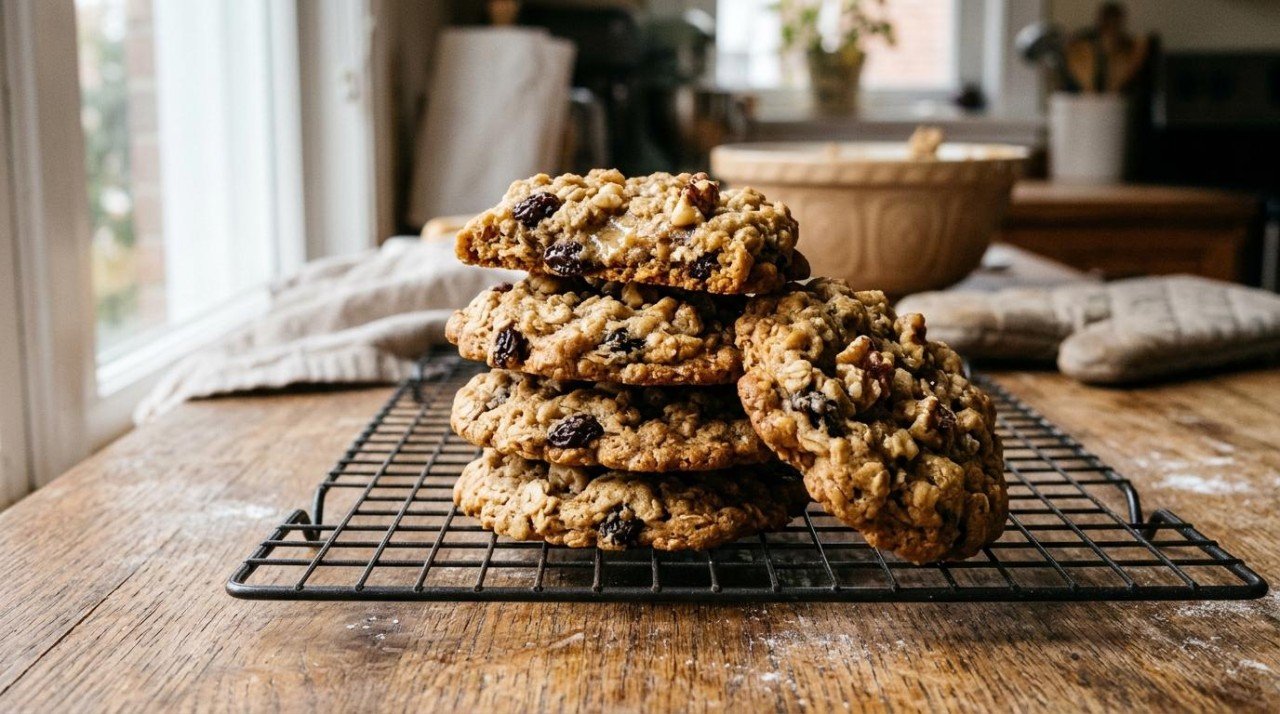
Oatmeal raisin cookies have a reputation. They are the cookie people call "basically breakfast," the one that gets packed in lunchboxes with a clear conscience, and the one that, in every cookie tin, gets picked last by kids and first by their grandparents. They feel healthier than a chocolate chip cookie. The question is whether they actually are.
So we scored them. The classic Quaker "Vanishing" oatmeal raisin cookie, the recipe that has been printed on the oats canister for decades, earns a Nutrition Score of 28 out of 100. That is low, but it is ten points higher than the Toll House chocolate chip cookie we scored for our chocolate chip cookie makeover (18). The health halo is partly real, and we can tell you exactly which ingredient earns it. (Spoiler: it is not the raisins.)
Then we rebuilt it. Four swaps take the same cookie to 41, with half the added sugar, nearly double the fiber, and a real dose of omega-3 from walnuts, at the same 100 calories per cookie. It is still chewy, still cinnamon-warm, still full of raisins. Here is every swap, what it is worth, and where a cookie runs out of room.
The original: what's in it and how it scores
We used Quaker's Vanishing Oatmeal Raisin Cookies, which is about as standard as this cookie gets. For about four dozen small cookies:
- 14 tablespoons butter
- 3/4 cup packed brown sugar and 1/2 cup granulated sugar
- 2 eggs and 1 teaspoon vanilla
- 1 1/2 cups all-purpose flour, 1 teaspoon baking soda, 1 teaspoon cinnamon, 1/2 teaspoon salt
- 3 cups rolled oats
- 1 cup raisins
Per cookie, the app puts it at 98 calories, 5.4 g of added sugar, 2.0 g of saturated fat, 0.8 g of fiber, 1.6 g of protein, and 80 mg of sodium. Its score of 28 comes with one formal caution, added sugar at 21% of the Daily Value per cookie, and "High Added Sugar" leads the weaknesses list.
Here is the part we found most interesting. We took the oats and raisins out one at a time to see where the halo lives:
- The same dough with no oats and no raisins (a plain butter-sugar drop cookie): 16
- Raisins, no oats: 22
- Oats, no raisins: 27
- Both (the real cookie): 28
The oats are worth 11 points. Once they are in, the raisins add just 1. Three cups of rolled oats is a lot of whole grain for a cookie, and it is where almost all of this recipe's fiber, protein, and minerals come from. Rolled oats also carry beta-glucan, the soluble fiber behind the FDA-authorized heart health claim. Rolled oats must be at least 4% beta-glucan to qualify, so at 240 g of oats across 48 cookies, each one carries roughly 0.2 g. The claim is built around 3 g a day, so be honest with yourself here: a cookie is a nice way to eat some oats, not a cholesterol strategy.
What holds the score down is everything around the oats. The flour is refined. There are about 265 g of sugar in the batch, more than the weight of the flour. And 14 tablespoons of butter supply most of the saturated fat. Sodium, the single biggest lever in most of our savory makeovers, is a non-issue in a cookie this small. We will prove that in a minute.
The upgrades
We scored each swap cumulatively, in the order below, so each number is what that change was worth at that point in the build. Highest impact and lowest flavor cost first.
1. All-purpose flour to white whole wheat flour
- Swap: 1 1/2 cups all-purpose flour → 1 1/2 cups white whole wheat flour
- Score impact: +5 points (28 → 33)
- What it changes: Fiber goes from 0.8 g to 1.2 g per cookie, and the recipe picks up another whole grain
- What it costs you: Almost nothing. The cookie is a shade darker
This is the easiest swap in the post, and oatmeal cookies are the best possible place to make it. When King Arthur's test kitchen baked an oatmeal cookie with 100% white whole wheat flour, the result was "a shade darker" with no change in flavor, and with all those oats and raisins in the dough, they could not detect a texture difference either. White whole wheat is milled from a paler variety of wheat, so it is milder than the red whole wheat most people picture. Whole wheat pastry flour scored identically (+5) if that is what you have. See our all-purpose flour substitutes guide for more options.
One technique note: King Arthur found that drop cookie doughs with 50% or more whole wheat spread less after a long chill unless you add about 2 teaspoons of liquid per cup of whole wheat flour. Our recipe bakes right away, which sidesteps that. If you want to make the dough ahead, add 1 tablespoon of milk or water.
We also tested putting the all-purpose flour back at the very end, with every other swap in place. It cost 4 points (41 → 37). A 50/50 blend landed in between at 39.
2. A third of the butter to almond butter
- Swap: 14 tablespoons butter → 9 tablespoons butter + 1/4 cup almond butter
- Score impact: +4 points (33 → 37)
- What it changes: Saturated fat drops from 2.0 g to 1.4 g per cookie, protein rises, and almonds count as another plant
- What it costs you: A faint toasty, nutty note that oats are very happy to sit next to
The card for this post suggested testing either nut butter or oil for part of the butter, and the scores made the choice easy. On the original cookie, almond butter for a third of the butter was worth +4, peanut butter +3, canola oil +2, and olive oil +1. Further down the build, the gap held: with every other swap in place, the canola version finished 3 points behind the almond butter version. Nut butter lowers saturated fat the same way oil does, but it also brings protein and fiber, and the score rewards that.
The butter that stays is doing important work. It is what makes the edges crisp and gives the cookie its browned, caramel flavor, which is why we cut a third rather than all of it. If you prefer peanut butter, use it: it scored the same 41 at the end. Our butter substitutes guide covers the other options and what each does to texture.
3. Half the sugar, all of it brown
- Swap: 3/4 cup brown sugar + 1/2 cup granulated sugar → 1/2 cup plus 2 tablespoons brown sugar, no granulated
- Score impact: +2 points (37 → 39)
- What it changes: Added sugar drops from 5.4 g to 2.7 g per cookie, and the 21% DV added sugar caution disappears
- What it costs you: A slightly less sweet, puffier cookie that spreads less. The raisins cover more of the gap than you would expect
This is the swap that matters most for the actual nutrition, even though the score only gives it +2. Two things are going on. First, cookies are small. Even after the cut, "High Added Sugar" is still on the weaknesses list, because the score judges sugar against how much nutrition comes with it, and a 100-calorie cookie does not come with much. Second, nothing nutritious replaces the sugar. When it leaves, the cookie loses calories (95 down to 84 at this step) but does not gain fiber, protein, or minerals.
Why stop at half? Because King Arthur already ran this exact experiment. In their sugar reduction tests, their rule of thumb is that you can halve the sugar in a drop cookie when the recipe starts with at least as much sugar as flour by weight. Quaker's original has about 1.4 times as much, so it qualifies. Their half-sugar oatmeal-raisin cookies did not spread much but were "fairly moist," with good flavor and stronger spice. Cutting further, to sugar at 50% of the flour's weight, made them "tougher, drier, and flatter tasting," and they noted that only the raisins earned that batch a passing grade. At 25%, the cookies were hard and crumbly.
Our 135 g of sugar is about 72% of the flour's weight, comfortably above the level where their cookies got tough. Keeping all brown sugar rather than half brown, half white keeps the molasses flavor and the moisture that make an oatmeal cookie chewy. More on swapping sugars in our brown sugar substitutes guide.
Putting the full original sugar back on the finished cookie cost 2 points (41 → 39).
4. Add walnuts
- Swap: Add 1 cup chopped walnuts
- Score impact: +2 points (39 → 41)
- What it changes: Omega-3 ALA jumps from 0.02 g to 0.23 g per cookie, enough for the app to call the cookie a good source. Protein reaches 2.1 g
- What it costs you: About 16 calories per cookie, which puts back the calories the sugar cut removed
Quaker's own recipe lists a cup of chopped nuts as an optional variation, so this is not a stretch. Walnuts are the nut to pick here: on the original cookie they were worth +3, while the same weight of pecans was worth 0. Walnuts are unusually rich in plant omega-3, and pecans are not. Toasting them for 6 to 8 minutes first makes a big difference in flavor.
The calories are the honest trade-off. The finished cookie is 100 calories against the original's 98. What changed is what those calories are made of.
What we kept (on purpose)
All three cups of oats. They are the reason this cookie outscores most cookies, and they stay exactly as written. We also tested adding more oats in place of a third of the flour. It was +2 on the original but worth nothing once the flour was whole wheat, and more oats with less flour means a crumblier cookie.
All the raisins. Here is the twist. With every other swap in place, the finished cookie scored 41 with no raisins, 41 with the recipe's 1 cup, and 41 with 2 cups. Raisins are score-neutral. They add a little fiber and potassium, but also about 9 calories per cookie. Their sugar does not count as added sugar, because the FDA counts naturally occurring sugar in fruit separately from added sugar, but it is still sugar. We kept the cup because they make the cookie, and because they are what let the sugar cut work.
The butter (most of it), the eggs, the cinnamon, and the salt. Halving the salt or dropping it entirely changed the finished score by 0. At about 70 mg of sodium per cookie, salt is not this recipe's problem, and it is what keeps a lower-sugar cookie from tasting flat.
Take the Guesswork Out of Eating Well
Eat Well Planner helps you organize your favorite recipes, plan balanced meals, and automatically generate shopping lists — all in one place. Whether you're tracking macros, managing dietary restrictions, or just trying to stop asking "what's for dinner?", we've got you covered.
Our AI-powered tools can adapt any recipe to your dietary needs, help you discover new meals you'll love, and even log your nutrition effortlessly. It's meal planning made simple.
Start Organizing Your Meals — FreeThe healthier version: full recipe
Nutrition Score: 41 (up from 28). Makes about 48 small cookies.
Ingredients
- 9 tablespoons (128 g) butter, softened
- 1/4 cup (64 g) almond butter, well stirred (or peanut butter)
- 1/2 cup plus 2 tablespoons (135 g) packed brown sugar
- 2 large eggs
- 1 teaspoon vanilla extract
- 1 1/2 cups (188 g) white whole wheat flour
- 1 teaspoon baking soda
- 1 teaspoon ground cinnamon
- 1/2 teaspoon salt
- 3 cups (240 g) old-fashioned rolled oats
- 1 cup (145 g) raisins
- 1 cup (115 g) walnuts, toasted and chopped
Instructions
- Heat the oven to 350F. Use two ungreased baking sheets, or line them with parchment.
- Beat the butter, almond butter, and brown sugar together until creamy, about 2 minutes. Beat in the eggs one at a time, then the vanilla.
- In a separate bowl, whisk the white whole wheat flour, baking soda, cinnamon, and salt. Add it to the butter mixture and mix just until no dry flour remains.
- Stir in the oats, raisins, and walnuts. The dough will be thick.
- Drop rounded tablespoons of dough about 2 inches apart on the sheets. Press each mound down slightly with your fingers, since lower-sugar dough spreads less on its own.
- Bake 9 to 11 minutes, until the edges are light golden brown and the centers look just set. Cool on the sheet for 2 minutes, then move to a rack.
To make the dough ahead, add 1 tablespoon of milk or water with the eggs, then refrigerate it for up to 2 days. The bran in whole wheat flour soaks up moisture as it rests.
Original vs. healthier, per cookie
- Nutrition Score: 28 → 41
- Calories: 98 → 100
- Added sugar: 5.4 g → 2.7 g
- Fiber: 0.8 g → 1.5 g
- Saturated fat: 2.0 g → 1.6 g
- Protein: 1.6 g → 2.1 g
- Omega-3 (ALA): 0.02 g → 0.23 g (now a good source)
- Sodium: 80 mg → 70 mg
- Plant points per batch: 2.25 → 5.25 (adds whole wheat, almonds, and walnuts)
Swaps we tested and skipped
- Cutting the sugar further, to 1/2 cup: +1 (42), and it is the only version that clears "High Added Sugar" from the weaknesses list. But that puts sugar at about 53% of the flour's weight, right next to the 50% level where King Arthur's oatmeal cookies turned tougher and drier, and passed only because of the raisins. One point is not worth a cookie nobody finishes. If you like them barely sweet, this is your dial.
- Doubling the raisins to "let the fruit sweeten it": +1 on the original, 0 on the finished cookie, and 9 more calories each. Raisins are a flavor decision, not a nutrition one.
- Canola or olive oil for part of the butter: +2 and +1 on the original, and the canola version finished 3 points behind almond butter. Same saturated fat savings, none of the protein.
- Ground flaxseed: +3 on the original, but 0 once walnuts were in. The walnuts already deliver the omega-3 the score was crediting.
- Pecans instead of walnuts: +0 on the original, compared with +3 for walnuts.
- Less salt: 0, at half or none.
- One egg instead of two: -1, since it costs protein and binding in a dough with this many oats.
Make it fit other diets
- Gluten-free: Use certified gluten-free oats, and replace the flour with a cup-for-cup gluten-free blend or oat flour. Oat flour scored +4 on the original, close to whole wheat's +5.
- Dairy-free: Swap the butter for a plant-based butter stick. Keep the almond butter, which does a lot of the work of making a dairy-free dough taste rich.
- Nut-free: Use sunflower seed butter in place of almond butter and leave out the walnuts, or use 1 cup of pumpkin seeds instead.
If you would rather not work out the swaps yourself, save this recipe to Eat Well Planner and ask the AI recipe chat or Recipe Variations to make it gluten-free, dairy-free, or nut-free. It rewrites the whole recipe with the substitutions worked in.
Do this to any recipe
Every number in this post came from the same tools you can use on your own recipes. Import your family's oatmeal cookie recipe from a website, a photo of the recipe card, or a video, and Eat Well Planner scores it. Then tap Make It Healthier: the AI proposes swaps like the ones above, and a calculator checks the real nutritional gain before each one is shown to you. Want to keep all 14 tablespoons of butter and make up the points somewhere else? The Recipe Playground shows you what each change does to the score as you make it.
An oatmeal raisin cookie was never going to be health food. But its oats were already doing the work, and with half the sugar, real whole wheat, and a handful of walnuts, it is now a much better version of the cookie it already was.