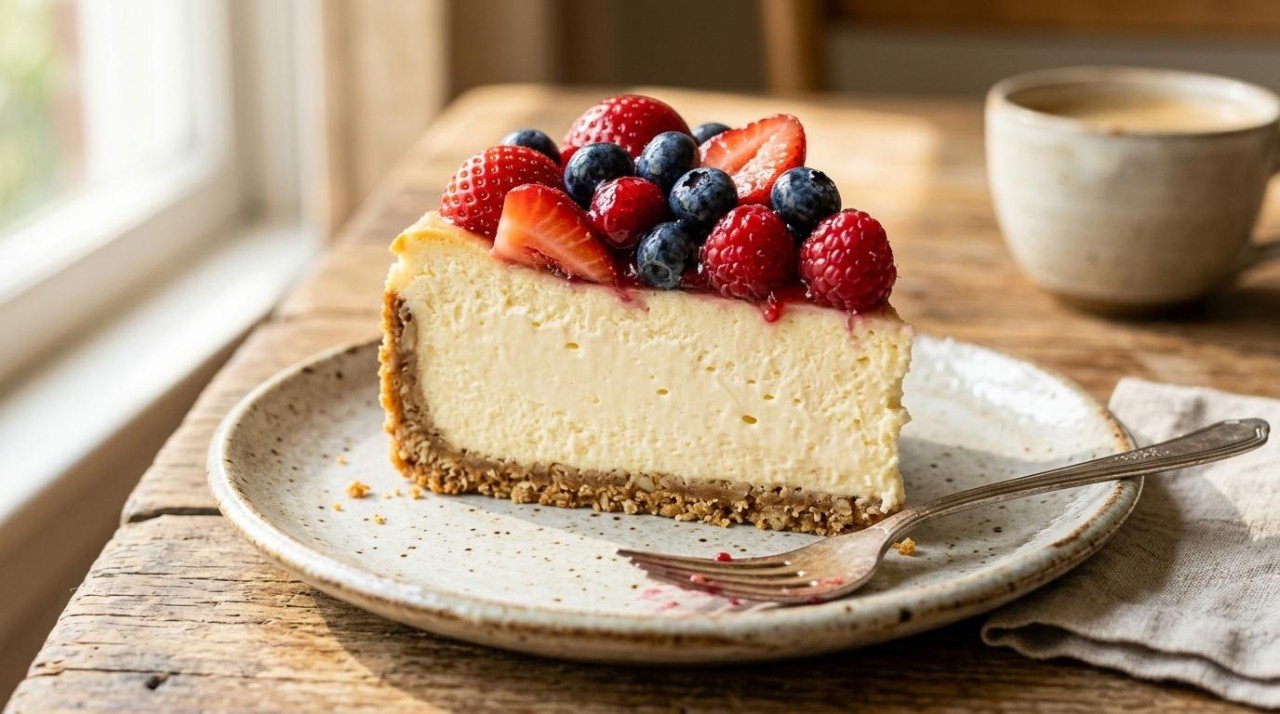
New York cheesecake is the hardest dessert we have tried to improve. There is no fruit hiding in it, no vegetable in the name, no whole grain anywhere near it. It is two pounds of cream cheese, a cup and a half of sugar, six eggs' worth of yolk and a butter-soaked crumb crust, and every one of those things is load-bearing. Take out the wrong one and you do not have a lighter cheesecake, you have a sad baked custard.
That density is the whole point of the style. American cheesecakes used to be made with curd cheese - farmer, pot or cottage cheese - which gave a lighter, fluffier, slightly coarse texture. Then a New York dairyman named William Lawrence accidentally invented cream cheese in the 1870s, and in 1929 the restaurateur Arnold Reuben swapped it in for the curds. Lindy's on Broadway made the version everybody pictures: tall, dense, tangy, with strawberries set in gel on top.
So we built a standard New York cheesecake in Eat Well Planner and ran the app's Nutrition Score on it. It came back at 16 out of 100. Then we rebuilt it one verified swap at a time and got it to 43, while keeping it dense, tangy and sliceable. This post is the receipt for all 27 points - including the two changes that everyone recommends for cheesecake and that actually made our score go down.
The original: what's in it and how it scores
We scored the version that shows up in most classic recipes, baked in a 9-inch springform and cut into 12 slices. Crust: 1 1/2 cups (150 g) graham cracker crumbs, 5 tablespoons (70 g) butter, 1/4 cup sugar. Filling: 2 lb (907 g) full-fat block cream cheese, 1 1/2 cups (300 g) granulated sugar, 4 eggs plus 2 extra yolks, 2/3 cup (160 g) sour cream, 1/4 cup heavy cream, 2 tablespoons flour, 2 teaspoons vanilla, a pinch of salt. On top, one 21 oz can of cherry pie filling. Every number below is one slice.
Nutrition Score: 16/100. Per slice: 610 calories, 8.7 g protein, 0.8 g fiber, 480 mg sodium, 21.0 g saturated fat (90% of a day's reference, flagged very high) and 45.3 g added sugar (172%, also flagged very high). The American Heart Association's daily limit is 24 g of added sugar for women and 36 g for men. One slice clears both, by itself, before you have eaten anything else that day.
The saturated fat is the other half of the problem. The Dietary Guidelines cap saturated fat at less than 10 percent of daily calories, and the AHA at 7 percent - for most adults somewhere around 13 to 22 g a day. A slice of cheesecake is the entire allowance.
Two things surprised us in the breakdown. First, the canned cherry topping is not a garnish - it contributes roughly 12 g of added sugar per slice on its own, more than a quarter of the total. Second, the app scored the recipe at zero plant points. Not one ingredient in a cheesecake with cherries on it counted as a plant, because pie filling is scored as what it is: sugar syrup with some fruit in it.
Now the honest other side. This is real food, not an industrial dessert - eggs, cream cheese, butter, sugar, and nothing that needs a label decoder. It is already an excellent source of vitamin A (37% DV), riboflavin (27%), phosphorus (25%) and choline (20%), all from the dairy and the eggs. The fat is not the enemy here so much as the amount of it, sitting next to nearly a day and a half of added sugar with 0.8 g of fiber to slow any of it down.
The upgrades
We applied these in order and re-scored after each one, so every delta below is what that swap was worth at that point in the build. The five deltas sum to exactly 27, which is the whole movement. If you only make one change, make the first one - it is the biggest single gain in the post and it costs you nothing.
1. Fresh berries instead of the canned cherry topping
- Swap: One 21 oz can of cherry pie filling → 14 oz strawberries, 1 1/3 cups blueberries, 1 1/4 cups raspberries, plus the zest of 2 lemons in the batter
- Score impact: +11 points (16 to 27)
- What it changes: Added sugar drops from 45.3 g to 33.3 g a slice, fiber triples, and plant points go from 0 to 4
- What it costs you: Nothing. It is better. It is also more expensive in February.
This is the largest single swap in the post and it is not close. Canned pie filling is fruit suspended in sweetened, thickened syrup; fresh berries are fruit. Swapping them out removed a quarter of the recipe's added sugar without touching the cheesecake itself, and it is the reason the finished version is an excellent source of vitamin C (28% DV) when the original had none worth counting.
The lemon zest is a small trick with a large payoff. Cheesecake reads as sweeter than it is when there is acid and aroma in the batter, which is exactly what makes the sugar cut in step 4 survivable. Zest two lemons into the filling and pile the berries on cold, right before serving, so they stay glossy instead of weeping into the top.
2. Half the cream cheese becomes blended cottage cheese
- Swap: 2 lb cream cheese → 1 lb full-fat block cream cheese + 1 lb small-curd cottage cheese, blended completely smooth
- Score impact: +4 points (27 to 31)
- What it changes: Saturated fat falls from 21.0 g to 14.1 g a slice, calories from 583 to 485, protein rises
- What it costs you: A slightly softer set and a little more tang. You have to blend it properly or it is grainy.
This is the swap the whole post was built to test, and the answer is: it works, at half. Cottage cheese is about the same food as cream cheese with most of the cream taken out - similar protein, a fraction of the fat - and once it has been run through a food processor for a full minute it is indistinguishable from cream cheese in the batter. Skinnytaste's cottage cheese cheesecake lands in the same place we did: half and half is creamy and rich, and going all the way to cottage cheese tastes like Italian cheesecake instead of New York.
Two practical notes. Use small-curd cottage cheese and blend it alone first, until it is completely smooth and no curd is visible, before anything else joins it - graininess in the finished cake is almost always under-blending. And keep the remaining cream cheese as full-fat block cream cheese, not spread, which is what holds the set together. If cottage cheese is not your thing, our cottage cheese substitutes guide covers what else blends smooth, and the cream cheese guide has a section specifically on cheesecake.
3. An oat, pecan and flaxseed crust instead of graham and butter
- Swap: 150 g graham crumbs + 5 tablespoons butter + 1/4 cup sugar → 1 cup rolled oats + 3/4 cup pecans + 3 tablespoons ground flaxseed + 2 1/2 tablespoons butter
- Score impact: +6 points (31 to 37)
- What it changes: Fiber 2.3 g to 3.4 g, added sugar 33.3 g to 25 g, sodium 450 mg to 370 mg, plant points 4 to 7
- What it costs you: A nuttier, slightly less snappy crust. It tastes more like a granola base than a cookie base.
- Cross-link: substitutes for butter
Graham crackers are cookies. A cup and a half of crumbs brings its own sugar and sodium along, which is why this swap cut 8 g of added sugar a slice without anyone touching the sugar jar. Oats and pecans replace it with fiber, minerals and unsaturated fat, and the flaxseed is there for the omega-3 - ALA, the plant omega-3 the body cannot make itself. The finished cheesecake is an excellent source of it at 31% DV.
Technique matters more here than in a graham crust. Pulse the oats, pecans and flaxseed to coarse crumbs, work in the melted butter, press it down hard with the flat bottom of a glass, and par-bake it for 12 minutes before the filling goes in. Skip the par-bake and the oats stay soft under a wet batter.
4. Cut the sugar in half
- Swap: 1 1/2 cups (300 g) sugar in the filling → 3/4 cup (150 g)
- Score impact: +3 points (37 to 40)
- What it changes: Added sugar 25 g to 12.5 g a slice, calories 475 to 427
- What it costs you: This one you will taste. It is noticeably less sweet and much more tangy.
- Cross-link: substitutes for white sugar
Three points for halving the sugar looks like a poor return, and it is - because sugar is scored against a daily reference that a dessert is always going to spend a chunk of. What makes the cut worth it is where it lands: 12.5 g a slice is about half a woman's daily added sugar allowance instead of nearly twice it.
Be warned that this is the swap most likely to get a comment at the table. A cheesecake at half sugar is tangy and cheese-forward, and it needs the berries on top to read as dessert - which is precisely why we made the fruit swap first. If you want it sweeter, put the sugar back in 2 tablespoon increments rather than reaching for a sweetener; sugar is also doing textural work in cheesecake, and the case against sugar is about quantity and context, not about it being poison.
5. Greek yogurt instead of the sour cream and heavy cream
- Swap: 2/3 cup sour cream + 1/4 cup heavy cream → scant 1 cup (220 g) plain whole-milk Greek yogurt
- Score impact: +3 points (40 to 43)
- What it changes: Saturated fat 13.1 g to 10.7 g, protein 12.0 g to 13.3 g, calories 427 to 396
- What it costs you: Very little. Slightly more tang, slightly less silk on the tongue.
- Cross-links: substitutes for sour cream, substitutes for Greek yogurt
Sour cream is in a New York cheesecake for tang and softness, and Greek yogurt does both jobs with roughly twice the protein and a third of the fat. The usual worry - that yogurt splits when heated - does not apply here: it is suspended in an egg-set batter baked gently in a water bath, not simmered in a pan. Use whole-milk Greek yogurt, not nonfat, and stir it in at the end rather than beating it.
Take the Guesswork Out of Eating Well
Eat Well Planner helps you organize your favorite recipes, plan balanced meals, and automatically generate shopping lists — all in one place. Whether you're tracking macros, managing dietary restrictions, or just trying to stop asking "what's for dinner?", we've got you covered.
Our AI-powered tools can adapt any recipe to your dietary needs, help you discover new meals you'll love, and even log your nutrition effortlessly. It's meal planning made simple.
Start Organizing Your Meals — FreeWhat we kept, and where we stopped
The pound of full-fat cream cheese stays, and it is the single most expensive thing in the recipe score-wise. We tested taking it out entirely, replacing it with more blended cottage cheese: that version scores 50, with saturated fat down to 3.8 g a slice - low enough that the app drops the saturated fat warning altogether. Seven points, sitting right there.
We did not take them. At 100% cottage cheese the texture goes light and slightly curd-y and the flavor turns fresh and lactic - a good dessert, but an Italian-style baked cheese custard, not the dense New York slice this post promised. Half is the point where you get most of the nutritional gain and still get the dish.
The same logic applies to the sugar. Removing the last 3/4 cup entirely scores 53 and clears the added sugar flag completely. Stack that on top of the all-cottage-cheese version and the score hits 70, at 249 calories and 15.3 g protein a slice. That is the honest ceiling for this dish, and it is worth naming plainly: at 70, it is a baked cottage cheese custard with berries on it. Delicious, genuinely worth making, and not cheesecake. We stopped at 43 because 43 is still cheesecake.
The healthier version: full recipe
Nutrition Score: 43/100. One 9-inch cheesecake, 12 slices.
For the crust
- 1 cup (90 g) old-fashioned rolled oats
- 3/4 cup (70 g) pecans
- 3 tablespoons (20 g) ground flaxseed
- 2 1/2 tablespoons (35 g) butter, melted
- Pinch of salt
For the filling
- 1 lb (454 g) small-curd cottage cheese
- 1 lb (454 g) full-fat block cream cheese, at room temperature
- 3/4 cup (150 g) granulated sugar
- Scant 1 cup (220 g) plain whole-milk Greek yogurt
- 4 large eggs plus 2 large egg yolks, at room temperature
- 2 tablespoons (16 g) all-purpose flour
- 2 teaspoons vanilla extract
- Finely grated zest of 2 lemons
- 1/4 teaspoon fine salt
For the top
- 14 oz (400 g) strawberries, hulled and halved
- 1 1/3 cups (200 g) blueberries
- 1 1/4 cups (150 g) raspberries
- A squeeze of lemon juice
- Heat the oven to 325F. Wrap the outside of a 9-inch springform pan in two layers of heavy foil, all the way up the sides.
- Pulse the oats, pecans, flaxseed and salt in a food processor to coarse crumbs. Add the melted butter and pulse to combine. Press firmly into the bottom of the pan with the flat base of a glass. Bake 12 minutes, then cool while you make the filling.
- Blend the cottage cheese alone in a food processor or blender for a full minute, scraping down once or twice, until completely smooth with no visible curd. This step is the difference between creamy and grainy. If your cottage cheese is very wet, pour off the loose liquid first.
- Add the cream cheese, sugar, flour, lemon zest, vanilla and salt. Blend until smooth. Add the Greek yogurt and pulse just to combine.
- Add the eggs and yolks and mix only until they disappear into the batter. Do not keep going - whipping air into cheesecake batter after the eggs go in is what makes it puff, crack and deflate.
- Pour the batter over the cooled crust. Set the pan in a roasting pan and pour hot water into the roasting pan to come about 1 inch up the sides.
- Bake 70 to 85 minutes, until the outer edge is set and the middle 2 to 3 inches still wobbles as a single mass when you nudge the pan.
- Turn the oven off, crack the door open and leave the cheesecake inside for 1 hour. Lift it out of the water bath, cool completely at room temperature, then refrigerate at least 6 hours and preferably overnight. This version sets a little softer than an all-cream-cheese cake, so the overnight chill matters more, not less.
- Toss the berries with a squeeze of lemon juice and pile them on just before serving.
Per slice, original vs. improved:
- Nutrition Score: 16 → 43
- Calories: 610 → 396
- Added sugar: 45.3 g → 12.5 g
- Saturated fat: 21.0 g → 10.7 g
- Protein: 8.7 g → 13.3 g
- Fiber: 0.8 g → 3.4 g
- Sodium: 480 mg → 370 mg (no longer flagged)
- Plant points: 0 → 7
The improved slice is an excellent source of phosphorus, omega-3 ALA, biotin, vitamin C, riboflavin, vitamin A, B12 and choline, and a good source of protein, fiber, iron, calcium, zinc, magnesium and thiamine. Added sugar and saturated fat are both still flagged as high. It is a dessert. We are not going to pretend otherwise.
Swaps we tested and skipped
- Going crustless: 41, two points worse. The most commonly recommended cheesecake shortcut actively hurt the score, because by this point the crust is oats, pecans and flaxseed - it is the only source of fiber and most of the omega-3 in the recipe. Removing it takes out more good than bad.
- Dropping the 2 extra egg yolks: 42, one point worse. The yolks carry choline, biotin and vitamin A, and cutting them saved all of 10 calories and 0.3 g of saturated fat. Keep them - they are also what makes the texture dense rather than spongy.
- Greek yogurt instead of cottage cheese for the swapped half: 43, identical. Genuinely no difference in score, so use whichever you have. Blended cottage cheese gives a thicker batter and a firmer set; Greek yogurt is wetter and tangier.
- Neufchatel (1/3-less-fat) instead of full-fat cream cheese: 44, one point better. One point, in exchange for a softer set on a cake that is already softer than the original. Worth doing if your slice is already firm, but not a swap we would lead with.
- Almond flour crust instead of oats and pecans: 45, two points better. Real, but the texture goes shortbready rather than crumbly, and almond flour costs several times what oats do. We kept the oat crust for texture and cost - but see below if you need it gluten-free anyway.
Make it fit other diets
- Gluten-free: Replace the oats and pecans in the crust with 1 cup (120 g) almond flour, keeping the flaxseed and butter - that crust scored 45, two points above the published recipe. Swap the 2 tablespoons of all-purpose flour in the filling for cornstarch as well (a straight thickener swap we did not score separately).
- Lower saturated fat: Use all blended cottage cheese instead of the half-and-half filling. It scores 50 and drops the saturated fat flag, at the cost of the dense New York texture.
- Dairy-free: This one is a genuine rebuild, not a swap - cashew or coconut-based cheesecakes are a different recipe with a different score, and we would rather point you at a real one than hand-wave it.
In Eat Well Planner, any of these is one step: open the recipe, ask the AI for a gluten-free or dairy-free variation, and it rewrites the whole thing with the substitutions worked in - then scores the result so you can see what the change actually cost.
Do this to any recipe you love
Nothing in this post required us to guess. We built the original in the app, read its Nutrition Score and the reasons behind it, changed one ingredient at a time in the Recipe Playground, and watched the number move after each edit - which is how we found out that the crust was worth keeping and the extra yolks were not.
You can run the same process on any recipe you own. Import it from a URL, an Instagram reel or a YouTube video, let the app score it, then hit Make It Healthier - the AI proposes concrete swaps and a calculator verifies the actual nutritional gain before you ever see the suggestion, so nothing on the list is a guess. Apply the ones you like as a new variation and keep the original exactly as it is.
And if a swap ruins the dish, do not make it. A cheesecake nobody finishes scores nothing at all.