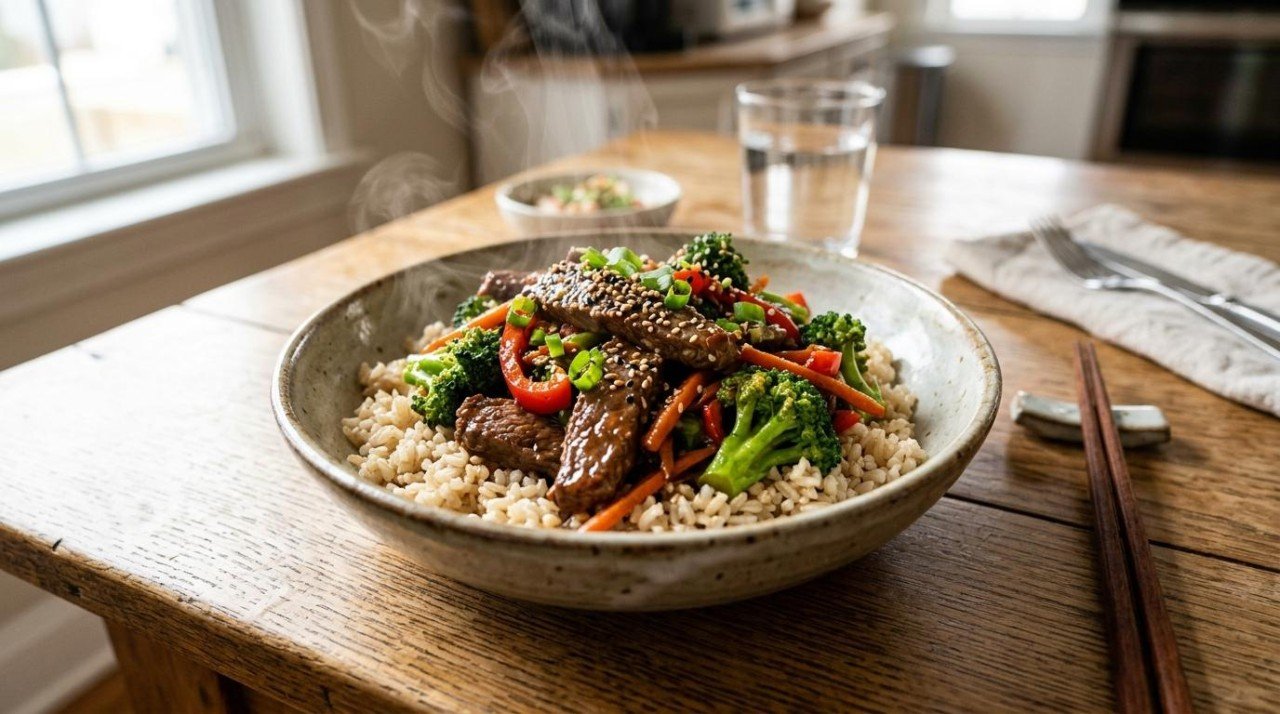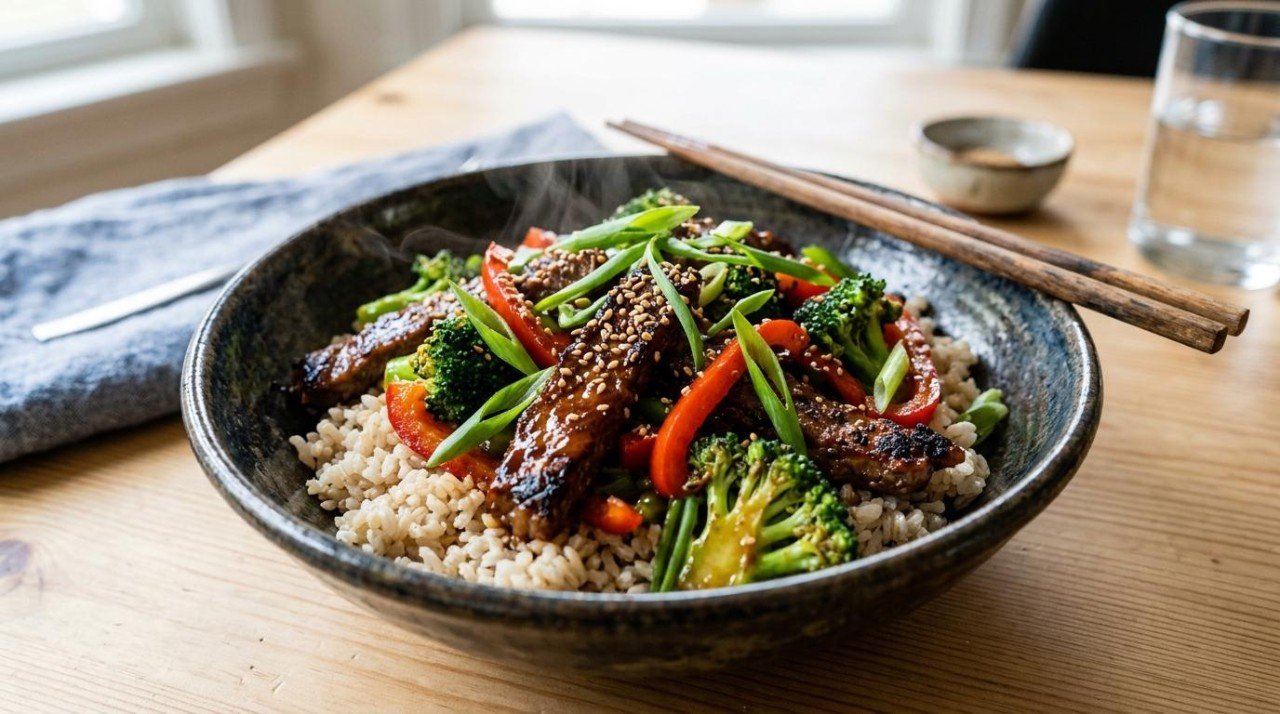
Mongolian beef is the takeout order for people who want something sweet, salty, and sticky in one bite. Crisp-edged strips of flank steak, a glossy brown glaze, a tangle of scallions, all over a pile of rice. Despite the name, it is an Americanized Chinese restaurant dish rather than anything from Mongolia, and according to Taste of Home it has been one of P.F. Chang's bestselling menu items since the chain opened in 1993.
We built the standard copycat version at home and ran it through Eat Well Planner's Nutrition Score, the same number that shows up on any public recipe page. It scored 38 out of 100. The beef is not the problem. The glaze is, plus one thing hiding in the rice pot that surprised us.
Our rebuilt version scores 84 out of 100, 46 points higher, and it is still sweet, still savory, and still Mongolian beef. Every swap below carries the real score change it earned, including the one that earned nothing at all.
The original: what's in it and how it scores
The copycat recipes that circulate online agree on the basics: thinly sliced flank steak dredged in cornstarch and fried in a generous amount of oil, then tossed in a reduction of soy sauce, water, and a lot of brown sugar. Here is the version we scored, for four servings:
- 1 lb flank steak, thinly sliced
- 1/4 cup cornstarch, for dredging
- Oil for frying (we counted the roughly 1/4 cup the beef absorbs)
- 1/2 cup regular soy sauce and 1/2 cup water
- 1/2 cup packed brown sugar
- 4 cloves garlic and 1 tablespoon fresh ginger
- 4 to 5 scallions
- About 2 1/2 cups cooked white rice, cooked with about 1/2 teaspoon of salt in the pot, the way many home cooks make it
Nutrition Score: 38/100. Here is why, starting with what is already good. Flank steak is a lean cut, and it makes this dish an excellent source of protein (about 30 g per serving), vitamin B6, niacin, iron, zinc, and vitamin B12. Saturated fat (5.3 g per serving) earns a caution, but it is not one of the score's weaknesses. So this is not a fatty-meat problem. Three things drag the score down:
- Added sugar: 26.7 g per serving. That half cup of brown sugar is more than half of the FDA's 50 g Daily Value for added sugars in a single plate, and it is the score's top weakness.
- Sodium: about 2,240 mg per serving. That is 97% of the 2,300 mg daily limit the Dietary Guidelines recommend, in one meal. Most of it comes from the half cup of regular soy sauce, and about 300 mg comes from salting the rice.
- No vegetables. Scallions are the only plant doing any work, so fiber sits at just 1.3 g per serving, vitamin A is flagged as low, and the plate counts only 1.5 plant points.
Notice what is not on the list: the frying. Hold that thought.
The upgrades
Six changes, scored one on top of the other in the order below. The first three do most of the work.
1. Turn it into a meal: add broccoli and red bell pepper
- Swap: Beef and scallions only → plus 12 oz broccoli florets, 1 large red bell pepper, and a full bunch of scallions
- Score impact: +12 points (38 → 50)
- What it changes: Fiber more than triples (1.3 g → 4.1 g), the "low vitamin A" flag disappears, and vitamin C and vitamin K jump to the top of the score's strengths
- What it costs you: Ten minutes of chopping. The glaze coats broccoli beautifully, and the pepper adds its own sweetness
Traditional Mongolian beef is a plate of meat and sauce, which means there is nothing on it to balance the sugar and salt. Adding two vegetables is the single biggest lever in this makeover, and we checked how much it matters at the end too: take the vegetables back out of the finished recipe and the score falls from 84 to 63, a 21-point drop.
If this starts to sound like beef and broccoli, it is a close cousin. We did a full makeover of beef and broccoli too, and the difference is instructive: beef and broccoli started with its vegetables and a modest amount of sugar, so it scored higher out of the gate. Mongolian beef starts sweeter and plainer, so it has more room to climb.
2. Cut the sugar hard, then rebuild the flavor with ginger and orange zest
- Swap: 1/2 cup packed brown sugar → 1 1/2 tablespoons, plus double the ginger and the zest of one orange
- Score impact: +12 points (50 → 62)
- What it changes: Added sugar drops from 26.7 g to 4.9 g per serving, about 82% less, and the "high added sugar" flag clears
- What it costs you: The real one in this makeover. The glaze is savory-sweet now instead of candy-sweet, and slightly less sticky
The big lesson here is that halfway does not work. We tested putting a quarter cup of brown sugar back into the finished recipe (half the original amount, which is what most "lighter" versions do) and the score crashed from 84 to 57. The score's added-sugar penalty works like a gate: until sugar gets down to roughly 5 g per serving, it holds the whole recipe back no matter what else you fix. Two tablespoons scored 83 with the sugar flag back on; one and a half tablespoons scored 84 and cleared it. If you want a stickier glaze, two tablespoons is a perfectly reasonable place to land.
What fills the gap is aromatics, not sweeteners. Doubling the fresh ginger gives the sauce heat and brightness, and orange zest brings a fruity, perfumed note that reads as "sweet" to your brain without adding sugar. If you do not keep fresh ginger around, our fresh ginger substitutes guide explains why ground ginger needs a very different ratio. And if you are tempted to just switch sweeteners instead of cutting, our brown sugar substitutes guide covers why most of them count as added sugar too.
3. Switch to low-sodium soy sauce, and use half as much
- Swap: 1/2 cup regular soy sauce → 1/4 cup low-sodium soy sauce
- Score impact: +8 points (62 → 70)
- What it changes: Sodium falls from about 2,260 mg to about 930 mg per serving
- What it costs you: Very little. With less sugar to balance, the sauce no longer needs as much salt to taste right
Here is a twist worth knowing: on the original recipe, making this exact soy swap by itself scored one point lower (38 → 37), even though it cut sodium by more than half. That is because the sugar penalty was still gating everything. Once the sugar is fixed, the same kind of soy swap is worth 8 points. Order matters, and it is why we cut the sugar first.
Kikkoman's less sodium soy sauce is brewed the same way as regular and has about 40% of the salt removed afterward, landing at 590 mg per tablespoon, 38% less than the original. Putting regular soy sauce back into the finished recipe (at the same 1/4 cup) cost 14 points. Our soy sauce substitutes guide has more lower-sodium options, including coconut aminos.
Take the Guesswork Out of Eating Well
Eat Well Planner helps you organize your favorite recipes, plan balanced meals, and automatically generate shopping lists — all in one place. Whether you're tracking macros, managing dietary restrictions, or just trying to stop asking "what's for dinner?", we've got you covered.
Our AI-powered tools can adapt any recipe to your dietary needs, help you discover new meals you'll love, and even log your nutrition effortlessly. It's meal planning made simple.
Start Organizing Your Meals — Free4. White rice → brown rice
- Swap: White rice → brown rice, same amount and (for this step) same salt
- Score impact: +4 points (70 → 74)
- What it changes: More fiber and magnesium from the bran and germ that white rice loses in milling
- What it costs you: A chewier, nuttier base and a longer cook time
We kept the salt identical for this step so the score reflects the grain itself, not the seasoning. It is a modest gain on the score, but the research behind it is solid: in a large Harvard follow-up, people who ate the most brown rice had an 11% lower risk of type 2 diabetes, while those who ate the most white rice had a 17% higher risk. Our white rice substitutes guide covers other whole-grain bases if brown rice is not your thing.
5. Don't salt the rice
- Swap: Rice cooked with 1/2 teaspoon salt → rice cooked in plain water
- Score impact: +10 points (74 → 84)
- What it changes: Sodium drops from about 930 mg to about 640 mg per serving
- What it costs you: Nothing you will notice. The glaze seasons every bite
This was the surprise of the makeover. Half a teaspoon of salt in a pot of rice sounds like nothing, but split four ways it is about 300 mg of sodium per serving, sitting under a sauce that is already salty. Once the rest of the recipe was clean, that one pinch was worth 10 points. If you only remember one trick from this post, it is this: when the sauce is salty, the base does not need to be.
6. Sear instead of deep-frying (the score shrugged)
- Swap: Deep-frying (about 1/4 cup oil absorbed) → searing in 2 tablespoons oil
- Score impact: +0 points (84 → 84)
- What it changes: About 60 fewer calories and 0.9 g less saturated fat per serving, and no pot of hot oil to deal with
- What it costs you: Slightly less crunch on the beef, but the cornstarch dusting still gives you crisp, browned edges
Everyone's first instinct with fried takeout is "just don't fry it." The score disagrees: frying contributed vegetable oil, which carries omega-3 (ALA) and vitamin E the score gives credit for, so removing the oil was a wash. Searing with even less oil (1 tablespoon plus 1 teaspoon) actually scored one point lower, at 83. We still recommend the sear because it is easier, faster, and lighter, but we want to be honest that the score does not reward it. The fryer was never what held this dish back. (If you are curious about the oil itself, our vegetable oil substitutes guide covers which oils handle high heat.)
What we kept (on purpose)
The flank steak stays exactly as it is: lean, iron-rich, and the point of the dish. The cornstarch dusting stays too, because it is what gives the beef its crisp edges and helps the glaze cling. (Our cornstarch substitutes guide covers arrowroot and potato starch if you need a swap.) And we kept real brown sugar, just much less of it, because a little caramel sweetness is what makes Mongolian beef taste like Mongolian beef. We stopped at 84 because the score's remaining weaknesses are low vitamin D (beef and vegetables simply don't carry much) and sodium that is still flagged, and cutting soy sauce further would start to make the glaze taste flat.
The healthier version: full recipe
Nutrition Score: 84/100. Serves 4.
For the beef:
- 1 lb flank steak, thinly sliced against the grain
- 3 tablespoons cornstarch
- 2 tablespoons vegetable oil, divided
For the sauce:
- 1/4 cup low-sodium soy sauce
- 1/2 cup water
- 1 1/2 tablespoons packed brown sugar
- 1 tablespoon cornstarch
- Zest of 1 orange (about 1 tablespoon)
- 2 tablespoons grated fresh ginger
- 4 cloves garlic, minced
For the vegetables and to serve:
- 12 oz broccoli florets (about 4 cups)
- 1 large red bell pepper, sliced
- 1 bunch scallions (about 3 1/2 oz), cut into 2-inch pieces, white and green parts separated
- About 2 1/2 cups cooked brown rice (from about 3/4 cup dry), cooked without salt
- Start the brown rice first in unsalted water, since it takes the longest.
- Pat the sliced beef dry, then toss it with 3 tablespoons cornstarch until every piece is thinly coated. Shake off the excess.
- Whisk the sauce ingredients together in a small bowl: low-sodium soy sauce, water, brown sugar, 1 tablespoon cornstarch, and orange zest. Set aside.
- Heat 1 1/2 tablespoons oil in a large skillet or wok over high heat until shimmering. Sear the beef in a single layer, in two batches, about 1 to 2 minutes per side, until browned and crisp at the edges. Move it to a plate.
- Add the remaining 1/2 tablespoon oil, then the broccoli, red pepper, and a splash of water. Stir-fry for 3 to 4 minutes, until crisp-tender. Add the garlic, ginger, and scallion whites and cook for 30 seconds, until fragrant.
- Stir the sauce and pour it in. Simmer for 1 to 2 minutes, until it thickens into a glossy glaze. Return the beef and add the scallion greens, tossing for 30 seconds to coat. Serve over the brown rice.
Per serving, before and after:
- Nutrition Score: 38 → 84
- Calories: about 616 → about 501
- Added sugar: 26.7 g → 4.9 g
- Sodium: about 2,240 mg → about 640 mg (from 97% to 28% of the daily limit)
- Fiber: 1.3 g → 4.9 g (now a good source)
- Saturated fat: 5.3 g → 4.7 g
- Protein: about 30 g → about 32 g
- Plant points: 1.5 → 5.5
Swaps we tested and skipped
- Cutting the sugar in half (scored 57). The most common "lighter" Mongolian beef move. With everything else fixed, a quarter cup of brown sugar still cost 27 points. It is a gate, not a slope.
- Cauliflower rice instead of brown rice (scored 81). It saves about 120 calories a serving and adds fiber, but it scored 3 points lower and brought back a saturated fat flag, since the grain was diluting the beef's fat. You lose the comfort of a real rice bowl, too.
- Searing in barely any oil (scored 83). One tablespoon plus one teaspoon instead of two tablespoons cost a point and makes it harder to get crisp edges. Two tablespoons is the sweet spot.
Make it fit other diets
Gluten-free: use a reduced-sodium tamari in place of soy sauce; cornstarch is already gluten-free. Vegetarian: swap the flank steak for extra-firm tofu, pressed, cubed, and dredged in the same cornstarch, or for thick-sliced king oyster mushrooms. In Eat Well Planner you can ask the AI recipe chat to "make this gluten-free" or "make this vegetarian," and it rewrites the whole recipe with the swaps worked in.
Do this to any recipe you love
Every number in this post came from Eat Well Planner's Nutrition Score. The app's Make It Healthier tool proposes swaps like these and has a calculator verify the real gain before it shows you a suggestion, so you never waste effort on a change that does not help. We ran each change in the Recipe Playground, which is how we caught that halving the sugar barely moves the needle, that the deep fryer was a wash, and that a pinch of salt in the rice was worth 10 points.
Saw a Mongolian beef recipe on YouTube or Instagram? Import the video straight into the app, score it before you cook it, and see where the easy points are. Same dish you love, better numbers.