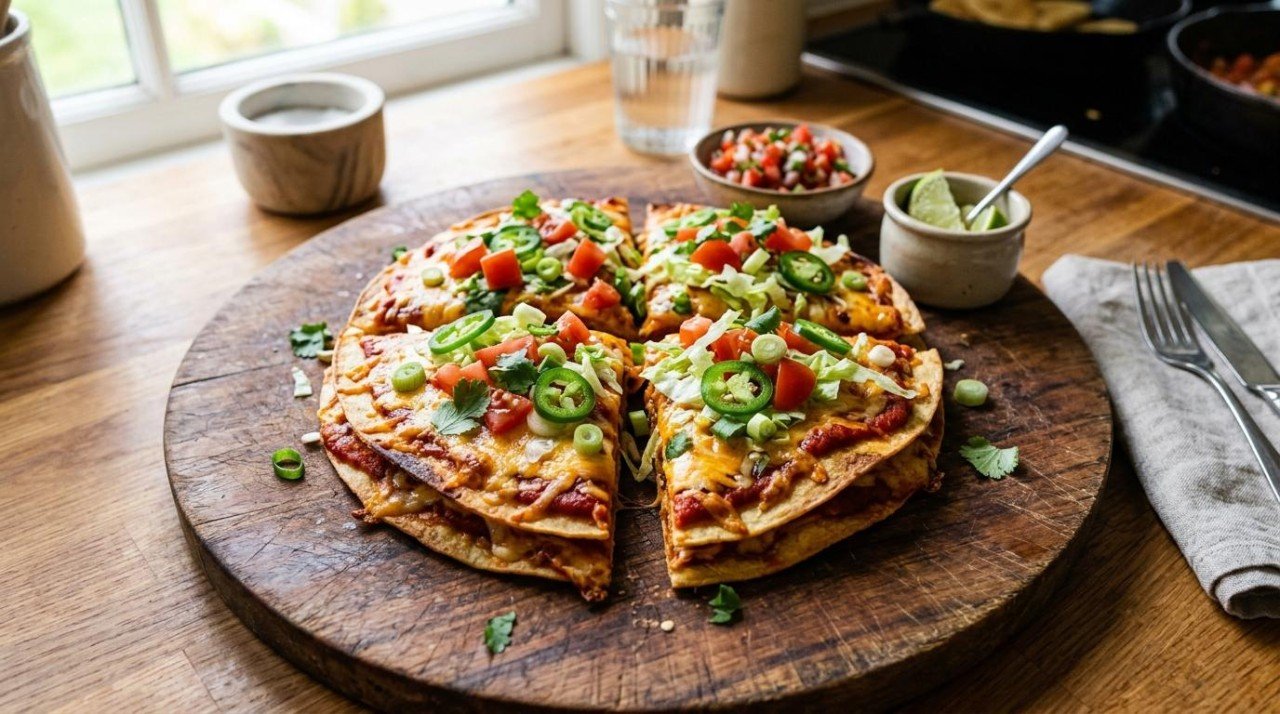
The Mexican Pizza is the only fast food item we can think of that came back from the dead because of a petition. Taco Bell pulled it from the menu in November 2020, and Krish Jagirdar's Change.org petition collected more than 171,000 signatures arguing that it was, for a lot of South Asian American families who grew up vegetarian, a piece of childhood. It worked. The pizza returned in May 2022 and sold out within about two weeks.
So people make it at home. The standard copycat is a good one: two flour tortillas flash-fried until they blister and crackle, refried beans and taco-seasoned beef pressed between them, red sauce and a snowdrift of shredded cheese on top, ten minutes in a hot oven. We scored that version against production nutrition data and it came back at 42 out of 100.
Then we rebuilt it. Same double-decker crunch, same melted cheese top, same sauce-and-beef-and-beans architecture. 74 out of 100 - a 32-point gain, with 1,500 mg less sodium and nearly double the fiber per serving. The one thing that did not help was the swap everyone assumes is the whole point: baking the shells instead of frying them made the score go down. More on that below, because it is the most interesting number in this post.
The original: what's in it and how it scores
We scored a representative homemade copycat - the kind you find on any recipe site, built for four people: 1 pound of 80/20 ground beef browned with a 1-ounce taco seasoning packet, eight taco-size flour tortillas shallow-fried in oil, a 15-ounce can of refried beans, a 10-ounce can of red enchilada sauce, 2 cups of shredded Mexican-blend cheese, and a diced tomato with some scallion on top.
One serving - one whole double-decker pizza - lands at:
- Nutrition Score: 42/100
- Calories: 873
- Sodium: 2,430 mg (105% of the Daily Value, flagged very high)
- Saturated fat: 19.3 g (82% DV, flagged very high)
- Fiber: 7.6 g
- Protein: 45 g
- Plant points: 3.25
Here is the diagnosis, and the useful part is that it is not one villain. It is sodium arriving from five directions at once. The seasoning packet contributes roughly 2,000 mg on its own. The canned enchilada sauce adds about 1,550. The flour tortillas - which taste like nothing in particular - carry around 1,680 mg between them. The canned refried beans bring another 1,570, and the cheese another 1,590. No single one of those is outrageous. Together they put a full day's sodium into one dinner. Harvard's nutrition team lists tacos and burritos among the top sources of sodium in the American diet, and this is exactly the mechanism: five moderately salty components stacked in one dish.
The saturated fat is simpler - 2 cups of cheese and 80/20 beef, and that is most of the 19.3 g right there.
What is already fine, and worth saying plainly: the beans are genuinely good. Canned refried beans score 67 on their own, which is better than most people assume. The protein is excellent at 45 g. And the fried shells, which everyone treats as the obvious problem, turn out not to be one - we will get to that.
The upgrades
Each swap below was scored on top of the one before it, in this order, so every number is the real gain at that point in the build. We ordered them by impact against flavor cost, so if you only make one change, make the first one.
1. Bury it in fresh toppings
- Swap: One diced tomato and a sprinkle of scallion, replaced with two Roma tomatoes, 2 cups of shredded romaine, four scallions, a sliced jalapeno, cilantro, and a squeeze of lime - all added after baking
- Score impact: 42 to 48 (+6)
- What it changes: Plant points from 3.25 to 5.5, plus vitamin C, vitamin K, potassium and folate
- What it costs you: Nothing. This is the free one.
The single biggest swap in the post is not a swap at all - it is an addition, and it costs you nothing but two minutes of chopping. The Mexican Pizza already has a garnish slot built into it; we just filled it properly. Everything goes on after the pizza comes out of the oven so the lettuce stays crisp and the lime stays bright.
This is also where plant diversity starts moving. The American Gut Project found that people eating more than 30 different plant types a week had meaningfully different gut microbial communities than people eating 10 or fewer - more of the short-chain-fatty-acid producers associated with gut health. A pizza that contributes six plants instead of two is a real contribution to that count.
2. Build the sauce from tomato paste
- Swap: A 10-ounce can of red enchilada sauce, replaced with 6 tablespoons of tomato paste thinned with water and spiked with chili powder, cumin, garlic powder, oregano and a teaspoon of vinegar
- Score impact: 48 to 51 (+3)
- What it changes: Cuts about 340 mg of sodium per serving and adds potassium and lycopene
- What it costs you: Two minutes with a whisk. Flavor-wise you gain - it tastes fresher and less tinny.
Tomato paste scores 98 on its own, one of the highest numbers in the whole ingredient catalog: concentrated tomato with almost no sodium and a lot of potassium. Canned enchilada sauce is mostly the same tomato plus about 550 mg of sodium per 100 g. Making the sauce yourself takes the length of time the beef needs to brown, and if you want other ways to use up the can, our tomato paste substitutes guide covers the reverse direction too.
3. Mix your own taco seasoning
- Swap: The 1-ounce seasoning packet, replaced with chili powder, cumin, paprika, oregano, garlic powder, onion powder and a scant half teaspoon of salt
- Score impact: 51 to 53 (+2)
- What it changes: Removes about 250 mg of sodium per serving and the packet's added sugar entirely
- What it costs you: Nothing, if your spice drawer is stocked. The homemade blend is more assertive.
A taco seasoning packet is roughly 7% sodium by weight, and it also carries added sugar and starch as bulking agents. Rebuilt from your own spices, you control the salt to the quarter teaspoon - and you can lean harder on the cumin and chili powder, which is where the flavor actually lives. This is the swap that most surprises people when they taste them side by side.
4. Corn tortillas instead of flour
- Swap: Eight taco-size flour tortillas, replaced with eight 6-inch corn tortillas
- Score impact: 53 to 56 (+3)
- What it changes: Cuts roughly 390 mg of sodium per serving, removes the tortillas' saturated fat, and makes the shells whole grain
- What it costs you: A corn flavor instead of a neutral one - which is arguably more correct for the dish anyway
This one contradicted our own starting hypothesis. We assumed whole wheat tortillas would win; they lost badly, and we have put the numbers in the rejected section below. Corn tortillas turned out to be the better shell by a wide margin, because a plain corn tortilla carries about 50 mg of sodium per 100 g against roughly 700 mg for a flour tortilla, and essentially no saturated fat where flour tortillas carry a few grams of shortening.
They are also a whole grain. The Whole Grains Council notes that traditional nixtamalization - treating the corn with alkali to make masa - liberates the niacin in corn, which is why cultures built on tortillas did not develop pellagra. Practically speaking, corn tortillas also crisp harder and hold up better under sauce than flour ones do. If you want to go further afield, our tortilla substitutes guide covers what else works.
5. Mash your own beans
- Swap: A 15-ounce can of refried beans, replaced with two 15-ounce cans of no-salt-added pinto beans, drained, rinsed and mashed with a splash of water
- Score impact: 56 to 58 (+2)
- What it changes: Fiber from 11.8 g to 13.7 g per serving, and a bigger bean layer
- What it costs you: Five minutes and a potato masher. The texture is chunkier and, honestly, better.
This is a smaller gain than we expected, because canned refried beans were never the problem the internet says they are. What you get is a thicker bean layer with more fiber and no lard. Rinsing matters here: draining and rinsing canned beans cuts their sodium by up to 40%, per dietitian Lindsay Malone at Case Western Reserve. Mash them warm with a splash of the bean liquid or unsalted broth and they spread exactly like the canned stuff.
6. Extra-lean ground beef
- Swap: 1 pound of 80/20 ground beef, replaced with 1 pound of 95% lean
- Score impact: 58 to 63 (+5)
- What it changes: Saturated fat down about 3 g per serving, 66 fewer calories, and more protein (48 g)
- What it costs you: Lean beef dries out if you overcook it - which is why the sauce and the splash of water in the pan matter
Normally we are cautious about lean ground beef, because in a burger it is a genuine downgrade. Here it is not, because the beef is a thin layer sitting under sauce and cheese, and it is being simmered with spices and a third of a cup of water rather than seared. Brown it, break it up fine, add the spices and water, and let it go until the liquid is mostly gone. It stays moist. Our ground beef substitutes guide covers the other directions you could take this.
7. Half the cheese, but sharper
- Swap: 2 cups of shredded Mexican blend, replaced with 4 oz (about 1 cup) of freshly shredded sharp cheddar
- Score impact: 63 to 74 (+11)
- What it changes: Saturated fat down another 4.1 g per serving, 88 fewer calories, 220 mg less sodium
- What it costs you: A thinner cheese layer - noticeable, but it still covers and still browns
Here is the finding worth carrying to your own cooking: we also tested halving the cheese on the original recipe by itself, and it was worth 2 points. The same swap, applied last, was worth 11. That is not a glitch. When a recipe is drowning in sodium and saturated fat from five sources, fixing one of them barely moves a score that is pinned by the others. Once the sodium is down and the beef is lean, the cheese is the last thing holding the numbers back - and cutting it pays out five times over.
The practical version of this: do not judge a single swap in isolation and give up when it does not seem worth it. Sharp cheddar helps because it is more assertive per gram than a mild blend, so a thinner layer still reads as cheesy. Shred it yourself - pre-shredded cheese is dusted with anti-caking starch that makes it melt grainier. Our cheddar substitutes guide has the melting notes if you want to use something else.
Take the Guesswork Out of Eating Well
Eat Well Planner helps you organize your favorite recipes, plan balanced meals, and automatically generate shopping lists — all in one place. Whether you're tracking macros, managing dietary restrictions, or just trying to stop asking "what's for dinner?", we've got you covered.
Our AI-powered tools can adapt any recipe to your dietary needs, help you discover new meals you'll love, and even log your nutrition effortlessly. It's meal planning made simple.
Start Organizing Your Meals — FreeWhat we kept on purpose: the fryer stays on
Every "healthier Mexican pizza" recipe online bakes or air-fries the shells. We tested it. It made the score worse.
Brushing the corn tortillas with a tablespoon of oil and crisping them in the oven instead of shallow-frying them took the finished pizza from 74 down to 71, while saving 90 calories per serving. Applied to the original recipe instead, the same change was worth exactly zero points.
The reason is that the oil is not just fat. The vegetable oil the shells absorb is soybean oil, and Harvard's nutrition team names soybean oil among the leading plant sources of ALA, the plant-based omega-3. In the finished pizza that oil is supplying 74% of the Daily Value for ALA and 48% for vitamin E per serving. It is also unsaturated fat sitting alongside cheese and beef, which improves the overall fat quality of the dish rather than degrading it. Take it out and you remove a genuine nutritional asset.
To be completely clear about the trade-off: the score measures nutrient quality per serving, not calories. If calories are your priority, bake the shells - you give up 3 points and save 90 calories, and that is a perfectly reasonable choice. We are talking about a thin film of oil in a skillet, not a deep fryer, and the shells are the entire textural point of this dish.
We also kept the real cheese, the real beef, and both shells. A single-decker Mexican pizza is not a Mexican pizza.
The healthier Mexican pizza: 74/100
Serves 4 (four double-decker pizzas). Prep 25 minutes, cook 12 minutes.
Spiced beef
- 1 lb extra-lean (95%) ground beef
- 1 tablespoon chili powder
- 1 tablespoon ground cumin
- 2 teaspoons paprika
- 2 teaspoons dried oregano
- 1 teaspoon garlic powder
- 1 teaspoon onion powder
- Scant 1/2 teaspoon fine salt (2 g)
- 1/3 cup water
Sauce
- 6 tablespoons tomato paste
- 3/4 cup water
- 1 1/2 teaspoons chili powder
- 1 teaspoon ground cumin
- 3/4 teaspoon garlic powder
- 1 teaspoon dried oregano
- 1 teaspoon apple cider vinegar
Beans, shells and cheese
- 2 (15-ounce) cans no-salt-added pinto beans, drained and rinsed
- 1/4 cup water or unsalted broth
- 8 (6-inch) corn tortillas
- 1/4 cup vegetable oil, for shallow-frying
- 4 oz sharp cheddar, freshly shredded (about 1 cup)
To finish, after baking
- 2 Roma tomatoes, diced
- 2 cups shredded romaine
- 4 scallions, thinly sliced
- 1 fresh jalapeno, thinly sliced
- 1/4 cup chopped cilantro
- 1 tablespoon lime juice
- Heat the oven to 400F. Whisk the sauce ingredients together in a small pot and simmer gently for 5 minutes, until it thickens to a spoonable consistency. Set aside.
- Brown the beef in a dry skillet over medium-high heat, breaking it up fine. Add the spices and salt, stir for 30 seconds, then add the water and simmer until the pan is almost dry, about 4 minutes.
- Warm the drained beans in a saucepan with the water or broth and mash to a thick, spreadable paste. Season with a pinch of the spice blend if you like.
- Heat the oil in a skillet over medium-high heat until it shimmers. Fry the tortillas one at a time, about 45 seconds per side, until golden and stiff. Drain on paper towels. They should crackle when tapped.
- Set four tortillas on a sheet pan. Spread each with the bean mash, then the beef. Top with a second tortilla and press down gently.
- Spoon sauce over each top tortilla, spreading to the edges, then scatter the cheddar over the sauce.
- Bake for 8 to 10 minutes, until the cheese is melted and bubbling at the edges.
- Toss the lettuce, tomato, scallion, jalapeno and cilantro with the lime juice, then pile it over the pizzas. Cut into quarters and serve immediately.
Per serving, original vs. improved:
- Nutrition Score: 42 to 74
- Calories: 873 to 679
- Sodium: 2,430 mg to 930 mg (105% DV to 40% DV)
- Saturated fat: 19.3 g to 10.3 g (82% DV to 44% DV)
- Fiber: 7.6 g to 13.7 g
- Protein: 45 g to 43 g
- Plant points: 3.25 to 8.75
The improved version earns "good source of" status for fiber (46% DV), potassium, vitamin E, folate and vitamin K, on top of the iron, zinc and B12 the original already had. And a note on portion: this is a big dinner. One serving weighs roughly 500 g, well over double the 213 g of an actual Taco Bell Mexican Pizza - and it still carries less sodium than the 1,010 mg in theirs. Sodium is still flagged high at 40% of the Daily Value, which is the honest ceiling for a dish built on cheese, beans and tortillas.
Swaps we tested and skipped
- Whole wheat tortillas (74 to 63). This was our own starting assumption and it was wrong by 11 points. Commercial whole wheat tortillas carry about 620 mg of sodium and nearly 5 g of saturated fat per 100 g - they are flour tortillas with bran added, not a health food. Corn wins outright.
- Reduced-fat cheddar (74 to 80). This one scored better and we still rejected it. Reduced-fat cheese melts badly: with less fat dispersed through it, the casein network tightens and dehydrates, which is why low-fat cheeses "tend to be tough and rubbery" and brown rather than flow. A Mexican pizza with a rubbery cheese top is a failed Mexican pizza. Six points is not worth the one texture the dish is named for.
- Half the beef, more beans (74 to 72). The classic bean-extender move lost 2 points and dropped protein from 43 g to 33 g. The beans were already doing their job.
- Beans instead of beef entirely (74 to 65). A vegetarian build with black beans in place of the meat lost 9 points and half the protein. Worth doing if you are vegetarian - see below - but not as a nutrition upgrade.
- Cutting the cheese to 2 oz total (74 to 81). This is where we stopped, and it is worth knowing the number. Halving the cheese again scores 7 points higher, but half an ounce per pizza is a dusting, not a melt. If you would rather have the points than the cheese pull, the option is there - we just would not publish it as a Mexican pizza.
Make it fit other diets
The two most-asked variations for this dish are easy. For vegetarian - the version the petition was really about - swap the beef for a 15-ounce can of black beans, drained, warmed with the same spice blend and lightly crushed; expect roughly 65 instead of 74, with more fiber and less protein. For dairy-free, the sauce and beans already qualify; the cheese is the only obstacle, and a thin layer of a cashew-based shred melts closest. The recipe is already gluten-free once you are on corn tortillas - just check that your chili powder blend has no wheat filler.
In the app, either of those is one step: open the recipe, ask the AI to make it vegetarian or dairy-free, and Recipe Variations rewrites the whole thing with the substitutions worked in - then scores the result so you can see what the change actually cost.
Do this to any recipe you love
None of this was guesswork. Every number here came out of Eat Well Planner: the original was scored ingredient by ingredient, each swap was applied in the Recipe Playground to read its individual delta, and Make It Healthier proposes swaps like these on any recipe with the nutritional gain verified by a calculator before you ever see the suggestion. That is why we can tell you that the cheese was worth 2 points in one place and 11 in another, and that the fryer earned its keep.
You can do exactly this with the recipe you actually cook. Import it from a URL, a TikTok, an Instagram reel or a YouTube video, look at the score, and work down the suggestions - keeping the ones that are worth it and refusing the ones that would cost you the dish. That last part is the whole skill. The score is a tool for keeping the food you love, not a reason to give it up.