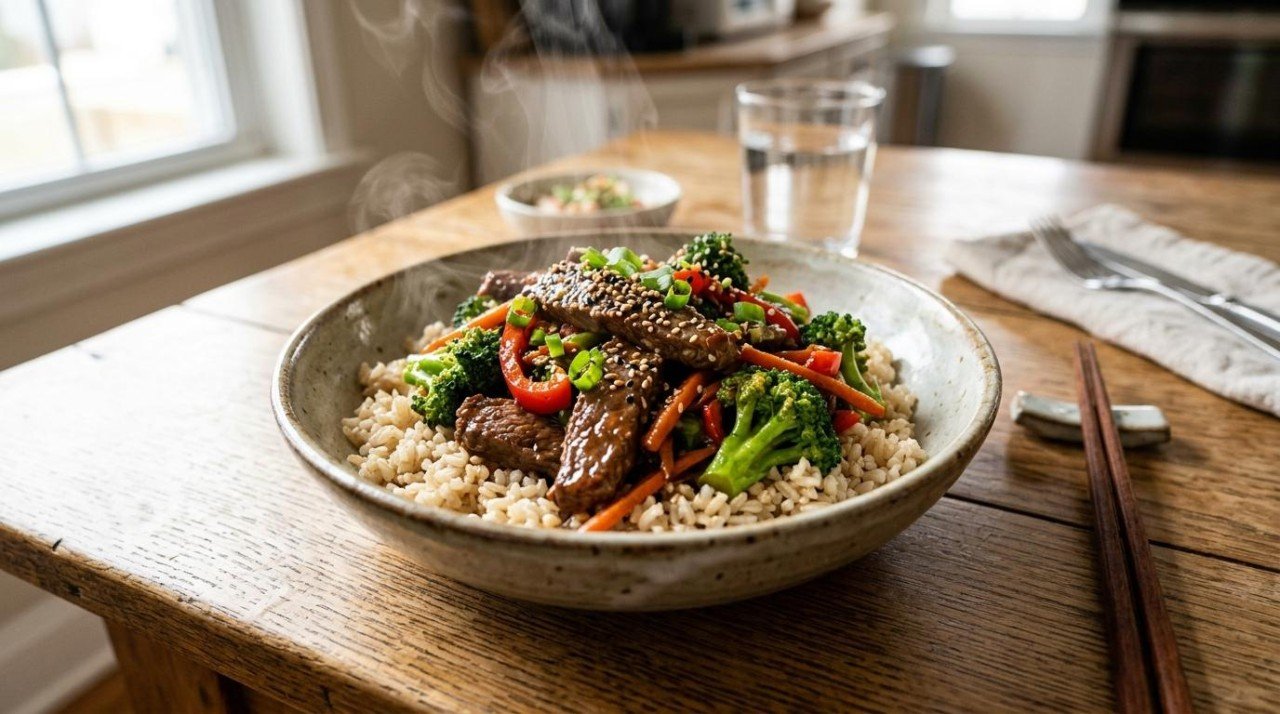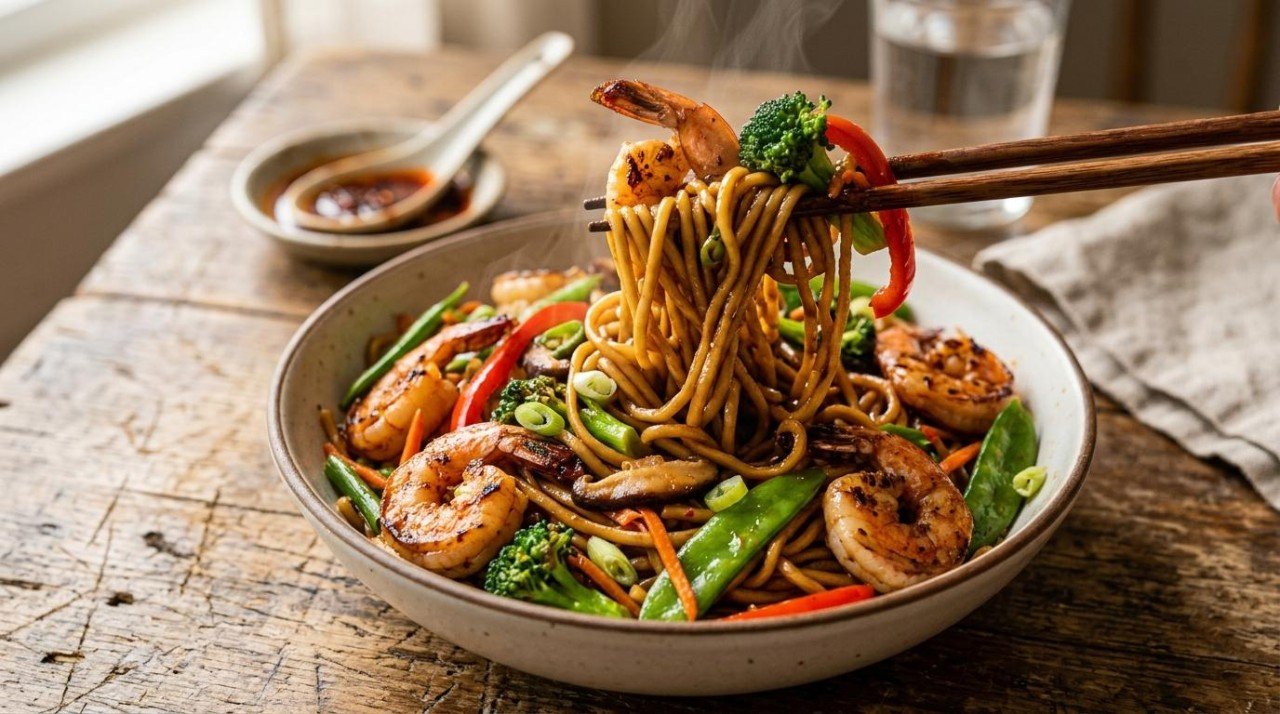
Lo mein is what you order when you want dinner to be comforting. Soft, slippery noodles glossed in a dark savory sauce, a tangle of cabbage and carrot, everything tossed so every strand carries flavor. The name is the method: chow mein means stir-fried noodles, while lo mein is fully cooked noodles tossed in sauce — which is exactly why it comes out soft rather than crisp.
So we built a standard homemade version — not a heavy one, more restrained than most takeout containers — and ran it through Eat Well Planner's Nutrition Score, the same number that appears on any public recipe page. It came back 50 out of 100.
Here is the promise: we kept all twelve ounces of noodles, kept the oyster sauce, kept every drop of the oil, and still got it to 92 out of 100. That is a 42-point jump, and every swap below carries the real, verified score change it earned — including two popular "healthy" swaps that pushed the score down, and one that scored higher than our final recipe and still did not make the cut.
The original: what's in it and how it scores
Here is the version we scored, for four people:
- 12 oz dried egg noodles
- 1/4 cup regular soy sauce, 2 tablespoons oyster sauce, 1 tablespoon brown sugar
- 3 tablespoons vegetable oil and 1 tablespoon toasted sesame oil
- 3 cloves garlic and 1 tablespoon fresh ginger
- About 1/2 lb of vegetables total: 1 cup shredded cabbage, 1 carrot, a handful each of scallions and bean sprouts
Nutrition Score: 50/100. Now the diagnosis, because understanding why a recipe scores the way it does is the part that transfers to your own cooking. Three things hold it down:
- Sodium, and it is not close. 1,180 mg per serving — 51% of a day's value in one bowl, and the only nutrient the app flags as a caution. Almost all of it is that quarter cup of soy sauce. Harvard's Nutrition Source puts the chronic-disease-reduction ceiling at 2,300 mg a day and notes most Americans already eat about 3,400 mg.
- The vegetables are a garnish. Twelve ounces of refined noodles against half a pound of raw vegetables gives 4.5 g of fiber per serving, against the 25 to 35 g a day Harvard says adults need. Plant variety comes in at 4.5 plant points against a weekly target of 30.
- It is not really a meal. 14.5 g of protein for 498 calories. Lo mein is usually ordered alongside something; on its own it is a plate of starch with seasoning.
Notice what is not on that list. Saturated fat is 2.9 g per serving, which is genuinely fine. The brown sugar works out to about 3 g of added sugar per serving, which is trivial. And the quarter cup of oil, the thing everyone flinches at, turns out to be doing useful work — we tested cutting it, and the numbers surprised us. This is a sodium-and-vegetables problem, not a fat problem.
The upgrades
Four changes, applied in this order, each scored on top of the last. If you make only one, make the first.
1. Rebuild the sauce instead of shrinking it
- Swap: 1/4 cup regular soy sauce and 2 tablespoons oyster sauce → 3 tablespoons low-sodium soy sauce, 1 tablespoon oyster sauce, plus double the garlic, more than double the ginger, 1 tablespoon rice vinegar, and 1 teaspoon white pepper
- Score impact: +15 points (50 → 65)
- What it changes: Sodium falls from 1,180 mg to 550 mg per serving — from 51% of a day's value to 24%, and out of "very high" caution territory entirely
- What it costs you: Nothing, provided you actually add the aromatics. Skip them and it tastes thin
The mistake people make is simply using less soy sauce. That cuts sodium, but it also cuts the color, the gloss, and the savory backbone, leaving pale, under-seasoned noodles. Low-sodium soy sauce keeps the volume of liquid instead: The Woks of Life notes it has had the salt extracted "without sacrificing the soy sauce flavor (as opposed to watered down soy sauce)" and recommends it specifically for dishes where a lot of soy sauce goes into the sauce — which is what lo mein is.
Then replace the missing salt with things that are not salt: double garlic and ginger, a tablespoon of rice vinegar for brightness, and a full teaspoon of white pepper, the warm signature heat of Cantonese noodle dishes. Halve the oyster sauce rather than dropping it — it is the glaze that makes the sauce cling. Our oyster sauce and soy sauce guides cover the ratios if you need to work around either bottle.
2. Make the vegetables outweigh the noodles
- Swap: About 1/2 lb of vegetables → about 2 1/2 lb: 12 oz cabbage, 2 carrots, broccoli, a red bell pepper, snow peas, shiitake mushrooms, scallions, bean sprouts
- Score impact: +18 points (65 → 83)
- What it changes: Fiber more than doubles (4.7 g → 9.9 g per serving), vitamin C hits 163% of a day's value and vitamin K 130%, and plant points go from 4.75 to 8.75
- What it costs you: Ten minutes of chopping, and you have to cook in batches or the whole thing steams
This is the biggest single mover, and it changes what the dish is. Restaurant lo mein is noodles with vegetables scattered through for color. Flip the ratio so the vegetables outweigh the cooked noodles and it is still lo mein — the noodles are all still there — but now it is a vegetable dish with noodles in it. The specific picks cover different ground: cabbage for bulk, carrots and red bell pepper for vitamin A and crunch, broccoli for fiber and sulforaphane, shiitake for a savory depth that lets the reduced sauce go further, snow peas and bean sprouts for texture at the end. That spread is why plant points nearly double, which is the reasoning behind the 30 plants a week target.
The honest cost is technique, not flavor. Two and a half pounds of vegetables will not fit in one wok, and The Woks of Life is blunt about why that matters: "Overcrowding a wok with too many ingredients cools it down severely, creating more of a slow-boiling stew than a stir-fry," with the rule that a stir-fry should fill no more than a third of the wok. Hard vegetables first, soft ones second, heat high throughout.
3. Add shrimp, specifically — not chicken
- Swap: No protein → 12 oz raw shrimp
- Score impact: +9 points (83 → 92)
- What it changes: Protein goes from 18.4 g to 31.6 g per serving, and EPA+DHA omega-3s go from a flagged weakness to 51% of a day's value. Heart health jumps from 79 to 90, brain health from 73 to 95
- What it costs you: Shrimp is naturally salty — sodium climbs back from 590 mg to 890 mg, giving back about a third of what the sauce rebuild saved
This is the section we did not expect to write. We scored three proteins at the same 12 oz, at the same point in the build:
- Shrimp: 92 (+9)
- Edamame: 84 (+1)
- Chicken breast: 83 (+0)
Chicken breast — the obvious, sensible choice — moved the score by nothing at all. It adds plenty of protein, but the recipe had already earned its points elsewhere, so there was nothing left for it to fix. Shrimp scored nine points higher for one reason: by that stage the only remaining gap was long-chain omega-3s, and shrimp is the only one of the three that fills it. Harvard's Nutrition Source is direct that marine omega-3s cannot be adequately replaced by plant sources, recommends seafood twice a week, and lists shrimp among the low-mercury choices. The lesson generalizes: the best thing to add is whatever covers the hole your dish still has. Chicken lo mein is a fine dinner — it just is not where the points were.
4. Whole wheat noodles (for the fiber, not the score)
- Swap: 12 oz egg noodles → 12 oz whole wheat spaghetti or linguine
- Score impact: +0 points (92 → 92)
- What it changes: Fiber goes from 10.1 g to 12.5 g per serving, adds a plant point, and drops about 33 calories — with no change to the score at all
- What it costs you: A firmer, nuttier noodle, noticeably less silky than an egg noodle. This is the swap most people will taste
We are including this one precisely because it earned nothing. By this point the vegetables had carried fiber and gut health so far that upgrading the noodles had nowhere left to move the number — though the same swap applied to the original recipe was worth +6. Order matters.
It still goes in our recipe, because 2.4 g of extra fiber and a genuine whole grain are worth having even when the score shrugs, and whole grain intake tracks with a 22% lower risk of total mortality at around 70 g a day. But if you would rather have silky egg noodles, take them: you lose the fiber and you lose no points. Our pasta substitutes guide ranks the other options, including 100% buckwheat soba, which suits this dish well.
What we kept (on purpose)
All 12 oz of noodles. The oyster sauce, halved rather than removed. All three tablespoons of cooking oil plus the toasted sesame oil finish. The brown sugar. The makeover stops where the next change would stop it being lo mein — and, as it turns out, where the next change would also stop helping.
Take the Guesswork Out of Eating Well
Eat Well Planner helps you organize your favorite recipes, plan balanced meals, and automatically generate shopping lists — all in one place. Whether you're tracking macros, managing dietary restrictions, or just trying to stop asking "what's for dinner?", we've got you covered.
Our AI-powered tools can adapt any recipe to your dietary needs, help you discover new meals you'll love, and even log your nutrition effortlessly. It's meal planning made simple.
Start Organizing Your Meals — FreeSwaps we tested and skipped
- Cutting the oil in half: 92 → 89. Three points worse. Halving the oil in the original recipe was worth +5, so this was genuinely counterintuitive — but by the end of the build the oils carried most of the plant omega-3 (ALA) and vitamin E in the dish, and losing them cost more than the 71 calories saved. Two tablespoons instead of three lands at 91: that is your compromise if you are counting calories. Worth reading alongside what the evidence actually says about seed oils.
- Cutting the noodles from 12 oz to 8 oz: 92 → 87. Five points worse, for a smaller and less satisfying plate. With the vegetables already tripled, the noodles are no longer the problem.
- Spiralized zucchini instead of noodles: 92 → 74. Eighteen points worse, and it is not lo mein — it is a shrimp and vegetable stir-fry with the noodles taken out. A swap that guts the dish and loses on the numbers too.
- Coconut aminos instead of low-sodium soy sauce: 92 → 97. This is the honest problem. It is the highest score we recorded, it drops sodium to 470 mg per serving, and it clears sodium off the weakness list entirely. We still did not make it the recipe, because coconut aminos is distinctly sweeter and much less savory, and in a dish where soy sauce is the flavor a 1:1 swap tastes noticeably milder — you would want to drop the brown sugar and lean harder on the aromatics. If you are soy-free, gluten-free, or specifically targeting blood pressure, it is the best lever left in this recipe and you should take it. If you want lo mein to taste like lo mein, use the low-sodium soy sauce.
The healthier version: full recipe
Nutrition Score: 92/100. Serves 4 generously.
Ingredients
- 12 oz whole wheat spaghetti or linguine
- 12 oz raw shrimp, peeled and deveined
- 3 tablespoons vegetable or peanut oil, divided
- 1 tablespoon toasted sesame oil
- 3 tablespoons low-sodium soy sauce
- 1 tablespoon oyster sauce
- 1 tablespoon brown sugar
- 1 tablespoon rice vinegar
- 1 teaspoon ground white pepper
- 2 tablespoons water
- 6 cloves garlic, minced (about 2 tablespoons)
- 2 tablespoons grated fresh ginger (about 1/2 oz)
- 12 oz green cabbage, shredded (about 5 cups)
- 2 medium carrots, julienned
- 7 oz broccoli florets (about 2 1/2 cups)
- 1 red bell pepper, thinly sliced
- 3 1/2 oz snow peas (about 1 1/2 cups)
- 3 1/2 oz shiitake mushrooms, sliced (about 1 1/2 cups)
- 4 scallions, cut into 1-inch pieces
- 3 1/2 oz bean sprouts (about 1 cup)
Instructions
- Stir together the low-sodium soy sauce, oyster sauce, brown sugar, rice vinegar, white pepper, and water. Set the sauce aside.
- Boil the pasta one minute short of the package directions, so it stays firm through the tossing. Drain, rinse under cold water to stop the cooking, and toss with the toasted sesame oil to keep the strands separate.
- Heat 1 tablespoon of the oil in a wok or large skillet over high heat until it shimmers. Add the shrimp in a single layer and cook about 1 minute per side, until just pink and opaque. Transfer to a plate.
- Add another tablespoon of oil, then the garlic and ginger. Stir constantly for 20 to 30 seconds, until fragrant but not browned.
- Add the broccoli, carrots, and shiitake mushrooms. Stir-fry over high heat for 3 minutes. If your pan is crowded more than a third full, do the vegetables in two batches — crowding drops the temperature and steams them instead of searing them.
- Add the cabbage, bell pepper, and snow peas. Stir-fry 3 to 4 minutes more, until everything is crisp-tender and the cabbage has wilted but still has bite.
- Add the last tablespoon of oil, then the noodles and the sauce. Toss for about 2 minutes, lifting from the bottom, until every strand is coated and glossy.
- Return the shrimp to the pan and add the bean sprouts and scallions. Toss for 1 minute to heat through, then serve immediately.
Per serving, original vs. improved
- Nutrition Score: 50 → 92
- Calories: 498 → 668
- Protein: 14.5 g → 30.4 g
- Fiber: 4.5 g → 12.5 g
- Sodium: 1,180 mg → 870 mg
- Saturated fat: 2.9 g → 3.5 g
- Plant points: 4.5 → 9.75
The calories go up, and we are not going to hide that. The improved version is a much bigger plate — about 340 g of food per serving became about 650 g — because we added two and a half pounds of vegetables and a protein without taking any noodles away. Those extra 170 calories buy 16 g of protein and 8 g of fiber, which is the difference between a bowl of noodles you are hungry after and a dinner that is finished. If you want the smaller plate, halve the noodles: 570 calories, and a score of 87.
Make it fit other diets
- Vegan or vegetarian: edamame in place of the shrimp (it scored 84 in our build — you lose the omega-3s, you gain nearly 4 g more fiber and another plant point) or crisped firm tofu, with a mushroom-based vegetarian "oyster" sauce.
- Gluten-free: tamari or coconut aminos for the soy sauce, and 100% buckwheat soba or brown rice noodles for the pasta.
- Shellfish allergy: chicken breast. It scores the same 83 as the no-protein version, but it is still 19 g more protein per serving and a real dinner.
You do not have to work these out by hand — Recipe Variations will rewrite the whole recipe vegan, dairy-free, or gluten-free in one step, with the substitutions already worked into the amounts and instructions.
Do this to any recipe you love
None of this was guesswork. Every number came from scoring the actual ingredient list against production nutrition data, one swap at a time — which is how we found out that halving the oil made things worse and that the protein choice was worth nine points instead of zero.
That is the idea behind Make It Healthier in Eat Well Planner. Import any recipe — a website URL, an Instagram reel, a YouTube video — and you get its Nutrition Score plus concrete swaps, each one checked by a calculator that verifies the real nutritional gain before you ever see the suggestion. And the Recipe Playground lets you change ingredients and watch the score move per edit, so you can find out what keeping the egg noodles really costs before you commit.
Take the dish you already love, find out what it scores, then fix the two things actually holding it back — and leave everything else alone.