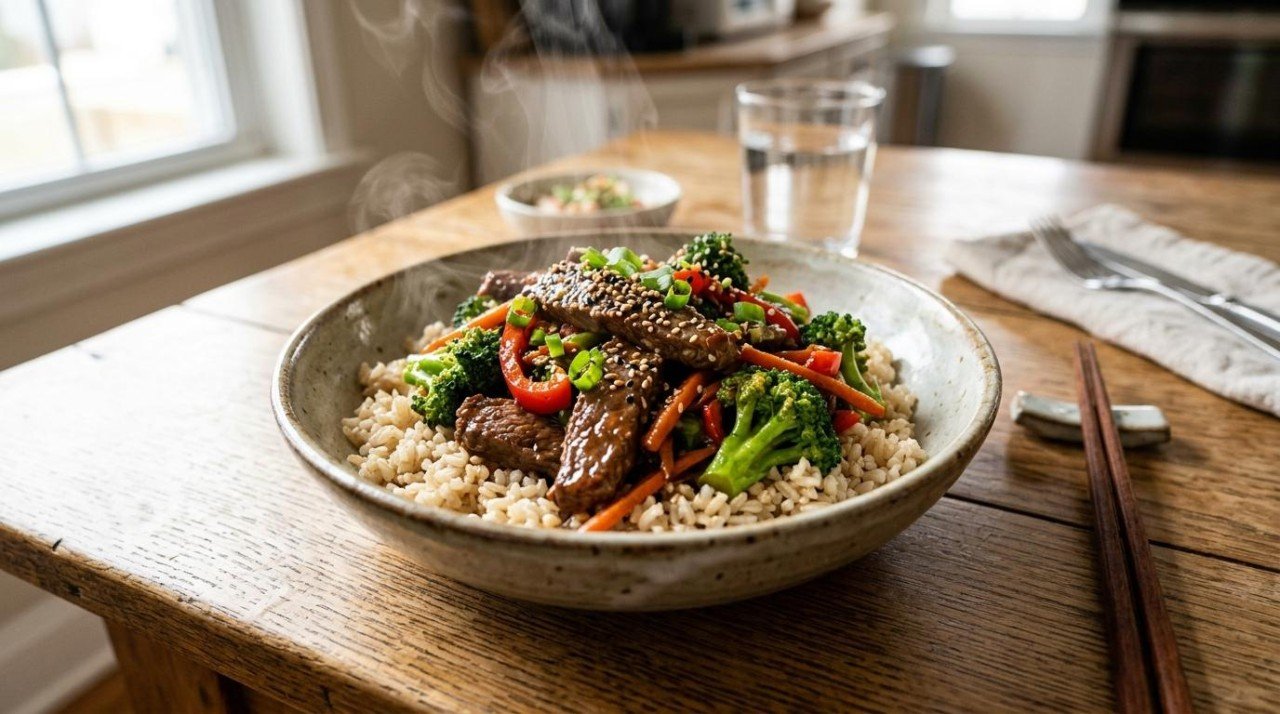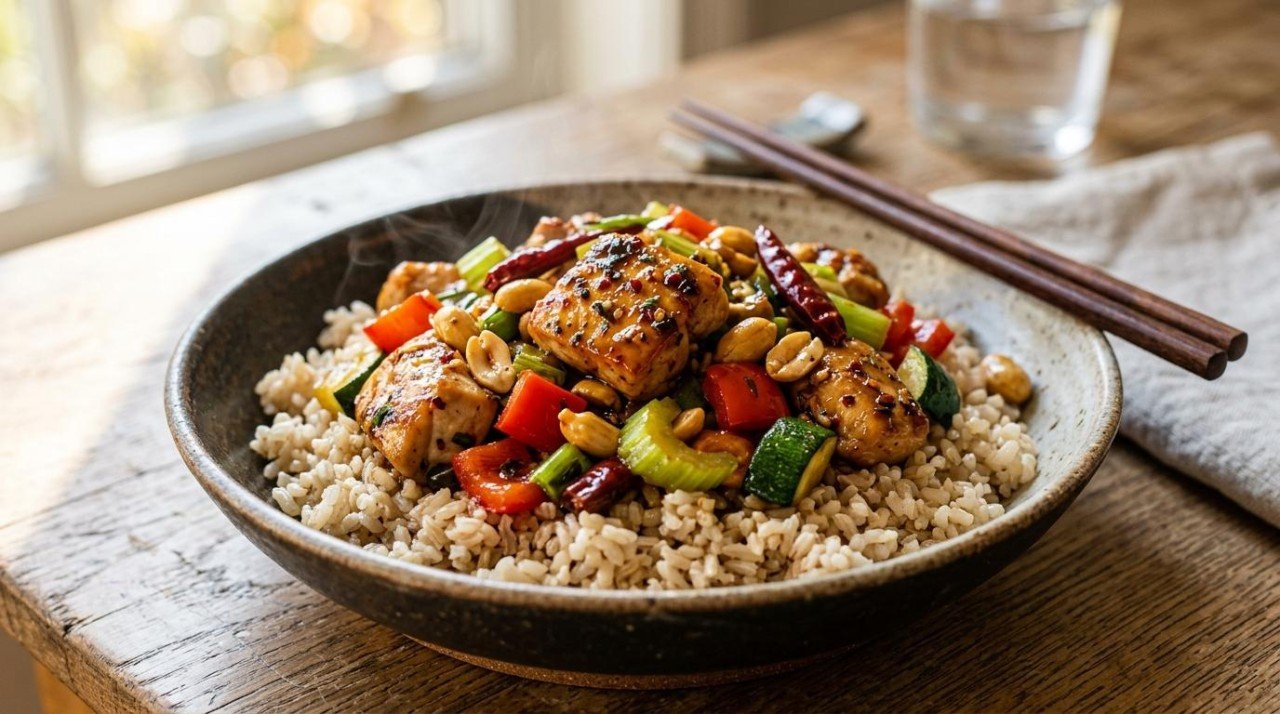
Kung pao chicken is one of the few takeout dishes that is genuinely good cooking. The real one comes from Sichuan and is widely credited to the kitchen of Ding Baozhen, a Qing dynasty governor whose court title, Gongbao, gave the dish its name. Cubes of chicken, whole dried chilies bloomed in hot oil, peanuts, and a sauce that lands sweet, sour, and savory in the same bite. The American takeout version keeps the shape of that and turns up the sugar.
So we built the standard takeout-style version — deep-fried cornstarch-coated chicken, a quarter cup of soy sauce, hoisin, three tablespoons of sugar, a token stalk of celery, and a cup of white rice per person — and ran it through Eat Well Planner's Nutrition Score, the same number that shows on any public recipe page. It came back 51 out of 100.
We got it to 76. All the peanuts stayed. All the chilies stayed. The sesame oil stayed. And the swap everyone assumes is the whole story — skipping the deep fryer — turned out to be worth negative one point when we tested it on its own. The vegetables were worth ten. Here is every change with the real number it earned.
The original: what's in it and how it scores
Here is the version we scored, for four people:
- 1 1/2 lb boneless skinless chicken breast, cubed, tossed in 3 tablespoons cornstarch and an egg white, then deep-fried (about 5 tablespoons of oil ends up in the dish)
- 1/4 cup soy sauce, 2 tablespoons hoisin sauce, 3 tablespoons white sugar, 2 tablespoons rice vinegar, 1 tablespoon toasted sesame oil
- 10 to 12 dried red chilies, 4 cloves garlic, a 1-inch piece of ginger, 6 scallions
- 1 stalk of celery — about 2 oz, the only vegetable in the pan
- 1/2 cup unsalted peanuts
- 4 cups cooked white rice
Nutrition Score: 51/100. Now the diagnosis, because understanding why a dish scores the way it does is the part that transfers to your own cooking. Three things hold it down:
- Sodium, flagged "very high." 1,560 mg per serving — 68% of a day's Daily Value in one plate. The FDA puts the limit at 2,300 mg a day, notes Americans average about 3,400 mg, and points out that over 70% of it comes from packaged and prepared food rather than the salt shaker. This dish is a small, delicious demonstration of that statistic.
- Added sugar. 9.7 g per serving, 37% of the Daily Value. The 2025-2030 Dietary Guidelines tightened this considerably: rather than a daily percentage, they now advise that no single meal should contain more than 10 grams of added sugars. Takeout kung pao sits right on that ceiling, and most restaurant versions are sweeter than ours.
- The vegetables are a garnish. One stalk of celery and some scallions against a pound and a half of chicken and four cups of rice gives 4.1 g of fiber per serving and 3.75 plant points against a weekly target of 30.
Now notice what is not a problem here, because manufacturing one would be dishonest. Protein is excellent: 51 g per serving, 63% of a day's value. Saturated fat is 5.1 g, flagged only mildly. The dish is an outstanding source of niacin (182% DV) and vitamin B6 (111% DV), it carries 48% of a day's iron, and the peanuts are doing real nutritional work. This is a sodium-and-vegetables problem wearing a deep-fryer costume.
The upgrades
Four changes, applied in this order, each one scored on top of the last. If you only make one, make the first — and it is not the one you would guess.
1. Multiply the vegetables by five
- Swap: 1 stalk of celery → 3 stalks of celery, 1 large red bell pepper, and 1 medium zucchini (about 1 1/4 lb of vegetables total)
- Score impact: +10 points (51 → 61)
- What it changes: Fiber goes from 4.1 g to 5.4 g per serving, potassium from 980 mg to 1,260 mg, plant points from 3.75 to 5.75 — and vitamin C jumps from 10 mg to 80 mg, from nothing to 94% of a day's value
- What it costs you: Ten minutes of knife work, and you have to cook in stages or the pan steams
This is the largest single mover in the entire makeover, it costs nothing in flavor, and almost nobody does it. Restaurant kung pao treats celery as texture and color; there is no rule in the dish saying the vegetables have to stay a garnish. Bell pepper belongs there anyway — it is sweet, it holds its crunch, and it is where essentially all of that vitamin C comes from. Zucchini is not traditional, and we are not pretending otherwise: it is in there because it drinks up sauce and adds volume for almost no calories. Snow peas or broccoli would do a similar job, though the numbers above are the ones we actually scored, with zucchini.
The technique cost is real. A pound and a quarter of vegetables plus a pound and a half of chicken will not stir-fry in one pan load — crowd it and everything releases water and simmers instead of searing. Cook the vegetables first, pull them onto a plate, sear the chicken, then bring everything back together at the end with the sauce.
2. Rebuild the sauce instead of shrinking it
- Swap: 1/4 cup soy sauce, 2 tablespoons hoisin, 3 tablespoons sugar → 3 tablespoons low-sodium soy sauce, 1 tablespoon hoisin, 1 tablespoon sugar, with the 2 tablespoons of rice vinegar kept in full
- Score impact: +8 points (61 → 69)
- What it changes: Sodium falls from 1,580 mg to 1,050 mg per serving, and added sugar drops from 9.7 g to 3.3 g — the added-sugar caution disappears from the report entirely
- What it costs you: The sticky, candied glaze. It tastes more like Sichuan kung pao and less like a food court, which we think is an upgrade, but it is a real change
The mistake is to simply use less soy sauce. That cuts sodium and also cuts the color, the savoriness, and the volume of liquid the sauce needs to coat everything. Low-sodium soy sauce keeps the liquid and drops roughly 40% of the salt with it; our soy sauce guide covers the ratios if you are working from a different bottle. Halve the hoisin rather than dropping it — one tablespoon still gives the sauce its body and dark gloss, and hoisin is where a surprising amount of the original's sugar hides.
The sugar is the interesting one. Kung pao sauce is built on a sweet-sour axis, so the instinct is that cutting sugar by two-thirds will wreck it. It does not, as long as you leave the vinegar alone. Two tablespoons of rice vinegar against one tablespoon of sugar reads as balanced and bright; two tablespoons against three reads as syrup. Keeping the acid is what makes the sugar cut survivable — the same trick our white sugar guide leans on.
3. Brown rice, cooked in plain water
- Swap: 4 cups cooked white rice → 4 cups cooked brown rice, no salt in the pot
- Score impact: +2 points (69 → 71)
- What it changes: Fiber goes from 5.2 g to 6.3 g per serving, magnesium from 130 mg to 180 mg, plant points to 6.75 — and sodium drops another 450 mg, though see the honest note below
- What it costs you: Chew, and about 25 extra minutes of cooking. Brown rice is nuttier and firmer, and some people simply prefer white rice under a saucy stir-fry
Two points is a smaller return than most people expect from the swap they have been told is important, and that is worth knowing before you change your whole rice habit. It is still worth making: in Harvard's cohort data, people eating the most white rice had a 17% higher risk of type 2 diabetes, those eating brown rice twice a week or more had 11% lower risk, and researchers estimated that swapping whole grains in place of even some white rice could lower diabetes risk by 36%. Our white rice guide covers the other grains that work here.
Now the honest note, because a 450 mg sodium drop from switching grains should make you suspicious. It is not the grain. The white rice in our scoring is rice cooked with salt in the water, the way a lot of home cooks make it; the brown rice is cooked plain. That is where the sodium went. It is genuinely useful information — salting the rice pot is an easy few hundred milligrams nobody counts — but if you salt your brown rice the same way, add roughly 450 mg per serving back onto every sodium number below.
4. Sear the chicken instead of deep-frying it
- Swap: 3 tablespoons cornstarch, 1 egg white, and deep-frying in about 5 tablespoons of oil → 1 1/2 tablespoons cornstarch, no egg white, and searing in 2 tablespoons of oil
- Score impact: +5 points (71 → 76)
- What it changes: Calories fall from 900 to 795 per serving, total fat from 35.7 g to 25.7 g, saturated fat from 5.4 g to 4.1 g — and the saturated fat caution clears, leaving sodium as the only flag on the report
- What it costs you: The shattering crust. You get a thin, tender coating instead, which is what the dish traditionally has anyway
Here is the finding that surprised us most. We also tested this swap first, on the untouched original, and it scored minus one point — 51 down to 50. Cutting 100 calories and 10 grams of fat moved the score backwards, because the score rewards nutrient density, and on a plate already dominated by sodium and sugar, pulling out that oil also pulled vitamin E from 35% of a day's value down to 22% and omega-3 ALA from 78% to 33%, without touching either of the actual problems. Only after the vegetables, the sauce, and the grain were fixed did dropping the fryer become worth five points.
That is the general lesson of this whole post: the deep fryer is the most visible thing about takeout and one of the least important things about its nutrition. Fix the sodium, the sugar, and the vegetables first.
Technique-wise you lose nothing. The Woks of Life recommends searing the chicken in a hot wok rather than deep-frying it — easier, and it brings out more chicken flavor — and is blunt that the egg white step is unnecessary and not worth the trouble. A cornstarch-and-water coating, 15 minutes of rest, and a genuinely hot pan gets you tender cubes with a light crust that melts into the sauce and helps it cling.
Take the Guesswork Out of Eating Well
Eat Well Planner helps you organize your favorite recipes, plan balanced meals, and automatically generate shopping lists — all in one place. Whether you're tracking macros, managing dietary restrictions, or just trying to stop asking "what's for dinner?", we've got you covered.
Our AI-powered tools can adapt any recipe to your dietary needs, help you discover new meals you'll love, and even log your nutrition effortlessly. It's meal planning made simple.
Start Organizing Your Meals — FreeWhat we kept (on purpose)
All the peanuts. The obvious calorie target in kung pao is the half cup of peanuts, and it is the wrong one. We tested removing them: the score dropped from 76 to 74, fiber fell from 6.3 g to 4.7 g, and protein fell by 5 g. Peanuts are technically a legume but behave nutritionally like nuts, and in Harvard's analysis of more than 210,000 people followed for up to 32 years, eating an ounce of nuts five or more times a week was associated with a 14% lower risk of cardiovascular disease — with peanuts showing the same benefit as tree nuts. They stay.
All the chilies, the sesame oil, and one tablespoon of sugar. The whole dried chilies bloomed in oil are the dish. The tablespoon of toasted sesame oil is 14 grams of fat across the entire recipe and carries most of the aroma. And the last tablespoon of sugar is load-bearing: kung pao with no sweetness at all is just a spicy chicken stir-fry.
The white-meat chicken, and the rice itself. We tested chicken thighs — the score fell a point and the saturated fat caution came back at 27% of a day's value. And we stopped short of taking the rice away entirely, which is where the next section starts.
The healthier version: full recipe
Nutrition Score: 76/100. Per serving it now delivers 50 g of protein (63% DV), 94% of a day's vitamin C, 45% of magnesium, 21% of fiber, and 193% of niacin, with sodium at 25% DV as the only remaining caution.
Serves 4.
- 1 1/2 lb boneless skinless chicken breast, cut into 3/4-inch cubes
- 1 1/2 tablespoons cornstarch, divided
- 3 tablespoons water, divided
- 3 tablespoons low-sodium soy sauce
- 2 tablespoons rice vinegar
- 1 tablespoon hoisin sauce
- 1 tablespoon sugar
- 2 tablespoons peanut or vegetable oil
- 1 large red bell pepper, cut into 3/4-inch pieces (about 7 oz)
- 1 medium zucchini, halved lengthwise and sliced (about 7 oz)
- 3 stalks celery, sliced on the diagonal (about 5 oz)
- 10 to 12 whole dried red chilies
- 1 teaspoon Sichuan peppercorns, toasted and lightly crushed (optional)
- 4 cloves garlic, minced
- 1-inch piece fresh ginger, minced
- 6 scallions, white and green parts separated, cut into 1-inch pieces
- 1/2 cup unsalted roasted peanuts
- 1 tablespoon toasted sesame oil
- 4 cups cooked brown rice, cooked in unsalted water
- Toss the chicken cubes with 1 tablespoon of the cornstarch and 1 tablespoon of the water until every piece is evenly coated and slightly tacky. Let it sit 15 minutes while you prep everything else.
- Whisk the sauce: low-sodium soy sauce, rice vinegar, hoisin, sugar, the remaining 1/2 tablespoon cornstarch, and the remaining 2 tablespoons water. Set it next to the stove.
- Heat 1 tablespoon of the oil in a wok or large skillet over high heat until it shimmers. Add the bell pepper, zucchini, and celery and stir-fry 2 to 3 minutes, until just crisp-tender. Transfer to a plate.
- Add the remaining tablespoon of oil. Spread the chicken in a single layer and leave it undisturbed for 90 seconds to sear, then stir-fry 2 to 3 minutes more until just cooked through. Work in two batches if the pan looks crowded. Move it to the plate with the vegetables.
- Turn the heat to medium. Add the dried chilies and the Sichuan peppercorns, if using, and stir 20 to 30 seconds, until the chilies darken a shade and smell toasty. Do not let them blacken.
- Add the garlic, ginger, and the white parts of the scallions and stir 30 seconds more, until fragrant.
- Return the chicken and vegetables to the pan. Stir the sauce to recombine, pour it in, and toss about 1 minute, until it thickens and coats everything.
- Off the heat, stir in the peanuts, the sesame oil, and the green parts of the scallions. Serve over the brown rice.
Per serving, original versus improved:
- Nutrition Score: 51 → 76
- Calories: 919 → 795
- Protein: 51.1 g → 50.5 g
- Fiber: 4.1 g → 6.3 g
- Added sugar: 9.7 g → 3.3 g
- Total fat: 34.1 g → 25.7 g
- Saturated fat: 5.1 g → 4.1 g
- Sodium: 1,560 mg → 590 mg
- Plant points: 3.75 → 6.75
Swaps we tested and skipped
- Cauliflower rice instead of brown rice: 88 points. This scored twelve points higher than our final recipe — the biggest single number we saw all day, with calories down to 611 and fiber up to 8.1 g. We left it out because it stops being the meal people order. Kung pao over rice is a plate of takeout; kung pao over cauliflower is a low-carb dinner, which is a perfectly good thing to want but a different thing to want. If you do want it, that is the change and that is what it is worth.
- Shrinking the rice portion by a third: +1 point. Cutting each serving from a cup of cooked rice to about three-quarters of a cup saved 70 calories and moved the score a single point. Adding vegetables was worth ten. In this scoring model, adding beats subtracting almost every time.
- One more notch off the soy sauce: 0 points. Going from 3 tablespoons of low-sodium soy down to 2, with extra vinegar to compensate, cut another 110 mg of sodium per serving and moved the score not at all — and it tasted noticeably flat. We stopped at 3.
- Dropping the peanuts: minus 2 points. Covered above, but worth repeating, because it is the change most people would make first.
Make it fit other diets
Two swaps cover most of what people ask about this dish. For gluten-free, use tamari in place of the low-sodium soy sauce and check the hoisin, which almost always contains wheat — several brands make a gluten-free version. For vegan or vegetarian, press a block of extra-firm tofu, cube it, coat it in the same cornstarch, and sear it hard before the sauce goes in; the chilies, peanuts, and sauce carry the dish without the chicken. If peanuts are off the table, cashews are the standard substitute and behave the same way in the pan.
In the app, any of these is one request: open the recipe, ask for a gluten-free or vegan version, and Recipe Variations rewrites the whole thing with the substitutions already worked in.
Do this to your own recipes
Every number in this post came out of the same three tools any Eat Well Planner account has. Import a recipe from a URL, a photo, or an Instagram reel and it gets a Nutrition Score along with the specific things dragging it down. Make It Healthier proposes swaps and runs each one through a calculator before showing it to you, so you never see a suggestion that does not actually improve the numbers. And the Recipe Playground lets you test your own ideas one at a time and watch the score move — which is exactly how we found out that skipping the deep fryer was worth nothing until everything else had been fixed.
That is the part worth taking with you. The visible, guilt-shaped ingredient is rarely the one holding your dinner back. Score it, and the real answer is usually more vegetables.