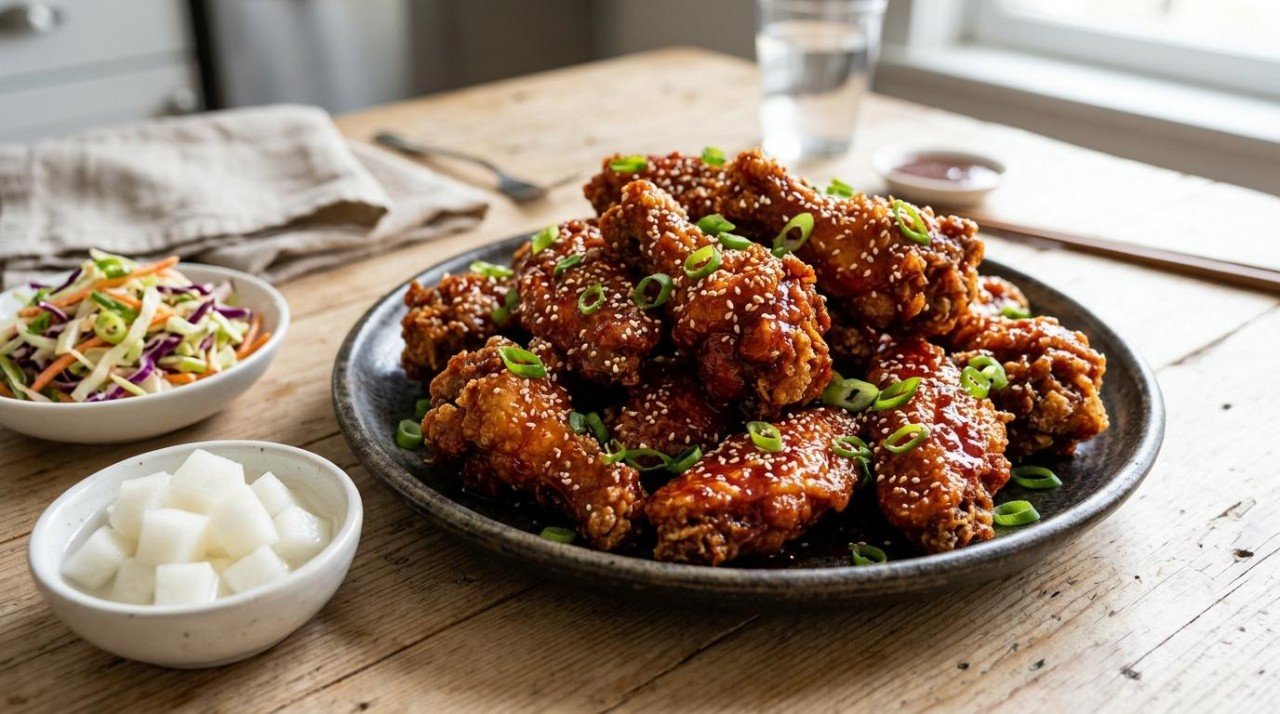
Korean fried chicken is one of the great engineering achievements of the fried food world. A thin starch coating, fried twice, produces a crust that shatters instead of crunching and stays crisp under a wet sauce — something American fried chicken has never quite managed. The most famous version, yangnyeom chicken, is coated in a glossy red gochujang glaze that is sweet, spicy, garlicky, and completely addictive.
We built a standard restaurant-style version in Eat Well Planner — 2 pounds of wings, a potato starch dredge, double-fried, tossed in a gochujang and corn syrup glaze — and scored it. It came back at 36 out of 100. The number we did not expect was the added sugar: 30 grams per serving, which is 114% of a day's worth. One plate of wings.
So we rebuilt it, one swap at a time, scoring each change in the app's Recipe Playground before keeping it. The finished version scores 67 — a 31-point move — and it still has the skin, the shatter, and a glaze you would recognize with your eyes closed. The frying, for what it is worth, turned out to be the least of its problems.
The original: what is in it and how it scores
Fried chicken arrived in South Korea after the Korean War, and the first dedicated fried chicken restaurant, Lim's Chicken, opened in 1977. The sauced version came a few years later: yangnyeom chicken was created in 1982 by Yoon Jonggye at his Daegu restaurant, after he noticed the crust was so hard it was scraping his customers' palates. Coating it in sauce softened it. The idea spread through the Pelicana chain and never left.
The version we scored is the standard one, for four servings:
- 2 lb (900 g) chicken wings, dredged in 2/3 cup potato starch, 1/4 cup all-purpose flour, 1 egg, and 1 teaspoon salt
- Double-fried in neutral oil — about 1/4 cup (55 g) of it stays in the food
- Glaze: 1/3 cup gochujang, 1/4 cup ketchup, 1/4 cup corn syrup, 2 tablespoons brown sugar, 2 tablespoons soy sauce, 1 tablespoon rice vinegar, 4 cloves garlic, 2 teaspoons toasted sesame oil
- Sesame seeds on top
Nutrition Score: 36/100. Per serving: 820 calories, 48 g protein, 43 g total fat, 9.2 g saturated fat, 1,980 mg sodium, 30 g added sugar, 3.0 g fiber.
Three things drag it down, and they are not the ones people usually name.
The glaze is a sugar delivery system. Between the corn syrup, the brown sugar, the ketchup, and the sugar already in gochujang, one serving carries 30 g of added sugar. The American Heart Association caps added sugar at 25 g a day for women and 36 g for men — so a single plate of wings is a woman's entire daily allowance plus 20%. This is the loudest flag on the whole recipe.
Sodium is at 1,980 mg per serving, 86% of the 2,300 mg daily limit, from the salt in the dredge, the soy sauce, and gochujang, which is a salted fermented paste before it is anything else. The AHA notes that cutting back by 1,000 mg a day improves blood pressure for most people, and this dish alone is most of a day.
There is nothing green on the plate. Fiber comes in at 3.0 g against a 25 to 35 g target, and the app flags Low Plant Diversity — the whole dish scores 1.25 plant points, essentially just garlic and sesame.
What is already fine deserves saying, because it is a lot. Chicken wings are genuinely nutrient-dense meat: this scores as an excellent source of niacin (95% DV), vitamin B6 (84%), iron (71%), and protein (60% DV, 48 g a serving). Saturated fat at 9.2 g is flagged, but at 39% DV it is the mildest of the three cautions — this is not a saturated fat problem the way a cheese dish is. And the frying oil, unglamorous as it sounds, is where a quarter of the day's vitamin E is coming from.
The upgrades
Five swaps, applied in this order, each scored on top of the last. Order matters more than usual here, and we will show you exactly where.
1. Put the banchan back on the table
- Swap: A plate of wings alone → wings plus pickled daikon, smashed cucumber, a cabbage-and-carrot slaw, and scallions
- Score impact: +13 points (36 → 49)
- What it changes: Doubles the fiber (3.0 → 6.3 g), takes plant points from 1.25 to 6.25, clears the Low Plant Diversity flag
- What it costs you: Twenty minutes of knife work and 46 calories. Nothing on the plate changes.
This is not us inventing a vegetable requirement. Korean fried chicken is supposed to come with pickled radish — chicken-mu is standard alongside the beer, because the cold, sour, crunchy cubes cut the fat and reset your palate between bites. Restaurant portioning quietly shrank it to a garnish. We put it back at real portion size and added a cabbage slaw and smashed cucumbers, which is what the table would look like in Seoul anyway.
Thirteen points for adding food is the largest single move in this makeover, and it costs the dish nothing, which is why it goes first. If you make exactly one change from this post, make this one. The variety matters as much as the volume: five different plants in one meal is a real dent in the 30-plants-a-week target that gut microbiome research keeps pointing at.
2. Rebuild the glaze around vinegar instead of syrup
- Swap: 1/4 cup corn syrup + 2 tablespoons brown sugar → 1 tablespoon honey; ketchup halved; rice vinegar doubled; garlic increased and fresh ginger added
- Score impact: +8 points (49 → 57)
- What it changes: Added sugar drops from 30 g to 10.4 g per serving (114% of a day's limit down to 39%), and 69 calories go with it
- What it costs you: Real sweetness. The first bite tastes noticeably less candied — and then you stop noticing.
The original glaze uses three sweeteners stacked on each other. Cut them to one tablespoon of honey and the glaze collapses flat, so you have to rebuild the flavor from the other direction: double the rice vinegar, push the garlic from four cloves to six, and add a tablespoon of grated ginger. Acid and aromatics do the work sugar was doing, and what you get back is a glaze that tastes more of gochujang and less of syrup.
The gloss is a technique question, not a sugar question. Simmer the glaze for a minute until it coats a spoon, then paint it on thin with a brush rather than tossing the wings in a bowl — which is how Korean restaurants do it anyway, to keep the crust from going soft. Less sauce, better adhesion, same shine.
3. Cut the sodium three ways at once
- Swap: Regular → low-sodium soy sauce; 1 teaspoon salt in the dredge → a scant 1/2 teaspoon; gochujang from 1/3 cup → 1/4 cup
- Score impact: +10 points (57 → 67)
- What it changes: Sodium falls from 1,930 mg to 1,250 mg per serving (84% of the daily limit down to 54%)
- What it costs you: A little heat, from the smaller pour of gochujang. Gochugaru puts it back without the salt.
Here is the finding that surprised us most. We also tested this exact swap on its own, applied straight to the original recipe before anything else — and it was worth zero points. The score did not move at all. The same three changes, made after the sugar came out, were worth ten.
That is not a glitch, it is how the scoring works: while added sugar was sitting at 114% of a day, it was the binding constraint, and improving something else underneath it changed nothing visible. Fix the loudest problem and the next one starts paying. It is also a useful thing to know about your own cooking — buying low-sodium soy sauce and then leaving everything else alone often buys you less than you think.
4. Whole wheat flour in the dredge
- Swap: 1/4 cup all-purpose flour → 1/4 cup whole wheat flour (the potato starch stays exactly as it is)
- Score impact: +2 points (67 → 69)
- What it changes: Fiber 6.1 → 6.7 g, plus another plant point
- What it costs you: Nothing detectable. It is a quarter cup against two-thirds of a cup of starch.
The important half of this swap is what we did not touch. Potato starch is what makes the crust shatter: it blocks gluten from forming, holds far less moisture than wheat flour does, and sets into a porous, brittle network instead of a chewy one. Swap the starch for whole wheat and you do not get healthier Korean fried chicken, you get a soggy cutlet. The small flour component is the only part of the dredge that can carry a whole grain without consequence, so that is the part we changed.
5. Air fryer or oven instead of the double fry — and it costs 2 points
- Swap: Double deep-frying (about 1/4 cup absorbed oil) → 1 tablespoon of oil, air-fried or oven-roasted on a rack
- Score impact: Minus 2 points (69 → 67)
- What it changes: 92 fewer calories and 10 g less total fat per serving — but vitamin E drops from 25% to 12% DV
- What it costs you: The crust is honestly thinner and less shattering. This is the one real trade in the post.
Everyone assumes the fryer is the villain of Korean fried chicken. The score says otherwise: skipping it made the number worse. Pouring off 41 grams of oil also pours off the vitamin E and unsaturated fat that oil was carrying, while the things actually holding the dish back — sodium, sugar — do not budge. We got the same result in our sweet and sour chicken makeover, where air-frying was worth exactly nothing, and in the Buffalo wings rebuild, where baking cost a point.
We kept it anyway, and here is the honest reasoning: 92 calories and 10 grams of fat a serving is a real change to the meal even when the score shrugs, and most people are not going to keep a quart of frying oil going on a Tuesday. To get as close to the double fry as you can, dry the wings thoroughly, dredge them, mist them properly with oil, cook at a moderate temperature first to render the skin, then finish hot — the same two-stage logic as double frying, run in an air fryer.
What we kept (on purpose)
The skin stays. The wings stay. We tested boneless skinless thighs, and the score barely moved while the dish stopped being Korean fried chicken. Real gochujang stays — a quarter cup of it, not a token spoonful, because the fermented chili paste is the entire identity of the glaze. The potato starch stays. The toasted sesame oil stays, all two teaspoons, because it is doing aromatic work no substitute does.
We stopped at 67. The dish still carries three cautions — sodium at 54% of a day, added sugar at 35%, saturated fat at 34% — and every remaining lever we found starts removing things that make this dish itself. Dropping the honey entirely scores 69. Taking off the skin scores 66 and costs 4 grams of protein. At some point you are no longer making Korean fried chicken healthier, you are making something else.
Take the Guesswork Out of Eating Well
Eat Well Planner helps you organize your favorite recipes, plan balanced meals, and automatically generate shopping lists — all in one place. Whether you're tracking macros, managing dietary restrictions, or just trying to stop asking "what's for dinner?", we've got you covered.
Our AI-powered tools can adapt any recipe to your dietary needs, help you discover new meals you'll love, and even log your nutrition effortlessly. It's meal planning made simple.
Start Organizing Your Meals — FreeThe healthier version: full recipe
Nutrition Score: 67/100. Serves 4.
For the chicken
- 2 lb (900 g) chicken wings, split into drumettes and flats, patted very dry
- 2/3 cup (100 g) potato starch (cornstarch works, slightly less crisp)
- 1/4 cup (30 g) whole wheat flour
- 1 large egg, beaten
- 1/2 teaspoon kosher salt (about 2 g)
- 1/2 teaspoon black pepper
- 1 tablespoon (14 g) neutral oil, for misting or brushing
For the glaze
- 1/4 cup (75 g) gochujang
- 2 tablespoons low-sodium soy sauce
- 2 tablespoons rice vinegar
- 1 tablespoon honey
- 2 tablespoons ketchup
- 6 cloves garlic (25 g), minced
- 1 tablespoon (12 g) fresh ginger, grated
- 2 teaspoons toasted sesame oil
- 2 teaspoons sesame seeds, plus more to finish
- Gochugaru, to taste, for heat without extra salt
For the table (do not skip this part)
- 7 oz (200 g) daikon radish, cut into 1/2-inch cubes
- 1 medium cucumber (200 g), smashed and torn
- 3 cups (200 g) green cabbage, shredded
- 1 large carrot (100 g), julienned
- 4 scallions (40 g), sliced on the bias
- Rice vinegar, a pinch of sugar, and salt for the quick pickle and the slaw dressing
Instructions
- Make the pickled radish first so it has time to sit: toss the daikon cubes with 3 tablespoons rice vinegar, 2 teaspoons sugar, and 1/4 teaspoon salt. Refrigerate at least 30 minutes, and up to a week.
- Smash the cucumber with the flat of a knife, tear it into rough pieces, and toss with a splash of rice vinegar and a pinch of salt. Toss the shredded cabbage and carrot with rice vinegar, a little sesame oil, and salt. Refrigerate both.
- Pat the wings completely dry — this matters more than any other step. Toss them with the salt and pepper, then the beaten egg, then the potato starch and whole wheat flour until every piece has a thin, even, chalky coat. Shake off the excess.
- Arrange the wings skin side up and not touching on a wire rack set over a rimmed baking sheet, or in an air fryer basket in a single layer. Mist thoroughly with oil.
- Cook in two stages, the way double frying works. Air fryer: 320F for 12 minutes, then 400F for 10 to 14 minutes, turning once. Oven: 300F for 20 minutes, then 450F for 20 to 25 minutes, turning once. They are done at deep golden and audibly crisp.
- While they cook, make the glaze: warm the sesame oil in a small saucepan over medium-low heat, add the garlic and ginger, and stir for 30 seconds until fragrant. Add the gochujang, soy sauce, rice vinegar, honey, ketchup, and gochugaru. Simmer 1 to 2 minutes, stirring, until it coats a spoon. Take it off the heat.
- Brush the glaze onto the hot wings in a thin layer rather than tossing them in a bowl — you use less sauce and the crust stays crisp longer.
- Scatter with sesame seeds and scallions. Serve immediately, with the pickled radish, cucumbers, and slaw on the table.
Per serving, original vs. improved
- Nutrition Score: 36 → 67
- Calories: 820 → 691
- Protein: 48 g → 50 g
- Total fat: 43 g → 33 g
- Saturated fat: 9.2 g (39% DV) → 7.9 g (34% DV)
- Sodium: 1,980 mg (86% of the daily limit) → 1,250 mg (54%)
- Added sugar: 30.0 g (114% of a day) → 9.3 g (35%)
- Fiber: 3.0 g → 6.7 g
- Vitamin C: essentially none → 46% DV
- Vitamin A: essentially none → 35% DV
- Plant points: 1.25 → 7.5
The finished dish reads as an excellent source of vitamin B6 (99% DV), niacin (96%), iron (73%), protein (62%), vitamin K (61%), vitamin C (46%), potassium (40%), and fiber (23%).
Swaps we tested and skipped
- Boneless skinless thighs instead of wings — scored 66, one point lower. Saturated fat halves, which sounds great, but protein falls from 50 g to 46 g and you lose the skin, which is the entire structural point of the dish. Skinless Korean fried chicken is a different, perfectly nice recipe. It is not this one.
- Cauliflower instead of chicken — scored 55, twelve points lower. Fiber nearly doubles, but protein collapses from 50 g to 12 g and the score punishes it hard. Worth cooking if you want cauliflower. Not a substitute.
- Serving it over white rice — scored 66, one point lower, and added 200 calories. The interesting part is how little the score cared. If rice is how you eat this, eat it with rice; just know the calories moved and the score did not.
- Dropping the honey entirely — scored 69, two points higher. This one we are flagging rather than rejecting. Zero added sweetener takes added sugar down to 5 g a serving, but the glaze loses its gloss and its balance against the vinegar and the chili. Two points is a fair price for a glaze that still tastes like yangnyeom sauce. If you would rather have the two points, take them.
Make it fit other diets
- Gluten-free: use tamari or a certified gluten-free soy sauce, replace the 1/4 cup whole wheat flour with more potato starch, and check your gochujang — most commercial brands contain wheat, though gluten-free versions are widely sold.
- Dairy-free: already is.
- Vegetarian or vegan: pressed extra-firm tofu or cauliflower in the same dredge, with maple syrup in place of the honey. Expect the protein to drop sharply, and lean harder on the slaw and pickles.
If you want any of these written out properly, Eat Well Planner's Recipe Variations will rewrite this exact recipe for a diet in one step, and the AI recipe chat will talk through substitutions with the full ingredient list in context rather than in the abstract.
Do this to any recipe you love
Nothing in this post was guesswork. Every score came out of Eat Well Planner's Nutrition Score, and every delta came from applying one change at a time in the Recipe Playground and watching the number move — including the three changes that moved it the wrong way.
You can run the same process on whatever you were already planning to cook this week. Import a recipe from a website, an Instagram reel, or a YouTube video, and the app extracts the ingredients and scores it. Then Make It Healthier proposes swaps, with a calculator verifying the actual nutritional gain before a suggestion is ever shown to you — so you find out which change is worth thirteen points and which one is worth nothing, before you cook it rather than after.
The dish you love does not have to become a different dish. It usually just needs the right three changes, in the right order.