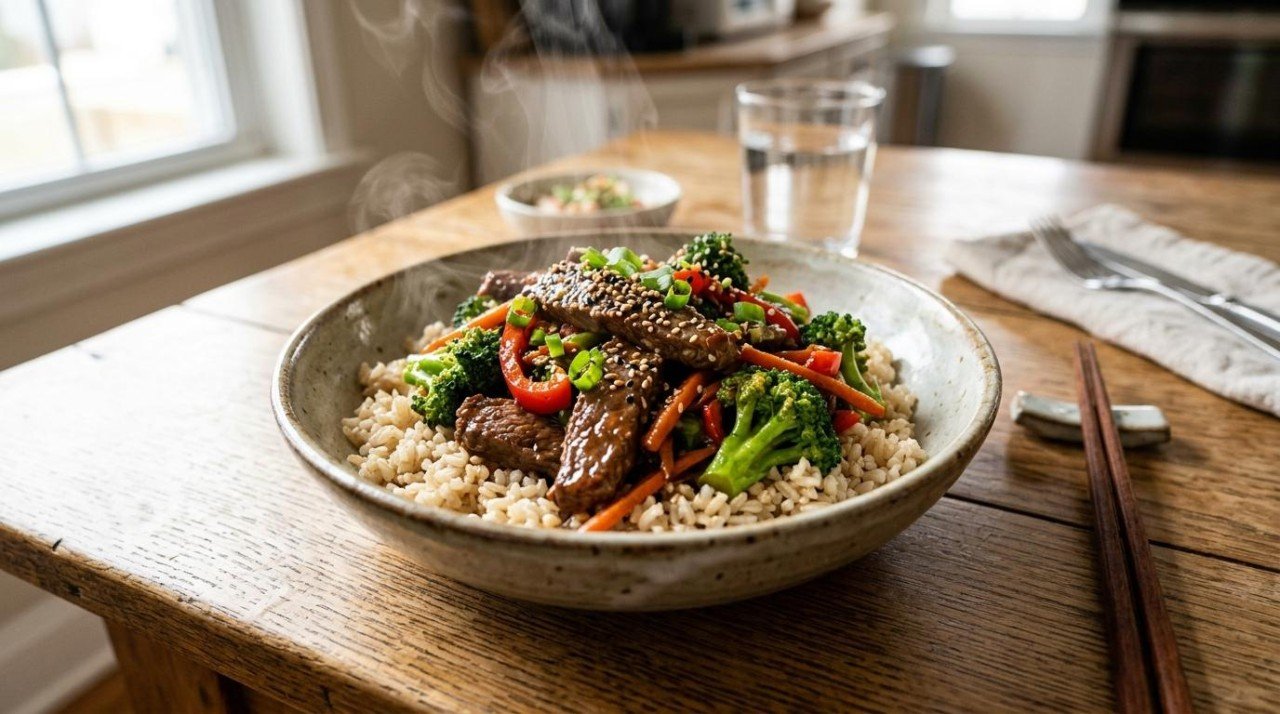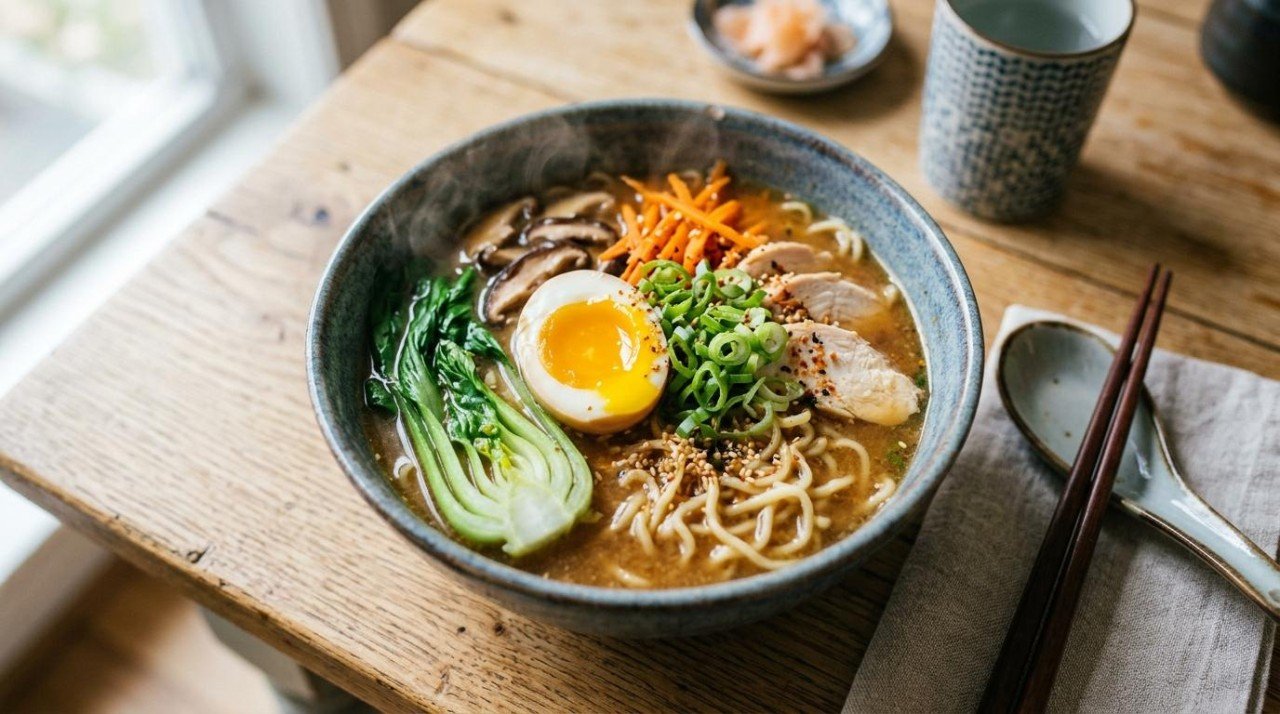
Instant ramen earns its love honestly. It is 40 cents, it is ready in five minutes, and at 11 p.m. after a long day it is exactly, precisely what you want. It got a lot of us through college, and plenty of us still keep a stack in the cupboard for the nights when cooking is not happening. Nobody needs to be talked out of loving it.
But we were curious what the packet actually scores, so we built a standard bowl - the fried noodle block plus the little seasoning packet - in Eat Well Planner and ran it through the app's Nutrition Score. It came back at 25 out of 100, tied with orange chicken for the lowest we have put through this series.
So we rebuilt it, one verified swap at a time, and got the same five-minute bowl to 61 - a 36-point jump - without giving up the noodles or the speed. The surprising part is which change did almost all the work, because it is the one swap nearly everyone skips. Here is every move, exactly what it was worth, and the one ceiling we could not break without leaving instant ramen behind.
The packet: what's in it and how it scores
The version we scored is the one in your cupboard: a roughly 3-ounce package - a deep-fried noodle block plus a foil seasoning packet that is mostly salt - prepared with hot water and eaten as one bowl.
Nutrition Score: 25/100. Per bowl, that is about 375 calories, only 8 grams of protein, about 7 grams of saturated fat, and the number that sinks it: roughly 1,640 mg of sodium. That is not us inflating it - a full package of Maruchan or Nissin Top Ramen lands between about 1,500 and 1,800 mg, and the app scored ours right in that range.
The app flagged three weaknesses, and it is worth seeing them clearly:
- Sodium, very high. One bowl is about 71% of the day's upper limit. The American Heart Association recommends no more than 2,300 mg a day, and ideally 1,500 mg - so a single packet can put you at your entire ideal target in one sitting.
- Zero plant diversity. There is not a single vegetable in the bowl. Fiber comes in at 2.8 grams.
- High saturated fat. The noodle block is deep-fried, which is where most of the 7 grams comes from.
There is a quieter problem underneath all three: 8 grams of protein and a pile of refined carbs is a snack wearing a meal's clothing. You are hungry again in an hour. This matters most when instant ramen is a habit rather than a treat - a large study of more than 10,000 adults found that eating instant noodles two or more times a week was linked to a 68% higher risk of metabolic syndrome in women. As the senior author put it, once or twice a month is not a problem; a few times a week is. The good news is that the fixes are cheap, fast, and do not require giving up the noodles.
And here is what is not the main problem: the MSG (it is the sodium that matters, not the msg, which is safe), and even the calories, which are modest. What holds instant ramen back is not what is in the bowl. It is what is missing.
The upgrades
We kept the actual noodle block the whole way through - the five-minute cupboard staple is the entire point of instant ramen, so trading it away would be a different post. Everything here still cooks in one pot in about the same time. We ordered the swaps by how much they move the score, biggest first, so if you only do one, you do the right one.
1. Load it with vegetables (the swap everyone skips)
- Swap: Noodles and salt alone → add bok choy, shiitake mushrooms, shredded carrot, spinach, and scallions
- Score impact: +33 points (25 to 58) - by far the biggest single jump in the whole rebuild
- What it changes: Takes plant diversity from zero to five, nearly triples the fiber (2.8 g to 7.4 g), and takes vitamin C from a trace to about half a day's worth
- What it costs you: Two minutes and a cutting board. Nothing on flavor - it is more food, not less.
This is the change that matters most, and it is the one almost nobody makes. A handful of vegetables tossed into the same broth closes two of the three weaknesses at once - the empty plate and the missing fiber - and it takes barely any extra time, because bok choy, thin-sliced mushrooms, and shredded carrot all cook in the two to three minutes the noodles need anyway. Frozen works perfectly here: a bag of frozen stir-fry mix or a handful of frozen spinach means there is nothing to chop. Every different plant you add also feeds a wider range of gut bacteria, which is the whole idea behind our 30-plants-a-week approach - and a loaded ramen bowl can knock out five or six of them in one go.
2. Ditch most of the packet; build real flavor with miso, garlic, and ginger
- Swap: The whole seasoning packet → about a quarter of the packet, plus 1 tablespoon white miso, garlic, and fresh ginger
- Score impact: +5 points (58 to 63)
- What it changes: Cuts sodium by roughly 370 mg per bowl (about 1,730 mg down to 1,360 mg) at this point in the build
- What it costs you: Nothing - the flavor actually gets deeper and more savory
The seasoning packet is mostly salt, and you do not need all of it once you give the broth real depth. White miso - fermented soybean paste - brings a savory, almost meaty backbone that the packet is only imitating, and it counts as a fermented food and another plant in the bowl. Garlic and ginger do the rest of the aromatic work. The score only moved five points here, but do not skip it for that reason: the sodium drop is real, and cutting roughly 1,000 mg of sodium a day measurably lowers blood pressure. Stir the miso in off the heat so you do not boil away its character. If you would rather lean on a splash of soy or tamari for the salt, our soy sauce substitutes guide covers the low-sodium options, and the fresh ginger guide has you covered if all you have is ground.
3. Add a soft egg and some shredded chicken (make it a meal)
- Swap: Noodles and vegetables → the same, plus a soft-boiled egg and shredded chicken (or tofu)
- Score impact: -2 points (63 to 61)
- What it changes: Takes protein from 14 g to 39 g - the difference between a snack and a dinner
- What it costs you: Two points of score, and here is the honest reason why
This is where we have to be straight with you: adding the egg and the chicken nudged the score down two points. Not because protein is bad - because they bring a little saturated fat with them (the egg yolk, mostly), and the fried noodle block had already pushed saturated fat into the app's caution zone, so it counts against you. But 8 grams of protein leaves you hungry in an hour; 39 grams keeps you full for the evening. That is a trade we make on purpose - two points of score for 25 extra grams of protein and actual satiety. The score is a guide, not a boss. (Prefer to keep it meatless? Firm tofu in place of the chicken scores about the same - a 63 - and brings iron and calcium instead; more on that below.)
Take the Guesswork Out of Eating Well
Eat Well Planner helps you organize your favorite recipes, plan balanced meals, and automatically generate shopping lists — all in one place. Whether you're tracking macros, managing dietary restrictions, or just trying to stop asking "what's for dinner?", we've got you covered.
Our AI-powered tools can adapt any recipe to your dietary needs, help you discover new meals you'll love, and even log your nutrition effortlessly. It's meal planning made simple.
Start Organizing Your Meals — FreeWhat we kept, and the one ceiling we didn't break
We kept the fried noodle block, on purpose. It is instant ramen - the five-minute cupboard block is the whole premise, and swapping it out would make this a different dish. We also kept a little of the seasoning packet, because that specific flavor is part of what you are craving.
But keeping the block is also what caps the bowl in the low 60s. Its saturated fat is the one weakness the app still flags at the finish, and there is exactly one lever that breaks that ceiling: swap the fried block for a non-fried noodle - soba (buckwheat), rice noodles, or one of the air-dried instant noodles. When we ran the same loaded bowl with soba instead of the fried block, it jumped from 61 to 68, the saturated-fat flag disappeared entirely, and sodium was the only weakness left. We left it out of the main recipe because at that point you have quietly left the instant packet behind - but if you keep soba in the cupboard, it is the best single upgrade past this point, and it adds fiber and another plant on top.
The healthier version: full recipe
Final Nutrition Score: 61/100. Makes one big bowl.
- 1 package instant ramen noodles (use about a quarter of the seasoning packet; save or toss the rest)
- 1 tablespoon white miso paste
- 2 cloves garlic, minced
- 1 tablespoon fresh ginger, grated
- 2 scallions, sliced
- 1 baby bok choy (about 3 oz), roughly chopped
- 4 or 5 shiitake mushrooms (about 1 1/2 oz), sliced
- 1 small carrot (about 1 1/2 oz), shredded
- 1 big handful baby spinach (about 1 1/2 oz)
- 1 large egg
- 3 oz cooked chicken breast, shredded (or 4 oz firm tofu, cubed)
- 1 teaspoon toasted sesame oil
- Optional: a splash of rice vinegar, chili crisp or sriracha, sesame seeds
- Soft-boil the egg first: lower it into boiling water for 6 to 7 minutes, then move it to an ice bath and peel. (You can do this while the rest cooks.)
- Bring about 2 cups of water to a boil. Add the garlic, ginger, shiitake, and carrot, and simmer for 2 minutes.
- Add the noodle block and about a quarter of the seasoning packet. Cook for 2 to 3 minutes, adding the bok choy and spinach for the last minute so they just wilt.
- Take the pot off the heat and stir in the miso paste - do not boil it - along with the sesame oil.
- Pour into a bowl and top with the shredded chicken (or tofu), the halved soft egg, the scallions, and chili crisp or sesame seeds if you like.
Per bowl, original vs. improved:
- Nutrition Score: 25 → 61
- Protein: about 8 g → about 39 g
- Fiber: about 2.8 g → about 8.4 g
- Sodium: about 1,640 mg → about 1,480 mg
- Vitamin C: a trace → about 54% of a day
- Vitamin A: a trace → about 84% of a day
- Plant diversity: 0 → more than 6
- Calories: about 375 → about 735
- Saturated fat: about 7 g → about 10 g
Two of those numbers went the "wrong" way, and we are not going to hide them. The calories nearly doubled and the saturated fat crept up - but that is because the original is a 375-calorie snack and the upgrade is a genuine dinner, with a full quarter of your day's vitamin A and 39 grams of protein where there used to be almost none. You are not adding empty calories; you are adding the food that was missing. The score, which measures nutritional quality, still climbed 36 points as the bowl got bigger. And if the saturated fat bothers you, that is exactly what the soba swap above erases - it drops it back to about 3 grams.
Swaps we tested and skipped
- Ditching the packet entirely. Going all-miso with no seasoning packet at all cuts more sodium, but the bowl loses the specific savory note you actually came for - it starts tasting like a plain miso-vegetable soup instead of ramen. That last quarter of the packet is what keeps it recognizable. We kept it.
- Skipping the sesame oil to save fat. That single teaspoon of toasted sesame oil is most of the "this tastes like real ramen" magic, and it is a heart-healthy fat, not the saturated kind holding the score back. Cutting it saves almost nothing and costs a lot of flavor. If anything, our sesame oil guide is for when you are out of it, not looking to remove it.
Make it fit other diets
The two most-asked versions are easy. For vegetarian or vegan, use firm tofu instead of chicken (it scored a touch higher, a 63, with more iron and calcium), skip the egg for fully vegan, and double-check the seasoning packet or go all-miso. For gluten-free, this is the one real hurdle with ramen: the wheat noodle block is not gluten-free, so swap in rice noodles or certified gluten-free soba, and use tamari or a gluten-free miso. In Eat Well Planner you can ask the AI to rewrite this exact bowl as vegan or gluten-free in one step, and it hands back a full version with the swaps already worked in.
Do this to any recipe you love
Every number in this post came out of Eat Well Planner's Make It Healthier tool, not out of thin air. Import a recipe from any website - or, since this is the internet's favorite genre, import a viral TikTok or YouTube ramen hack straight from the video - and the app scores it and tells you plainly what is actually dragging the number down. For instant ramen it was not the calories, and not even mostly the frying everyone blames; it was the empty bowl. You can test each swap in the Recipe Playground and watch the score move in real time, then save the result as a new healthier version or keep the original.
Keep the 3 a.m. bowl. Just throw a handful of vegetables and an egg into it - that one move does more for you than any "healthy ramen" hack on the internet, and it still takes five minutes. (We did the same thing to takeout orange chicken, where the real culprit also turned out to be the last thing anyone suspected.)