The instant oatmeal packet is one of the great breakfast bargains. Cheap, ninety seconds, one bowl to wash, and it tastes like maple. Whole grain oats, says the box, and that part is true. Millions of people start the day this way on purpose, and they are not wrong to.
So we built one in Eat Well Planner and ran it through the app's Nutrition Score: a single 43 g packet of maple and brown sugar instant oatmeal, made with hot water, the way it says on the back. It came back at 43 out of 100, with one caution flag. Then we rebuilt it, one verified swap at a time, and got to 90.
The interesting part is where the points came from. Not the oats, which were never the problem. Not the instant format either - we scored steel-cut and quick oats in the finished bowl and both landed on exactly the same number. Almost the whole gap traces back to 12 g of sugar and a serving that is smaller than it looks. Here is the whole thing, with receipts.
The packet: what's in it and how it scores
We scored the flavor that defines the category: Quaker Instant Oatmeal Maple and Brown Sugar, one 43 g packet made with 1/2 cup of hot water. The ingredient list is short - whole grain oats, sugar, natural flavor, salt - so we modeled it that way: about 28 g of oats, 12 g of sugar, and enough salt to account for the 260 mg of sodium on the panel. The result matched the label almost exactly (154 calories against the panel's 160, 3.0 g fiber against 3, 11.7 g added sugar against 12), which is how we know the model is honest.
Nutrition Score: 43/100. Per packet: about 154 calories, 3.8 g protein, 3.0 g fiber, 0.3 g saturated fat, 260 mg sodium, and 11.7 g of added sugar - 44% of a day's reference, flagged high. Plant points: 1.
Now the fair part. A lot of this packet is genuinely fine and we are not going to invent problems it does not have. It really is whole grain oats, and it comes out of the scoring as an excellent source of biotin and a good source of phosphorus, iron, fiber, and magnesium. The saturated fat is nothing. The sodium, at 11% of a day, is not the villain the internet says it is - one packet is about the same as two slices of bread. The oats are doing real work.
Two things hold it down. The first is the sugar: 12 g in a 154-calorie breakfast, which is roughly half of the American Heart Association's 24 g daily limit for women spent before you have left the kitchen. The second is that it is small. Under four grams of protein and three grams of fiber is not a lot of ballast for a morning, which is why the packet has a reputation for wearing off by ten - we went into the mechanics of that in why you're starving an hour after a healthy breakfast.
And the obvious fix makes it worse
Most people who find one packet too small make two. So we scored that: 41, two points below a single packet. Doubling up doubles the good things, but it also puts added sugar at 23.3 g (88% of a day's reference, now flagged very high) and sodium at 530 mg. The bowl gets bigger and the score goes down. That is the whole problem with the packet in one number - it does not scale, because what limits it scales with it.
The upgrades
We applied these in order and re-scored after each one, so every number below is what that change was worth at that point in the build. The first swap is worth more than the other three combined, and it takes about the same amount of effort as opening the packet.
1. Plain rolled oats, and a real half cup
- Swap: One 43 g flavored packet → 1/2 cup (40 g) plain rolled oats with a pinch of salt
- Score impact: +29 points (43 to 72) - the entire makeover in one move
- What it changes: Added sugar from 11.7 g to zero, sodium from 260 mg to 120 mg, fiber from 3.0 g to 4.2 g, protein from 3.8 g to 5.4 g
- What it costs you: The maple flavor, and about three minutes on the stove. Swaps 2 and 3 buy the flavor back.
Twenty-nine points, and the order in which the two halves matter is the most useful thing we found in this post. We scored them separately. Dropping the sugar but keeping the packet's small 28 g of oats scores 55, so the sugar alone is worth 12. Keeping the sugar and scaling up to a full half cup of oats scores 43 - exactly what the packet scored. Not one point.
The sugar is a gate. While 12 g of added sugar sits in a small bowl, adding more oats does nothing at all, because the flag it triggers drowns out everything you add. Take the sugar out first and the same extra oats are suddenly worth 17 points. This is why "I'll just eat more of it" never works and "I'll fix the sugar" always does.
2. Cook it in milk instead of water
- Swap: 1/2 cup water → 1 cup (240 ml) skim milk
- Score impact: +7 points (72 to 79)
- What it changes: Protein from 5.4 g to 13.6 g, and it switches on calcium, vitamin B12, riboflavin, and vitamin D
- What it costs you: Nothing culinary. Oatmeal cooked in milk is creamier than oatmeal cooked in water. It is the single easiest upgrade here.
Protein is what turns a bowl of starch into a breakfast that holds, and milk is the cheapest way to get 8 g of it into oatmeal without changing the recipe. Cook the oats directly in the milk rather than stirring it in cold at the end - the oats swell into it and the whole bowl thickens instead of going soupy.
Which milk matters more than we expected, so we scored them head to head at this exact point in the build: skim 79, 2% 73, whole 64, unsweetened soy 87. Whole milk here scores below plain oats made with water, because it adds enough saturated fat to earn a caution flag on its own. We built the rest of the post on skim, but see the section below before you switch - by the time the bowl is finished, that gap almost closes. (For oat, almond, and soy comparisons, our milk substitutes guide covers what each one does in cooking.)
3. Let fruit do the sweetening
- Swap: Add 1/2 a banana (60 g) and 1/2 cup (75 g) blueberries
- Score impact: +7 points (79 to 86)
- What it changes: Fiber from 4.2 g to 7.1 g, plant points from 1 to 3, and it brings in vitamin C, vitamin K, and potassium
- What it costs you: Nothing, if you mash the banana in. A whole sliced banana sitting on top is a garnish; a mashed half stirred into the hot oats in the last minute is the sweetener.
This is the swap that replaces what the packet was actually selling. A ripe banana mashed into hot oatmeal dissolves into it and sweetens the entire bowl rather than the top spoonful, and the berries add tartness that reads as flavor rather than sugar. None of it counts as added sugar, because none of it is.
It also starts the plant count moving. Oatmeal made with a packet is one plant; this bowl finishes at 5.25 different plant species, which matters more than it sounds - the research behind that is in 30 plants a week.
4. Almonds and chia - and not the nut you would expect
- Swap: Add 2 tablespoons (14 g) chopped almonds and 1 tablespoon (12 g) chia seeds
- Score impact: +4 points (86 to 90), and it clears the last two weaknesses on the board
- What it changes: Fiber from 7.1 g to 12.7 g, protein from 14.6 g to 19.6 g, omega-3 ALA to 138% of a day's reference
- What it costs you: About 145 calories, and 5 minutes of resting time for the chia to gel
We tried this with walnuts first, because walnuts are the nut with the omega-3 reputation. The walnut version scored 86. The identical bowl with almonds scored 90. Walnuts brought so much omega-6 along with their omega-3 that the score flagged the ratio, and they left vitamin E - which almonds are one of the best food sources of - still sitting at the bottom of the list. Almonds cleared both weaknesses at once. The chia is what carries the omega-3 instead: 60% of the oil in chia is ALA, and two tablespoons carry 11 g of fiber.
Stir the chia in off the heat and give the bowl five minutes. Chia absorbs up to ten times its weight in liquid, so it thickens the oatmeal into something closer to a pudding. Added at the table it just sits there and crunches.
5. Three things that cost nothing
Once the sugar flag is gone, the score has room to be generous, and we tested where the edges are. All three of these scored 90 - identical to the finished bowl without them:
- 1/2 teaspoon of cinnamon: +0 points, and a quarter of a plant point. Free, and it does more for the maple illusion than anything else on this list.
- 1 teaspoon of brown sugar stirred in at the table: +0 points. It puts 3.9 g of added sugar in the bowl, which stays under the flag threshold. If a spoonful of brown sugar is what gets you to eat oatmeal on a Tuesday, the score does not care.
- 1 tablespoon of peanut butter: +0 points, plus 3.5 g of protein. It costs 95 calories and buys nothing on the scoreboard, but it costs nothing either. (Nut-free house? The peanut butter substitutes guide has the school-safe options.)
The edge is closer than you would think, though. Two teaspoons of maple syrup (10 g) score 89 and bring the added sugar caution back at 23% of a day. A full tablespoon scores 62 - a 28-point fall from one spoon, because 12.1 g of added sugar puts you right back where the packet was. Sweeten with a teaspoon of something, not a tablespoon. If you want the maple flavor specifically, a few drops of real maple extract cost nothing at all, and our maple syrup substitutes guide covers the rest.
Take the Guesswork Out of Eating Well
Eat Well Planner helps you organize your favorite recipes, plan balanced meals, and automatically generate shopping lists — all in one place. Whether you're tracking macros, managing dietary restrictions, or just trying to stop asking "what's for dinner?", we've got you covered.
Our AI-powered tools can adapt any recipe to your dietary needs, help you discover new meals you'll love, and even log your nutrition effortlessly. It's meal planning made simple.
Start Organizing Your Meals — FreeWhat we kept, and where we stopped
Two things we tested, liked, and left out of the official build, because both make the bowl better in ways the score does not pay for:
Greek yogurt costs one point. Half a cup (100 g) of plain nonfat Greek yogurt spooned on at the end takes the bowl from 90 to 89, while raising protein from 19.6 g to 29.9 g. That is a rounding error against a genuinely large protein gain, and if you are eating this after a workout or you are over 60, take the trade. It is in the recipe below as optional. (Our Greek yogurt substitutes guide covers the swaps if you do not keep it in the house.)
Whole milk costs ten. The finished bowl made with whole milk instead of skim scores 80, picking up a saturated fat caution. But 2% scores 89 - one point off. That is worth knowing, because at the plain-oats stage 2% cost six points. Once the bowl is full of fiber, plants, and nuts, the milk fat barely registers. If you drink 2%, use 2% and stop thinking about it.
Where we stopped is the sweetener. The finished bowl has no added sugar at all and no caution flags, and we could have pushed the score higher by dropping the banana (88, so the banana is worth 2) or leaving out the almonds. We did not, because at that point you are optimizing a number instead of making breakfast. Ninety with a banana in it is the honest ceiling for a bowl of oatmeal you will actually eat.
The healthier version: full recipe
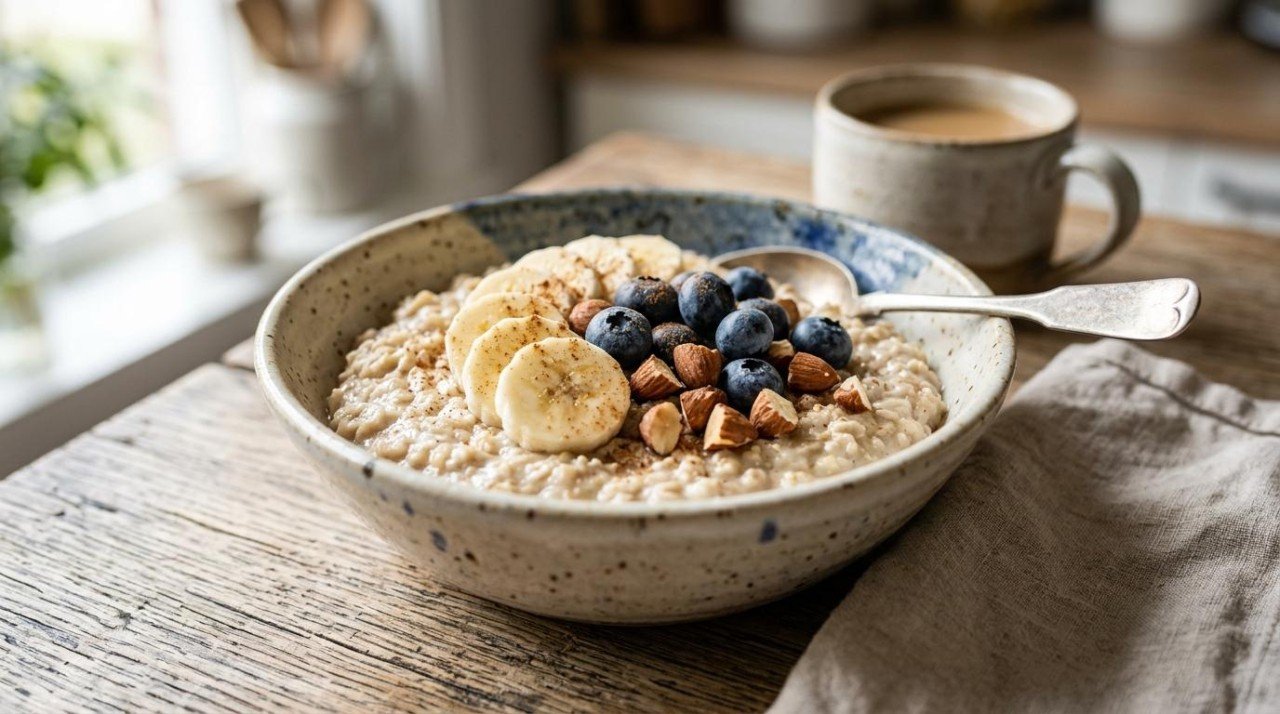
Nutrition Score: 90/100. No caution flags, no flagged weaknesses. Takes about ten minutes, most of which is the chia resting.
Serves 1.
- 1/2 cup (40 g) old-fashioned rolled oats
- 1 cup (240 ml) skim milk (2% costs one point)
- 1/2 teaspoon ground cinnamon
- Pinch of salt (about 1/16 teaspoon)
- 1/2 medium banana (60 g), ripe
- 1/2 cup (75 g) blueberries, fresh or frozen
- 2 tablespoons (14 g) almonds, roughly chopped
- 1 tablespoon (12 g) chia seeds
- Optional: 1/2 cup (100 g) plain nonfat Greek yogurt, 1 teaspoon brown sugar, or 1 tablespoon peanut butter
- Combine the oats, milk, cinnamon, and salt in a small saucepan. Bring to a bare simmer over medium heat, stirring often, and cook 5 minutes until thick and creamy. (Microwave: use a bowl at least twice the volume of the liquid, heat 2 to 2 1/2 minutes, and stop to stir at the halfway point or the milk will climb the sides.)
- Mash half of your banana piece (about 30 g) with a fork and stir it into the oats for the last minute of cooking, so it melts through the whole bowl. Slice the remaining piece.
- Take the pan off the heat and stir in the chia seeds. Let the oatmeal stand 5 minutes - it will thicken noticeably as the chia hydrates.
- Spoon into a bowl and top with the blueberries, the sliced banana, and the almonds. If you are adding Greek yogurt, spoon it on last so it stays cool against the hot oats.
Per serving, packet versus this bowl:
- Nutrition Score: 43 → 90
- Calories: 154 → 489 (this is a real breakfast, not a snack - that is the point)
- Protein: 3.8 g → 19.6 g
- Fiber: 3.0 g → 13.5 g (46% of a day, against the roughly 15 g most Americans manage in total)
- Added sugar: 11.7 g → 0 g
- Sodium: 260 mg → 220 mg
- Saturated fat: 0.3 g → 1.7 g
- Plant points: 1 → 5.25
The finished bowl comes out as an excellent source of omega-3 ALA (138% of a day's reference), biotin (89%), phosphorus (84%), vitamin B12 (58%), calcium (47%), fiber (46%), magnesium (45%), riboflavin (45%), iron (42%), zinc (32%), vitamin E (27%), and protein (24%). Every one of the app's six health dimensions lands in the 80s or 90s, against 36 to 51 for the packet.
Swaps we tested and skipped
- The lower-sugar packet: 45. Quaker's reduced-sugar version cuts added sugar from 12 g to 4 g and scores two points better than the regular one. It is still a small bowl with 240 mg of sodium and nothing but oats in it. Two points is the whole prize.
- Steel-cut oats: 90. Quick oats: 90. We scored the finished bowl three ways and the oat format was worth exactly zero points each time, because the nutrition is essentially identical. The difference is real but invisible to a nutrient score: Harvard's Nutrition Source notes that less processed oats digest more slowly and have a lower glycemic index, with highly processed instant oats landing at a high glycemic load and steel-cut at low to medium. If blood sugar is your reason for reading this, use steel-cut or rolled. If it is not, the instant plain oats in the same packet format are fine - the flavoring was always the problem, not the milling.
- Walnuts instead of almonds: 86. Four points worse, for the reasons above.
- Raisins instead of blueberries: 85. Five points worse. Dried fruit concentrates the sugar and loses the vitamin C and vitamin K the fresh berries bring.
- A tablespoon of maple syrup: 62. The single most expensive thing you can do to a finished bowl of oatmeal.
If you are keeping the packets
Plenty of people are not going to stand over a saucepan on a Wednesday, and the packet has real virtues - it is cheap, it travels, and it works in an office kitchen. So we scored the best possible packet-based bowl: one flavored packet made with a cup of skim milk instead of water, with blueberries, almonds, and chia stirred in. It scores 58.
That is 15 points better than the packet alone and a genuinely decent breakfast - 17.5 g of protein and 10.4 g of fiber. It is also 32 points below the same toppings on plain oats, and it never clears the added sugar flag, because the flag comes with the packet. If you only change one thing, change the packet, not the toppings. Plain instant oatmeal packets exist and cost less.
Make it fit other diets
Two swaps cover almost everyone who asks:
- Vegan or dairy-free: unsweetened soy milk in place of the skim. We scored it: 93, three points above the dairy version, with the same protein. Make sure it is the unsweetened carton - the sweetened versions carry several grams of added sugar per cup, which walks you straight back toward the packet.
- Gluten-free: oats are naturally gluten-free but are routinely cross-contaminated in milling, so use oats labeled certified gluten-free. Nothing else in the recipe changes, and the score does not move.
For anything else - lower carb, nut-free, higher protein - Eat Well Planner's Recipe Variations will rewrite the whole recipe in one step, and the AI recipe chat will talk through a substitution with the full ingredient list in front of it.
Do this to your own breakfast
Every number in this post came out of the same two tools you get free in the app. The Nutrition Score is what told us the packet was a 43 and, more usefully, why. Make It Healthier is what proposes the swaps - and it runs each one through a calculator before showing it to you, so a suggestion only appears if the gain is real. The per-swap deltas came from the Recipe Playground, where you can change one ingredient and watch the score move.
Import the breakfast you actually eat - from a website, an Instagram reel, a YouTube video, or by typing it in - score it, and see which single change is your 29-pointer. It is rarely the one you expect. Ours was a canister of plain oats.
More breakfasts we have put through the same process: granola, which people already believe is healthy and scores 45, and baked oats, the viral one, at 39.