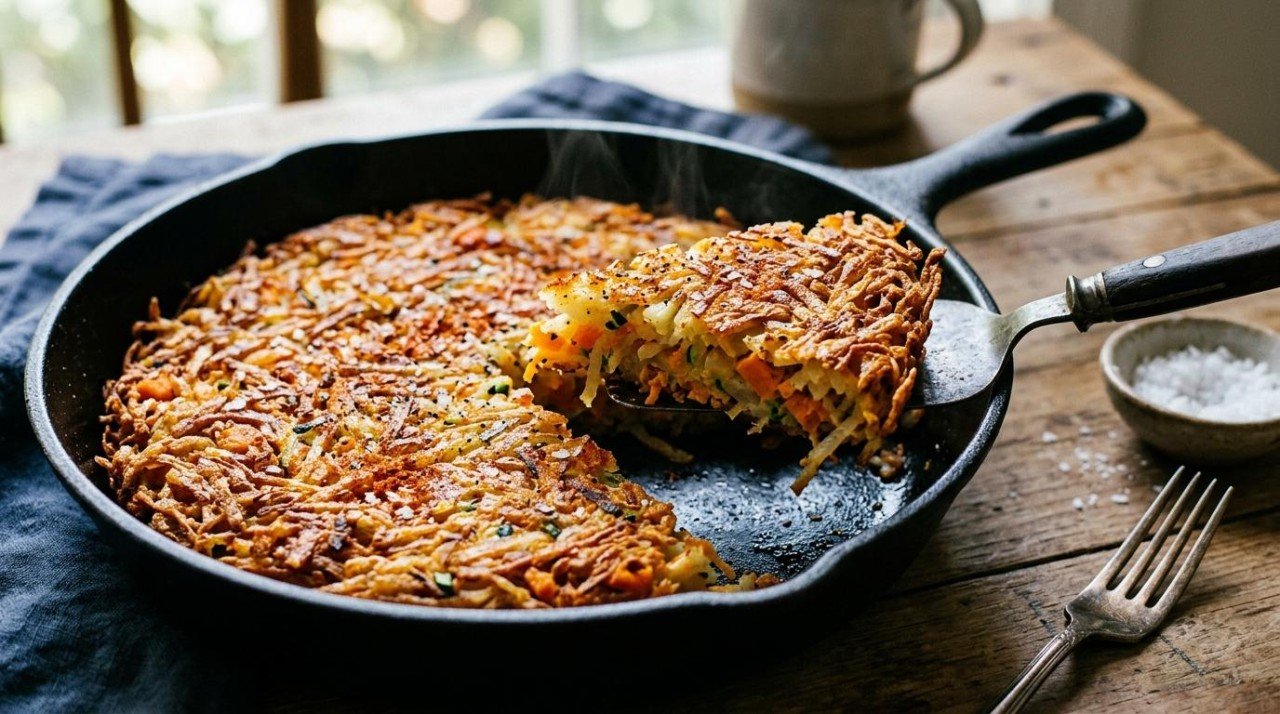
A good hash brown is a texture achievement. Shreds of potato pressed into a hot pan, left alone long enough to weld into a single golden cake, crisp enough to crack when the fork goes in and still steamy underneath. Nobody eats them for the nutrition. People eat them because a diner breakfast without them feels incomplete.
So we built the standard version in Eat Well Planner and ran it through the app's Nutrition Score. It came back at 40 out of 100, with two caution flags. Then we rebuilt it one verified swap at a time and got to 76, with no flags left - and the crust survived.
The interesting part is what the numbers did and did not reward. Shredded potato is a sponge, so the fat swap was the biggest single move by a distance. But taking the fat all the way to zero - the air fryer, no oil, the move every "healthy hash brown" recipe leads with - scored seven points lower than keeping one honest tablespoon of olive oil. There is a floor here, and it is easy to fall through.
The original: what's in it and how it scores
Diner-style hash browns, the version most people make at home: 1 pound (454 g) of russet potatoes, peeled and coarsely shredded, pressed into a skillet with a generous pour of fat - we modeled 2 tablespoons (28 g) of vegetable oil plus 1 tablespoon (14 g) of butter, which is on the conservative side of what a griddle actually uses - and salted hard, about 3/4 teaspoon (4 g) over a batch that serves two.
Nutrition Score: 40/100. Per serving: 357 calories, 4.9 g protein, 41 g carbs, 3.0 g fiber, 19.9 g total fat, 5.1 g saturated fat, 820 mg sodium, 950 mg potassium, and zero added sugar. Two cautions: sodium at 36% of a day's reference, and saturated fat at 22%. Plant points: 1.
Some of that is genuinely fine, and we are not going to invent problems. There is nothing ultra-processed in the pan and no added sugar anywhere. A serving is an excellent source of vitamin B6 (60% of a day's reference), potassium (28%), biotin (26%), and iron (25%), and a good source of phosphorus, vitamin E, thiamine, niacin, and vitamin C. Potatoes are a real vegetable and they carry real nutrients.
Three things drag the score down. Sodium first: 820 mg in a side dish is 36% of the 2,300 mg daily value, and the FDA considers 20% DV or more per serving high. Then the fat, and specifically its type - 19.9 g total with 5.1 g saturated, close to a quarter of a day's saturated fat in a side of potatoes. And the plate is one plant, once: a single plant point, no color, no herbs, nothing else in the pan.
One more number for context, because everyone reaches for the freezer on a weekday. Frozen hash brown patties, cooked as directed, score 41 - functionally the same as the homemade version, with 620 mg of sodium a serving and zero plant points. The homemade ones are not winning by much, because the thing that defines the dish is the same in both: potato plus a lot of hot fat.
The upgrades
We applied these in order and re-scored after each one, so every number below is what that change is worth at that point in the build. They are ordered by impact, so if you only make one change, make the first one.
1. One tablespoon of olive oil instead of three tablespoons of fat
- Swap: 2 tbsp vegetable oil + 1 tbsp butter to 1 tbsp (14 g) extra virgin olive oil for the whole pan
- Score impact: +17 points (40 to 57)
- What it changes: Calories from 357 to 241 per serving, total fat from 19.9 g to 7.2 g, saturated fat from 5.1 g to 1.1 g - the saturated fat caution clears
- What it costs you: The butter flavor, honestly. Not the crust, if you do the squeeze step below.
Seventeen points from one change, and it is the whole reason this dish scores the way it does. Shredded potato has enormous surface area, so it drinks whatever it is cooked in - the fat does not sit under the cake, it goes into it. Cutting from three tablespoons to one takes 12.7 g of fat and 116 calories out of every serving, and because the tablespoon that stays is olive oil rather than butter, saturated fat falls by more than three-quarters. That is exactly the trade the guidance asks for: use olive or canola oil instead of butter and other solid fats, keeping saturated fat under 10% of daily calories.
Here is the technique that makes one tablespoon enough, and it is not optional: squeeze the shreds dry. Rinse the shredded potato in cold water until the water runs clear, then wring it out in a clean kitchen towel until almost nothing more comes out. Water is what stops browning - a wet shred has to boil off its moisture before its surface can climb past 212F, and while that is happening it is steaming, not crisping. Dry shreds hit a hot pan and start browning immediately, which means they need far less fat to get there. Wet shreds need a fat bath to compensate. Also: get the pan properly hot before the potatoes go in, use cast iron or another heavy skillet, and then leave it completely alone for six minutes. Poking is how hash browns fall apart.
If you want the butter flavor back, see the tested-and-skipped section below - we scored that, and it is expensive. If you are choosing an oil, our olive oil substitutes guide and vegetable oil substitutes guide cover what behaves the same at high heat, and the butter substitutes guide takes on the flavor problem directly.
2. Halve the salt, and hand the job to smoked paprika
- Swap: 3/4 tsp (4 g) salt down to 1/3 tsp (2 g), plus 1 tsp smoked paprika and 1/2 tsp black pepper
- Score impact: +13 points (57 to 70)
- What it changes: Sodium from 790 mg to 400 mg per serving - from 34% of a day's reference to 17%, clearing the last caution flag
- What it costs you: Less than you would think, if you salt the surface rather than the mixture
Thirteen points for two grams of salt. Sodium is the single most sensitive input in this dish, and it is worth understanding why the score moves so hard: Americans average about 3,400 mg of sodium a day against a 2,300 mg daily value, so a breakfast side carrying 820 mg is taking a serious bite out of the day before anyone reaches for a slice of bacon.
Smoked paprika is doing real work here, not decoration. Smoke and salt read as the same kind of savory depth to most palates, and paprika also browns beautifully against the potato, so the cake looks like it was cooked in more fat than it was. Black pepper adds bite. The other trick is placement: salt mixed evenly through the shreds disappears into them, while a few grains scattered across the finished crust hit the tongue directly and read as much saltier. Season the mixture lightly, finish at the table.
3. Shred in onion and zucchini
- Swap: Replace about a third of the potato with 3 oz (85 g) shredded onion and 4 oz (115 g) shredded zucchini
- Score impact: +4 points (70 to 74)
- What it changes: Calories from 245 to 210 per serving, plant points from 1.5 to 3.5
- What it costs you: Nothing, if you squeeze the zucchini. Everything, if you do not.
Onion in hash browns is not a health swap, it is what good diners already do - it sweetens as it caramelizes and it makes the cake taste like more than starch. Zucchini is the newcomer, and it disappears completely: shredded on the coarse side of a grater, it is the same shape and thickness as the potato, browns at the same rate, and turns mild and faintly sweet. Nobody at the table identifies it.
The catch is water. Zucchini is over 90% water and it will flood the pan and give you a gray, floppy cake if you skip the squeeze. Shred it, salt it lightly, let it sit 10 minutes, then wring it out in the towel along with the potato. If onion is the part you would rather leave out, our onion substitutes guide lists what fills the same savory gap.
4. Trade a third of the potato for sweet potato
- Swap: Replace 4 oz (115 g) of the russet with shredded sweet potato, skin on
- Score impact: +2 points (74 to 76)
- What it changes: Fiber from 3.6 g to 4.5 g per serving, plus beta carotene, plus another plant point
- What it costs you: A faint sweetness, and it browns faster - watch it
This is the smallest swap in the post and the one most likely to divide a table, so it is last on purpose. Sweet potato carries roughly twice the fiber of russet ounce for ounce, and Americans average about 16 g of fiber a day against a 21 to 38 g recommendation, so a gram here is not nothing. It also brings the beta carotene that russet has none of.
Keep it to about a third. Sweet potato has more sugar, so it browns sooner and can go from golden to scorched while the russet is still pale - a third was the most we could add before the cake started burning at the edges before its center set. If your household objects, leave it out and take the 74. That version is still 34 points above where we started.
Take the Guesswork Out of Eating Well
Eat Well Planner helps you organize your favorite recipes, plan balanced meals, and automatically generate shopping lists — all in one place. Whether you're tracking macros, managing dietary restrictions, or just trying to stop asking "what's for dinner?", we've got you covered.
Our AI-powered tools can adapt any recipe to your dietary needs, help you discover new meals you'll love, and even log your nutrition effortlessly. It's meal planning made simple.
Start Organizing Your Meals — FreeWhat we kept on purpose
The tablespoon of oil. We tested the zero-oil air fryer version, and it scored 69 - seven points below the version with a tablespoon of olive oil. Fat is not a penalty in a nutrient-density score; the right fat is a contribution, carrying monounsaturated fat and vitamin E that the potato cannot supply. Stripping it out removes those and gains you nothing but a drier cake. One tablespoon is the sweet spot.
The skins. Leave them on and just scrub. We cannot show you a score for this one, because our russet entry includes the skin either way - so here is the outside number instead: a medium potato has about 2 g of fiber with the skin and roughly half that without it, and peeling also loses around 150 mg of potassium (Potatoes USA, from USDA data). The skins also brown into little crisp flecks, which is a texture win, not a compromise.
Real salt, just less of it. No salt substitute, no "salt-free seasoning blend." Two grams of actual salt in the mixture plus a pinch on top does more for the dish than any replacement, and at 390 mg per serving the score is already clear of the caution threshold.
Where we stopped. One tablespoon of oil, a third of the potato replaced, skins on. The next move on the list would be swapping more of the potato for cauliflower or turnip, and that is where the dish stops being hash browns. We scored that too - see below.
The healthier version: full recipe
Nutrition Score: 76/100, up from 40, with no caution flags. Serves 2.
- 7 oz (200 g) russet potato, scrubbed, skin on, coarsely shredded (about 1 medium)
- 4 oz (115 g) sweet potato, scrubbed, skin on, coarsely shredded (about half a medium)
- 4 oz (115 g) zucchini, coarsely shredded (about 1 small)
- 3 oz (85 g) yellow onion, coarsely shredded (about half a medium)
- 1 tablespoon (14 g) extra virgin olive oil
- 1 teaspoon smoked paprika
- 1/3 teaspoon (2 g) fine salt, plus a pinch to finish
- 1/2 teaspoon black pepper
- Shred the russet, sweet potato, zucchini, and onion on the coarse side of a box grater or with the shredding disk of a food processor. Leave the potato and sweet potato skins on.
- Rinse the potato and sweet potato shreds in a bowl of cold water until the water runs clear, then drain. Soaking them 15 to 30 minutes instead of rinsing also works, and the FDA notes that soaking cut potatoes reduces acrylamide formation. Store your potatoes in a cool pantry rather than the refrigerator for the same reason.
- Pile everything into the center of a clean kitchen towel, gather the corners, and wring it out hard over the sink. Keep twisting until barely any liquid comes out. This step is the recipe - do not shortcut it.
- Toss the dry shreds in a bowl with the olive oil, smoked paprika, salt, and pepper until every strand is coated.
- Heat a 10-inch cast iron or heavy skillet over medium-high until a dropped shred sizzles on contact. Add the mixture and press it into an even cake about 1/2 inch thick.
- Cook undisturbed for 6 to 8 minutes, until the underside is deep golden and the cake slides when you shake the pan. Do not stir, lift, or check before minute five.
- Flip in one motion, or slide the cake onto a plate and invert it back into the pan, and cook another 5 to 7 minutes, to golden rather than dark brown.
- Slide onto a board, cut in half, scatter with a pinch of salt, and serve immediately.
No skillet space? The same mixture goes into a preheated waffle iron for 8 to 10 minutes, which gives you far more crisp surface per gram of potato, or onto a preheated sheet pan at 425F for about 25 minutes, flipped once.
Per serving, original vs. improved:
- Nutrition Score: 40 to 76
- Calories: 357 to 215
- Total fat: 19.9 g to 7.6 g
- Saturated fat: 5.1 g to 1.2 g
- Sodium: 820 mg to 390 mg (36% to 17% of a day's reference)
- Fiber: 3.0 g to 4.5 g
- Protein: 4.9 g to 4.2 g (down slightly - see the egg note below)
- Potassium: 950 mg to 930 mg
- Plant points: 1 to 4.5
- Caution flags: 2 to 0
A serving of the finished version is an excellent source of vitamin B6 (45% of a day's reference), vitamin C (29%), and potassium (27%), and a good source of iron, phosphorus, pantothenic acid, fiber, thiamine, biotin, magnesium, niacin, vitamin E, folate, and riboflavin.
Swaps we tested and skipped
- No oil at all (dry air fryer): 69, seven points worse. The most-recommended healthy hash brown swap on the internet is the one that costs the most points here. Without the olive oil the dish loses its monounsaturated fat and vitamin E and gains nothing.
- Cauliflower for half the remaining potato: 71, five points worse. It even added a plant point, and it still scored lower - the potato is carrying the B6, potassium, and iron. It also does not brown into a cake; it browns into wet crumbs. Skipped on both counts.
- An egg as binder: 76, exactly no change. Worth doing anyway. One large egg beaten through the shreds holds the cake together and takes protein from 4.2 g to 7.3 g per serving. The score does not move, which is a fair reminder that a score is not the only reason to do something. If protein at breakfast matters to you, add the egg.
- Half a tablespoon of butter back in, for flavor: 67, nine points worse. That is the honest price of buttery hash browns - nine points for 7 g of butter across two servings, almost all of it saturated fat. Worth it occasionally, and now you know what "occasionally" is buying.
Make it fit other diets
This version is already dairy-free, gluten-free, and vegan as written - the fat is olive oil and there is no binder. For low-carb, the honest answer is that this is not the dish to force: the cauliflower version scored five points lower and does not hold together, so eat something else and come back to hash browns another day. For higher protein, the egg binder above is the move. In Eat Well Planner, the AI Recipe Chat and Recipe Variations will rewrite any saved recipe to fit a diet in one step, with the substitutions already worked into the method.
Do this to your own breakfast
None of this came from guessing. We built the diner version in Eat Well Planner, read its Nutrition Score and the two flags behind it, then used Make It Healthier - the app proposes ingredient swaps and a calculator verifies the actual nutritional gain before you ever see the suggestion - and the Recipe Playground to watch each change move the number in real time. The butter test, the zero-oil test, the cauliflower test: each of those took about a minute.
You can do exactly this to the breakfast you already make. Import a recipe from any website, Instagram reel, or YouTube video, look at the score, and find out which of your assumptions about it are right. Ours were half wrong: the fat mattered more than we expected, and cutting it to zero would have made things worse. If potatoes are your weakness generally, the same treatment on french fries took them from 55 to 93.