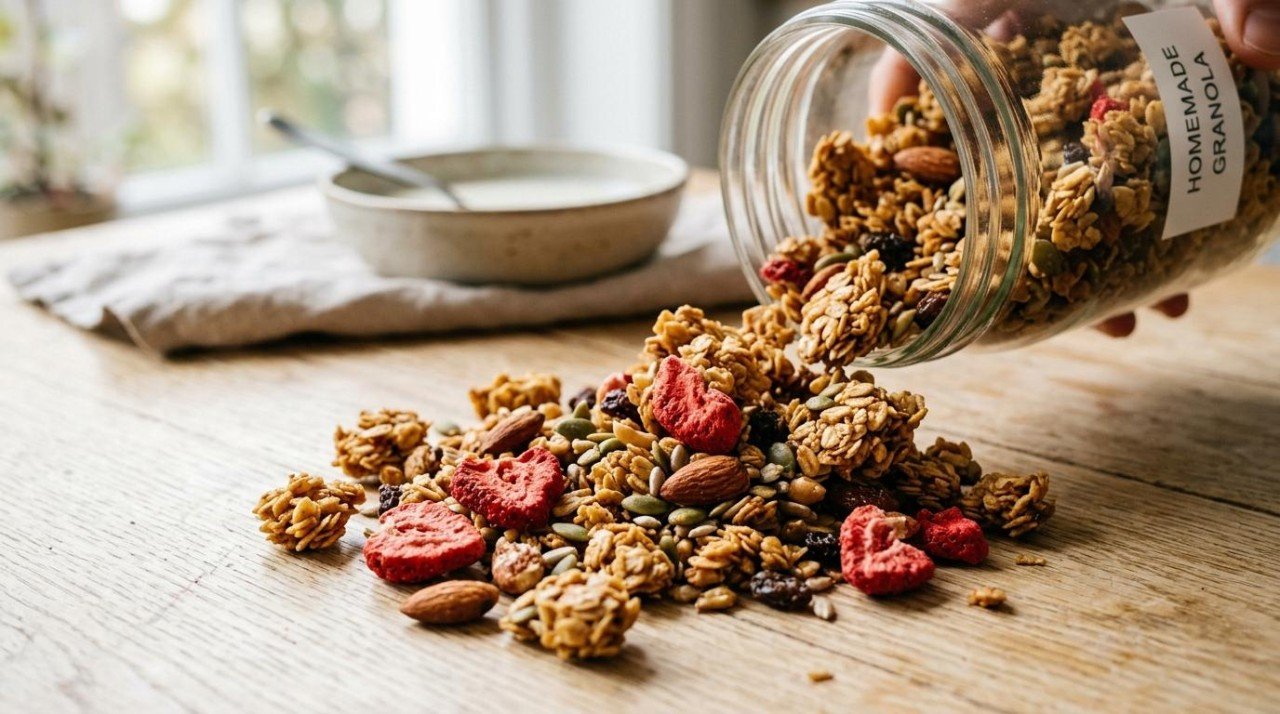
Granola is the only recipe we have put through this series that people already believe is healthy. Nobody makes banana bread under the impression it is health food. Granola gets made on a Sunday afternoon by someone actively trying to eat better, and goes into a jar on the counter with the air of a decision well made.
So we built a standard homemade granola in Eat Well Planner and ran it through the app's Nutrition Score. It came back at 45 out of 100, with one caution flag: added sugar, at 43% of a day's reference in a half-cup serving. That is genuinely better than the muffin or the cinnamon roll. It is also nowhere near what the jar's reputation implies. Then we rebuilt it one verified swap at a time and got it to 77, with no caution flags at all.
Along the way the granola rules everyone repeats fell apart in an interesting order. Switching to olive oil made it worse. Coconut oil made it four points worse than that. Taking the dried fruit out cost five points. And the single change worth 17 points was one nobody frames as a swap at all. Here is the whole thing, with receipts.
The original: what's in it and how it scores
There is no canonical granola, so we scored the version that shows up again and again with small variations - the ratio you will recognize from Cookie and Kate's and Once Upon a Chef's versions, which between them cover most of what gets made in home kitchens. Ours was 4 1/2 cups (400 g) rolled oats, 1/2 cup (109 g) vegetable oil, 1/2 cup (170 g) honey, 1/4 cup (55 g) packed light brown sugar, 1 cup (140 g) almonds, 1 cup (150 g) raisins, 3/4 cup (60 g) sweetened shredded coconut, cinnamon, salt, and vanilla. It makes about 8 cups.
Nutrition Score: 45/100. Per half-cup (55 g) serving: about 257 calories, 4.8 g protein, 3.6 g fiber, 2.3 g saturated fat, 70 mg sodium, and 11.3 g of added sugar - 43% of a day's reference, flagged as high. Plant points: 3.25.
Now the part that surprises people: a lot of this granola is genuinely good, and we are not going to pretend otherwise. It is an excellent source of ALA omega-3 (27% of a day's reference), vitamin E (20%) and biotin (20%), and a good source of phosphorus, iron, magnesium, and riboflavin. The sodium is a non-issue. The oats and almonds are real food doing real work. The score is being held down by exactly one thing, and it is not the fat.
It is the sweetener. A half cup of honey plus a quarter cup of brown sugar means every serving carries almost half a day's added sugar allowance - and the American Heart Association's limit is 24 g a day for women and 36 g for men. One bowl of granola spends half of it.
And nobody eats a half-cup serving
This is where granola differs from every other recipe in this series. Researchers in Public Health Nutrition asked people to pour themselves a normal bowl of various breakfast cereals and weighed the result. For granola the median free-pour was 95 g against a recommended serving of 45 g - the largest overshoot of any category they tested, because dense cereals fill a bowl slowly and look like less than they are.
So we scored the original again at 95 g. It drops to 43, with 443 calories and 19.5 g of added sugar - 74% of a day's reference, now flagged very high, before you add milk or yogurt. That is the health halo in one number. The granola did not change; the honesty of the serving size did.
The upgrades
We applied these in order and re-scored after each one, so every number below is what that change was worth at that point in the build. If you only make one of them, make the first - it is worth more than the other five combined.
1. Cut the sweetener to 3 tablespoons, and let applesauce do the sticking
- Swap: 1/2 cup honey + 1/4 cup brown sugar → 3 tablespoons honey + 1/2 cup unsweetened applesauce
- Score impact: +17 points (45 to 62) - by far the biggest move in the makeover
- What it changes: Added sugar from 11.3 g to 4.3 g per serving, and the caution flag disappears entirely
- What it costs you: Real sweetness. This is the swap with a genuine price tag, and the applesauce is what pays most of it back.
Seventeen points from one change, and the reason is the caution flag rather than the sugar itself. Once added sugar drops below the threshold the app flags, the score stops docking the recipe for it and starts noticing everything else that was already good. Cutting to 3 tablespoons crosses that line. Cutting to zero does not help further - we tested that too, at the end of the build, and a version with no honey at all scored 76, one point below the version that keeps it. Three tablespoons of honey spread across nineteen servings is effectively free. Take the flavor.
The applesauce is not a health gimmick here, it is structural. Sugar syrup is what glues granola into clusters, so cutting two-thirds of it leaves you with loose toasted oats unless something replaces the stickiness. Unsweetened applesauce brings pectin and just enough body to coat the oats, and it bakes away to almost nothing. It is worth 2 points on its own at the end of the build - without it the final version scores 75 instead of 77. (If you would rather swap the honey than cut it, our honey substitutes guide and brown sugar substitutes guide cover the ratios, though the amount matters far more than the choice.)
2. Add pumpkin and sunflower seeds
- Swap: Nothing → 1/2 cup (70 g) raw pumpkin seeds + 1/2 cup (70 g) raw sunflower seeds
- Score impact: +8 points (62 to 70)
- What it changes: Protein from 5.5 g to 6.6 g per serving, plant points from 3.25 to 5.25, phosphorus from 21% to 30% of a day's reference, and zinc appears on the highlights list at 12%
- What it costs you: Nothing in flavor, and a few dollars a batch.
Seeds are the cheapest score in granola because they are the one add-in that brings minerals without sugar. They also fix granola's quiet protein problem: at 4.8 g a serving the original is a breakfast that will not hold you, which is a large part of why the bowl gets refilled. Buy them raw rather than roasted and salted, and add them with the oats so they toast.
3. Add ground flaxseed and chia
- Swap: Nothing → 1/3 cup (40 g) ground flaxseed + 3 tablespoons (35 g) chia seeds
- Score impact: +3 points (70 to 73)
- What it changes: ALA omega-3 from 0.50 g to 1.15 g per serving (31% to 72% of a day's reference), fiber from 4.3 g to 5.0 g, plant points from 5.25 to 7.25
- What it costs you: Nothing you will taste. Ground flax is invisible in granola.
Three points looks small next to what it does to the omega-3 number, and that is because the score was already crediting the recipe for ALA - from the vegetable oil, of all things. Hold that thought, because it is about to matter.
The flax has to be ground - whole flaxseed passes through you intact, which makes it a decoration rather than an ingredient. Keep it in the freezer, since the same fats that make it worth eating go rancid at room temperature.
4. Swap 1/2 cup vegetable oil for 1/4 cup olive oil
- Swap: 1/2 cup (109 g) vegetable oil → 1/4 cup (55 g) extra virgin olive oil
- Score impact: +1 point (73 to 74)
- What it changes: Calories from 274 to 263 per serving, omega-6 from 6.5 g to 4.1 g
- What it costs you: A faint fruity, savory note. In granola this reads as sophisticated rather than wrong.
Here is the most useful thing we found in this entire post. We tested this exact swap at the start of the build, against the original recipe, and it scored 43 - two points worse. Same swap, same oil, opposite result.
In the original, the vegetable oil was the recipe's main source of ALA omega-3 and a big contributor to its vitamin E. Replacing it with olive oil, which has almost none of the former, stripped out a genuine strength to fix a problem the recipe did not really have. Only once the flax and chia took over the omega-3 job did olive oil become an upgrade. That is the whole argument for verifying swaps instead of trusting rules: "use olive oil instead" is good advice attached to a precondition nobody mentions.
The coconut oil that so many granola recipes call for is worse in both worlds. In the original it scores 41, four points down, adding a second caution flag for saturated fat at 27% of a day's reference. In the finished version it costs 14 points, dropping a 77 to 63. It is the most health-coded ingredient in the recipe and the most expensive one on the scorecard. (Our vegetable oil and olive oil substitutes guides cover the rest.)
5. Use unsweetened coconut instead of sweetened
- Swap: 3/4 cup sweetened shredded coconut → 3/4 cup unsweetened
- Score impact: 0 points (74 to 74)
- What it changes: Added sugar from 3.7 g to 2.5 g per serving, fiber from 5.3 g to 5.7 g, plant points from 7.25 to 8.25
- What it costs you: Nothing. It toasts better without the sugar coating.
We are including a swap worth zero points on purpose, because it shows how the score works. Once the caution is gone, removing more added sugar earns nothing - the score has already stopped complaining. The swap is still worth making: it is free, it drops a third of the remaining added sugar, and unsweetened coconut browns instead of burning. But it will not move the number, and anyone promising you it will is guessing.
6. Trade a third of the raisins for freeze-dried strawberries
- Swap: 1 cup (150 g) raisins → 2/3 cup (100 g) raisins + 1 cup (30 g) freeze-dried strawberries
- Score impact: +3 points (74 to 77)
- What it changes: Fiber from 5.7 g to 6.0 g per serving, plant points from 8.25 to 9.25, and vitamin C stops showing up as a weakness
- What it costs you: Freeze-dried fruit is expensive by weight and goes soft if it meets milk early. Add it to the bowl, not the jar, if that bothers you.
Freeze-dried fruit is just fruit with the water removed - no syrup, no sugar coating - so it brings vitamin C and a fourth plant into a jar that needed both.
What we did not do is take the raisins out. That instinct is wrong, and expensively so: removing all the dried fruit from the finished version drops it from 77 to 72. Raisins are one of the few dried fruits sold with no added sugar at all, and they bring potassium and fiber with their sweetness - more than can be said for the fancier-sounding alternative in the skipped swaps below.
Take the Guesswork Out of Eating Well
Eat Well Planner helps you organize your favorite recipes, plan balanced meals, and automatically generate shopping lists — all in one place. Whether you're tracking macros, managing dietary restrictions, or just trying to stop asking "what's for dinner?", we've got you covered.
Our AI-powered tools can adapt any recipe to your dietary needs, help you discover new meals you'll love, and even log your nutrition effortlessly. It's meal planning made simple.
Start Organizing Your Meals — FreeWhat we kept on purpose, and where we stopped
We kept real honey, real oil, real coconut, real raisins, and every one of the oats. No protein powder, no sugar substitute, no dates blitzed into paste, and no attempt to make granola into something that is not granola.
The oats especially stay untouched, with one honest caveat nobody attaches to granola. Oats carry beta-glucan, the soluble fiber behind the one breakfast-cereal health claim that holds up: 3 grams a day from whole oats modestly lowers blood cholesterol. But a half-cup of this recipe contains about 21 g of oats, roughly half the 40 g in a bowl of oatmeal, because everything else in the jar takes up room. Granola is a weaker beta-glucan vehicle than plain oatmeal. That is the trade you make for the crunch.
We stopped at six swaps because the seventh did not exist - every further change we tested either did nothing or made things worse, which is the honest signal that a makeover is finished. The remaining weaknesses are low vitamin A and low vitamin K, and no granola fixes those. That is what the fruit you put on top is for.
One thing to be straight about: this version is not lower in calories. At the same half-cup serving it is 271 calories against the original's 257. Nuts and seeds are calorie-dense, and swapping sugar for them trades cheap calories for expensive ones rather than removing them. What you get is 64% more fiber, 54% more protein, nearly triple the plant points, and 77% less added sugar in the same size bowl. If you want the bowl to be lighter, the lever is the bowl, not the recipe.
The healthier version: full recipe
Final Nutrition Score: 77/100, with no caution flags. Makes about 8 cups, or roughly nineteen 1/2-cup servings.
- 4 1/2 cups (400 g) old-fashioned rolled oats, divided
- 1 cup (140 g) raw almonds, roughly chopped
- 1/2 cup (70 g) raw pumpkin seeds
- 1/2 cup (70 g) raw sunflower seeds
- 1/3 cup (40 g) ground flaxseed
- 3 tablespoons (35 g) chia seeds
- 3/4 cup (60 g) unsweetened shredded coconut
- 1 teaspoon ground cinnamon
- 1/2 teaspoon fine sea salt
- 1/4 cup (55 g) extra virgin olive oil
- 3 tablespoons (60 g) honey
- 1/2 cup (120 g) unsweetened applesauce
- 2 teaspoons vanilla extract
- 2/3 cup (100 g) raisins
- 1 cup (30 g) freeze-dried strawberries
- Heat the oven to 300°F and line a large rimmed baking sheet with parchment.
- Measure 1/4 cup of the oats into a blender or food processor and blitz to a rough flour. King Arthur's test kitchen found that a little flour is the best thing for granola clusters, beating egg white, which made fragile clumps. Grinding your own oats costs nothing and keeps it whole grain.
- In a large bowl, stir together the remaining oats, the oat flour, almonds, pumpkin seeds, sunflower seeds, flaxseed, chia, coconut, cinnamon, and salt.
- Whisk the olive oil, honey, applesauce, and vanilla in a small bowl until smooth, then pour over the dry mixture. Stir thoroughly - every oat should look damp. This takes longer than it did with a half cup of honey, so keep going.
- Spread onto the sheet and press it down firmly with a spatula into one compact, even slab. Pressing is what creates clusters; a loose scatter bakes into loose granola.
- Bake 45 to 55 minutes, rotating the pan once at the halfway point but not stirring. The applesauce adds moisture, so this runs longer than a standard granola. It is done when the surface is dry to the touch and the edges are deep golden. It will still feel slightly soft in the middle.
- Cool completely on the sheet, undisturbed, for at least an hour. The clusters set as it cools, and breaking it up while warm is the most common way people end up with loose granola.
- Break into clumps, then fold in the raisins and freeze-dried strawberries. Store airtight at room temperature for up to 3 weeks.
Per 1/2-cup (55 g) serving, original vs. improved:
- Nutrition Score: 45 → 77
- Added sugar: about 11.3 g → about 2.6 g
- Fiber: about 3.6 g → about 6.0 g
- Protein: about 4.8 g → about 7.4 g
- ALA omega-3: about 0.44 g → about 0.84 g (27% → 53% of a day's reference)
- Calories: about 257 → about 271
- Saturated fat: about 2.3 g → about 3.4 g
- Sodium: about 70 mg → about 70 mg
- Potassium: about 210 mg → about 290 mg
- Plant points: 3.25 → 9.25
- Caution flags: high added sugar → none
And at the 95 g portion people actually pour, the improved version holds at 77 where the original fell to 43 - 468 calories, 10.3 g of fiber, 12.8 g of protein, 4.5 g of added sugar. It does pick up a saturated fat flag at that size, from the nuts and coconut. Surviving an honest portion is the real test, and it is the number we are proudest of.
Swaps we tested and skipped
- Sweetened dried cranberries instead of raisins. The worst result in the whole post: 53, a 24-point collapse, with the added sugar caution straight back on. Cranberries are too tart to dry without sweetening, so a quarter cup carries about 26 g of added sugar and no potassium at all, where raisins have none and 314 mg. If you change one thing after reading this, check the bag.
- Coconut oil instead of olive oil. Scored 63 - down 14 points, with a saturated fat caution. It is in half the granola recipes online and it is the most costly ingredient here.
- Dark chocolate chips (3 oz). Took the finished granola from 77 to 60. That is the honest price of chocolate granola, and it is still 15 points above the original, so this is not a defeat if it is the version your household will actually eat. Add it after cooling so it does not melt.
- Egg white for bigger clusters. Scored 73, down 4, and King Arthur's testing found it makes worse clusters than a spoonful of flour anyway. Losing on both counts is rare.
- Removing the honey entirely. Scored 76 - one point below keeping it. Zero added sugar buys you nothing here and costs you the browning and the flavor. Worth knowing before someone talks you into it.
- Just using less oil, and changing nothing else. Cutting the original's oil from 1/2 cup to 1/4 cup scored 47, up 2. It is not wrong, it is just not the lever - and at a fixed portion it barely changes the calories, because a smaller batch means your scoop is simply more oats.
Make it fit other diets
For vegan, swap the honey for maple syrup at the same 3 tablespoons - at this quantity the sweetener you choose is nearly irrelevant, since removing it altogether only moved the score by a point. For nut-free, replace the almonds with another cup of pumpkin and sunflower seeds, which is where most of the mineral scoring came from anyway. For gluten-free, use certified gluten-free oats; nothing else in the recipe contains gluten. In Eat Well Planner you can ask the AI to rewrite this exact recipe any of those ways in one step, and it hands back the full version with the swaps already worked in.
Do this to any recipe you love
Every number in this post came out of Eat Well Planner's Make It Healthier tool, not an estimate. Import a recipe from any website, or straight from the reel you saved it from, and the app scores it and shows you what is actually holding the number down - then proposes swaps with the gain verified by a calculator before you ever see them. The Recipe Playground is where you test them one at a time and watch the score move before committing.
Granola's lesson is worth taking with you: the ingredient everyone blames is rarely the one costing you points, and a swap that helps one recipe can hurt another. Olive oil was a downgrade until the flaxseed made it an upgrade. Coconut oil was never anything but a downgrade. And the fix worth 17 points was not an ingredient swap at all - it was using less of something already there. We found the same shape of answer rebuilding the viral baked oats, where the batter turned out to be innocent too.
Now go make the batch. Then, just once, weigh what you pour.