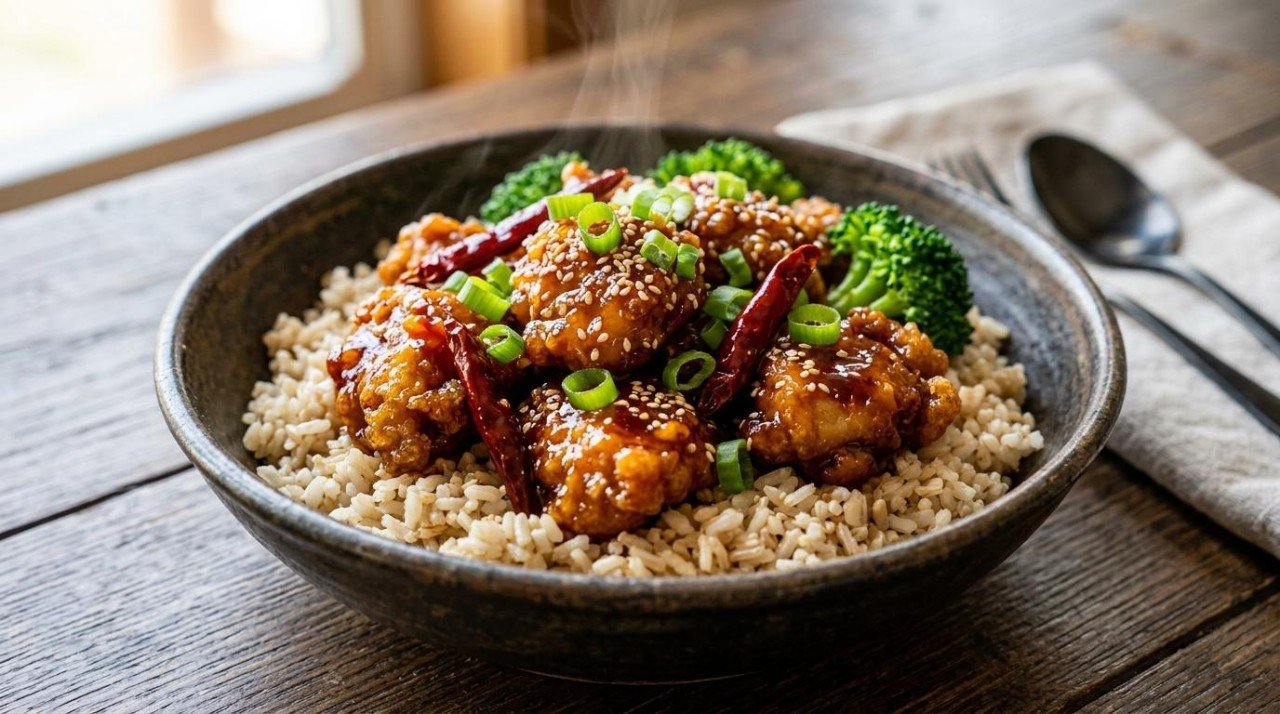
General Tso's chicken is the crown jewel of the American takeout menu: glossy, sticky, a little sweet, a little spicy, the pieces shatter-crisp under a lacquered sauce. People do not order it because they think it is a salad. They order it because it is one of the most satisfying things you can eat out of a paper carton, and no amount of nutrition talk is going to change that. Nor should it.
Here is a fact that reframes the whole dish, though. The version most of us know was created by a Hunanese chef, Peng Chang-kuei, who brought it to New York in the early 1970s and named it for a 19th-century general, Zuo Zongtang (Smithsonian has the story). His original was not sweet. As Peng described it, the flavors were "heavy, sour, hot and salty" — it was Americanized into the sugar bomb we know today. When he later served his own version in Hunan, locals complained it was too sweet.
So we scored a standard takeout-style General Tso's with the app's Nutrition Score. It came back at 30 out of 100. Then we rebuilt it swap by swap, scoring every change, and landed at 66 — a 36-point jump. And the most interesting part is that the biggest fixes were not the ones you would guess, and one of them accidentally walks the dish back toward what Chef Peng cooked in the first place.
The original: what's in it and how it scores
The version we scored is the takeout standard: about 1.5 pounds of boneless thigh, cut into chunks, coated in a thick egg-and-cornstarch batter, deep-fried, then tossed in a glossy sauce built on soy sauce, hoisin, and roughly half a cup of sugar, with dried chiles, garlic, and ginger. Served over a generous scoop of white rice. Per serving (this recipe feeds four) that lands at roughly 1,035 calories, 42 g protein, 110 g carbs, 3.1 g fiber, 25.8 g added sugar, 35 g total fat, 5 g saturated fat, and about 2,050 mg sodium. Nutrition Score: 30.
Here is what drags it down:
- The added sugar. 25.8 g a serving — that is essentially a woman's entire daily added-sugar allowance in one dinner, since the American Heart Association caps it at 25 g for women and 36 g for men. It is the score's single loudest complaint.
- The sodium. About 2,050 mg, 89% of the daily limit, between the soy sauce, the hoisin, and the salted rice. The AHA puts the ceiling at 2,300 mg, with 1,500 the real target.
- No vegetables, at all. The score flags Low Vitamin C and gives it just 1.5 plant points, because classic General Tso's is chicken and sauce over rice with nothing green in sight.
- The deep-fried batter. A thick cornstarch coating that drinks up frying oil is most of why one serving crests 1,000 calories.
And here is what is already fine — because a good makeover keeps what works. It is a genuinely strong protein hit (42 g, more than half a day) and it delivers a serious load of niacin, vitamin B6, and iron from the real chicken. The saturated fat? Only about 5 g, a quarter of the daily cap — moderate, not the problem. If you pictured General Tso's as a saturated-fat disaster, the score politely disagrees. Its problems are sugar, salt, the missing vegetable, and the oil load — so that is exactly where we aim.
The upgrades
We rebuilt the recipe one change at a time in the app's Recipe Playground, scoring after each swap, so the deltas below are measured, not estimated. We have put them in the order that a home cook should care about them — biggest, most defining fixes first.
Upgrade 1: Rebuild the sauce and pull the sugar way back
- Swap: About 1/2 cup sugar → 2 tablespoons, with more garlic, ginger, and dried chiles to fill the gap
- Score impact: +9 points (30 to 39)
- What it changes: Cuts added sugar from 25.8 g to 7.4 g a serving — a full day's worth down to about a third
- What it costs you: Less candy-sweet, more savory and hot — which is arguably the point
This is where the makeover starts, and it is also where it honors the original. Chef Peng's General Tso's leaned hot, sour, and salty; the American sugar avalanche came later. Pulling the sugar back from a half cup to two tablespoons does not make it a health food — it makes it taste more like the dish was supposed to taste. You backfill the flavor with aromatics: more garlic and ginger, a real hit of dried chiles, and the tang of rice vinegar. A cornstarch slurry keeps the sauce every bit as glossy and clingy, so it still looks like the version you love. On the score, that is +9 and the difference between a "very high" added-sugar caution and a minor one.
Upgrade 2: Switch to low-sodium soy sauce (and broth)
- Swap: Regular soy sauce and broth → low-sodium versions, and a little less soy
- Score impact: +6 points (39 to 45)
- What it changes: Drops sodium from about 1,960 to 1,110 mg a serving
- What it costs you: Nothing you can taste in a sauce this aromatic
Soy sauce is the backbone of the flavor and also the biggest single source of salt. The fix is not to use less of it and end up with a flat sauce — it is to use the low-sodium version, which carries roughly 40% less sodium for the same savory depth, and lean a little harder on the garlic, ginger, and chiles you already added in Upgrade 1. In a glaze this punchy, nobody at the table can tell. That one move cuts sodium by more than 800 mg a serving, comfortably the kind of reduction the AHA links to measurably better blood pressure. If you want to push sodium down even further, the soy sauce substitutes guide covers coconut aminos and the other lower-salt options.
Upgrade 3: Add broccoli
- Swap: + about 3/4 pound (4 cups) broccoli florets
- Score impact: +15 points (45 to 60)
- What it changes: Takes vitamin C from zero to 89% of a day, fiber from 3 to nearly 6 g, and clears the Low Vitamin C flag
- What it costs you: Nothing — broccoli belongs here and always has
This is the single biggest lever in the whole build, and it is almost embarrassing how simple it is: the dish had no vegetable, so we added one. Steakhouse-style takeout often pairs General Tso's with broccoli anyway, so this is not even a stretch. Broccoli brings a huge dose of vitamin C, a real bump of fiber, and — the part the score rewards hardest — it turns a plate of protein and starch into an actual meal with something green in it. It also pushes your weekly plant count up. Roast or steam it and toss it in with the sauce at the end so it stays bright, not gray — and if you want to keep its best compounds intact, here is how to cook broccoli so it actually helps you. Fifteen points for one vegetable is the best trade in this post.
Upgrade 4: Serve it over brown rice
- Swap: White rice → brown rice
- Score impact: +1 point (60 to 61)
- What it changes: More fiber, whole grain instead of refined, and a little less sodium
- What it costs you: A nuttier, chewier bite — a real preference question
Here is an honest one. Swapping white rice for brown moves the score by a single point — because rice is the quiet part of this plate, and the loud problems were already handled. But it is still worth doing. Refining rice strips out the bran and germ, and with them more than half the B vitamins and nearly all the fiber, per Harvard's Nutrition Source; the fiber in whole grains is also what "slows the breakdown of starch into glucose," which matters under a sweet-savory sauce. It even shaved a little more sodium off our scored version. One point on the board, a genuine real-food upgrade off it. If brown rice is a hard sell in your house, the white rice substitutes guide has gentler middle grounds like a half-and-half mix or quick-cooking brown options.
Upgrade 5: Skip the deep fry — crisp-bake or air-fry instead
- Swap: Thick deep-fried batter → a light cornstarch dusting, air-fried or oven-crisped
- Score impact: +5 points (61 to 66)
- What it changes: About 120 fewer calories a serving and roughly 10 g less total fat
- What it costs you: Maybe 10% of the shatter — the sauce hides the rest
Notice where this landed: dead last. The deep fry is the thing everyone assumes is the villain of General Tso's, and it is worth real calories — but on the score it moved the needle less than the sauce and the broccoli did. That is the honest lesson of this makeover. Frying still deserves the swap, because a thick battered coating deep-fried in oil is where those 120-plus calories a serving hide. The trick is to dust the chicken in a thinner layer of cornstarch instead of a heavy batter, then air-fry it or bake it on an oiled rack in a hot oven. As The Foodie Physician notes, cornstarch is what crisps and also what makes the sauce grip; arrange the pieces in a single layer, mist with oil, and flip once so they brown on all sides. It comes out crackly enough that, under a glossy sauce, you would be hard-pressed to call it. Cornstarch is doing the heavy lifting either way — the cornstarch substitutes guide covers what else crisps like it if you are out.
Take the Guesswork Out of Eating Well
Eat Well Planner helps you organize your favorite recipes, plan balanced meals, and automatically generate shopping lists — all in one place. Whether you're tracking macros, managing dietary restrictions, or just trying to stop asking "what's for dinner?", we've got you covered.
Our AI-powered tools can adapt any recipe to your dietary needs, help you discover new meals you'll love, and even log your nutrition effortlessly. It's meal planning made simple.
Start Organizing Your Meals — FreeWhat we kept, on purpose
Real dark-meat thighs. Breast would be a touch leaner, but thighs carry more iron and zinc and stay juicy through an air-fry where breast turns dry and stringy. The protein is the good news of this dish; we did not touch it.
Real sugar in the glaze. We kept two tablespoons. General Tso's is supposed to be a little sweet — that sweet-savory-hot balance is the whole personality. We tested taking it to zero (more on that below) and it was not worth it.
Where we stopped. 66 is an honest ceiling for a glazed, crisped-chicken-over-rice dish, because at the end of the day it is still mostly protein, starch, and a sweet-salty sauce. The lever that would push it higher is the same one that did the most work: more vegetables relative to everything else. Double the broccoli, or swap some of the rice for cauliflower rice, and the number climbs — but at some point you are eating a stir-fry, not General Tso's. We stopped where it is still unmistakably the dish you came for.
The healthier version: full recipe
Final Nutrition Score: 66 out of 100 (up from 30). Serves 4.
Ingredients
- 1.5 lb (680 g) boneless, skinless chicken thighs, cut into 1-inch pieces
- 1 large egg, beaten
- 1/2 cup (about 64 g) cornstarch, for dusting
- 1/4 cup (31 g) all-purpose flour
- 1 tablespoon neutral oil (canola or avocado), plus more for spraying
- About 3/4 lb (340 g) broccoli florets (about 4 cups)
- 3 cups cooked brown rice (from about 1 cup dry), to serve
- Sliced scallions and sesame seeds, to garnish (optional)
For the sauce
- 3 1/2 tablespoons (55 ml) low-sodium soy sauce
- 1/2 cup (120 ml) low-sodium chicken broth
- 2 tablespoons granulated sugar
- 1 tablespoon hoisin sauce
- 2 tablespoons rice vinegar
- 1 tablespoon toasted sesame oil
- 5 cloves garlic, minced
- 2 tablespoons grated fresh ginger
- 8 to 10 dried red chiles (to taste)
- 1 tablespoon cornstarch, for the slurry
Instructions
- Get the brown rice cooking (or use leftover rice), and roast or steam the broccoli until just tender and still bright green. Set both aside.
- Heat the oven to 425F (or an air-fryer to 400F). Set a wire rack over a baking sheet and mist it with oil.
- Toss the chicken pieces with the beaten egg, then dredge in the cornstarch-and-flour mixture, pressing so a thin, even coat sticks; shake off the excess. Arrange in a single layer on the rack and mist the tops with oil.
- Bake 20 to 25 minutes (or air-fry 15 to 18), flipping once halfway, until golden, crisp, and cooked through (165F). For an extra-crackly crust, mist again and give it 2 to 3 minutes at a higher heat at the end.
- Meanwhile, whisk together the soy sauce, broth, sugar, hoisin, vinegar, and the 1 tablespoon cornstarch until smooth. Warm the sesame oil in a large skillet over medium heat, add the dried chiles, garlic, and ginger, and stir for about 30 seconds until fragrant.
- Pour in the sauce and simmer, stirring, until glossy and thick enough to coat a spoon, 1 to 2 minutes.
- Add the crisped chicken and the broccoli to the skillet and toss to coat in the sauce. Serve over brown rice, garnished with scallions and sesame seeds.
Per serving, original vs. this version:
- Nutrition Score: 30 → 66
- Calories: 1,035 → 851
- Protein: 42 g → 44 g
- Added sugar: 25.8 g → 7.4 g
- Total fat: 35 g → 25 g
- Saturated fat: 5.0 g → 4.9 g (about flat)
- Sodium: about 2,050 mg → 760 mg
- Fiber: 3.1 g → 6.8 g
- Vitamin C: none → 89% of a day
- Plant points: 1.5 → 3.5
Swaps we tested and skipped
Going all the way to zero sugar. We tried a fully sugar-free version of the finished sauce. The score did not move at all — still 66 — because at two tablespoons the sugar is no longer what is holding the number back. What it did do was strip out the glossy sweet-savory balance that makes this General Tso's and not just chile chicken. When a swap costs you the dish and buys you nothing on the score, you skip it. That is the whole reason we score every change instead of guessing.
Cauliflower rice instead of brown. This one actually scores higher — 69, with about 190 fewer calories and a fraction of the carbs. If you are eating low-carb, do it and enjoy it. But it turns a comforting takeout rice bowl into a different meal, and this post is about keeping the dish you love, so we kept the real (brown) rice as the default and left cauliflower rice as an option, not the recipe.
Make it fit other diets
- Gluten-free: use tamari in place of soy sauce and a certified gluten-free hoisin; the cornstarch coating is already gluten-free.
- Vegetarian: swap the chicken for cubes of extra-firm tofu or cauliflower, dusted in cornstarch and crisped the same way — the sauce carries the dish.
- Even less sugar or sodium: the sauce is forgiving; dial the sugar to 1 tablespoon or the soy down further and let the chiles and ginger lead.
If you would rather not work the swaps out yourself, import this recipe into Eat Well Planner and ask the AI recipe chat to make it gluten-free or vegetarian — it rewrites the whole thing with the substitutions already worked in, in one step.
Do this to any recipe you love
This entire post is one long Make It Healthier session, run in the open. That is a real feature: import any recipe — from a website, an Instagram reel, or one of those glossy TikTok General Tso's videos — get its honest Nutrition Score, and the app proposes swaps like these with the nutritional gain verified by a calculator before you ever see the suggestion. General Tso's proved exactly why that verification matters: the deep frying everyone blames turned out to be worth fewer points than the sauce and a head of broccoli, and the score caught what a guess would have missed.
One last honest note. The single best thing you can do for this dish is not a fancy swap — it is the broccoli, and then whatever else you can pile on beside it. Score your whole plate, not just the chicken, add a vegetable, and watch a takeout favorite quietly become a dinner you can feel good about serving.