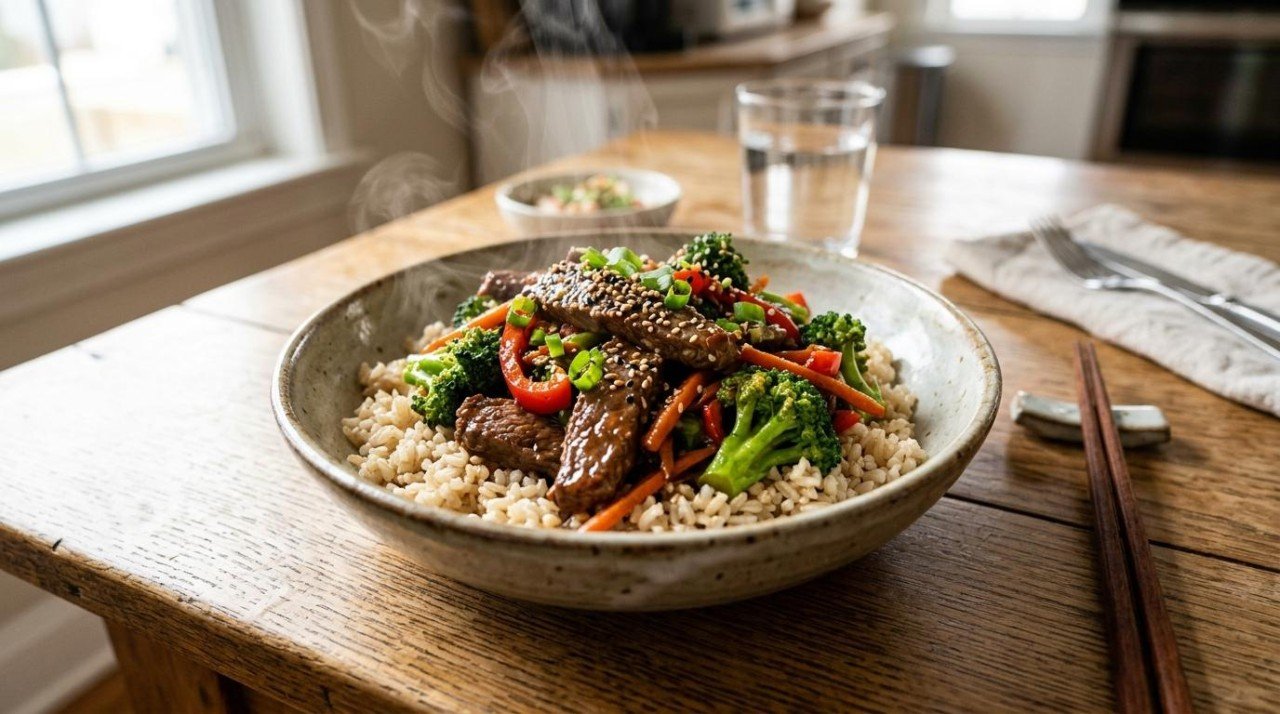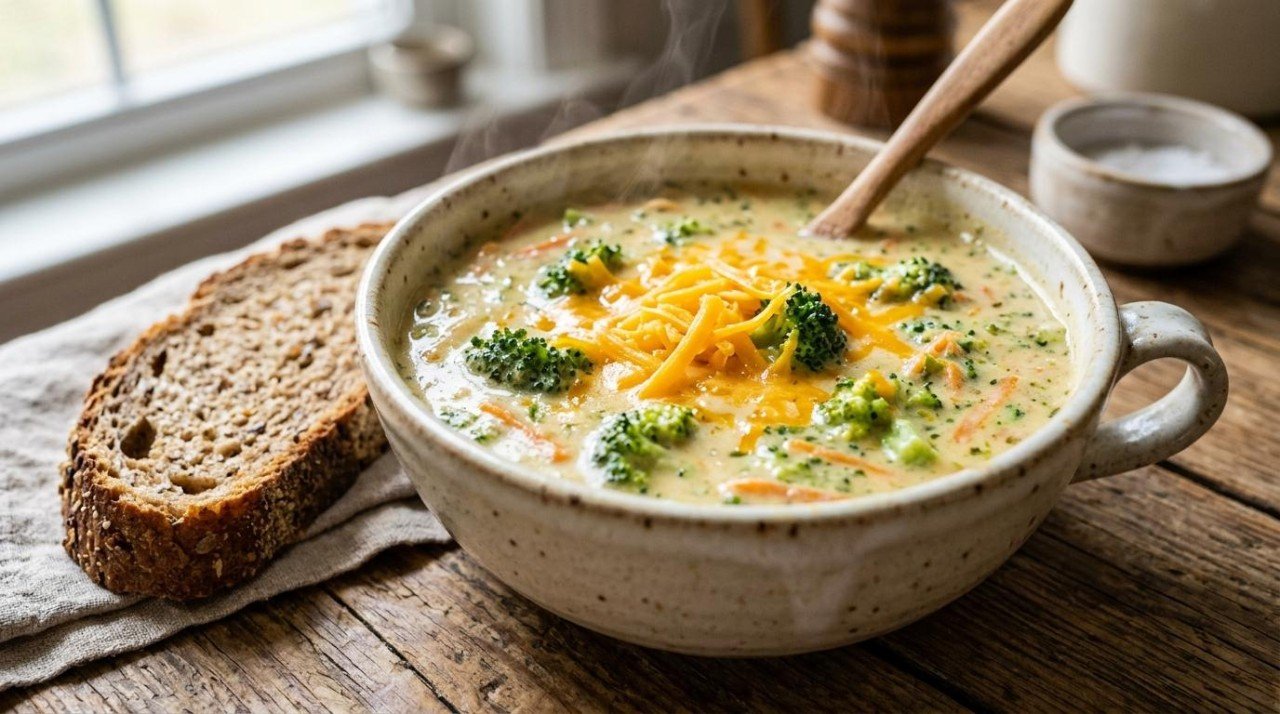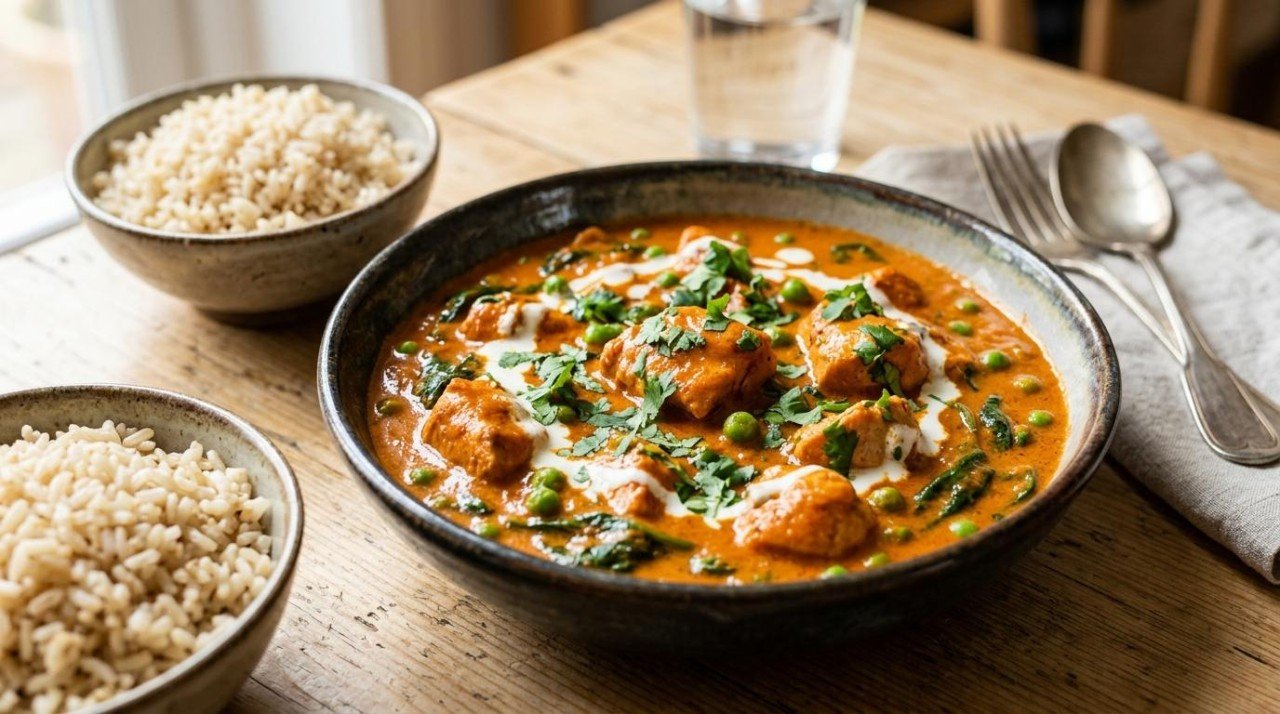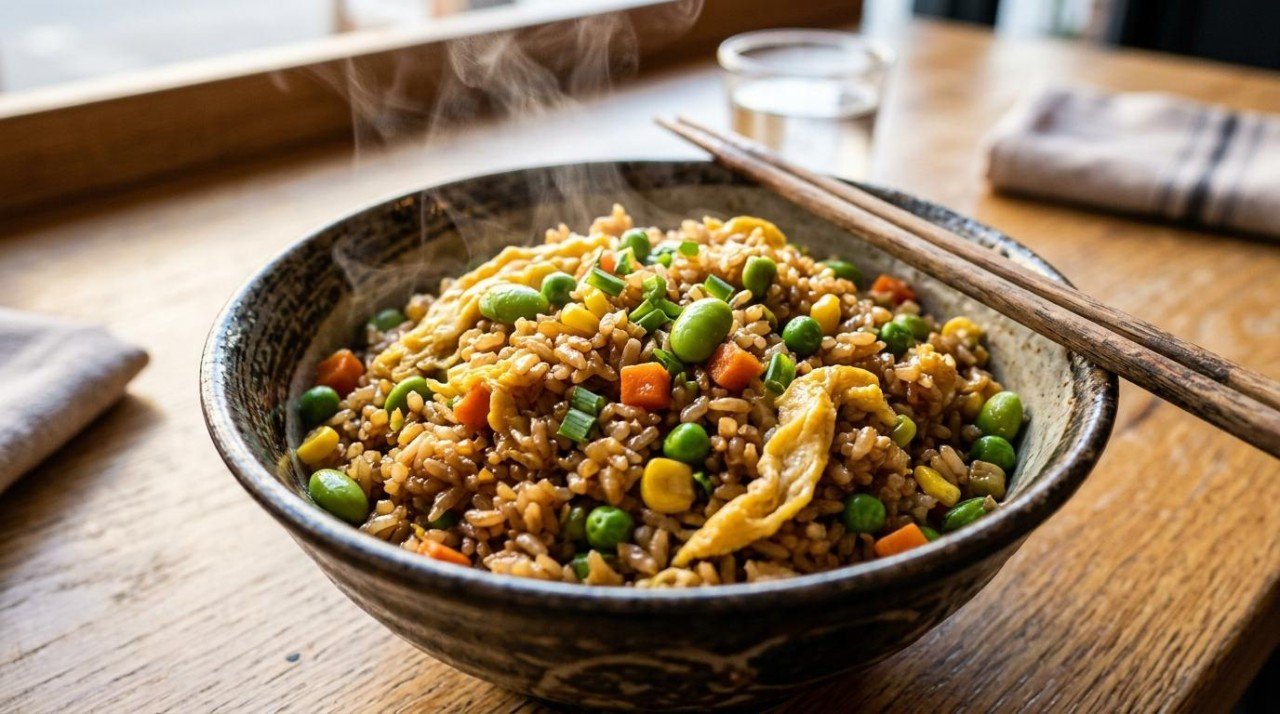
Takeout fried rice is one of the great leftover foods. It was born as one: the earliest versions show up in China's Sui dynasty as a way to use up day-old rice that was past its prime but too good to waste, tossed in a screaming-hot wok with egg, a few vegetables, and whatever was around. Centuries later it is the thing half the table orders, the side that quietly disappears first, and the reason there is never quite enough rice.
It also has a bit of a reputation. Fried rice is the dish people feel a little guilty about ordering, and the standard takeout version earns some of that. So we built a representative one and ran it through Eat Well Planner's Nutrition Score, the same at-a-glance number that shows up on any public recipe page. It came back 43 out of 100.
Here is the promise. We kept the wok-fried egg, the toasty rice, the savory soy backbone that makes this taste like fried rice and not like a rice salad, and still got it to 86 out of 100. That is a 43-point jump, and every swap below carries the real, verified score change it earned. Same dish, twice the score.
The original: what's in it and how it scores
Here is the standard takeout-style version we scored, for four people as a main:
- 4 cups cooked day-old white rice
- 3 tablespoons vegetable oil
- 2 large eggs
- 1/2 cup frozen peas and carrots
- 3 tablespoons regular soy sauce
- 3 green onions
- 2 cloves garlic
- 1/2 teaspoon salt
Nutrition Score: 43/100. Now the diagnosis, because knowing why it scores that way is what lets you fix your own recipes. Two things are dragging it down, and it is worth being precise about which:
- Sodium is very high — about 1,650 mg per serving, roughly 72% of a full day's worth in one bowl, and it is the single biggest problem. It comes from the double hit of 3 tablespoons of soy sauce plus the added salt. The American Heart Association puts the daily limit at 2,300 mg, with an optimal goal closer to 1,500 mg, so a side of fried rice can spend most of your day's budget before the main course arrives.
- Almost no fiber and very few plants. Fiber comes in at just 1.6 g per serving. Half a cup of peas and carrots split four ways is barely a garnish, and white rice underneath contributes fast starch and little else. Americans already average only about 15 g of fiber a day against a target of 25 to 35 g, and this dish does nothing to close that gap.
Now notice what is not on that list. Saturated fat is low, about 2.3 g per serving, because there is no fatty meat or cheese here. There is no added sugar at all. And the enriched white rice actually makes the original a decent source of folate and iron. This is not a junk plate — it is a plate with a salt problem and an empty-base problem. So we are not going to fight the wrong battle. We are going to add what is missing and quietly walk the salt back down.
The upgrades
Four swaps, ordered from the biggest score mover to the finishing touch. If you only make one change, make the first one.
1. Make vegetables and edamame the bulk of it (and add an egg)
- Swap: 1/2 cup peas and carrots and 2 eggs → 1.5 cups mixed vegetables, 1 cup shelled edamame, and 3 eggs
- Score impact: +15 points (43 → 58)
- What it changes: Triples the fiber (1.6 g → 4.8 g), nearly doubles the protein (9 g → 16 g), and turns a beige bowl into a real meal
- What it costs you: Nothing but a little more chopping — and a slightly fuller plate
This is the highest-impact move in the whole makeover, and it is really one idea: fried rice should be a vegetable dish that happens to have rice in it, not a rice dish with vegetables for show. Doubling the frozen medley and adding a cup of shelled edamame is what does the heavy lifting. The edamame is the quiet hero here — a cup brings a big slug of plant protein and fiber, so the dish finally has enough staying power to be dinner instead of the thing you are hungry an hour after. The third egg adds more protein and that soft, savory scramble everyone actually wants more of.
Because the vegetables and egg now carry the bowl, this is also where the plant-diversity count starts climbing — and plant variety, not just fiber grams, is what the research on gut health keeps pointing to. A wider range of plants feeds a wider range of gut bacteria, which is the whole idea behind tracking a weekly plant count — and this one bowl now has four and a half different plants in it.
2. Brown rice for white
- Swap: Day-old white rice → day-old brown rice
- Score impact: +5 points (58 → 63)
- What it changes: Adds fiber and magnesium, and turns the empty base into one that contributes real nutrition
- What it costs you: A nuttier, chewier bite — and it is genuinely better in fried rice
Here is the good news for fried rice specifically: brown rice actually wants to be day-old. Cold, dried-out grains are what keep fried rice from turning to mush in the wok, and brown rice, with its tougher bran layer, holds its texture even better than white. If you have been avoiding brown rice because it goes gluey, fried rice is the technique that fixes that — the same reason takeout cooks swear by yesterday's rice. Cooling cooked rice overnight also builds resistant starch, a gut-friendly starch your body treats more like fiber.
One honest note: white rice in the US is enriched, so switching to brown gives up some of the added iron and folate. But the edamame and vegetables you just piled in more than replace both — the finished dish still lands as an excellent source of iron and folate, now from real food instead of fortification. Brown keeps the bran and germ where the fiber, magnesium, and B vitamins live, and Harvard's researchers link eating brown rice instead of white to an 11% lower risk of type 2 diabetes. If you are not ready to go all the way, our white rice substitutes guide covers halfway moves, like cutting it 50/50 with brown, that still move the needle.
Take the Guesswork Out of Eating Well
Eat Well Planner helps you organize your favorite recipes, plan balanced meals, and automatically generate shopping lists — all in one place. Whether you're tracking macros, managing dietary restrictions, or just trying to stop asking "what's for dinner?", we've got you covered.
Our AI-powered tools can adapt any recipe to your dietary needs, help you discover new meals you'll love, and even log your nutrition effortlessly. It's meal planning made simple.
Start Organizing Your Meals — Free3. Halve the oil with a hotter wok
- Swap: 3 tablespoons vegetable oil → 1.5 tablespoons
- Score impact: +4 points (63 → 67)
- What it changes: Drops about 45 calories per serving and trims total fat, with no change to the flavor
- What it costs you: Nothing you can taste — you just have to get the pan hot first
Takeout fried rice glistens because it is cooked in a lot of oil. You do not need most of it. The trick is heat: a properly hot wok or wide skillet sears the rice and vegetables so they crisp instead of steam, and crisp rice needs far less oil to taste rich. Get the pan ripping hot before anything goes in, work in the oil a tablespoon and a half at a time, and do not crowd the pan. The oil is not the villain here — vegetable oil is fine, and the panic about seed oils is largely overblown — it is just that three tablespoons is more than the dish needs to taste like itself.
4. Cut the sodium, and build the flavor back
- Swap: 3 tablespoons regular soy sauce plus 1/2 teaspoon salt → 2 tablespoons low-sodium soy sauce, no added salt, finished with toasted sesame oil, fresh ginger, and extra scallion and garlic
- Score impact: +19 points (67 → 86)
- What it changes: Cuts sodium by nearly 80% (about 1,650 mg → 350 mg per serving) and clears the last thing holding the score down
- What it costs you: Nothing — the finish makes it taste like more, not less
This is the swap to pay attention to, and it hides a lesson about the score itself. On its own, applied to the original bowl, cutting the sodium this way is worth almost nothing — we tested it, and it moved the score a single point. But applied here, as the last change, it is worth 19. Nothing about the salt changed between those two tests. What changed is everything around it: once the fiber, plants, protein, and whole grain are in place, sodium is the only thing left dragging the number down, so removing it unlocks the whole rest of the score at once. That is the entire philosophy of the Nutrition Score in one swap — fix the biggest remaining problem, not the scariest-sounding one in isolation.
And you lose the salt without losing the flavor. Low-sodium soy sauce has roughly 40% less sodium than regular while tasting nearly identical once it hits a hot pan, and dropping the extra 1/2 teaspoon of salt on top is what takes the sodium from very high to a non-issue. The flavor you would have gotten from salt comes instead from a teaspoon of toasted sesame oil stirred in off the heat, a knob of grated fresh ginger, and an extra scallion and clove of garlic — aromatics do the seasoning that salt used to. Our soy sauce substitutes guide covers even-lower-sodium options like coconut aminos, and the sesame oil and fresh ginger guides have swaps if you are out of either.
What we kept (on purpose)
A makeover that guts the dish is a failed makeover, so a few things stayed put. We kept the egg — we added one, in fact — because the soft scramble is half of why fried rice is comforting, and it brings choline and protein. We kept real soy sauce, just the lower-sodium kind and a little less of it, because soy is the savory backbone; swap it for something bland and you have steamed rice with vegetables, not fried rice. And we kept it fried in actual oil in a hot pan, because the toasty, slightly crisp texture is the entire point — this is not a steamed-rice bowl wearing a disguise. We stopped at 86 because the next honest change would start subtracting from the dish instead of adding to it.
The healthier version: full recipe
Nutrition Score: 86/100. Serves 4.
- 4 cups cooked day-old brown rice (cold from the fridge)
- 1.5 tablespoons vegetable or peanut oil
- 3 large eggs, beaten
- 1.5 cups frozen mixed vegetables (peas, carrots, corn, green beans)
- 1 cup shelled edamame, thawed
- 4 green onions, sliced (whites and greens kept separate)
- 3 cloves garlic, minced
- 1 tablespoon fresh ginger, grated
- 2 tablespoons low-sodium soy sauce
- 1 teaspoon toasted sesame oil
- Black pepper, to taste
- Use rice cooked at least a few hours ahead and chilled — cold, dry grains are the whole secret to fried rice that fries instead of steams. Break up any clumps with your fingers before you start.
- Heat a wide skillet or wok over medium-high until hot. Add a teaspoon of the oil, pour in the beaten eggs, and scramble softly just until set. Scrape them onto a plate and set aside.
- Return the pan to high heat with the rest of the oil. Add the scallion whites, garlic, and ginger and stir for about 30 seconds, until fragrant but not browned.
- Add the mixed vegetables and edamame and stir-fry for 3 to 4 minutes, until hot and crisp-tender.
- Add the cold rice, spread it out, and let it sit for a moment before tossing, so it sears and crisps rather than steams. Stir-fry for 3 to 4 minutes, pressing it into the pan between tosses.
- Drizzle the low-sodium soy sauce around the edge of the pan and toss to coat. Return the eggs, add the scallion greens, and toss to break the eggs into the rice.
- Turn off the heat, stir in the toasted sesame oil, and season with black pepper. Serve right away.
Per serving, here is the before and after:
- Nutrition Score: 43 → 86
- Sodium: about 1,650 mg → about 350 mg (down nearly 80%, from 72% to 15% of the daily limit)
- Fiber: 1.6 g → 5.9 g (now an excellent source, at 20% of the daily value)
- Protein: about 9 g → about 15 g (roughly 70% more)
- Saturated fat: 2.3 g → 2.7 g (still low)
- Calories: about 354 → about 398
- Plants on the plate: 2.25 → 4.5 different plants
One number moved the "wrong" way on purpose: calories went slightly up. That is because this makeover adds food — a cup of edamame, more vegetables, another egg — rather than taking it away. What you get for those roughly 45 extra calories is 6 more grams of protein and 4 more grams of fiber, which is exactly the trade that makes a plate more filling instead of less. This is a rare makeover you eat more of, not less.
Swaps we tested and skipped
We scored a few popular swaps that did not make the cut, and here is why:
- All cauliflower rice instead of grain (scored 65). Swapping every cup of rice for riced cauliflower does score well on paper, but it drops the dish to about 180 calories a serving — that is a side of seasoned vegetables, not the satisfying bowl of fried rice anyone sat down for. Cauliflower also weeps water in a hot pan and goes soft, working against the crisp texture that defines the dish. If you love it, do half rice and half cauliflower for a middle ground, but full cauliflower stops being fried rice.
- Egg whites only. Cutting the yolks trims a trace of fat and cholesterol but costs you the choline and most of the flavor, for a score change too small to measure. Dietary cholesterol from whole eggs is not the problem it was once made out to be — more on that in our piece on eggs and cholesterol — so we kept the whole eggs and simply added one.
- Skipping the soy sauce to kill the sodium. It technically works, but bland fried rice is not fried rice. Low-sodium soy plus a sesame-and-ginger finish got the salt down nearly 80% while keeping the savory flavor, which is the better trade.
Make it fit other diets
This dish bends easily. Vegan: skip the eggs and lean on extra edamame plus crumbled firm tofu for the protein and soft texture the egg gave. Gluten-free: use tamari or a certified gluten-free soy sauce in place of regular. In Eat Well Planner you do not have to work these out by hand — ask the AI recipe chat to "make this vegan" or "make this gluten-free" and it rewrites the whole recipe with the swaps built in.
Do this to any recipe you love
None of this was guesswork. Every score and every point in this post came from running the recipe through Eat Well Planner's Make It Healthier tool, which proposes swaps like these and uses a calculator to verify the real nutritional gain before it shows you a suggestion — so you never chase a change that does not actually help. We tested each swap in the Recipe Playground, watching the score move in real time, which is exactly how we caught that the sodium fix is worth a single point in isolation but 19 as the final piece.
You can do the same with the food you actually cook. Import any recipe from a website, or paste in a video you saw online, score it, and let Make It Healthier show you where the easy points are hiding. Keep the dish you love. Just make the numbers better.