French toast started as thrift. The French name for it is pain perdu — lost bread — because it was the trick that rescued a stale loaf from the bin, and the Romans were soaking bread in milk and egg long before anyone called it French anything. Somewhere between there and the American diner it stopped being frugal and became a treat: thick slices, cream in the custard, butter in the pan, syrup poured with feeling.
It is a great breakfast. It also scores 25 out of 100 on our Nutrition Score, which is low enough that we wanted to know exactly where the points were going. Six changes took it to 50 — the score literally doubles — and it still soaks, still browns, still has that custardy middle under a crisp edge.
One thing to flag up front, because it shapes the whole post. We scored the original with a real quarter-cup pour of maple syrup per person, which is what comes out of the bottle when nobody is measuring. If you already pour more like 2 tablespoons, your starting point is higher than 25 and a chunk of the gain below is already yours. Every delta was measured one swap at a time, in the order they appear.
The original: what is in it and how it scores
We scored the standard American version — thick white bread, an egg-and-cream custard, fried in butter. For four people, eight slices, two each:
- 8 thick slices (320 g) white sandwich bread
- 4 large eggs
- 1 cup (240 ml) half-and-half
- 2 tablespoons (25 g) granulated sugar
- 1 teaspoon vanilla extract, 1 teaspoon ground cinnamon, a pinch of salt
- 4 tablespoons (56 g) butter for the pan
- 1 cup (320 g) maple syrup poured over — a quarter cup each
Scored per serving against our default profile, that is 25/100. In real numbers, one plate of two slices:
- Calories: about 707
- Added sugar: 57.4 g — 217% of a day's worth, and more than double the American Heart Association's daily ceiling of 25 g for women and 36 g for men
- Saturated fat: 12.8 g — 54% of a day
- Fiber: 2.5 g
- Protein: 16.1 g
- Sodium: about 800 mg
- Plant points: 0.25 (the cinnamon, and that is it)
The syrup is the event. Of that 57.4 g of added sugar, about 51 g is the pour and roughly 6 g is the sugar in the custard. That is worth sitting with, because most healthy-French-toast advice goes straight after the batter — and the batter is nearly innocent. The thing on top is doing the damage.
The bread is doing nothing. White sandwich bread is the endosperm of the wheat kernel with the bran and germ milled off, which removes, per Harvard's Nutrition Source, more than half of wheat's B vitamins, 90 percent of the vitamin E, and virtually all of the fiber. Two slices of French toast return 2.5 g of fiber against a target of 25 to 35 g a day. It is a soft, neutral sponge — which is genuinely why it works here — but it contributes nothing nutritionally beyond starch.
The cream and the pan butter stack up. Half-and-half in the custard plus 4 tablespoons of butter across eight slices puts saturated fat at 12.8 g per serving, over half a day, before anyone puts a pat on top.
What is already fine — and it is more than you would guess. This is real food: eggs, milk, bread, butter, real maple. The eggs and dairy do serious work, and the score says so. One serving is an excellent source of riboflavin (118% DV), iron (41%), choline (35%), phosphorus (33%), folate (28%), calcium (26%) and vitamin B12 (21%), and it delivers 16.1 g of protein. Nothing below touches the eggs. The problem is not that French toast is built out of bad ingredients; it is that two of them are in the wrong proportion and one of them is inert.
The upgrades
Six changes, ordered by what they are worth against what they cost you. If you only make one, make the first.
1. Sturdy 100% whole grain bread instead of white
- Swap: White sandwich bread → 100% whole wheat, thick-sliced
- Score impact: +8 points (25 → 33)
- What it changes: Doubles the fiber (2.5 g → 5.2 g), adds the bran and germ back — B vitamins, magnesium, zinc — and takes plant points from 0.25 to 1.25
- What it costs you: A nuttier, less neutral background flavor, and it needs a longer soak
This is the biggest single lever, and it is the one people are most nervous about, because they picture the sad dry wheat bread of childhood. Buy the right loaf and the fear does not survive contact: you want a dense, sturdy, high-rising sandwich loaf where whole wheat flour is the first ingredient and there is no wheat flour, enriched flour or caramel color further down. (We wrote a whole guide on telling real whole grain bread from the brown-colored kind, because the label games are relentless.)
The texture argument actually runs in favor of whole grain here. King Arthur's method calls for a high-rising, sturdy bread sliced thick, preferably slightly stale, soaked about 30 seconds a side — the enemy of French toast is a slice that turns to mush. A tight whole wheat crumb holds its structure through a longer soak, which means it can take on more custard, not less. Give it 45 to 60 seconds a side instead of 30, and if your loaf is fresh, leave the slices out on a rack for an hour or overnight first. That is the original trick anyway: this dish was invented for bread that was already past its best.
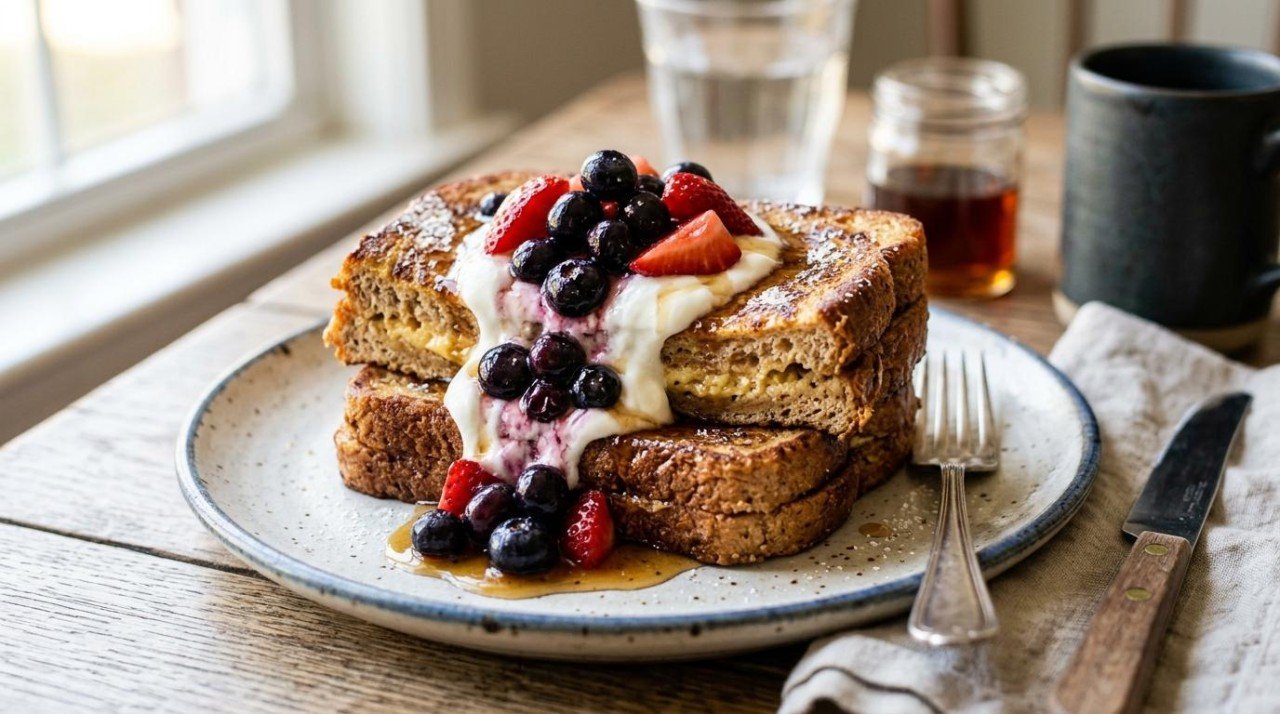
2. Macerated berries and Greek yogurt on top
- Swap: Add 2 cups of berries and 1 cup of plain Greek yogurt across the four plates
- Score impact: +7 points (33 → 40)
- What it changes: Protein 18.1 g → 24.7 g, vitamin C from zero to 28% DV, plant points 1.25 → 3.25
- What it costs you: Nothing in flavor. It costs about 78 calories at this stage — and the next swap gives back far more
This is an addition, not a substitution, which is why it is painless and why it is worth this many points. Toss the berries with a teaspoon of maple and a squeeze of lemon and leave them for ten minutes while you cook — they slump, release juice, and turn into something that behaves like syrup on the plate. That matters for the next swap: the wet, sweet berries are what let you pour less from the bottle without the toast feeling dry.
The yogurt is doing the protein work. A spoonful of plain Greek yogurt where you would have put whipped cream adds about 6 g of protein per plate and a tang that plays well against the cinnamon. Between the whole wheat and the two fruits, this version now brings 3 different plants to breakfast — which counts toward the 30 plants a week target our Plant Points tracker is built around.
3. Measure the maple instead of pouring it
- Swap: A quarter cup per person → 2 tablespoons per person, in a small dish
- Score impact: +4 points (40 → 44)
- What it changes: Added sugar 57.4 g → 33.2 g per serving; calories drop by about 104
- What it costs you: Genuinely very little, once the berries are there
Note what this is not: it is not a substitution. The maple stays, and it stays real. This is a measurement — the same pour, put in a dish first so you can see it. A quarter cup of maple syrup is about 208 calories and 51 g of sugar, roughly two days' worth of added sugar for a woman, on top of toast that already had sugar in the custard.
Two tablespoons on toast that comes with juicy macerated berries does not read as deprivation. If you want to go further, our guide to maple syrup substitutes covers what actually works when you want the flavor with less of the sugar — and which of the popular swaps do not survive contact with hot bread.
4. Whole milk instead of half-and-half in the custard
- Swap: 1 cup half-and-half → 1 cup whole milk
- Score impact: +3 points (44 → 47)
- What it changes: Saturated fat 13.2 g → 10.1 g; calories drop by about 42
- What it costs you: A little richness — but less than you would think, because the eggs carry it
This is where the received wisdom is wrong. Cream in a French toast custard sounds like the thing that makes it luxurious, but the custardy interior comes from egg setting inside the bread, not from butterfat in the soak. Four eggs to one cup of liquid is an egg-forward ratio, and it sets into something silky whether that liquid is cream or milk. Cut the cream and the texture holds; cut the eggs and it collapses.
Whole milk, not skim — we tested skim and it is covered below. If you are used to reaching for cream here, the half-and-half substitutes guide has the ratios for going the other direction too.
5. Half the butter in the pan
- Swap: 4 tablespoons butter → 2 tablespoons
- Score impact: +2 points (47 → 49)
- What it changes: Saturated fat 10.1 g → 6.9 g, from 30% of a day down from the original 54%; calories drop another 52
- What it costs you: Slightly less even browning if your pan is not up to it
Two tablespoons across eight slices is about half a teaspoon per slice, which is enough to brown if — and only if — you use a nonstick or a well-seasoned cast iron pan over medium heat, and add the butter in small amounts per batch rather than all at once. Butter over high heat burns before the custard sets; medium heat and a little patience is the whole technique.
Here is the honest part. We tested the common workaround of adding a tablespoon of neutral oil to the butter for a higher smoke point — and it handed back both points. Butter plus oil scored 47, the same as not cutting the butter at all. If you want the fat cut to count, cut the fat; do not replace it with different fat. (Our butter substitutes guide covers where butter genuinely can be swapped, and this pan is not one of those places.)
6. Leave the sugar out of the custard
- Swap: 2 tablespoons granulated sugar in the batter → none
- Score impact: +1 point (49 → 50)
- What it changes: Added sugar 33.2 g → 27.0 g per serving
- What it costs you: The slices brown a touch slower and a shade paler
The smallest swap, and we are including it mostly to be straight with you about scale: this is the one everyone reaches for first and it is worth a single point. Still, it is 6 g of added sugar per plate for nothing you will miss, because the vanilla and cinnamon are already doing the perceptual work. Penn State sensory researchers found that vanilla makes milk taste sweeter to tasters who do not know it is there, enough that sugar could be cut 20 to 50% with no drop in perceived sweetness. Keep the full teaspoon of vanilla — arguably go to two — and the missing tablespoons never register.
Take the Guesswork Out of Eating Well
Eat Well Planner helps you organize your favorite recipes, plan balanced meals, and automatically generate shopping lists — all in one place. Whether you're tracking macros, managing dietary restrictions, or just trying to stop asking "what's for dinner?", we've got you covered.
Our AI-powered tools can adapt any recipe to your dietary needs, help you discover new meals you'll love, and even log your nutrition effortlessly. It's meal planning made simple.
Start Organizing Your Meals — FreeWhat we kept (on purpose)
Real butter in the pan, because nothing else browns bread like it. Whole eggs, all four — the yolks are the custard, and they carry the choline and the B12. Whole milk. Real maple syrup, not a sugar-free imitation. And two thick slices per person, because a serving that leaves you hunting through the cupboard at 10 a.m. is not an upgrade.
We also stopped somewhere specific, and it is worth naming. Serve this with no syrup at all and it scores 65 — fifteen points above where we landed, in one move. The berries genuinely are sweet enough to carry it. We did not put it in the recipe because French toast without syrup is a different breakfast, and a makeover that quietly deletes the best part of the dish is not a makeover. But now you know exactly what those 2 tablespoons cost, and you can decide.
One more honest limit: sodium barely moved, 800 mg down to 750 mg. Whole wheat sandwich bread is about as salty as white sandwich bread, and bread is most of the sodium here. If that is your priority, the lever is the loaf itself, not anything in this recipe.
The healthier version: full recipe
Scores 50/100. Serves 4, two slices each.
- 8 thick slices (about 320 g) sturdy 100% whole wheat sandwich bread, preferably a day old
- 4 large eggs
- 1 cup (240 ml) whole milk
- 1 teaspoon vanilla extract
- 1 teaspoon ground cinnamon
- 1/4 teaspoon salt
- 2 tablespoons (28 g) butter, for the pan
- 1 cup (150 g) blueberries
- 1 cup (150 g) strawberries, sliced
- 1 cup (240 g) plain Greek yogurt
- 1/2 cup (160 g) pure maple syrup, for serving
- If your bread is fresh, spread the slices on a rack and leave them out for an hour, or overnight. Dry bread drinks custard; fresh bread turns to mush.
- Toss the blueberries and sliced strawberries with a teaspoon of the maple syrup and a squeeze of lemon if you have one. Set aside to macerate while you cook.
- Whisk the eggs, milk, vanilla, cinnamon and salt in a wide, shallow dish until completely uniform — no ropes of white left, or they will show up as scrambled patches on the finished slice.
- Heat a nonstick or well-seasoned cast iron skillet over medium heat and add about half a tablespoon of the butter.
- Soak two slices at a time, 45 to 60 seconds a side. Whole wheat takes longer than white; you want the custard through to the middle without the slice going limp. Lift each slice and let the excess drip off before it goes in the pan.
- Cook about 2 to 3 minutes a side, until deep golden and the center is set and springs back when pressed. Do not push the heat up to hurry it — the butter will burn before the custard sets.
- Repeat in batches, adding another half tablespoon of butter each time and wiping out any burnt crumbs between rounds.
- Serve two slices per plate with a quarter of the macerated berries, a heaped spoonful of Greek yogurt, and 2 tablespoons of maple syrup measured into a small dish rather than poured from the bottle.
Per serving, original versus improved:
- Nutrition Score: 25 → 50
- Calories: 707 → 553
- Added sugar: 57.4 g → 27.0 g (217% DV → 102%)
- Saturated fat: 12.8 g → 6.9 g (54% DV → 30%)
- Fiber: 2.5 g → 6.7 g
- Protein: 16.1 g → 24.7 g
- Sodium: 800 mg → 750 mg
- Plant points: 0.25 → 3.25
The improved plate is now an excellent source of riboflavin (86% DV), phosphorus (60%), vitamin B12 (52%), iron (41%), biotin (40%), choline (39%), pantothenic acid (38%), thiamine (37%), calcium (35%), protein (31%), zinc (30%), vitamin C (28%), niacin (26%), magnesium (24%), vitamin B6 (24%) and fiber (23%) — the last two of those, plus the vitamin C, being things the original had essentially none of.
Swaps we tested and skipped
- Egg whites instead of whole eggs — scores 49, one point lower. The most-recommended healthy French toast swap on the internet makes the score worse: you lose the yolks' choline, B12, vitamin D and vitamin A, and you lose the custard. Skip it.
- Skim milk instead of whole — scores 51, one point higher. Real, but small, and a skim custard sets noticeably thinner. If you drink skim anyway, take the point. We would not buy it for this.
- Butter plus a tablespoon of oil in the pan — scores 47, giving back both points from swap 5. Higher smoke point, same total fat, no gain.
- Chopped walnuts on top — scores 51, plus a fourth plant point and a little omega-3 ALA, for about 66 calories a plate. This one is genuinely your call; we left it out of the recipe to keep the plate simple. Worth knowing: when we tested walnuts on the version that still had the extra oil in the pan, the score dropped six points. Added fat on added fat stops paying.
- No syrup at all — scores 65, as covered above. The highest-scoring version we made, and the one least likely to get cooked twice.
Make it fit other diets
- Dairy-free: unsweetened soy milk in the custard (it is the only common plant milk with comparable protein), coconut oil or a vegan butter in the pan, and a thick coconut or almond yogurt on top.
- Gluten-free: use a sturdy whole grain gluten-free loaf and dry the slices out properly first — GF bread has less structure and will fall apart in a long soak. Cut the soak to 20 to 30 seconds a side.
- Egg-free: this one is hard to fake. The eggs are the dish, and a starch-thickened custard gives you sweet soggy toast rather than French toast. We would cook something else.
If you want any of these written out properly, Eat Well Planner's Recipe Variations will rewrite the whole recipe for a dietary need in one step — amounts adjusted, method adjusted — and you can ask the AI recipe chat follow-up questions with the full recipe in context.
Do this to your own recipes
Nothing above was guesswork. Every number came from the same tools that are in the app: we imported the recipe, read its Nutrition Score, and used Make It Healthier, which proposes concrete ingredient swaps and runs each one through a calculator to verify the real nutritional gain before it shows you the suggestion. Then we took the shortlist into the Recipe Playground and applied them one at a time to see what each was individually worth — which is how we caught that the butter-and-oil trick gives back its own gain, and that egg whites make things worse.
You can do exactly this to any recipe you love. Import it from a URL, an Instagram reel or a YouTube video, look at what the score says is dragging it down, and let the app propose the swaps — then keep the ones you would actually eat. That last part is the whole method. A recipe you improved by 25 points and cook every other Sunday beats a perfect one you never make again.
Eat Well Planner is free to use — import your first recipe and see what it scores.