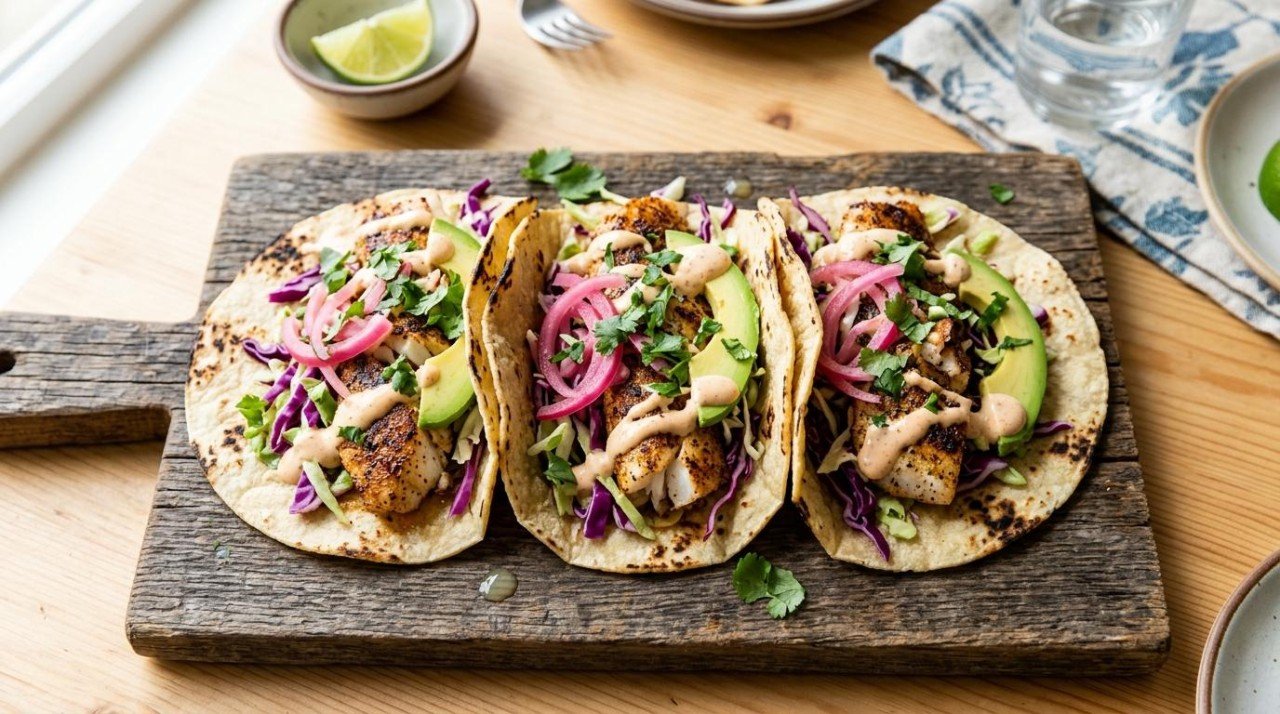
Fish tacos are one of the best fast dinners there is. Flaky white fish, crunchy cabbage, something creamy, something sharp, a squeeze of lime, all folded into a warm tortilla in about the time it takes to set the table. They come from Baja California, and in the US they owe a lot to Ralph Rubio, who first ate them at a stand in San Felipe on spring break and opened the first Rubio's in San Diego in 1983.
So we scored the version most Americans actually make at home with the app's Nutrition Score: beer-battered, deep-fried fish on flour tortillas, with a chipotle sauce built on mayo and sour cream and a handful of shredded cheese on top. It came back at 52 out of 100. That is a respectable start for anything that has been through a deep fryer, and the fish is the reason.
Then we rebuilt it one swap at a time, scoring after every change, and finished at 94. The biggest single gain was not the fryer. It was the tortilla. And when we took the fish out of the batter, the score went down. Here is every number, including the ones that surprised us.
The original: what's in it and how it scores
The version we scored makes 8 tacos, 2 per serving for 4 people. It is 1 pound of white fish in a beer batter (1 cup of all-purpose flour, 1 cup of lager, a teaspoon of baking powder), deep-fried until about 3 tablespoons of oil ends up absorbed. The fish goes into 8 small flour tortillas with 2 cups of shredded green cabbage, a simple pico de gallo (tomato, white onion, cilantro, jalapeño), 3/4 cup of shredded Monterey Jack, and a sauce of 1/4 cup mayonnaise, 1/2 cup sour cream, a chipotle in adobo, and lime juice. About a teaspoon of salt across the whole thing.
A scoring note: we used Alaska pollock for the fish. It is a lean, mild, inexpensive white fish, and it is easy to find frozen. Cod, haddock, and tilapia all work the same way in this recipe, and all four are on the FDA's "Best Choices" list for low mercury.
Per serving that comes to 768 calories, 34.9 g protein, 39.7 g fat, 11.7 g saturated fat, 1,490 mg sodium, and 4.5 g fiber. Nutrition Score: 52.
Here is what drags it down:
- Sodium, flagged very high. 1,490 mg is 65% of the daily value in one dinner. Harvard's Nutrition Source puts the chronic-disease limit at 2,300 mg a day and notes most Americans already eat about 3,400. The biggest single source here is not the salt shaker. It is the flour tortillas, at roughly 420 mg for the two in each serving.
- Saturated fat, also flagged very high, at 11.7 g (50% of the daily value). Almost none of it comes from the fish or the fryer. About 4 g is the cheese, and nearly 5 g is the mayo-and-sour-cream sauce.
- 4.5 g of fiber for a 768-calorie meal, because the batter and the tortillas are both refined flour.
And what is already good, because the fish taco deserves credit: this plate is an excellent source of long-chain omega-3s (186% of the daily value), vitamin B12 (176%), and phosphorus (98%), with nearly 35 g of protein. It also already has raw cabbage, tomato, onion, cilantro, and jalapeño in it, which is more plants than most takeout. The format is good. The fillings around the fish are where the points are.
The upgrades
We rebuilt this in the app's Recipe Playground, in the order below. Every delta is cumulative, measured on top of the change before it, and together they add up to exactly the 42 points between 52 and 94. One of them is negative. We left it in because that is what the score said.
Upgrade 1: Switch to corn tortillas
- Swap: 8 small flour tortillas → 8 corn tortillas (6-inch)
- Score impact: +13 points (52 to 65)
- What it changes: Sodium drops from 1,490 to 1,100 mg a serving, fiber rises from 4.5 to 5.7 g, and saturated fat falls by 1.6 g
- What it costs you: A more toasty, corn-forward taco. In Baja this is not really a swap. Both tortillas are traditional
The best upgrade on the list is also the easiest one. A corn tortilla is basically corn, lime, and water. A flour tortilla has fat and salt worked into the dough, and at 700 mg of sodium per 100 g in the app's data, the two in each serving carried more than a quarter of the sodium in the whole dinner. The corn version has almost none. Corn tortillas are also made from nixtamalized corn, the old process of cooking corn in an alkaline solution, which makes the niacin in corn available to the body and raises its calcium.
The trick is heat. A cold corn tortilla cracks. Warm each one in a dry skillet for 30 to 45 seconds a side until it gets soft and picks up a few brown spots, then stack them in a clean kitchen towel so they steam each other. If you want a flour tortilla anyway, see our tortilla substitutes guide, but read the skipped swaps below first.
Upgrade 2: Make the chipotle crema with Greek yogurt
- Swap: 1/4 cup mayonnaise + 1/2 cup sour cream → 3/4 cup plain low-fat Greek yogurt, with the same chipotle and lime
- Score impact: +10 points (65 to 75)
- What it changes: 124 fewer calories a serving, saturated fat from 10.1 to 5.7 g, and protein up 3 g
- What it costs you: A tangier, slightly thinner sauce. With chipotle and lime in it, nobody can tell
Fish taco sauce is mostly there to be cool, creamy, and smoky against the hot fish, and Greek yogurt does all three. Adobo sauce hides the difference completely. Stir in one minced chipotle plus a teaspoon of the adobo, a tablespoon of lime juice, and a small pinch of salt. Keep it cold and spoon it on at the table. Our sour cream substitutes guide covers the other options if yogurt is not your thing.
Upgrade 3: Skip the shredded cheese
- Swap: 3/4 cup shredded Monterey Jack → none
- Score impact: +3 points (75 to 78)
- What it changes: Saturated fat from 5.7 to 1.6 g, 83 fewer calories, and 140 mg less sodium a serving
- What it costs you: Less than you would guess. The crema already does the job the cheese was doing
Shredded cheese is an American add-on. The Baja fish taco is built on fish, cabbage, pico de gallo, and a creamy sauce, with no cheese. On a taco that already has a rich sauce, the Jack mostly adds saturated fat. Taking it off was worth 3 points here, and would have been worth 7 on the original recipe. It is worth less at this stage because the yogurt crema already fixed most of the saturated fat problem.
Upgrade 4: Grill the fish with a spice rub (the one that cost points)
- Swap: Beer batter and deep-frying → a smoked paprika rub and a hot cast-iron pan with 1 tablespoon of oil
- Score impact: −3 points (78 to 75)
- What it changes: 192 fewer calories a serving and fat cut in half, but also less folate, thiamine, and omega-3 ALA
- What it costs you: The crunch of the batter. You get a smoky, spicy crust instead
This is the swap everyone expects to be the big win, and the score marked it down. The reason is worth knowing. The Nutrition Score is not a calorie counter. It rates what the meal gives you. The batter's enriched flour carried a lot of B vitamins: folate fell from 40% to 11% of the daily value when it came out, and thiamine fell from 41% to 18%. The frying oil was canola, which the score credits for its plant omega-3 ALA, and that fell from 67% to 27%. Take away 192 calories of batter and oil, and you also take away things the score was counting. (As a check, we added back a second tablespoon of canola oil to the finished grilled build, and it scored 2 points higher.)
So we tested the other path too. With every other upgrade in this post applied, the beer-battered version finishes at 96, and our grilled version finishes at 94. That is close enough to call a tie, and it matches what we found with fish and chips: the fryer is rarely what makes a fish dinner score badly. We still grill ours, because it is 15 minutes with no pot of oil to deal with and 190 fewer calories per serving. If crispy battered fish is the whole point for you, keep it and make the other six changes. You will lose nothing on the score.
If you grill, the rub matters. Plain grilled fish scored a point lower than rubbed fish at this step, and removing the spices from the finished recipe cost 2 points. Smoked paprika, garlic powder, onion powder, cumin, oregano, and a little cayenne on a very hot pan is close to the blackening method Paul Prudhomme made famous, using a tablespoon of oil instead of a dip in melted butter. Turn on your kitchen fan.
Upgrade 5: Make a real slaw with pickled red onion
- Swap: 2 cups plain green cabbage → half green and half red cabbage tossed with lime, plus a quick-pickled red onion
- Score impact: +0 points (75 to 75)
- What it changes: Plant points from 6.75 to 8.75, fiber up to 6.4 g, potassium up 80 mg a serving
- What it costs you: Five minutes, and it makes the taco taste better
The score did not move, and we kept it anyway. This upgrade is mainly about flavor. A sharp, bright pickled onion is what makes a fish taco taste finished, and it lets the rest of the taco get away with less salt, which matters in a minute. Red cabbage also adds color and is a different plant for your weekly count. Slice half a red onion thin, cover it with 2 tablespoons of apple cider vinegar and a pinch of salt, and let it sit while you make everything else.
Upgrade 6: Add avocado
- Swap: No avocado → 1 large avocado, sliced across the 8 tacos
- Score impact: +2 points (75 to 77)
- What it changes: Fiber from 6.4 to 8.9 g, potassium from 890 to 1,070 mg a serving
- What it costs you: About 60 calories a serving
This adds back some of the richness we removed with the cheese and the sour cream, but with fiber and potassium in it. With the avocado, a serving of these tacos has 8.9 g of fiber, nearly a third of the daily value. Harvard reports that adults need at least 25 to 35 g a day, and most Americans get about 15.
Upgrade 7: Cut the salt in half
- Swap: About 1 teaspoon of salt across the recipe → 1/2 teaspoon, split between the rub, the crema, and the pickled onions
- Score impact: +17 points (77 to 94)
- What it changes: Sodium from 790 to 500 mg a serving
- What it costs you: Nothing you will notice, with lime, vinegar, chipotle, and smoked paprika all on the taco
This is the biggest number in the post, and it comes from a half teaspoon of salt. The same cut was worth only +5 on the original recipe. The score's sodium penalty hits hardest when everything else in the dish is already in good shape, so the last bit of salt is expensive. We also tested 3/4 teaspoon: it scored 88, so that final quarter teaspoon alone was worth 6 points. This is why the pickled onion was worth making. Acid gives the same kind of lift salt does. If you want more on why that works, our post on salt, fat, acid, and heat covers it.
What we kept (on purpose)
We kept the fish, of course. It is the best thing in the original and the reason it started at 52. We kept the chipotle and the smoke. We kept the pico de gallo exactly as it was, because tomato, onion, cilantro, and jalapeño were never a problem. We also kept 2 tacos as a serving and a tablespoon of oil in the pan. And we stopped at 94, because the only thing left to cut was flavor.
Take the Guesswork Out of Eating Well
Eat Well Planner helps you organize your favorite recipes, plan balanced meals, and automatically generate shopping lists — all in one place. Whether you're tracking macros, managing dietary restrictions, or just trying to stop asking "what's for dinner?", we've got you covered.
Our AI-powered tools can adapt any recipe to your dietary needs, help you discover new meals you'll love, and even log your nutrition effortlessly. It's meal planning made simple.
Start Organizing Your Meals — FreeThe healthier version: full recipe
Nutrition Score: 94 (up from 52). Serves 4 (8 tacos).
For the fish
- 1 lb (454 g) Alaska pollock fillets, or cod, haddock, or another lean white fish
- 2 teaspoons (6 g) smoked paprika
- 1 teaspoon (3 g) garlic powder
- 1 teaspoon (3 g) onion powder
- 1 teaspoon (2 g) ground cumin
- 1 teaspoon (1 g) dried oregano
- 1/4 teaspoon cayenne pepper
- 1 tablespoon (14 g) canola oil
For the chipotle crema
- 3/4 cup (170 g) plain low-fat Greek yogurt
- 1 chipotle pepper in adobo, minced, plus 1 teaspoon of the sauce (about 15 g total)
For the slaw, onions, and pico
- 1 1/2 cups (100 g) finely shredded green cabbage
- 1 1/2 cups (100 g) finely shredded red cabbage
- 1/2 small red onion (60 g), thinly sliced
- 2 tablespoons (30 g) apple cider vinegar
- 1 medium tomato (120 g), diced
- 1/4 white onion (40 g), finely diced
- 1/2 cup (10 g) chopped cilantro
- 1/2 jalapeño pepper (10 g), seeded and minced
To finish
- 2 tablespoons (30 g) fresh lime juice, divided
- 1/2 teaspoon (3 g) fine salt, divided
- 1 large ripe avocado (about 5 oz / 150 g flesh), sliced
- 8 corn tortillas, 6-inch (about 7 1/2 oz / 208 g)
- Pickle the onion first: toss the sliced red onion with the apple cider vinegar and 1/8 teaspoon of the salt, and set it aside for at least 15 minutes, stirring once.
- Make the crema: stir the Greek yogurt, minced chipotle, adobo sauce, 1 tablespoon of the lime juice, and 1/8 teaspoon of the salt together. Refrigerate until serving.
- Make the slaw and pico: toss both cabbages with the remaining tablespoon of lime juice. In a separate bowl, combine the tomato, white onion, cilantro, and jalapeño.
- Mix the smoked paprika, garlic powder, onion powder, cumin, oregano, cayenne, and the remaining 1/4 teaspoon of salt. Pat the fish very dry, brush it all over with the oil, and press the spice mix onto both sides.
- Heat a cast-iron skillet over medium-high heat for 4 to 5 minutes, until very hot, and turn on your kitchen fan. Cook the fish 2 to 3 minutes per side, without moving it, until a dark crust forms and the fish flakes easily in the center (145°F). Move it to a plate.
- Wipe out the skillet and warm the tortillas one or two at a time, 30 to 45 seconds per side, until soft and lightly spotted. Stack them in a clean kitchen towel.
- Break the fish into large flakes. Build each taco with slaw, fish, avocado, pico, pickled onions, and a spoonful of crema. Serve right away.
Per serving (2 tacos), original → healthier:
- Nutrition Score: 52 → 94
- Calories: 768 → 373
- Protein: 34.9 g → 29.4 g
- Saturated fat: 11.7 g → 1.9 g
- Sodium: 1,490 mg → 500 mg
- Fiber: 4.5 g → 8.9 g
- Potassium: 790 mg → 1,070 mg
- Plant points: 4.25 → 9.75
Protein drops by about 5 g, all of it from the batter flour and the cheese. The fish is the same pound. It still has 186% of the daily value for EPA and DHA omega-3s, which is a big part of why it scores 94. If you want more fish in your week, our guide to eating fish twice a week without the mercury worry is a good next read.
Swaps we tested and skipped
- Whole wheat flour tortillas instead of corn. These were worth +6 on the original, compared with +13 for corn. They add more fiber, but they still carry most of the sodium of a regular flour tortilla. Corn does better and tastes more like a fish taco.
- A sprinkle of cotija instead of no cheese. One ounce of cotija in place of the Jack scored +0 at that step, compared with +3 for skipping cheese. It is very salty, so a little gives a lot of flavor, but it cancels out the gain. If you love it, crumble a small amount over the top.
- Keeping a tablespoon of mayonnaise in the crema. This makes the crema a little richer, and it cost 2 points on the finished recipe (92 instead of 94). Yogurt alone was fine.
- Grilling the fish with no rub. This scored a point below rubbed fish at the grilling step, and removing the spices from the finished recipe cost 2 points. The rub adds plants and a lot of flavor, so it stays.
- Beer batter, with everything else upgraded. This was not rejected on the score, which was 96, 2 points higher than ours. We went with the grilled version for weeknight ease and 190 fewer calories per serving. Both are good options.
Make it fit other diets
Gluten-free: the grilled version is already gluten-free if your corn tortillas are 100% corn (check the label, since some brands add wheat flour). Dairy-free: replace the crema with avocado blended with lime juice, chipotle, and a splash of water, or see our Greek yogurt substitutes. Vegetarian: use the same rub on thick slices of roasted cauliflower. If you import this recipe into Eat Well Planner, Recipe Variations can rewrite it for any of these diets in one step, with the swaps already worked into the ingredients and instructions.
Do this to any recipe
We did not guess at any of this. Every number above came from scoring the recipe, changing one thing, and scoring it again. That is what Make It Healthier in Eat Well Planner does with any recipe you import from a website, an Instagram reel, or a YouTube video. It suggests swaps, and a calculator checks the real gain before you see them. If you would rather keep the beer batter, open the recipe in the Recipe Playground and see what it costs you. You might find, like we did, that it costs you nothing at all.