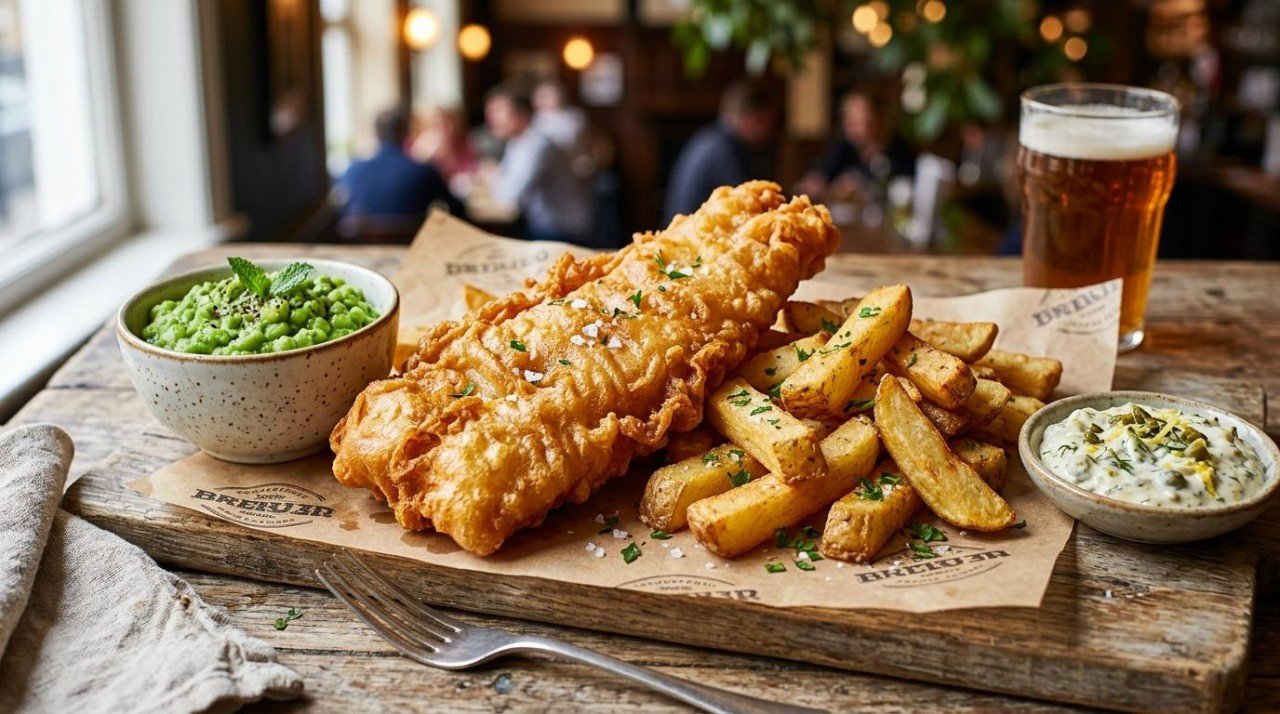
Fish and chips is one of the great arguments for frying things. A piece of white fish in a batter that shatters, chips with a crust and a fluffy middle, salt, vinegar, and a paper cone. It has been a working-class staple in Britain since the 19th century, when, as the dish's history records, the fried-fish tradition brought by Jewish immigrants met the fried potato and became a national habit.
So we scored a standard version with the app's Nutrition Score, expecting the worst. It came back at 53 out of 100 — one of the highest starting scores we have ever put through this series. Fish and chips is a much better dinner than its reputation, and the reason is sitting right in the middle of the plate.
Then we rebuilt it one swap at a time, scoring after every change, and finished at 86. The strangest part: the fish never left the deep fryer. Here is what actually moved the number, and what each change costs you at the table.
The original: what's in it and how it scores
The version we scored serves four and is the one a good chip shop makes: about 1 1/2 pounds of white fish fillets dipped in a beer batter (1 cup of white flour, a cup of cold lager, a teaspoon of baking powder), 2 pounds of russet potatoes cut into thick chips, both deep-fried in neutral oil until roughly 10 tablespoons of it ends up absorbed across the two. Tartar sauce is 1/2 cup of mayonnaise with pickle relish and lemon. Across the whole plate, about 2 teaspoons of salt.
One scoring note, because it matters: we scored the fish as Alaska pollock, which is the white fish most fried-fish products actually contain — it is the fillet in the McDonald's Filet-O-Fish, Arby's fish sandwich, and Birds Eye fish fingers. Cod and haddock are the chip-shop classics and are nutritionally close, though cod runs lower in EPA and DHA, so treat the omega-3 figures below as the pollock version of this plate.
Per serving that lands at 962 calories, 38.9 g protein, 57.9 g total fat, 8.3 g saturated fat, about 1,490 mg sodium, and 3.9 g fiber. Nutrition Score: 53.
Here is what drags it down:
- Sodium, flagged very high. 1,490 mg a serving is 65% of the daily ceiling in one meal. Harvard's Nutrition Source puts the chronic-disease limit at 2,300 mg a day and the adequate-intake target at 1,500 mg, and notes most Americans already run around 3,400 mg.
- Nothing green on the plate. Plant points: 1, against a weekly target of 30. The score flags Low Plant Diversity and Low Vitamin A.
- 3.9 g of fiber for a 962-calorie dinner, because the batter is refined white flour and there is nothing on the plate that is not fish or potato.
- Saturated fat at 8.3 g, flagged high — most of it from the frying oil and the mayonnaise rather than from anything you would call rich.
And here is what is already fine, because a makeover that manufactures problems is not worth reading. This plate is an excellent source of long-chain omega-3s at 276% of the daily value, vitamin B12 at 249%, and phosphorus at 95%, with 38.9 g of protein and 1,610 mg of potassium. The fish is not the problem. The fish is the reason a deep-fried dinner starts at 53 instead of in the thirties like most of the dishes in this series. Everything we did next was about the other four fifths of the plate.
The upgrades
We rebuilt this in the app's Recipe Playground, scoring after each change, in the order below. The deltas are real and cumulative — each one is measured on top of the last, and they add up to exactly the 33 points between 53 and 86.
Upgrade 1: Put the mushy peas back
- Swap: No vegetable → a bowl of minted mushy peas alongside
- Score impact: +15 points (53 to 68)
- What it changes: Fiber 3.9 to 9.6 g, protein 38.9 to 44.4 g, plant points 1 to 2.25
- What it costs you: Ten minutes and about 80 extra calories. That is the whole bill
The single biggest lever in this makeover adds calories, changes nothing about the fish or the chips, and is not even our idea. Mushy peas are a traditional accompaniment to fish and chips throughout England and Scotland — they were already part of the dish, and somewhere along the way the American version dropped them. Putting them back was worth more than the fryer, the batter, and the tartar sauce combined.
The reason is fiber, and the gap is real: Harvard reports that adults need at least 25 to 35 g a day and most Americans get about 15. This one bowl takes the meal from 3.9 to 9.6 g. Authentic mushy peas use dried marrowfat peas soaked overnight with baking soda; we scored ordinary frozen green peas, which is the ten-minute version and what most people will actually cook. Simmer 3 cups of frozen peas for five minutes, drain, add mint, black pepper, and a squeeze of lemon, then crush them with a fork — leave some texture, do not puree them.
Upgrade 2: Halve the salt, lean on the vinegar
- Swap: 2 teaspoons of salt across the plate → 1 teaspoon, with malt vinegar doing the rest
- Score impact: +6 points (68 to 74)
- What it changes: Sodium from about 1,500 to 1,010 mg a serving, moving it from very high to high
- What it costs you: Nothing, if the vinegar bottle is on the table
Sodium was the score's loudest single complaint, and this dish has an unusually easy fix built into its own tradition: salt and vinegar are both traditionally sprinkled over fish and chips, and only one of them is the problem. Acid and salt hit some of the same notes on the palate, and malt vinegar hits them hard. Cut the salt in half, put the vinegar within reach, and what people notice is that the chips taste sharper, not blander. Salt the chips lightly the moment they come out, while the surface is still hot enough to hold it, and you get more flavor from less.
Upgrade 3: Rebuild the tartar on Greek yogurt
- Swap: 1/2 cup mayonnaise → 1/2 cup plain Greek yogurt, 4 teaspoons mayonnaise, capers, dill, relish, lemon
- Score impact: +4 points (74 to 78)
- What it changes: 137 fewer calories a serving, saturated fat 8.4 to 5.9 g, protein up to 47.3 g, plant points to 3.5
- What it costs you: Tang. It is sharper and looser than the mayonnaise version
Tartar sauce is a cold sauce, which is the entire reason this swap works — Greek yogurt is unpredictable in a hot pan but perfectly stable in a bowl, so there is no technique risk here at all. Keeping four teaspoons of real mayonnaise matters more than it sounds like it should: it puts back the fat that carries the dill and caper flavor and stops the sauce tasting like seasoned yogurt. Chop the capers rather than leaving them whole so their salt spreads through the sauce instead of arriving in bursts, and make it first so it has half an hour in the fridge to come together. The mayonnaise substitutes guide covers the other bases that hold up in a bound sauce, and the Greek yogurt guide has what to use if you do not keep it in the house.
Upgrade 4: Take the chips out of the fryer (and leave the skins on)
- Swap: Deep-fried chips → oven or air-fryer chips, skins on, tossed in 1 tablespoon olive oil
- Score impact: +5 points (78 to 83), all of it from the oil
- What it changes: 130 fewer calories a serving, total fat 41.7 to 27.2 g, and the saturated fat caution clears entirely
- What it costs you: Honestly, a lot. These are excellent roast potatoes. They are not chip-shop chips
This is the swap with the biggest gap between what the number says and what your mouth says, so here is the technique that closes most of it. Cut the potatoes thick with the skins on, parboil them in unsalted water until the edges just soften, drain them and let them steam dry for five minutes, then shake them hard in the dry pot so the outsides go fluffy and ragged. That roughed-up surface is what turns into crust. Spread them in one layer on a hot sheet at 450F and leave them alone until they are deeply golden. You will get about 85% of the way there, and you will notice the missing 15%.
Leave the skins on while you are at it. In fairness to the numbers, that part is not what earned the 5 points — the nutrition database treats a russet as a russet either way, so the whole delta above is the frying oil coming out. The skins are free fiber the score simply cannot see, plus they save you ten minutes with a peeler.
If that trade is not worth it to you, skip ahead to the skipped-swaps section — we priced deep-frying the chips anyway, and it is cheaper than you would think.
Upgrade 5: Whole wheat flour in the beer batter
- Swap: White flour beer batter → whole wheat flour beer batter, still deep-fried
- Score impact: +3 points (83 to 86)
- What it changes: Fiber 9.7 to 12.2 g, plant points 3.5 to 4.5
- What it costs you: A darker, nuttier, slightly less shattering crust — and a 30-minute wait
Refining flour strips out more than half of wheat's B vitamins, 90% of the vitamin E, and virtually all of the fiber, so putting the whole grain back into a coating you are going to eat all of is worth doing. The catch is textural and it needs managing: King Arthur notes that whole wheat flour absorbs more liquid than white and that 100% whole wheat batters should rest 30 minutes before cooking so the flour has time to take the liquid up. Do that here. Whisk the batter, walk away for half an hour, then check it — if it has thickened past the consistency of heavy cream, loosen it with a splash more cold beer. Keep the beer cold and fry at 350 to 360F, and the crust comes out browner and nuttier than the white-flour version, a little denser, and still genuinely crisp. If you want to go partway, a 50/50 blend gets most of the fiber with less of the density; the all-purpose flour substitutes guide covers the other options.
Take the Guesswork Out of Eating Well
Eat Well Planner helps you organize your favorite recipes, plan balanced meals, and automatically generate shopping lists — all in one place. Whether you're tracking macros, managing dietary restrictions, or just trying to stop asking "what's for dinner?", we've got you covered.
Our AI-powered tools can adapt any recipe to your dietary needs, help you discover new meals you'll love, and even log your nutrition effortlessly. It's meal planning made simple.
Start Organizing Your Meals — FreeWhat we kept, on purpose
The deep-fried, beer-battered fish. This is the finding that surprised us most. We tested the move everybody expects — drop the batter, coat the fish in whole wheat panko, bake it — and it scored 80. Six points worse than the fried version, despite cutting 178 calories and 12 g of fat per serving. Two things drive it: the frying oil was quietly supplying most of the plate's omega-3 ALA, which falls off a cliff without it (101% of the daily value in the fried build, 23% baked), and packaged panko carries its own sodium, nudging the plate from 950 to 980 mg. On composition alone, the fryer wins.
One honest caveat on that. The Nutrition Score measures what is in the food, not how often you cook it that way, and frying has an epidemiological record the score cannot see. A 2021 meta-analysis in Heart pooling 562,445 people found that each additional 114 g weekly serving of fried food was linked to a 3% higher risk of major cardiovascular events and 12% for heart failure — though the authors note the studies all relied on recall. So: if fish and chips is a once-a-month treat, fry it and take the 86. If it is a weekly fixture, the baked version at 80 is the better long game. Both numbers are real; the choice is about frequency, not about which recipe is correct.
Real potatoes, cut thick. Nothing in this makeover replaces the chips with vegetables pretending to be chips.
Where we stopped. We could have gone further on salt — see below — but 86 with a fried fish, a real chip, and tartar sauce on the plate is a dish we would order. The next moves all start subtracting things people come here for.
The healthier version: full recipe
Final Nutrition Score: 86 out of 100 (up from 53). Serves 4.
Ingredients
- 1 1/2 lb (680 g) skinless cod, haddock, or pollock fillets, cut into 4 pieces
- 1 cup (125 g) whole wheat flour
- 1 cup (240 ml) cold lager or other light beer
- 1 teaspoon baking powder
- Neutral oil for deep-frying (about 5 tablespoons ends up absorbed into the batter)
- 2 lb (900 g) russet potatoes, scrubbed, skins on
- 1 tablespoon olive oil, for the chips
- 1 teaspoon fine sea salt, divided: 1/2 teaspoon for the chips, 1/4 teaspoon for the peas, 1/4 teaspoon for the fish
- Malt vinegar, for serving
- For the tartar sauce: 1/2 cup (120 g) plain Greek yogurt, 4 teaspoons (20 g) mayonnaise, 1 tablespoon capers, chopped, 1 tablespoon dill pickle relish, 1 tablespoon chopped fresh dill, 1 tablespoon lemon juice
- For the mushy peas: 3 cups (400 g) frozen green peas, 1 tablespoon chopped fresh mint, black pepper, squeeze of lemon
Instructions
- Make the tartar sauce first so it has time to sit: stir together the Greek yogurt, mayonnaise, chopped capers, relish, dill, lemon juice, and plenty of black pepper. Refrigerate.
- Whisk the whole wheat flour and baking powder together, then whisk in the cold beer until smooth. Let the batter rest 30 minutes so the flour absorbs the liquid. If it thickens past the consistency of heavy cream, loosen it with a splash more cold beer.
- Heat the oven to 450F. Cut the potatoes, skins on, into chips about 1/2 inch thick.
- Boil the chips in unsalted water for 6 to 8 minutes, until the edges are just soft but the centers are firm. Drain, let them steam dry in the colander for 5 minutes, then return them to the dry pot and shake it hard a few times to rough up the surfaces.
- Toss the chips with the olive oil, spread them in a single layer on a hot baking sheet, and roast 30 to 35 minutes, turning once, until deep golden. (Air fryer: 400F for 20 to 25 minutes.) Salt them with 1/2 teaspoon the moment they come out.
- While the chips roast, heat 2 inches of neutral oil in a heavy pot to 350 to 360F.
- Pat the fish completely dry. Dip each piece in the batter, let the excess drip off, and lower it away from you into the oil. Fry 5 to 7 minutes, until the crust is deep golden and the fish reaches 145F. Drain on a wire rack, not on paper, so the underside stays crisp. Season with 1/4 teaspoon salt.
- Simmer the peas in a splash of water for 4 to 5 minutes, drain, and add the mint, 1/4 teaspoon salt, black pepper, and a squeeze of lemon. Crush with a fork, leaving plenty of texture.
- Serve immediately, with the tartar sauce, the peas, and malt vinegar on the table.
Per serving, original vs. this version:
- Nutrition Score: 53 → 86
- Calories: 962 → 770
- Protein: 38.9 g → 47.4 g
- Total fat: 57.9 g → 27.5 g
- Saturated fat: 8.3 g → 4.1 g (the high-saturated-fat caution clears)
- Sodium: about 1,490 mg → 950 mg (65% of the daily limit down to 41%)
- Fiber: 3.9 g → 12.2 g
- Plant points: 1 → 4.5
It keeps everything the original was genuinely good for — 276% of the daily value for long-chain omega-3s, 257% for vitamin B12, protein — and adds what it never had. The finished plate is now an excellent source of fiber (41% DV) and vitamin C (62% DV), both of which the original barely registered, and its potassium climbs from 1,610 to 1,970 mg, which matters because potassium is the other half of the salt equation. Those 4.5 plant points are also 4.5 toward the weekly 30 that gut-microbiome research keeps pointing at — from a fish and chips dinner.
Swaps we tested and skipped
Whole wheat panko, oven-baked fish. Scored 80 — six points below the fried version, as covered above. It is 178 calories lighter per serving and it is the right call if you eat this often, but the score does not reward it, and we are not going to pretend otherwise.
Keeping the full-mayonnaise tartar sauce. Swapped back into the otherwise finished build, it scores 85. One point. The yogurt tartar was worth 4 points at the moment we made the swap and almost nothing by the end, because once the peas are on the plate and the salt is down, the score has bigger things on its mind. Worth knowing: it still costs 137 calories and 2.5 g of saturated fat per serving, which is real even when the score shrugs. If you love proper tartar sauce, this is a cheap point to spend.
Deep-frying the chips too. The finished plate with the chips back in the fryer scores 84, at 900 calories instead of 770. Two points for actual chip-shop chips is the best deal in this entire post. If you are frying the fish anyway, the oil is already hot — take it.
Cutting the salt further. Dropping from 1 teaspoon to 1/2 teaspoon across the whole dish scores 89, our highest reading, at 760 mg of sodium a serving. We did not make it the default because at that point the chips need the vinegar bottle to taste like anything, and a plate you have to rescue is not a recipe. But if sodium is the number you are watching, those three points are sitting there for the taking.
Make it fit other diets
- Gluten-free: use a 50/50 blend of rice flour and a gluten-free all-purpose blend for the batter, with hard cider or gluten-free beer for the fizz. Rice flour actually fries crisper than wheat, so this one is no hardship.
- Dairy-free: the batter and chips already are. Build the tartar on a plain unsweetened coconut or soy yogurt with an extra squeeze of lemon.
- Cannot get cod: haddock, pollock, hake, and coley all fry the same way. The white fish substitutes guide has the cook-time adjustments, which come down to fillet thickness rather than species.
If you would rather not work the swaps out yourself, import the recipe into Eat Well Planner and ask the AI recipe chat to make it gluten-free or dairy-free. It rewrites the whole thing with the substitutions already worked in, in one step.
Do this to any recipe you love
This post is a Make It Healthier session run in the open. That is a real feature: import any recipe — from a website, an Instagram reel, or a YouTube video — get its honest Nutrition Score, and the app proposes swaps like these with the nutritional gain verified by a calculator before the suggestion ever reaches you. Then take it into the Recipe Playground and argue with it. Want the chips fried after all? Change it and watch what it actually costs, in points, before you decide.
Fish and chips is the best argument we have found for doing it that way. Every instinct said the fryer was the villain, and the fryer turned out to be worth keeping. The thing that fixed the plate was a side dish the recipe used to include and quietly lost. Our healthier fried chicken makeover ran into a version of the same lesson from the other direction.
So score the whole plate, not just the thing in the middle of it. Nine times out of ten the dish you love is fine. It is the empty space around it that the numbers are complaining about.