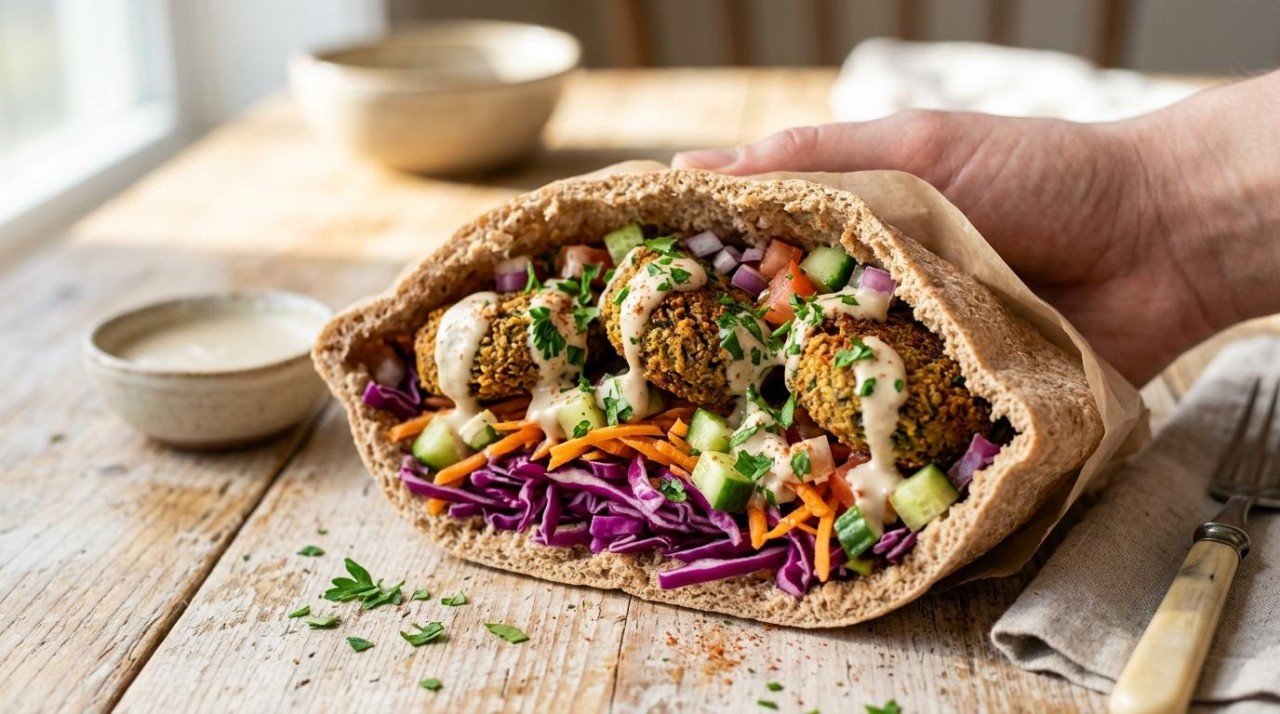
A good falafel wrap is one of the great street foods: craggy, herb-flecked fritters still hot from the oil, tahini running down the inside of the bread, tomato and pickles cutting through it all. The dish is old and well traveled — falafel most likely started in Egypt, where it is called ta'amiya and traditionally made with fava beans, and picked up chickpeas as it moved into the Levant.
It also has a reputation problem. Because it is deep-fried, falafel gets filed next to fried chicken and mozzarella sticks in most people's heads, and the standard advice is to bake it. So we scored a representative street-cart falafel wrap in Eat Well Planner, expecting a low number and an obvious villain.
We got neither. The original scored 69 out of 100 — respectable, and well above most of the sandwiches we have rebuilt in this series. And when we finally tested the swap everyone recommends, baking instead of frying, the score went down. The wrap below scores 89, twenty points higher, and almost none of that came from the fryer. Here is where it actually came from.
The original: what's in it and how it scores
The version we scored is what you would get from a good falafel cart, built for four wraps: about 1 1/4 cups of dried chickpeas soaked overnight and ground with an onion, a big handful of parsley and cilantro, garlic, cumin, coriander, a teaspoon of baking powder, a couple tablespoons of flour, and a teaspoon of salt. Deep-fried. Wrapped in white pita with a tahini sauce made from 6 tablespoons of tahini and lemon juice, plus tomato and shredded iceberg.
Nobody measures how much oil a falafel drinks, so we modeled the fry at about 20 g of absorbed oil per wrap — deliberately conservative, since a 2023 study that fried falafel balls at 356°F measured the uncoated control at nearly 24 percent oil by weight.
That build comes out at 69/100, and the reason it scores that well is the filling. Per wrap: 658 calories, 17.8 g protein, 10.6 g fiber, 4.7 g saturated fat. Ground chickpeas and a fistful of herbs are a genuinely good base — the app flagged the original as an excellent source of iron, folate, thiamine, phosphorus and vitamin K before we changed a thing. The filling was never the problem. What dragged it down:
- Sodium: 1,170 mg per wrap. Fifty-one percent of a day's limit in one sandwich, flagged as a very high caution. The salt goes in twice — once in the mix, once baked into the pita.
- 35.5 g of fat per wrap, 17.4 g of it omega-6. The frying oil dominates the fat profile.
- White pita. Refining strips away more than half of wheat's B vitamins, 90 percent of its vitamin E, and virtually all of its fiber, and this wrap leans on 2 oz of it.
- Barely any vegetables. Iceberg and tomato left the wrap flagged low in vitamin A, with only 6.25 plant points against a weekly target of 30.
The upgrades
We tested each of these in the Recipe Playground and ordered them by how much score they move for how little damage to the sandwich. If you make only one change, make the first one.
1. Cut the added salt in half and push the acid instead
- Swap: 1 teaspoon of salt in the mix → 1/2 teaspoon, plus more lemon, more garlic, and a spoonful of sumac
- Score impact: +8 points (69 → 77)
- What it changes: Drops sodium from 1,170 mg to 880 mg per wrap
- What it costs you: The first bite tastes flatter. The acid covers most of it, but this is a real trade-off, not a free one
The biggest lever in a falafel wrap is the salt, and it is the one nobody talks about. Harvard's Nutrition Source puts the ceiling at 2,300 mg of sodium a day, with most Americans eating around 3,400 mg; the excess makes the body hold water, raising the volume of blood in circulation and, over years, stiffening blood vessels.
Halving it works here because falafel has so much else going on: sumac, extra lemon juice, a raw garlic clove grated into the tahini, and a heavier hand with the parsley all read as more flavor rather than less salt. Be clear-eyed about the 880 mg left, though: roughly 300 mg is the salt you added, and most of the rest is the pita and the baking powder.
2. Whole wheat pita instead of white
- Swap: White pita → 100% whole wheat pita, same 2 oz
- Score impact: +6 points (77 → 83)
- What it changes: Fiber goes from 10.6 g to 12.9 g per wrap, plus magnesium and B vitamins, and sodium drops a little too
- What it costs you: A nuttier, sturdier bread that tears more easily — warm it before you fill it
The cheapest six points in the build. Most Americans get about 15 g of fiber a day against a target of 25 to 35 g, and bread is the easiest place to close that gap, since it is doing a structural job whole wheat does just as well. The catch is at the store: plenty of "wheat" pita is white flour with caramel color, so check that the first ingredient reads whole wheat flour — our guide to buying bread that is actually whole grain covers the label tricks. Warm the pita 20 seconds a side in a dry pan before filling, or it splits under the weight of the falafel.
3. Trade the shredded iceberg for a cabbage, carrot and cucumber slaw
- Swap: Iceberg lettuce → shredded red cabbage, grated carrot and diced cucumber, dressed with olive oil and lemon
- Score impact: +5 points (83 → 88)
- What it changes: Clears the low vitamin A flag entirely, adds fiber, and takes the wrap from 7.25 to 9.25 plant points
- What it costs you: Nothing. It makes the sandwich better — cabbage holds its crunch against a hot fritter in a way iceberg does not
Iceberg is in a falafel wrap for texture and it is bad at its job by the third bite. Red cabbage does the same thing and stays crisp, the carrot is what actually fixed the vitamin A shortfall, and the cucumber adds water and coolness against the tahini. Three vegetables where there was one also takes the wrap from 7.25 plant points to 9.25 on its own — a sandwich quietly delivering nine of them is doing more for your week than most salads.
4. Bake the falafel instead of deep-frying it
- Swap: Deep-fried in vegetable oil → baked at 400°F with 1 tablespoon of olive oil
- Score impact: -2 points (88 → 86)
- What it changes: Cuts 117 calories, 13 g of fat and 9.7 g of omega-6 per wrap — but removes the omega-3 ALA the frying oil was supplying
- What it costs you: The shatter. Baked falafel is crisp; fried falafel is crunchy, and those are not the same thing
This is the honest one. Every healthy-falafel article leads with baking, and in our scoring it was the only change that made the number go down. The dimensions split underneath: weight management climbed from 88 to 90 while heart health slipped from 84 to 81, because the vegetable oil the falafel had been fried in was carrying 1.63 g of omega-3 ALA per wrap and olive oil brings almost none. Take away the fryer and the ALA leaves with it. (On what that omega-6 figure does and does not mean, our piece on whether seed oils are actually bad for you is more nuanced than the internet consensus.)
We still bake, and we would still tell you to: one number cannot see that you just took 13 g of fat and 117 calories out of a sandwich you eat regularly. What it did catch is that baking leaves a hole, which is what the next swap is for. Technique matters more than usual here, because baked falafel is where most home cooks fail. Chill the mixture at least an hour, flatten the balls into 1/2-inch patties for more surface to brown, brush the tops with olive oil, and flip them halfway through. An air fryer at 375°F takes about 12 minutes and lands closer to fried texture.
5. Bind with ground flaxseed and chickpea flour instead of white flour
- Swap: 2 tablespoons all-purpose flour → 3 tablespoons chickpea flour plus 3 tablespoons ground flaxseed
- Score impact: +3 points (86 → 89)
- What it changes: Puts the omega-3 ALA back (0.23 g → 1.2 g per wrap), adds 1.6 g of fiber, and makes the falafel itself gluten-free
- What it costs you: Nothing you will taste. Flax is faintly nutty and disappears behind cumin and parsley
This is the swap that makes baking worth doing, and it solves a cooking problem at the same time. Ground flaxseed gels when it meets water — its mucilage gums thicken considerably — which is exactly what a baked fritter needs, since it never gets the instant sealing crust hot oil provides. Chickpea flour handles the rest of the binding and keeps the flavor in the family.
Flax has to be ground to count; whole seeds pass through largely intact, with most of the oil still locked in the seed coat. Three tablespoons across four wraps restores about three quarters of the ALA the deep fryer had been accidentally providing, without the 9.7 g of omega-6 that came with it.
Take the Guesswork Out of Eating Well
Eat Well Planner helps you organize your favorite recipes, plan balanced meals, and automatically generate shopping lists — all in one place. Whether you're tracking macros, managing dietary restrictions, or just trying to stop asking "what's for dinner?", we've got you covered.
Our AI-powered tools can adapt any recipe to your dietary needs, help you discover new meals you'll love, and even log your nutrition effortlessly. It's meal planning made simple.
Start Organizing Your Meals — FreeWhat we kept (on purpose)
The tahini stays, all 6 tablespoons of it — it is the most obvious thing to cut here and cutting it would have been a mistake, as the skipped swaps below show. The soaked dried chickpeas stay, for reasons that have nothing to do with nutrition and everything to do with whether the falafel survives the oven. The pita stays, because a falafel wrap without bread is a bowl. And we stopped at five swaps, because the sixth would have meant shrinking the falafel or dropping to a smaller pita — at which point you are not making a better falafel wrap, you are making less of one.
The healthier falafel wrap
Nutrition Score: 89/100. Makes 4 wraps. About 30 minutes of active work, plus overnight soaking and an hour of chilling.
For the falafel
- 1 1/4 cups (250 g) dried chickpeas, soaked in cold water 18 to 24 hours, then drained and patted dry
- 1 small onion (100 g), quartered
- 1 packed cup (30 g) fresh parsley leaves
- 3/4 packed cup (20 g) fresh cilantro leaves
- 3 cloves garlic (12 g), divided
- 3 tablespoons (25 g) chickpea flour
- 3 tablespoons (20 g) ground flaxseed
- 1 tablespoon (6 g) ground cumin
- 1 tablespoon (6 g) ground coriander
- 1 teaspoon (4 g) baking powder
- 1/2 teaspoon (3 g) fine salt
- 2 tablespoons (28 g) extra-virgin olive oil, divided
For the sauce, slaw and wraps
- 6 tablespoons (90 g) tahini
- 2 tablespoons (30 g) lemon juice, divided
- 1/4 to 1/3 cup cold water
- 1 1/2 cups (120 g) red cabbage, finely shredded
- 1 medium carrot (80 g), coarsely grated
- 1 cup (100 g) cucumber, diced
- 1 large tomato (150 g), diced
- 1 teaspoon (3 g) ground sumac
- 4 whole wheat pita breads (240 g total)
- Drain the soaked chickpeas well and pat them dry. Do not cook them, and do not substitute canned.
- Pulse the onion, parsley, cilantro and 2 of the garlic cloves in a food processor until finely chopped. Add the chickpeas, cumin, coriander, salt, chickpea flour and ground flaxseed, and pulse to a coarse paste with the texture of damp couscous. Stop well before it turns smooth.
- Transfer to a bowl, cover, and chill at least 1 hour and up to 24. This step decides whether the falafel holds together.
- Heat the oven to 400°F. Stir the baking powder into the chilled mixture, form 16 balls, and press each into a patty about 1/2 inch thick. Brush a sheet pan with half the olive oil, arrange the patties on it, and brush the tops with the rest.
- Bake 15 minutes, flip, and bake another 8 to 12 minutes until deep golden and firm. (Air fryer: 375°F for about 12 minutes, flipping once.)
- While they bake, whisk the tahini with 1 1/2 tablespoons of the lemon juice and the remaining garlic clove, grated. Add cold water a tablespoon at a time, whisking, until pourable. It will seize and turn pale before it loosens — keep going.
- Toss the cabbage, carrot and cucumber with the remaining lemon juice and the sumac.
- Warm the pitas in a dry pan about 20 seconds a side so they do not tear. Fill each with 4 falafel, a quarter of the slaw, a quarter of the tomato, and a generous drizzle of tahini sauce.
Per wrap, original vs. improved:
- Nutrition Score: 69 → 89
- Calories: 658 → 569
- Fiber: 10.6 g → 16.1 g
- Protein: 17.8 g → 19.8 g
- Total fat: 35.5 g → 25.1 g
- Saturated fat: 4.7 g → 3.4 g
- Sodium: 1,170 mg → 830 mg
- Omega-6: 17.4 g → 7.8 g
- Plant points: 6.25 → 11.5
The improved wrap comes out an excellent source of fiber (54% DV), iron, phosphorus, folate, magnesium, zinc and omega-3 ALA. Sodium is still flagged at 36 percent of a day's limit, and we are not going to pretend otherwise — the pita sees to that. Building a potassium-rich day around it does more than shaving off another pinch would.
Swaps we tested and skipped
- Tahini-yogurt sauce (86, -3 points). The standard recommendation is to cut the tahini with Greek yogurt. We tested it both ways — half tahini plus yogurt, and full tahini extended with yogurt — and both scored below plain tahini sauce. Tahini carries much of the calcium, iron, thiamine and magnesium in this sandwich, and diluting it trades minerals for a little protein. If you want the tang, add yogurt as a separate spoonful instead of as a replacement.
- Canned chickpeas (64, -5 points). Tempting, and it fails twice. The score drops on added sodium, and the falafel does not work at all: cooked chickpeas have no raw starch left to bind, so the mixture turns to hummus in the processor and disintegrates in the oven. Soaked raw chickpeas are the whole technique.
- Skipping the pita for a lettuce wrap (88, -1 point). It did not even score better. You lose the pita's fiber and protein along with its sodium, and end up eating falafel out of a leaf with a fork. Enjoy it if you like it that way — just not for the numbers.
Make it fit other diets
- Gluten-free: The falafel already is, thanks to the chickpea flour and flax. Swap the pita for a gluten-free flatbread, or serve it as a bowl over rice or quinoa.
- Vegan: Also already there — nothing in this build comes from an animal.
- Sesame-free: Replace the tahini sauce with a lemony olive oil and herb dressing. You lose real minerals doing it, so lean harder on the slaw.
- Egyptian style: Use split, skinned dried fava beans in place of the chickpeas and you have ta'amiya, the original — greener inside and, to plenty of people, better.
The app's Recipe Variations feature does any of these in one step: ask for a gluten-free or fava-bean version of a saved recipe and it rewrites the whole thing with the substitutions worked in, then rescores it so you can see what the change cost.
Do this to your own recipes
What made this post possible is that we did not guess. Every number above came from scoring the ingredient list, changing one thing, and scoring it again — which is exactly what Make It Healthier does inside Eat Well Planner. Import a recipe from any URL, Instagram reel or YouTube video and the app proposes swaps, with a calculator verifying the gain before the suggestion ever reaches you; the Recipe Playground lets you test your own ideas the way we tested these, watching the score move edit by edit.
The falafel wrap is a good argument for working that way. The obvious villain turned out to be the least important change, and the salt was worth four times as much. The same kind of surprise is sitting in your own recipes, and measuring is the only way to find it.