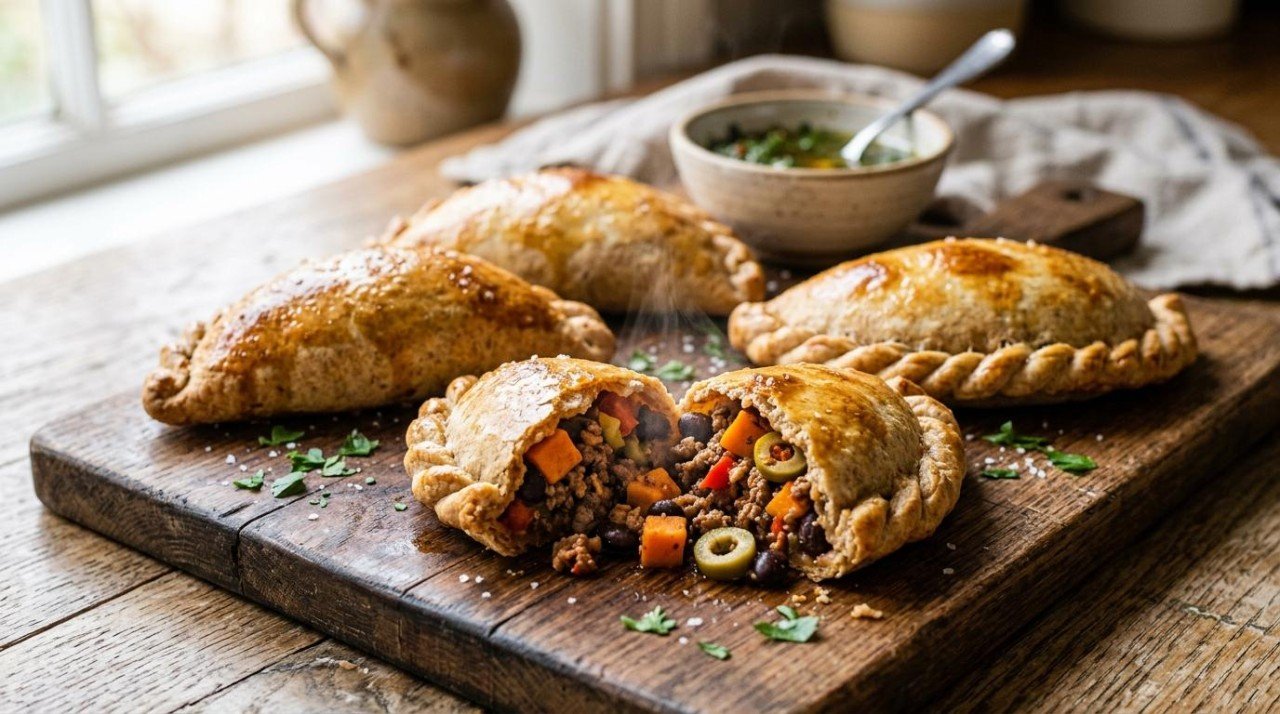
An empanada is a very old idea executed very well: filling wrapped in dough, crimped shut, cooked, eaten with one hand. The folded pie is thought to have originated in 7th-century Galicia, in northwest Spain, and it traveled with Galician emigrants until half of Latin America had its own version. In Argentina the standard is beef, onion, green olives and chopped hard-boiled egg, sealed with a braided repulgue and either baked or fried.
We ran a standard beef empanada build through Eat Well Planner's Nutrition Score - the same number a visitor sees on any public recipe page. Twelve empanadas, six servings of two, fried, with a lard dough. It came back 32 out of 100, and for once the diagnosis was exactly what you would guess: two very high flags and almost no fiber.
Then we rebuilt it to 80 out of 100. It is still a beef empanada. It still has the olives, still has the egg, still has the crimped edge and the crackle. Forty-eight points, and every swap below carries the exact score change it earned - including one that we expected to be the hero and that turned out to be worth almost nothing.
The original: what is in it and how it scores
Here is the version we scored, making twelve empanadas from three cups of flour, eaten two per person:
- Dough: 3 cups (360 g) all-purpose flour, 1/2 cup (113 g) lard, 1 egg, 1 1/2 teaspoons salt, warm water
- Filling: 1 lb 80/20 ground beef browned in 2 tablespoons of lard, 1 large onion, 1/2 cup chopped green olives, 2 hard-boiled eggs, paprika, cumin, oregano, 1 1/2 teaspoons salt
- Frying: about 100 g of oil absorbed across the twelve - roughly 2 teaspoons and 75 calories per empanada, which is the normal range for shallow- or deep-fried hand pies
Nutrition Score: 32/100. Per serving of two empanadas that is about 840 calories, 23.2 g protein, 50 g carbs, 2.9 g fiber, 60.5 g total fat, 18.3 g saturated fat, 0.9 g trans fat and 1,440 mg sodium. Two things drag it down, and the score flags both at its highest severity:
- Saturated fat, flagged very high - 18.3 g per serving, 78% of the daily value, from three separate sources stacking up: lard in the dough, more lard in the pan, and 80/20 beef. Lard is 39% saturated fat and 1% trans fat, and it is doing double duty here.
- Sodium, flagged very high - 1,440 mg per serving against a daily value of less than 2,300 mg. Three teaspoons of salt go into this recipe before the olives contribute anything, and the olives are salty by design.
The bigger problem is not on the caution list at all. Fiber comes in at 2.9 g per serving, 10% of the daily value, and plant points total 2.75 out of a weekly 30. For a dish built on refined flour, beef, fat and one onion, that is arithmetic rather than a surprise - but it means an 840-calorie meal that does very little for you between the protein and the next hunger pang. Most Americans already run about 15 g of fiber a day against a need of 25 to 35 g, and dinner is where that gap gets fixed or ignored.
What is already fine, and we want to say so plainly: the protein is respectable at 23.2 g, and the micronutrients are genuinely good - vitamin B12 at 91% of the daily value, iron at 74%, folate 61%, thiamine 55%, niacin 46%, zinc 37%. Beef and eggs are nutrient-dense foods and the score sees that. This is not a junk recipe. It is a good recipe with a fat problem, a salt problem, and a vegetable vacancy.
One honest note on portions before we start. The Nutrition Score reads the food, not the serving size: we re-scored the same empanadas at three per person and it moved from 32 to 31. Eating six does not make them worse for you per bite - it just means 2,500 calories. So treat the score and the portion as two separate conversations. Two empanadas with a sharp green salad is a meal. Six is a decision.
The upgrades: 32 to 80
Five changes, scored cumulatively in the order below, so each delta is what that swap was worth at that point in the build. They are ordered by impact against flavor cost, which means the one everybody expects to come first comes last.
1. Build a real sofrito into the filling
- Swap: The lone diced onion becomes onion plus red bell pepper, sweet potato, garlic and scallions
- Score impact: +8 points (32 to 40)
- What it changes: Plant points 2.75 to 6, fiber 2.9 to 3.9 g, and vitamin A from nothing worth mentioning to a headline number
- What it costs you: Ten minutes of dicing. Nothing on the plate.
This is the swap that pays best and asks least, which is why it goes first. Latin cooking already runs on sofrito - onion, pepper and garlic sweated slowly until sweet - so adding it to an empanada filling is not an intervention, it is putting back something a lot of home versions skipped. The sweet potato is the part that will feel new. Cut it small, a quarter-inch dice, and cook it with the sofrito until it just gives; it collapses slightly into the meat and makes the filling juicier, which matters more than usual in a pastry that has to survive twenty minutes in the oven. Orange-fleshed sweet potato is one of the top sources of beta-carotene, and it is most of the reason the finished empanadas end up at 397% of the daily value for vitamin A.
Note what did not happen: saturated fat and sodium did not move at all, and both stayed flagged very high. Adding vegetables improves a recipe. It does not fix one.
2. Rebuild the dough with olive oil and half whole wheat
- Swap: 1/2 cup lard to 6 tablespoons olive oil; 3 cups all-purpose flour to 1 1/2 cups all-purpose plus 1 1/2 cups whole wheat
- Score impact: +10 points (40 to 50)
- What it changes: Saturated fat 18.3 to 13.1 g per serving, fiber 3.9 to 6.4 g
- What it costs you: A sturdier, less flaky pastry - closer to good pita than to croissant
Two changes in one, because they happen in the same bowl. The fat swap is the straightforward half: lard is 39% saturated and 44% monounsaturated, olive oil is 13% saturated and 72% monounsaturated, and replacing saturated fat with unsaturated fat is one of the better-supported moves in cardiovascular nutrition. You also need less of it - 80 g of oil does the work of 113 g of lard, because oil coats flour more efficiently than a solid fat you have to cut in. If lard or shortening is your default pastry fat, our guide to shortening substitutes has the ratios for other doughs too.
The flour swap is where the honesty lives. You lose the flakiness that comes from solid fat sitting in layers, and whole wheat makes the dough firmer - whole-grain flours are thirstier, so this dough wants an extra tablespoon or two of water and a 30-minute rest before rolling, or it will crack at the crimp. What you get back is 2.5 g of fiber per serving plus the whole-grain effect itself, which in pooled prospective data is associated with about 22% lower cardiovascular disease risk per three servings a day. Half whole wheat also happens to taste right here: it is nutty, and it stands up to cumin and paprika in a way white flour does not. If you want to keep tuning the flour, our all-purpose flour substitutes guide has the full ladder.
3. Stretch leaner beef with black beans
- Swap: 1 lb of 80/20 beef to 12 oz of 93% lean plus 1 cup of drained black beans; lard in the pan to olive oil
- Score impact: +10 points (50 to 60)
- What it changes: Saturated fat 13.1 to 7.7 g, trans fat 0.9 to 0.2 g, fiber 6.4 to 8.7 g, protein up to 25.4 g
- What it costs you: Leaner beef needs help staying juicy. The beans and the sweet potato are that help.
This is the swap that finally pulls saturated fat out of the very-high band, and it does it without cutting the amount of filling by a gram - the beans replace the beef volume one for one. Protein goes up, not down, because 93% lean beef carries more protein per ounce than 80/20 once you subtract the fat that renders out anyway. Trans fat drops by more than three quarters, most of that being the naturally occurring ruminant trans fat that rides along with fattier beef.
The technique caveat is real. Lean ground beef dries out when you brown it hard, so brown it in the pan with the sofrito rather than separately, break it up less than you think you should, and pull it off the heat while it still looks slightly underdone - it finishes cooking inside the pastry. Black beans, mashed lightly against the side of the pan so about a third of them break down, do the rest: they hold moisture and bind the filling so it does not fall out of the first bite. Beans are also the cheapest fiber in the grocery store, and if you would rather move off beef entirely, our ground beef substitutes guide covers what holds up in a filling and what turns to mush.
4. Let the olives do the salting
- Swap: 3 teaspoons of added salt down to 1 teaspoon total - 1/2 in the dough, 1/2 in the filling
- Score impact: +18 points (60 to 78)
- What it changes: Sodium 1,560 to 780 mg per serving, and the very-high sodium flag clears
- What it costs you: Nothing, if you keep the olives. Quite a lot, if you do not.
Biggest single jump in the post, and it costs one measuring spoon. The logic is that the recipe already contains a salt delivery system: half a cup of brined green olives, chopped through the filling so you hit one every few bites. Salting the meat as though the olives were not there is double-salting. Cut the added salt to a third and the olives stop competing and start reading as seasoning.
Score aside, this is the change with the clearest health argument behind it. Americans average about 3,400 mg of sodium a day against a daily value of less than 2,300 mg, and one serving of the original was contributing 1,440 mg of that. Taste before you commit: the filling should taste very slightly underseasoned in the pan, because the olives and the browning both keep developing.
5. Bake with an egg wash instead of frying
- Swap: Deep-fried to baked at 400F, brushed with beaten egg
- Score impact: +2 points (78 to 80)
- What it changes: 150 fewer calories per serving; total fat 42.5 to 26.1 g
- What it costs you: The blistered, bubbled fried shell. You get burnished and crisp instead.
Here is the surprise, and it is the reason we score everything instead of guessing. We assumed baking would be the hero swap. We tested it on its own, against the untouched original, and the score went from 32 to 31. It went down. Pulling 100 g of vegetable oil out took 150 calories per serving with it, but it also took the recipe's omega-3 ALA from 1.31 g to 0.10 g and erased a vitamin E highlight worth 31% of the daily value, while saturated fat stayed flagged very high at 68% - because the lard and the 80/20 beef were never the frying oil's fault.
Applied last, after the fat sources are fixed, the same change is worth +2 points and 150 calories. That is the whole argument for verified swaps in a single example: "stop frying it" is the most common healthy-eating advice on the internet, and on this recipe, done alone, it was worth minus one point. Do it - but do it fourth. Brush the tops with beaten egg for color, cut a small vent, and bake on a preheated sheet pan at 400F so the bottoms set before the filling steams the pastry.
Take the Guesswork Out of Eating Well
Eat Well Planner helps you organize your favorite recipes, plan balanced meals, and automatically generate shopping lists — all in one place. Whether you're tracking macros, managing dietary restrictions, or just trying to stop asking "what's for dinner?", we've got you covered.
Our AI-powered tools can adapt any recipe to your dietary needs, help you discover new meals you'll love, and even log your nutrition effortlessly. It's meal planning made simple.
Start Organizing Your Meals — FreeWhat we kept on purpose
Three things survived deliberately, and we have the numbers for each.
- The olives. Removing them scores 85 - five points better. We are not doing it, and we would tell you not to either. Half a cup of green olives across twelve empanadas is about 12 g per person, it is the flavor most people mean when they say empanada, and the sodium it carries is already priced into the 790 mg above. A makeover that wins five points by deleting the defining ingredient is not a makeover.
- The hard-boiled eggs. Removing them scores 79 - one point worse. They are free. Keep them.
- The beef. Going all beans and no meat scores 70, ten points below where we landed, because per-serving protein falls from 25.8 g to 16.1 g. Beans stretch beef beautifully. They do not replace it here.
We stopped at 80. Sodium and saturated fat are both still flagged, at "high" rather than "very high" - which is an honest place to land for a pastry that was designed around fat, and the point past which the next swap starts deleting the empanada instead of improving it.
The healthier version: full recipe
Nutrition Score: 80/100. Makes 12 empanadas, serving 6 people two each.
For the dough:
- 1 1/2 cups (180 g) all-purpose flour
- 1 1/2 cups (180 g) whole wheat flour
- 1/2 teaspoon fine salt
- 6 tablespoons (80 g) extra-virgin olive oil
- 1 large egg
- 3/4 to 1 cup warm water
For the filling:
- 1 tablespoon olive oil
- 1 large onion (about 5 oz / 150 g), finely diced
- 1 red bell pepper (about 4 oz / 120 g), finely diced
- 3 cloves garlic, minced
- 1 small orange-fleshed sweet potato (about 5 oz / 150 g), peeled and cut into 1/4-inch dice
- 12 oz (340 g) 93% lean ground beef
- 2 teaspoons sweet paprika or pimenton
- 1 teaspoon ground cumin
- 1 teaspoon dried oregano
- 1/2 teaspoon fine salt
- 1 cup (200 g) canned black beans, drained and rinsed
- 1/2 cup (75 g) green olives, pitted and chopped
- 2 hard-boiled eggs, chopped
- 4 scallions (about 1 oz / 30 g), thinly sliced
- 1 egg, beaten, for the wash
- Whisk both flours and the salt together. Add the olive oil and egg and work them in with your fingers until the flour looks like damp sand. Add warm water a few tablespoons at a time until it comes together into a firm, smooth dough. Knead 2 minutes, wrap, and rest at room temperature for at least 30 minutes - the whole wheat needs that time or the dough will crack when you fold it.
- Warm the olive oil in a wide skillet over medium heat. Cook the onion, bell pepper and garlic with a pinch of the salt until soft and sweet, 8 to 10 minutes. Do not rush this part.
- Add the sweet potato and cook 5 minutes more, until it just yields to a fork.
- Push the vegetables to one side, add the beef, and let it sit undisturbed for a minute before breaking it up. Stir in the paprika, cumin, oregano and the remaining salt. Cook until the beef is just barely done, about 4 minutes - it finishes inside the pastry.
- Add the black beans and mash about a third of them against the side of the pan. Take the pan off the heat and stir in the olives, chopped eggs and scallions. Taste: it should read a touch underseasoned. Spread the filling on a plate and chill until cold, at least 30 minutes - warm filling makes soggy dough.
- Heat the oven to 400F with a sheet pan inside. Divide the dough into 12 pieces and roll each into a 5 1/2- to 6-inch round.
- Put a generous 1/3 cup of cold filling on each round, fold, press the edges firmly, and seal with a fork or a braided repulgue. Brush the tops with beaten egg and cut one small vent in each.
- Slide the empanadas onto the hot sheet pan and bake 20 to 24 minutes, until deep golden. Rest 5 minutes before eating - the filling comes out molten.
Per serving of two empanadas, original to improved:
- Nutrition Score: 32 to 80
- Calories: about 840 to about 574 (down 32%)
- Saturated fat: 18.3 g to 5.5 g (78% of the daily value down to 24%)
- Total fat: 60.5 g to 26.1 g
- Trans fat: 0.9 g to 0.2 g
- Sodium: about 1,440 mg to about 790 mg (down 45%)
- Fiber: 2.9 g to 8.7 g (10% of the daily value to 29%)
- Protein: 23.2 g to 25.8 g
- Plant points: 2.75 to 8
- Vitamin A: not a highlight at all, to 397% of the daily value - and vitamin C to 41%
Swaps we tested and skipped
- All whole wheat flour in the dough - scores 82. Two points better and 11.1 g of fiber per serving, which is genuinely tempting. We left it out of the main recipe because a 100% whole wheat dough is markedly less pliable and tears at the crimp when it has to wrap a heavy filling. If you bake with whole wheat regularly and know to hydrate it more, take the two points.
- Ground turkey instead of beef - scores 81. One point. A rounding error. Use whichever you prefer, or whichever is in the freezer.
- Frying the improved version - scores 78. Only two points below the baked version, but 150 more calories per serving. If you want fried empanadas for a party, that is the honest price, and it is lower than you would expect once the dough and the filling have been fixed.
- Baking the original with no other changes - scores 31. Covered above. The most famous healthy swap in the book, worth minus one point on its own.
- Dropping the olives (85) or the hard-boiled eggs (79). Also covered above: one we refused, and one the score told us to keep.
Make it fit other diets
A few small pivots cover the questions this dish gets most:
- Vegetarian or vegan: drop the beef and go to 2 cups of black beans plus 8 oz of finely chopped mushrooms for savory depth; for vegan, skip the hard-boiled eggs and brush the tops with olive oil instead of egg wash. Expect a lower protein number - our all-bean test came in at 16.1 g per serving.
- Gluten-free: a 1:1 gluten-free flour blend works, but roll the discs slightly thicker and chill them before filling, since there is no gluten to hold the crimp.
- Dairy-free: it already is. Nothing to change.
If you want any of these written out properly, Eat Well Planner's Recipe Variations will rewrite a saved recipe for a specific diet in one step, with the substitutions worked into the amounts and the method, and the AI recipe chat will argue the trade-offs with you with the full recipe in context.
Do this to your own recipes
Nothing here required a nutrition degree. It required knowing which change was worth 18 points and which was worth minus one, and the only way to know that is to measure.
That is what Make It Healthier does in Eat Well Planner. Import a recipe - a URL, an Instagram reel, a YouTube video, or your grandmother's card typed in by hand - and you get a Nutrition Score with the same flags and highlights you have been reading all the way down this page. Ask for improvements and the AI proposes concrete swaps, but a calculator verifies the actual nutritional gain before any of them reach you, so the suggestions that survive are the ones that move real numbers. The Recipe Playground is where you argue with it: change one ingredient, watch the score move, and decide for yourself whether the olives are worth five points.
They are, by the way. Eat Well Planner is free to use - bring the recipe you are not willing to give up.