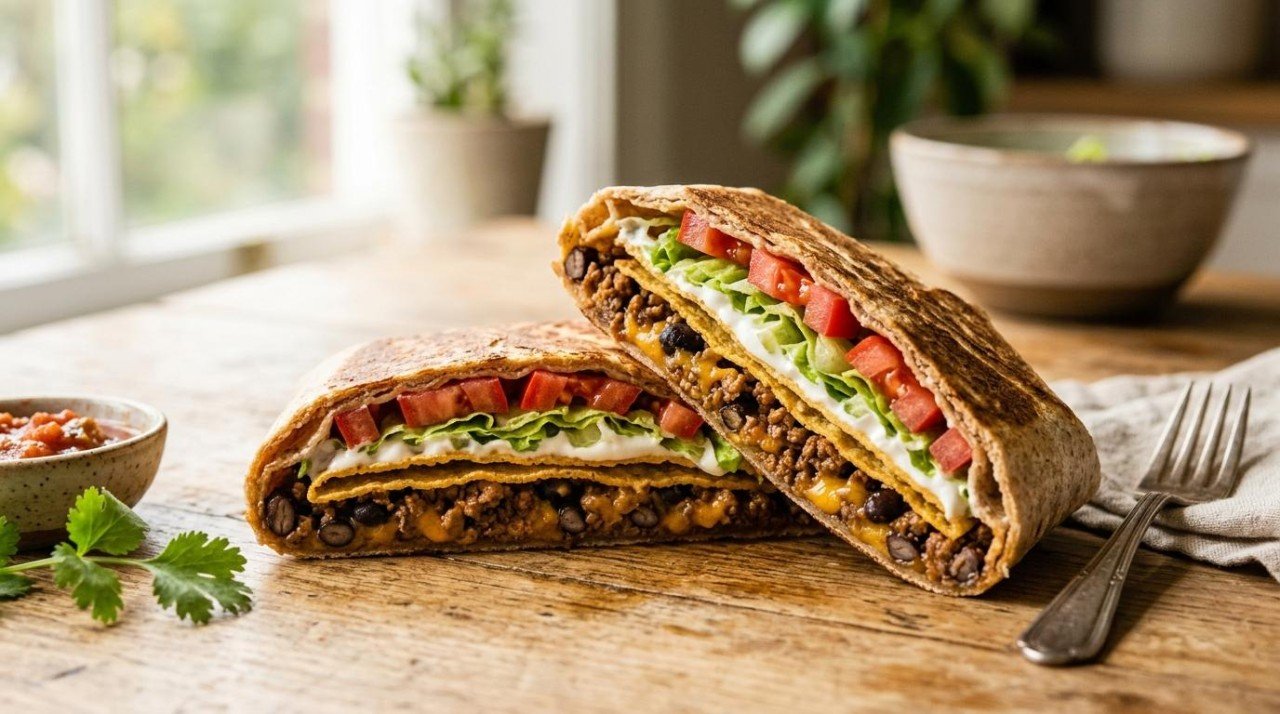
The Crunchwrap Supreme is a genuinely great piece of food engineering. When Taco Bell rolled it out on June 22, 2005, it was designed by food-innovation staffer Lois Carson to be the perfect mess-free, one-handed meal, and it sold 51 million units in six weeks, the fastest-selling item in the chain's history. The magic is the layering: a crisp corn tostada divides a warm bottom half (seasoned beef, nacho cheese) from a cool top half (sour cream, lettuce, tomato), all sealed in a big folded flour tortilla and griddled until the outside crackles. The tostada stays crunchy because it never touches anything wet. It is clever, and it is delicious.
It is also the recipe the internet cannot stop making at home, and a homemade copycat is a hefty thing. We built a representative one, four generous crunchwraps, and ran it through Eat Well Planner's Nutrition Score, the same at-a-glance number that shows up on any public recipe page. It came back 41 out of 100.
Here is the promise: we kept the crunch, kept the fold, kept the beef and the melt, and still got it to 61 out of 100. That is a 20-point jump, and every swap below carries the real, verified score change it earned. Same crunchwrap. Better numbers. And one honest surprise along the way, where the score and the right thing to do pointed in opposite directions.
The original: what's in it and how it scores
Here is the standard homemade copycat we scored, for four crunchwraps:
- 4 burrito-size flour tortillas
- 1 pound 80/20 ground beef
- 1 packet taco seasoning
- About 1/2 cup nacho cheese sauce
- 4 corn tostada shells
- 1/2 cup sour cream
- 2 cups shredded iceberg lettuce
- 2 roma tomatoes, diced
- Oil for griddling
Nutrition Score: 41/100. Now the diagnosis, because knowing why it scores that way is what lets you fix your own recipes. This dish has two real problems, and they are both about the fatty-and-salty bottom layer:
- Saturated fat is very high — about 18 grams per crunchwrap. To put that in perspective, the American Heart Association recommends capping saturated fat at roughly 13 grams a day (under 6% of calories), because it is the fat that raises LDL cholesterol. One homemade Crunchwrap Supreme spends more than a full day's budget, mostly on 80/20 beef, nacho cheese sauce, and sour cream stacked in the same bite.
- Sodium is very high — around 1,570 mg, about 68% of the AHA's 2,300 mg daily limit (and past their optimal 1,500 mg goal). It comes from a death-by-a-thousand-cuts pileup: the seasoning packet, the nacho cheese, the tostada, all salted.
Now notice what is not wrong here. The beef makes this a genuinely nutrient-dense plate: it is an excellent source of vitamin B12, iron, and zinc, and it carries about 32 grams of protein. This is not empty food. It is rich food with a saturated-fat problem, a sodium problem, and only 2.25 different plants and 5 grams of fiber to show for 800-plus calories. So we are not going to gut it. We are going to lean out the fatty half, pile in some plants, and quietly walk the salt back down, without touching the crunch that makes it a crunchwrap.
The upgrades
Four swaps, in the order we built them. The score climbs 23 points across them, and then, honestly, we give three of those points back on purpose. More on that after. If you only make one change, make the first one.
1. Lean beef and a can of black beans
- Swap: 1 pound of 80/20 beef, iceberg, and no beans → 3/4 pound of 93/7 lean beef, a can of black beans, romaine instead of iceberg, and a handful of diced onion
- Score impact: +10 points (41 → 51)
- What it changes: Cuts saturated fat by more than a third (18.4 g → 11.5 g), nearly doubles the fiber (5.4 g → 10.5 g), and adds two more plants
- What it costs you: Almost nothing — the beans stretch the filling, so you use less meat and never notice
This is the highest-impact move in the whole makeover, and it is really one idea: make the filling a beef-and-bean mix instead of all fatty beef. Dropping from 80/20 to 93/7 beef strips out a big slug of the saturated fat, and cutting the meat to three-quarters of a pound while adding a drained, rinsed can of black beans keeps the filling just as generous. The beans are the quiet hero here, bringing plant protein, folate, and a pile of fiber. Harvard's researchers link eating legumes several times a week to lower LDL cholesterol and a meaningfully lower risk of heart disease, which is a nice thing to get for free inside a food you already love. While you have the cutting board out, swap the iceberg for romaine and add some diced onion; it is the same crunch and freshness, with more actual nutrition and one more plant on the plate.
Lean beef can cook up drier than 80/20, so keep the heat moderate and do not overcook it, and let the beans and their little bit of starch add back some moisture. If you want to push the meat even lower, our ground beef substitutes guide covers leaner and part-plant options, and if you cook a lot of beans it is worth learning to make them from dried for pennies. This same beef-and-bean move is the backbone of our healthier ground beef tacos, too.
2. Greek yogurt for the sour cream
- Swap: 1/2 cup sour cream → 1/2 cup plain low-fat Greek yogurt
- Score impact: +5 points (51 → 56)
- What it changes: Cuts saturated fat again (11.5 g → 8.6 g) and adds a few grams of protein
- What it costs you: A slightly tangier cool layer — in a spiced, cheesy wrap, genuinely no one can tell
Sour cream is mostly cream, which means mostly saturated fat. Plain Greek yogurt gives you the same thick, cool, tangy swipe with a fraction of the saturated fat and roughly triple the protein, so it is one of the highest-value one-for-one swaps in any savory recipe. Use whole-milk Greek yogurt if you want it richer and closer to sour cream in mouthfeel; low-fat is what we scored. Because the yogurt is layered cold on the top half of the crunchwrap and never gets cooked, you also sidestep the one place Greek yogurt misbehaves, which is splitting under direct heat. Our sour cream substitutes guide has the full ranking of swaps and which ones hold up when heated, if you want to use this trick elsewhere.
3. A whole wheat tortilla
- Swap: Burrito-size flour tortilla → burrito-size whole wheat tortilla
- Score impact: +0 points (56 → 56)
- What it changes: Pushes fiber from 15.9 g up toward the day's target, and adds B vitamins and minerals
- What it costs you: A slightly heartier, nuttier wrap — you stop noticing after the first bite
Here is an honest one: this swap does not move the score at all, and we are showing you anyway, because it teaches how the number actually works. By this point in the build, the black beans have already banked most of the fiber the score cares about, so adding whole grain on top climbs past the level where the score keeps paying out. But the fiber still goes up, from about 16 to 17 grams, and the tortilla itself gets better, trading refined starch for the bran, germ, B vitamins, and minerals of whole wheat. Most Americans eat only about 15 grams of fiber a day against a 25-to-35-gram target, so a crunchwrap that quietly delivers most of a day's fiber is doing real work even when the score shrugs. Not all wheat tortillas are truly whole grain, so it is worth learning to read the label past the marketing; the same rule applies to tortillas, and our tortilla substitutes guide covers the rest.
4. Ditch the seasoning packet
- Swap: 1 packet of taco seasoning and a regular can of beans → a homemade spice blend with a pinch of salt, plus no-salt-added beans
- Score impact: +8 points (56 → 64)
- What it changes: Cuts sodium by about a third (1,710 mg → 1,170 mg) and clears the single biggest thing left dragging the score down
- What it costs you: Two minutes of measuring spices — and the flavor gets better, not blander
This is the swap to pay attention to, and it hides the whole lesson of the Nutrition Score. Saved for last, cutting the sodium is worth 8 points, more than any change except the beans, because by now it is the last real problem standing. A taco seasoning packet is mostly salt with some spice along for the ride; mix your own from chili powder, cumin, smoked paprika, garlic powder, onion powder, and just a pinch of actual salt, and you control exactly how much sodium goes in. Reaching for no-salt-added beans (or draining and rinsing regular ones well, which washes away a good share of their sodium) closes the gap the rest of the way. You are not trading flavor for health here: fresh-ground spices in the right amounts taste more like taco seasoning than the packet does, because the packet has been sitting on salt for a year. While you are at it, griddle the finished crunchwraps in a dry hot pan instead of an oiled one; the tortilla crisps just fine on its own and you save the added fat.
Take the Guesswork Out of Eating Well
Eat Well Planner helps you organize your favorite recipes, plan balanced meals, and automatically generate shopping lists — all in one place. Whether you're tracking macros, managing dietary restrictions, or just trying to stop asking "what's for dinner?", we've got you covered.
Our AI-powered tools can adapt any recipe to your dietary needs, help you discover new meals you'll love, and even log your nutrition effortlessly. It's meal planning made simple.
Start Organizing Your Meals — FreeThe one swap that cost us points: real cheese
Now the honest surprise. We took the last big change, swapping the ultra-processed nacho cheese sauce for a measured amount of real shredded sharp cheddar, and the score went down three points, from 64 to 61.
That is not a mistake, and it is worth sitting with. The Nutrition Score measures nutrients, and by that one measure the emulsified cheese sauce squeaks ahead, because it is diluted with water and oil and so carries a little less saturated fat per scoop than dense aged cheddar. Real cheese loses on that single line. But real cheese wins everywhere the number cannot see: no additives or fillers, actual calcium, and, crucially, you decide how much goes on. We used about half a cup of a sharp cheddar precisely because sharp cheese lets you use less and still taste it. Trading a processed cheese product for a smaller amount of real cheese is exactly the kind of move that makes food better in ways a single score will never fully capture, so we made it, took the three-point hit, and are telling you the number so you can decide for yourself. If you would rather keep every point, the nacho-sauce version scores 64; we just think real cheddar is the better plate. Our cheddar substitutes guide covers how to match that sharpness with less cheese.
What we kept (on purpose)
A makeover that guts the dish is a failed makeover, so a few things did not move. We kept the corn tostada, because the crunch is the entire identity of the thing; a crunchwrap without the crunch is just a wrap. We kept real beef, just leaner and a little less of it, because the iron, zinc, and B12 it brings are the filling's nutritional strong suit. And we kept the fold-and-griddle, because that crackly seared exterior is half the appeal. We stopped at 61 because the next honest change, pulling the tostada or the cheese entirely, would start subtracting the dish instead of improving it.
The healthier version: full recipe
Nutrition Score: 61/100. Makes 4 crunchwraps.
- 4 burrito-size whole wheat tortillas
- 4 corn tostada shells (or tostada-size corn tortillas)
- 3/4 pound (12 oz) 93/7 lean ground beef
- 1 can (15 oz) no-salt-added black beans, drained and rinsed
- 1 tablespoon chili powder
- 2 teaspoons ground cumin
- 1 1/2 teaspoons smoked paprika
- 1 teaspoon garlic powder
- 1 teaspoon onion powder
- 1/3 teaspoon salt (scant)
- 1/2 cup shredded sharp cheddar cheese (about 2 oz)
- 1/2 cup plain low-fat Greek yogurt
- 3 cups shredded romaine lettuce
- 2 roma tomatoes, diced
- 1/2 cup diced white onion
- Brown the lean beef in a skillet over medium heat, breaking it up, until just cooked through. Stir in the chili powder, cumin, smoked paprika, garlic powder, onion powder, and salt, along with a splash of water.
- Add the drained black beans and warm through, mashing a few against the pan so they help bind the filling. Taste and adjust the spices. Remove from the heat.
- Set up your layers: the beef-and-bean mix, the cheddar, the tostada shells, the Greek yogurt, romaine, tomato, and onion.
- Warm a whole wheat tortilla for a few seconds so it folds without cracking. In the center, spread a quarter of the beef and beans, then a quarter of the cheddar so it melts against the warm filling.
- Set a tostada shell on top, then layer on a quarter of the Greek yogurt, romaine, tomato, and onion, keeping everything inside the middle third of the tortilla.
- Fold the edges of the tortilla up and over the filling in pleats, working around the circle, so it closes into a hexagon with a flat bottom.
- Set each crunchwrap seam-side down in a dry hot skillet and griddle 2 to 3 minutes per side, until sealed, golden, and crisp. Serve right away.
Per crunchwrap, here is the before and after:
- Nutrition Score: 41 → 61
- Saturated fat: about 18.4 g → 11.0 g (down 40%, from more than a full day's limit to under it)
- Sodium: about 1,570 mg → 1,070 mg (down about 500 mg, from 68% to 47% of the daily limit)
- Fiber: 5.4 g → 17.1 g (roughly tripled, now an excellent source at about 60% of the daily value)
- Protein: about 32 g → 40 g
- Calories: about 811 → 674
- Plants on the plate: 2.25 → 6.25 different plants
Everything moved the right direction at once: less saturated fat, less sodium, fewer calories, and far more fiber, protein, and plant variety, all inside the same crunchy, folded, cheesy package. For reference, a single Crunchwrap Supreme off the Taco Bell menu is smaller than this homemade one, about 530 calories, so if you order it out rather than build it, these same principles are what to nudge when you can.
Swaps we tested and skipped
We scored a couple of popular swaps that did not make the cut, and here is why:
- Dropping the tostada shell to save calories. We scored a version without it and the number barely budged, a single point. But the crunchy corn layer is the reason this dish exists and the reason it is not soggy. Cutting it to save 40-odd calories deletes the entire experience, so it stays. This is a rare case where the score and the soul of the dish disagree, and the dish wins.
- Lean ground turkey instead of beef. Swapping the 93/7 beef for lean ground turkey moved the score about a point, a wash, while giving up the iron, zinc, and B12 that were the filling's nutritional bright spot, plus some of the savory flavor. Lean beef already solved the saturated-fat problem, so there was no reason to trade away the good parts. If you prefer turkey for other reasons, it is a fine choice, just not a healthier one here.
Make it fit other diets
This one bends easily. Vegetarian or vegan: drop the beef and double the beans (black plus pinto or a scoop of refried), and use a dairy-free cheese and yogurt; the spiced beans carry it. Gluten-free: the wheat tortilla is the only gluten here, so use a large gluten-free wrap and keep the corn tostada, which is already gluten-free. In Eat Well Planner you do not have to rework these by hand, ask the AI recipe chat to make this recipe vegan or gluten-free and it rewrites the whole thing with the swaps built in.
Do this to any recipe you love
None of this was guesswork. Every score and every point in this post came from running the recipe through Eat Well Planner's Make It Healthier tool, which proposes swaps like these and uses a calculator to verify the real nutritional gain before it shows you a suggestion, so you never chase a change that does not actually help. We tested each swap in the Recipe Playground, watching the score move in real time, which is exactly how we caught the two most interesting truths in this makeover: that the sodium fix is worth far more saved for last, and that real cheese honestly costs a few points and is worth it anyway.
You can do the same with the food you actually cook. Import any recipe from a website, or paste in a video you saw online, score it, and let Make It Healthier show you where the easy points are hiding, and where, like the tostada, the right move is to leave a beloved thing exactly as it is. Keep the crunch. Just make the numbers better.