A crepe is one of the least demanding things you can make from pantry staples. Flour, milk, eggs, a knob of butter, a hot pan, and ninety seconds later you have something thin and lacy and slightly crisp at the edges. Brittany has been doing it for centuries, and the original Breton galette was nothing more than buckwheat flour, water and salt.
The version most of us actually make is the sweet one: white flour batter, butter in the pan, a fat spoonful of chocolate hazelnut spread, a dusting of powdered sugar. We ran that through our Nutrition Score, and it came back at 31 out of 100.
Then we rebuilt it. Same thin, foldable, browned-at-the-edges crepe, four changes, and a final score of 88. Along the way the numbers told us something we did not expect: one of the swaps everybody recommends is worth almost nothing on its own, and a great deal once you fix something else first.
The original: what is in it and how it scores
Our reference version makes eight crepes and serves four people two each. The batter is 1 cup all-purpose flour, 1 1/4 cups whole milk, 2 large eggs, 2 tablespoons melted butter, 1 tablespoon sugar and a pinch of salt. Another 2 tablespoons of butter go into the pan across the batch. Each crepe gets about a tablespoon of chocolate hazelnut spread (1/2 cup total), and the stack gets a couple of tablespoons of powdered sugar over the top.
Scored per serving, that is:
- Nutrition Score: 31/100
- Calories: 533
- Added sugar: 27.3 g
- Saturated fat: 19.5 g
- Fiber: 2.9 g
- Protein: 11.1 g
- Plant points: 0
The score flagged three weaknesses: high added sugar, high saturated fat, and low plant diversity. Put those numbers against the FDA's Daily Values and the shape of the problem is clear. The 20 g daily limit for saturated fat is almost entirely spent by breakfast. The 50 g Daily Value for added sugars is set to keep added sugars under 10 percent of daily calories, and one plate of crepes uses more than half of it. Fiber lands at 2.9 g against a 28 g Daily Value, which matters more than it sounds: roughly 95 percent of Americans already fall short of fiber, averaging about 16 g a day.
Here is the part worth sitting with, because it changes what you do about it. The crepe itself is not the problem. Strip out the filling and the topping and you have a thin pancake of flour, milk and eggs — modest on its own, and genuinely decent on protein and B vitamins. Nearly all of the added sugar and a large share of the saturated fat arrive in the last thirty seconds, out of a jar and a sieve. The fixes are concentrated in the easiest part of the recipe to change.
The upgrades
Four changes, scored cumulatively in the order below, so every delta is the real movement at that point in the build.
1. Rebuild the sweet filling on yogurt, fruit and a thin smear of nut butter
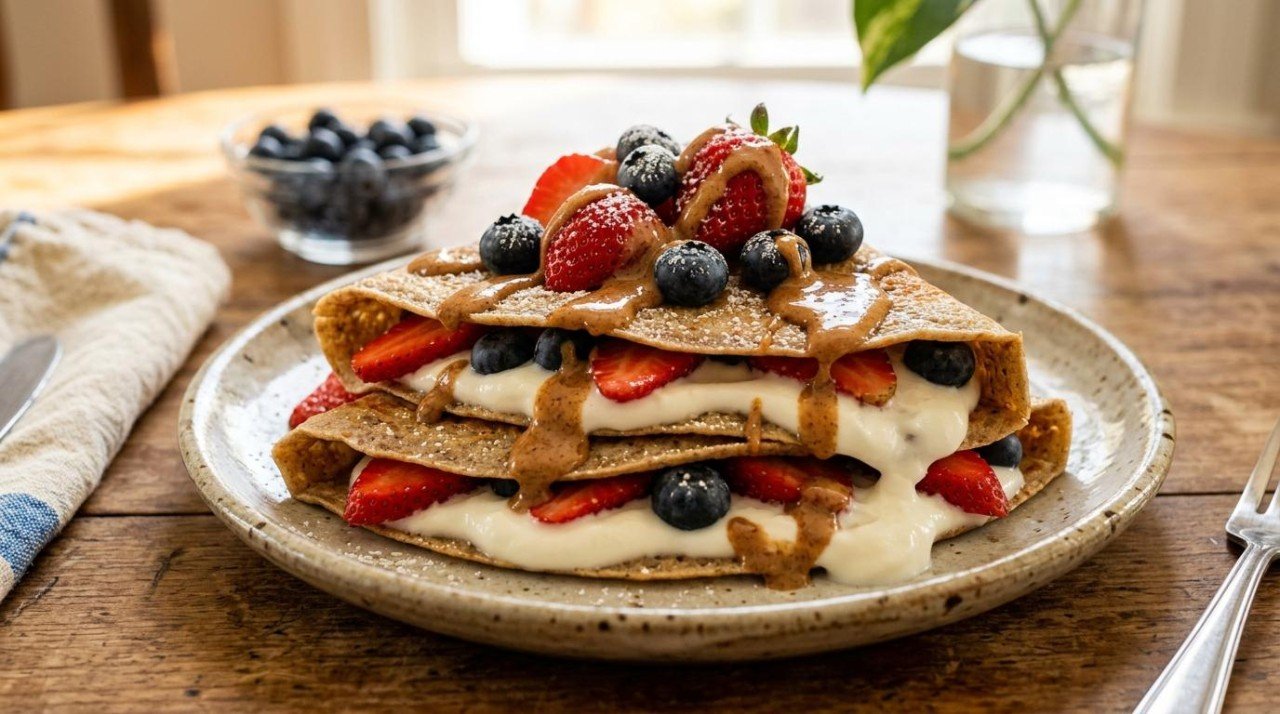
- Swap: 1/2 cup chocolate hazelnut spread + powdered sugar dusting → 1 1/4 cups plain Greek yogurt, 7 oz strawberries, 3.5 oz blueberries, 2 tablespoons almond butter
- Score impact: +20 points (31 → 51)
- What it changes: Added sugar falls from 27.3 g to 3 g per serving, saturated fat from 19.5 g to 9.6 g, protein rises from 11.1 g to 18.9 g, and plant points go from 0 to 3
- What it costs you: This is the real trade. Chocolate hazelnut spread tastes like chocolate hazelnut spread, and yogurt and berries do not. What you get instead is a filling that is cold and tart against a hot crepe, which is its own good thing — but nobody should tell you it is the same experience
The technique that makes this work is the almond butter. Two tablespoons across eight crepes is a whisper — less than a teaspoon each — but spread thin and warm it gives you the rich, toasty, slightly sticky layer your mouth is expecting under the fruit. Skip it and the whole thing reads as yogurt on a pancake. Warm the jar for ten seconds so it spreads instead of tearing the crepe.
Use plain Greek yogurt, not vanilla — flavored yogurts put back a good part of the sugar you just removed. Straining is why plain Greek yogurt carries roughly twice the protein of regular yogurt at the same volume, and why it holds its shape inside a folded crepe instead of running out the bottom. Our Greek yogurt substitutes guide covers what works if you are out.
2. Take the batter from white flour to buckwheat and whole wheat
- Swap: 1 cup all-purpose flour → 1/2 cup plus 1 tbsp buckwheat flour + 1/2 cup whole wheat flour
- Score impact: +8 points (51 → 59)
- What it changes: Nearly doubles fiber (3.1 g to 5.6 g per serving) and adds two more plant points
- What it costs you: Color and flavor, not texture. The crepes come out grey-brown and taste nutty and faintly earthy. Most people like it; a few miss the neutral canvas
This swap is really a restoration. Buckwheat is what crepes were made of in Brittany before white flour was cheap, and a 2023 review of buckwheat's nutritional profile lays out why it is worth going back to: more fiber and better-balanced protein than cereal grains, none of the gluten proteins involved in celiac disease, and rutin, a flavonoid that among the pseudocereals is essentially unique to buckwheat.
Why blend it with whole wheat rather than go all buckwheat? Because buckwheat has no gluten, so a 100 percent buckwheat batter has nothing holding it together and the crepes tear when you lift them. King Arthur's all-buckwheat crepe recipe works, but it leans on a long refrigerated rest and a careful hand. The half-and-half blend gives you the flavor with enough structure to flip one-handed; the all-purpose flour substitutes guide has ratios if you want a different partial swap.
3. Stop cooking in butter
- Swap: 4 tbsp butter total (batter + pan) → 2 tsp extra virgin olive oil total
- Score impact: +27 points (59 → 86)
- What it changes: Saturated fat drops from 9.6 g to 3.6 g per serving, calories from 437 to 353, and the recipe's last caution clears entirely
- What it costs you: Some browned-butter aroma. A well-heated nonstick pan browns the crepe just as well, and the buckwheat covers much of the flavor gap
Four tablespoons of butter sounds like a lot until you realize two of them are simply what a pan absorbs over eight crepes. Both of butter's jobs here — keeping the crepe from sticking, and adding a little fat to the batter for tenderness — get done by a fraction of the fat. One teaspoon of olive oil goes in the batter; the other lives on a folded paper towel you wipe across the pan between crepes. Our butter substitutes guide covers which fats behave like butter in which situations, and a thin pan film is the easiest case of all.
Now the interesting part. We tested this exact swap on the untouched original too, and there it was worth 3 points, not 27 (31 → 34). With half a cup of chocolate hazelnut spread still in the dish, the recipe stayed flagged for both added sugar and saturated fat, so pulling the butter barely moved the needle. Once the filling was rebuilt, the same swap cleared the last caution and unlocked most of the remaining score. Swaps are not a tally you can add up in any order — they compound. If you are only making one change to your crepes, make it the filling.
4. Add a third egg
- Swap: 2 large eggs → 3 large eggs
- Score impact: +2 points (86 → 88)
- What it changes: Protein per serving goes from 18.8 g to 20.3 g, with more choline and B12
- What it costs you: Nothing. The crepes get slightly more tender and hold together better without the butter
A small one, but free. The extra egg replaces some of the structure the butter used to provide, which matters more in a lower-fat batter, and it pushes the plate over 20 g of protein — the difference between a sweet breakfast and one that holds you until lunch.
What we kept on purpose
Whole milk stays. We tested low-fat and the score did not move a single point — 88 either way. Once the butter is out, milk fat is not what is dragging a crepe batter down, and whole milk makes the better batter. The milk substitutes guide covers non-dairy options if you need one, but do not swap it for score reasons.
The tablespoon of sugar stays in the batter too: removing it takes added sugar from 3 g to 0 g per serving and changes the score by exactly zero points, while costing you the browning and tenderness it buys. That is where we stopped. The next swap on the list would have been cutting the yogurt or the fruit to trim calories, and at that point you are not improving crepes any more, you are just serving fewer of them.
Take the Guesswork Out of Eating Well
Eat Well Planner helps you organize your favorite recipes, plan balanced meals, and automatically generate shopping lists — all in one place. Whether you're tracking macros, managing dietary restrictions, or just trying to stop asking "what's for dinner?", we've got you covered.
Our AI-powered tools can adapt any recipe to your dietary needs, help you discover new meals you'll love, and even log your nutrition effortlessly. It's meal planning made simple.
Start Organizing Your Meals — FreeThe healthier version: full recipe
Nutrition Score: 88/100. Makes 8 crepes, serves 4.
Batter
- 1/2 cup plus 1 tbsp (65 g) buckwheat flour
- 1/2 cup (60 g) whole wheat flour
- 1 tbsp (12 g) granulated sugar
- 1/4 tsp fine salt
- 3 large eggs
- 1 1/4 cups (300 ml) whole milk
- 2 tsp extra virgin olive oil, divided
Filling
- 1 1/4 cups (300 g) plain Greek yogurt
- 7 oz (200 g) strawberries, hulled and sliced
- 3.5 oz (100 g) blueberries
- 2 tbsp (32 g) almond butter
- Whisk the buckwheat flour, whole wheat flour, sugar and salt together in a bowl.
- Whisk in the eggs until you have a thick paste, then add the milk in three additions, whisking smooth after each. Whisk in 1 teaspoon of the olive oil. The batter should be about the consistency of heavy cream.
- Cover and rest the batter for at least 30 minutes at room temperature, or overnight in the refrigerator. Do not skip this — the rest hydrates the buckwheat starch and relaxes the gluten in the whole wheat, which is the difference between a crepe that lifts cleanly and one that tears.
- Heat a 10-inch nonstick or seasoned crepe pan over medium heat. Fold a paper towel, dip it in the remaining teaspoon of oil, and wipe the pan with a thin film.
- Pour in a scant 1/4 cup of batter and immediately swirl the pan to coat the bottom. Cook for 60 to 90 seconds, until the edges lift and pull away and the underside is browned in patches. Flip and cook 30 seconds more.
- Slide onto a plate and stack the crepes under a clean towel as you go. Re-wipe the pan with the oiled paper towel every second or third crepe.
- Stir the almond butter until it is loose and pourable, warming it for 10 seconds if it is stiff. Spread a thin layer over each crepe, spoon over the yogurt, scatter the berries, and fold into quarters.
- Serve right away, with a little lemon zest or cinnamon over the top if you like. They do not need powdered sugar.
Per serving (2 crepes), original vs. improved:
- Nutrition Score: 31 → 88
- Calories: 533 → 371
- Protein: 11.1 g → 20.3 g
- Fiber: 2.9 g → 5.6 g
- Added sugar: 27.3 g → 3 g
- Saturated fat: 19.5 g → 4 g
- Sodium: 300 mg → 270 mg
- Plant points: 0 → 5
Swaps we tested and skipped
- 100 percent buckwheat flour. Scored 86 — two points lower than the blend. Pair that with a batter that tears when you flip it and there is no argument for it, unless you need the crepes gluten-free.
- Low-fat milk instead of whole. 88 either way. Zero points in exchange for a thinner batter.
- Keeping a smear of chocolate hazelnut spread. We swapped the almond butter for a deliberately restrained 60 g of chocolate hazelnut spread — about 1 1/2 teaspoons per crepe, a fraction of what the original used. The score fell from 88 to 54. Added sugar went back up to 11.1 g per serving and saturated fat to 7.9 g, and both cautions returned. That is the honest answer to "can I just use a little?": a little costs 34 points.
- Dropping the last tablespoon of sugar from the batter. Zero points. Kept it.
The savory fork (and a surprise)
Buckwheat crepes have a savory tradition older than the sweet one. Fill the same batter Brittany-style — a cracked egg, wilted spinach and grated gruyere, folded into a square — and you would assume it beats the fruit version. It does not. We scored a galette complete with 3.5 oz of gruyere across four servings at 61, held back by the saturated fat and sodium in the cheese. Cutting the gruyere to 2 oz and adding 5 oz of sauteed mushrooms brings it to 72, with 23.8 g of protein per serving and a large amount of vitamin K from the spinach. Both are good breakfasts — but the savory one people assume is the virtuous choice still scores 16 points below the version with strawberries in it, which is a fair illustration of why guessing at this does not work.
Make it fit other diets
- Gluten-free: Go all buckwheat (86) and add 1 tablespoon of cornstarch or a teaspoon of psyllium husk for binding, since the whole wheat was doing that job. Rest the batter overnight.
- Dairy-free: Unsweetened soy milk holds up best in the batter; use a thick unsweetened coconut or almond yogurt in the filling and check the label for added sugar.
- Higher protein: The third egg plus the Greek yogurt already puts a serving over 20 g. A fourth egg in the batter takes it further without changing the texture much.
If you would rather not work these out by hand, Eat Well Planner's Recipe Variations rewrites a whole recipe for a given diet in one step, with the substitutions already worked into the ingredients and the instructions.
Do this to your own recipes
Nothing here required a nutrition degree. It required knowing which change to make first — and the only reason we knew the filling had to come before the butter is that we could see both numbers. That is what the Nutrition Score and Make It Healthier are for: import any recipe by URL, from an Instagram reel, or from a YouTube video, and the app scores it, proposes concrete swaps, and verifies the real nutritional gain with a calculator before it ever shows you the suggestion.
Then take it into the Recipe Playground and argue with it. Want to keep the butter in your crepes? Put it back, watch what it costs, and find the points somewhere else. That beats following rules you never got to test.