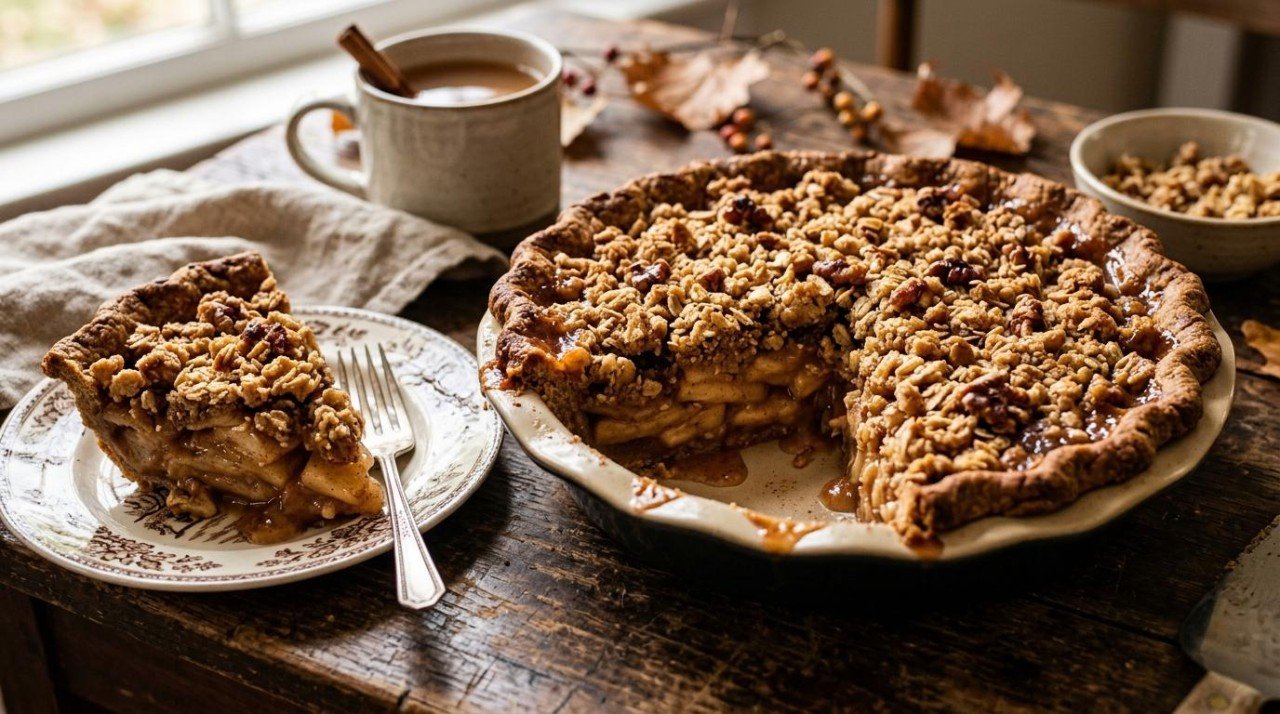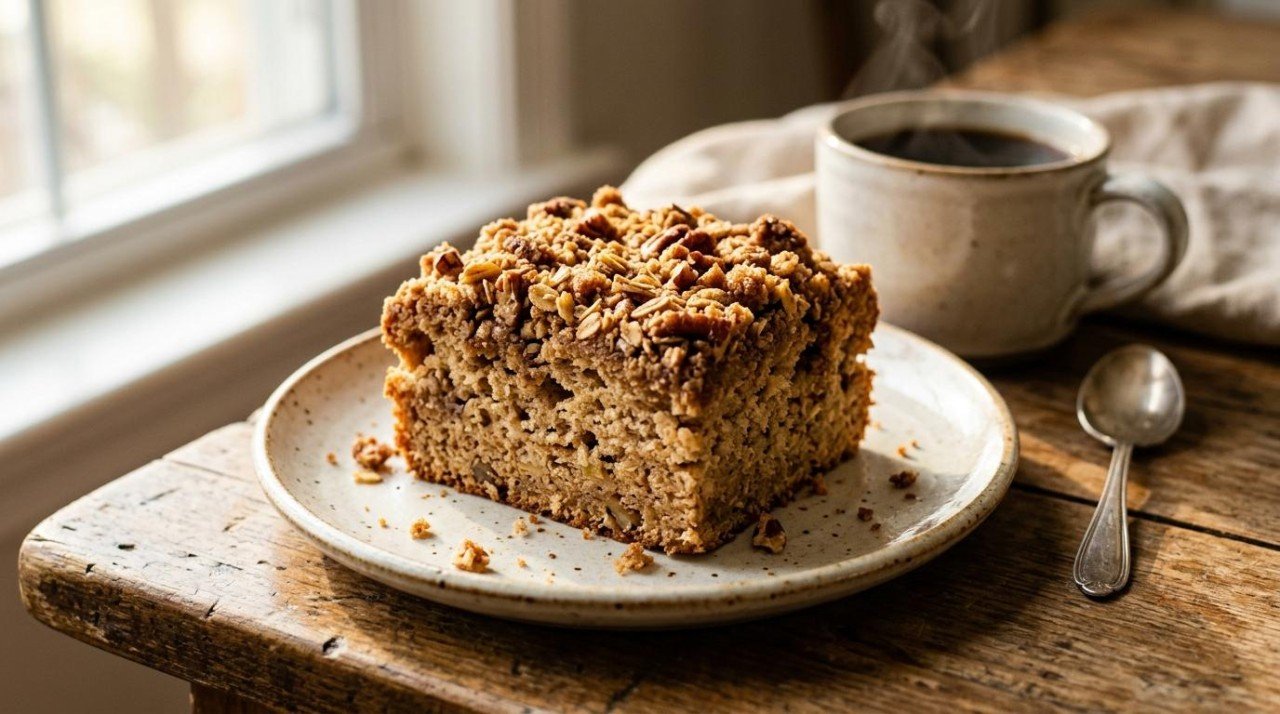
Coffee cake is the loophole. It is cake - creamed butter, a cup of sugar, a rubble of streusel on top - and yet it turns up at 9 a.m. next to the coffee pot and nobody blinks. Birthday cake at breakfast would start an argument. Coffee cake gets a second slice.
So we built the standard American version in Eat Well Planner - the sour cream one, tender crumb, brown sugar streusel baked in the middle and on top - and ran it through the app's Nutrition Score. It came back at 18 out of 100. Then we rebuilt it one verified swap at a time and got it to 40.
The interesting part was not the 22 points. It was the order. The change everyone reaches for first - cut the sugar - was worth 2 points when we tested it on the original recipe on its own. The exact same cut, made last, after the flour and the streusel and the fruit had already been dealt with, was worth 6. This post is partly about coffee cake and partly about why "just use less sugar" so often feels like it does nothing.
The original: what's in it and how it scores
We scored a standard sour cream coffee cake, the kind in every church cookbook and half the recipe blogs. The batter: 2 cups all-purpose flour, 1 cup granulated sugar, 1 stick (1/2 cup) butter, 1 cup full-fat sour cream, 2 eggs, 1 teaspoon each of baking powder, baking soda and vanilla, and 3/4 teaspoon salt. The streusel, half swirled through the middle and half scattered on top: 1/2 cup all-purpose flour, 3/4 cup packed brown sugar, 1/4 cup butter, 1 1/2 teaspoons cinnamon. Baked in a 9-inch square pan and cut into 12. Every number below is per slice.
Nutrition Score: 18/100. Per slice: about 368 calories, 4.5 g protein, 0.8 g fiber, 16.4 g total fat, 8.8 g saturated fat, 400 mg sodium, and 30 g of added sugar, which the app flags as very high. The app's six health dimensions all sit in the teens and twenties: gut health 14, heart health 15, longevity 15, weight management 18.
Thirty grams of added sugar in one slice is the number worth sitting with. The FDA sets the Daily Value for added sugars at 50 g, following the Dietary Guidelines advice to stay under 10% of daily calories. The American Heart Association's limits are stricter still - Harvard's Nutrition Source records them as about 24 grams a day for women and 36 for men. One slice of coffee cake is a woman's entire daily allowance and most of a man's, before the rest of the day has happened.
The second problem is that the cake is nutritionally hollow. Fiber comes in at 0.8 g against a Daily Value of 28 g. The whole recipe scores a quarter of one plant point against the app's 30-a-week gut health target - the cinnamon, essentially. There is no fruit, no whole grain, no seed, nothing with a skin or a bran layer anywhere in it.
What is not the problem is worth naming too, because this is where most coffee cake makeovers go wrong. The saturated fat is flagged, at 8.8 g a slice, but it is a secondary offense rather than the headline - and the butter is buying you something the sugar is not. The sodium is 400 mg and the app does not flag it at all. And the cake is genuinely a decent source of several nutrients: folate at 25% DV, iron at 22%, thiamine at 21%, riboflavin at 14%, because American all-purpose flour is enriched by law. That last fact will cost us something later, and we will come back to it honestly.
The upgrades
We applied these in order and re-scored after each one, so every delta below is what that swap was worth at that point in the build. Where a swap scored differently on its own, we say so.
1. Swap half the batter flour for whole wheat pastry flour
- Swap: 2 cups all-purpose flour in the batter → 1 cup all-purpose + 1 cup whole wheat pastry flour
- Score impact: +5 points (18 to 23) - the biggest single swap in the post
- What it changes: Fiber from 0.8 g to 1.9 g a slice, plus the magnesium, phosphorus and vitamin E that ride along with the bran
- What it costs you: A slightly deeper color and a faint nuttiness. Under the streusel, most people will not find it.
Five points from one bag of flour, and it is the change we would make if you only make one. Refining wheat, as Harvard's Nutrition Source puts it, strips away more than half of wheat's B vitamins, 90 percent of the vitamin E, and virtually all of the fiber - and the same page notes that people eating around 70 g of whole grains a day had a 22% lower risk of total mortality than those eating almost none. Putting half of it back costs you nothing you will notice.
Use whole wheat pastry flour specifically, not standard whole wheat. It is milled from soft wheat, so it is lower in protein and forms less gluten - which is exactly what you want in a cake, where gluten means toughness. Standard whole wheat flour at 50% will give you a heavier, chewier crumb and a more assertive wheaty flavor. If pastry flour is not something you keep, our all-purpose flour substitutes guide covers what does and does not work at what ratio.
2. Rebuild the streusel with oats and pecans
- Swap: Streusel of 1/2 cup flour + 1/4 cup butter → 2/3 cup rolled oats + 1/2 cup chopped pecans + 2 tablespoons butter
- Score impact: +3 points (23 to 26)
- What it changes: Fiber to 2.5 g a slice; plant points from 1.25 to 3.25; saturated fat down slightly, from 8.9 g to 8.2 g
- What it costs you: Nothing. This streusel is better - it goes crunchy and toasty rather than sandy.
This is the rare swap with no downside, and it is the one we would defend hardest on taste alone. Flour-and-butter streusel is a texture compromise; it bakes into a soft, sweet crumb layer. Oats and chopped pecans toast in the oven's dry top heat and give you actual crunch against a soft cake, which is what streusel was always trying to be.
Be honest about the dose, though. Two thirds of a cup of oats across twelve slices is about 5 g of oats per slice. That is not a meaningful beta-glucan dose - the meta-analysis Harvard cites found roughly 3 g of beta-glucan a day was what modestly lowered blood cholesterol, and you would need a bowl of oatmeal for that, not a slice of cake. The same goes for the pecans: 4 g a slice is nowhere near the ounce, five-times-a-week serving associated with 14% lower cardiovascular disease risk. What these two are doing here is replacing refined flour and butter with whole food, adding fiber and plant diversity, and improving the texture. That is enough. It does not need to be medicine.
Technique: melt the butter rather than cutting it in cold, stir it through the dry mix, and chill the streusel for ten minutes before it goes on the cake. Cold clumps hold their shape in the oven instead of melting flat.
3. Add a layer of grated apple - and pull two tablespoons of butter
- Swap: Add 2 medium apples, peeled and coarsely grated, folded into the batter; batter butter from 8 tablespoons to 6
- Score impact: +3 points (26 to 29)
- What it changes: Fiber to 3.0 g a slice, which crosses into a "good source"; saturated fat from 8.2 g to 7.1 g; a fourth plant point
- What it costs you: The crumb goes moister and slightly denser - closer to a good apple cake than a dry-ish crumb cake.
These two changes belong together, which is why we scored them together. Grated apple brings water and pectin into the batter, and that is precisely the job the extra butter was doing - keeping the crumb from going dry. Take the butter out on its own and you get a tough, dry cake. Take it out and put grated apple in and you get a cake that stays moist for three days on the counter, which the original does not.
Peel and grate the apples coarsely on a box grater, then squeeze them gently in a clean dish towel. You want them damp, not dripping - too much free juice and the bottom layer goes soggy. A firm baking apple works best; something that collapses to sauce is fine for flavor but will not give you the flecks of texture through the crumb.
4. Greek yogurt for the sour cream
- Swap: 1 cup full-fat sour cream → 1 cup plain Greek yogurt
- Score impact: +2 points (29 to 31)
- What it changes: Protein from 4.9 g to 6.3 g a slice; saturated fat from 7.1 g to 5.2 g, out of the app's high band; 24 fewer calories
- What it costs you: A sharper tang. Slightly, and only if you are looking for it.
Two points understates this one. It is the single biggest cut to saturated fat in the whole build - nearly 2 grams a slice - and it does the most for protein, and it changes the eating experience least. Sour cream and Greek yogurt are close cousins: both cultured, both thick, both acidic enough to react with the baking soda and keep the crumb tender. Greek yogurt is simply strained harder, which is where the extra protein and the lower fat come from.
Use plain Greek yogurt, not regular plain yogurt, and not anything vanilla or fruit-flavored. Regular yogurt is looser and will thin the batter. If you want the full picture on which direction this swap runs and what it does in hot dishes versus baked ones, we have guides to both sour cream substitutes and Greek yogurt substitutes.
5. Cut the sugar by nearly half - and double the cinnamon and vanilla
- Swap: 1 cup granulated sugar → 1/2 cup; 3/4 cup packed brown sugar in the streusel → 1/3 cup; cinnamon and vanilla both doubled
- Score impact: +6 points (31 to 37) - the biggest mover in the build, and +2 points when we tested it on the original recipe first
- What it changes: Added sugar from 30 g to 14 g a slice; calories from 351 to 289
- What it costs you: Real sweetness. This is the swap you will notice, and it only works because of the five before it.
Here is the finding that reorganized this post. We tested the sugar cut two ways. Applied to the original recipe, changing nothing else, it took the score from 18 to 20. Two points, for halving the most-blamed ingredient in the cake. Applied last, on top of everything above, the same cut was worth six. The score does not pay you much for removing something from a hollow recipe; it pays you once there is something there to reward.
The flavor side works the same way. Cut a cup of sugar to half a cup in the original and you get a flat, faintly floury cake, because sugar was carrying the whole flavor. Cut it in this cake and the apple, the toasted pecans, the tang of the yogurt and a full tablespoon of cinnamon are all still there to be tasted - they were being drowned out before. Doubling the cinnamon and vanilla is not a trick to fool your tongue into reading sweetness. It is giving the cake something else to taste like.
One warning: do not replace the missing sugar with honey, maple syrup or coconut sugar. The app counts all of them as added sugar in exactly the same way, and the score does not move. Our guides to white sugar substitutes and brown sugar substitutes go through which swaps are genuine nutritional changes and which are just a different bottle of sugar.
6. Two tablespoons of ground flaxseed in the streusel
- Swap: Add 2 tablespoons ground flaxseed to the streusel mix
- Score impact: +3 points (37 to 40)
- What it changes: Omega-3 ALA from 0.06 g to 0.28 g a slice - 18% DV, a good source, from nothing; fiber to 3.4 g; a fifth plant point
- What it costs you: Nothing detectable. It disappears into a nutty streusel completely.
Three points for two tablespoons of pantry seeds is the best return per unit of effort in this post. Unlike the oats and the pecans, the dose here genuinely lands: omega-3 ALA is needed in small enough amounts that roughly a gram of flax per slice takes the cake from essentially zero to a good source.
It must be ground. MedlinePlus is direct about it: ground flaxseeds are easiest to digest and may provide more nutrients than whole seeds, which can pass through your digestive system undigested. Buy whole seeds, grind what you need in a spice grinder, and keep the rest in the freezer, because pre-ground flax goes rancid fast.
Take the Guesswork Out of Eating Well
Eat Well Planner helps you organize your favorite recipes, plan balanced meals, and automatically generate shopping lists — all in one place. Whether you're tracking macros, managing dietary restrictions, or just trying to stop asking "what's for dinner?", we've got you covered.
Our AI-powered tools can adapt any recipe to your dietary needs, help you discover new meals you'll love, and even log your nutrition effortlessly. It's meal planning made simple.
Start Organizing Your Meals — FreeWhat we kept, and where we stopped
Six tablespoons of butter stay in the batter and two stay in the streusel, and together they are still the largest source of saturated fat in the cake. That is deliberate. Butter is doing structural work in a creamed batter and it is the only thing that makes streusel behave like streusel. We will come back to this in the skipped section, because the numbers argued with us.
Half the flour stays refined, and that costs something real: folate drops from 25% DV to 12%, thiamine from 21% to 16%, because enriched all-purpose flour was supplying them and whole wheat is not enriched. We think the trade is worth it - fiber, minerals and the whole grain package against two B vitamins that most American diets are not short of - but it is a trade, not a free win.
And the sugar stays at half rather than going to zero, the streusel stays, and the cake stays cake. Which brings us to the honest headline: 40 out of 100 is the ceiling here. A coffee cake that scores 80 is not a coffee cake, it is a bowl of oatmeal with apple in it. Forty is what this dish can score while still being the thing you want next to the coffee.
The healthier version: apple oat streusel coffee cake
Nutrition Score: 40/100. Makes 12 squares in a 9-inch square pan.
Streusel
- 2/3 cup (60 g) old-fashioned rolled oats
- 1/2 cup (50 g) pecans, roughly chopped
- 1/3 cup packed (70 g) brown sugar
- 2 tablespoons (14 g) ground flaxseed
- 2 teaspoons ground cinnamon
- 2 tablespoons (30 g) unsalted butter, melted
Batter
- 1 cup (120 g) all-purpose flour
- 1 cup (120 g) whole wheat pastry flour
- 1 teaspoon ground cinnamon
- 1 teaspoon baking powder
- 1 teaspoon baking soda
- 3/4 teaspoon fine salt
- 6 tablespoons (85 g) unsalted butter, softened
- 1/2 cup (100 g) granulated sugar
- 2 large eggs, room temperature
- 1 cup (230 g) plain Greek yogurt
- 2 teaspoons vanilla extract
- 2 medium apples (about 250 g peeled and coarsely grated)
- Heat the oven to 350°F. Butter a 9-inch square pan and line it with a parchment sling.
- Make the streusel first: stir the oats, pecans, brown sugar, flaxseed and cinnamon together, pour over the melted butter, and rub it through with your fingertips until it clumps. Put it in the fridge while you make the batter - cold streusel holds its clumps in the oven instead of melting flat.
- Peel and coarsely grate the apples, then squeeze them gently in a clean dish towel. They should be damp, not dripping.
- Whisk both flours, the cinnamon, baking powder, baking soda and salt together in a bowl.
- Beat the softened butter and granulated sugar for 2 to 3 minutes until lightened. With only 6 tablespoons of butter and half a cup of sugar it will not go as pale and fluffy as a full-fat creaming - that is expected, not a mistake.
- Beat in the eggs one at a time, then the vanilla, then the Greek yogurt. The mixture may look slightly split; it comes back together once the flour goes in.
- Fold in the dry ingredients until barely combined, then fold in the grated apple. Stop mixing the moment there is no dry flour left - this batter is stiff, and overworking it toughens the crumb.
- Spread half the batter in the pan, scatter about a third of the streusel over it, then dollop and gently spread the remaining batter on top. Finish with the rest of the streusel.
- Bake for 40 to 45 minutes, until a skewer in the center comes out with a few moist crumbs and the streusel is deep golden.
- Cool in the pan at least 20 minutes before lifting it out and cutting. The apple keeps it moist for three days, covered, at room temperature.
Per slice, original vs. improved:
- Nutrition Score: 18 → 40
- Calories: 368 → 295
- Protein: 4.5 g → 6.5 g
- Fiber: 0.8 g → 3.4 g, a good source at 12% DV
- Added sugar: 30 g → 14 g
- Total fat: 16.4 g → 13.2 g
- Saturated fat: 8.8 g → 5.2 g
- Omega-3 ALA: none to speak of → 18% DV, a good source
- Sodium: 400 mg → 370 mg (not flagged either way)
- Plant points: 0.25 → 5.25
Swaps we tested and skipped
Applesauce for all the butter. This is the standard lightened-baking move and it is the one the numbers argued hardest for: replacing every tablespoon of butter with unsweetened applesauce took the score from 40 to 47 and dropped saturated fat from 5.2 g to 0.9 g a slice. Seven points is more than any upgrade we kept. We still would not do it, for one specific reason: streusel cannot exist without solid fat. Rubbing butter into oats and sugar is what makes crumbs; applesauce makes a wet paste that bakes into a chewy lid. You would be deleting the defining feature of the dish to win points. If saturated fat matters to you medically, our butter substitutes guide covers the swaps that hold their structure, which is the direction we would go instead.
Dates instead of all the sugar. Replacing both sugars with date paste scores 53 - thirteen points, and zero added sugar, because the app counts whole dates as fruit rather than added sugar. It is the highest-scoring version of this recipe we built, and it is not coffee cake. Date paste bakes dark, dense and caramel-heavy, and the streusel simply will not crisp without granular sugar to crystallize.
Date paste in the batter only, keeping real brown sugar in the streusel, is the version we would actually recommend to someone who wants to push further: it scores 44 and takes added sugar down to 5.7 g a slice, while the streusel stays crunchy. It is a genuinely different cake - darker and stickier, more date loaf than crumb cake - but it is still recognizably the same idea. Four extra points, and we left it out of the main build only because it changes the flavor more than a "same cake, better numbers" makeover should.
100% whole wheat pastry flour. Taking the flour all the way whole grain scored 41 - one point above the half-and-half version, with fiber at 4.5 g a slice. One point is not nothing, and if you bake with whole wheat pastry flour regularly, go ahead. We left the default at half because a point is a thin reward for a denser crumb in a cake whose whole appeal is tenderness.
Make it fit other diets
For dairy-free, a thick unsweetened coconut or almond yogurt stands in for the Greek yogurt one for one (you lose about a gram of protein a slice), and a firm plant butter handles both the batter and the streusel. For vegan, the eggs are the harder problem than the dairy - two flax eggs work in a batter this moist and this heavily leavened, but expect a slightly tighter crumb. Gluten-free is the most forgiving of the three here: a 1:1 gluten-free baking blend swaps in for both flours, and since a low-gluten tender crumb was the goal anyway, you are not fighting the recipe. You will lose the fiber the whole wheat was providing, so keep the oats and flax in the streusel.
Rather than guessing at ratios, import the recipe into Eat Well Planner and ask Recipe Variations for the version you need. It rewrites the whole thing with the swaps worked in, and you can score the result before you commit an afternoon to it.
Do this to your own recipes
Every number on this page came out of the app's Make It Healthier feature and its Recipe Playground. You import a recipe - from a URL, an Instagram reel, a YouTube video, or a photo of a handwritten card - and the app scores it, then proposes ingredient swaps with the nutritional gain verified by a calculator before the suggestion ever reaches you. In the playground you change one thing at a time and watch the number move.
That is the only way we would have found out that halving the sugar was worth two points on its own and six at the end. It is a genuinely useful thing to know about your own cooking: the first change you make to a hollow recipe rarely pays, and the same change made fifth often does. Try it on the recipe in your house that nobody is willing to give up. The honest fix is usually smaller, more specific, and less miserable than the internet told you it would be.