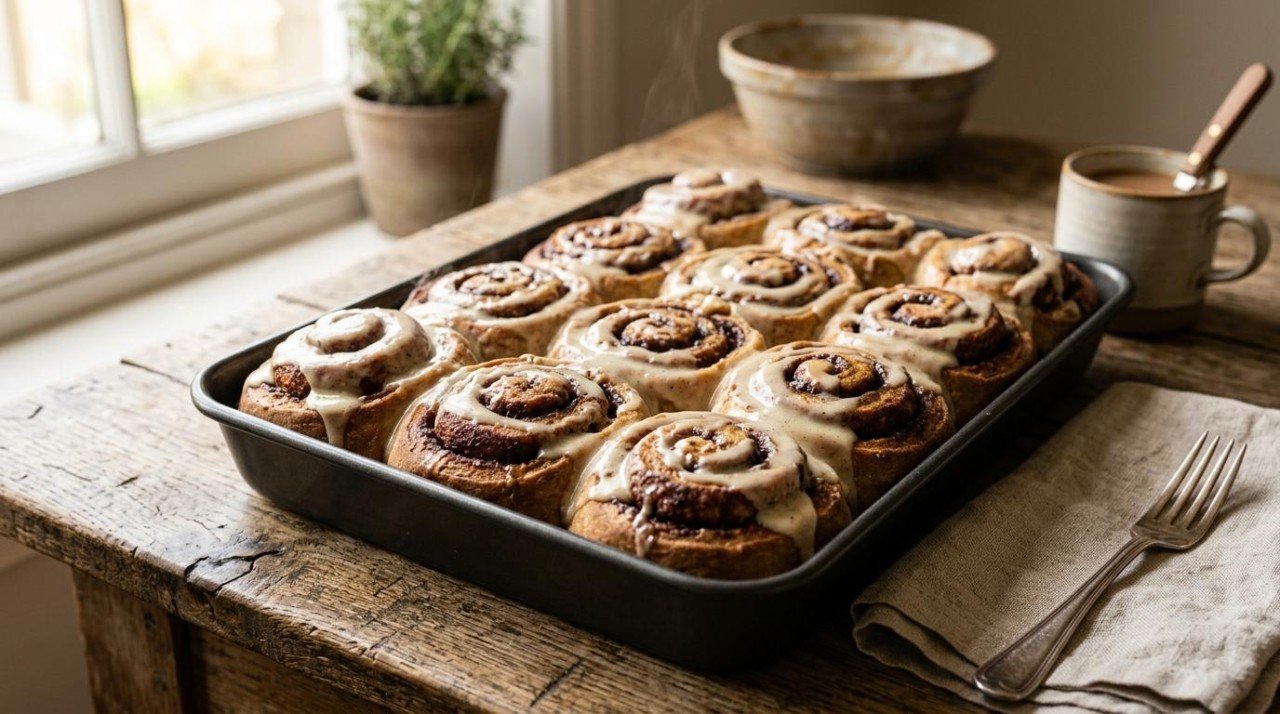
A cinnamon roll is a delivery system for butter, sugar, and the smell of a Sunday morning. Nobody bakes them for the nutrition, and the honest starting position for this post is that we were not going to turn them into a health food.
Still, we wanted to know how far one could move. So we built a standard homemade cinnamon roll in Eat Well Planner - enriched milk-and-butter dough, butter-and-brown-sugar filling, cream cheese icing, cut into 12 - and ran it through the app's Nutrition Score. It came back at 20 out of 100, with two flags in the very-high band. Then we rebuilt it one verified swap at a time and got it to 42.
That is a 22-point jump, and it is also a 42, which is the point of this post. One swap did half the work and it is the one nobody puts in the headline. The recipe's biggest sugar source turned out not to be the part everyone assumes. And we found the ceiling, tested past it, and came back. Here is every move and what it was really worth.
The original: what's in it and how it scores
We scored the version most home bakers make. The dough: 4 cups all-purpose flour, 1 cup whole milk, 1/3 cup granulated sugar, a packet of yeast, 1/3 cup melted butter, 2 eggs, and a teaspoon of salt. The filling: 1/2 cup softened butter, 3/4 cup packed brown sugar, 2 tablespoons cinnamon. The icing: 4 ounces cream cheese, 1/4 cup butter, 1 1/2 cups powdered sugar, vanilla, and a splash of milk. Twelve rolls. Every number below is per roll.
Nutrition Score: 20/100. Per roll: about 492 calories, 8 g protein, 1.9 g fiber, 11.9 g saturated fat, and the number that sinks it - 33.9 g of added sugar, which the app flags as very high at 128% of a day's reference. The American Heart Association recommends no more than 25 g of added sugar a day for women and 36 g for men. One roll is over the line for a woman and within a rounding error of it for a man, before anything else you eat that day. Saturated fat came in second at 51% of the daily ceiling, also very high.
Here is the part that surprised us: the icing is the single largest sugar source in the recipe, not the filling. That 1 1/2 cups of powdered sugar is 180 g of pure sucrose, about 44% of all the added sugar in the pan - more than the brown sugar in the swirl and the sugar in the dough combined. The thing you spread on at the end after the baking is done is the thing doing the most damage.
And plenty here is genuinely fine. Sodium is a non-issue. The eggs, milk, and butter are real food, and the flour is enriched, so the rolls are an excellent source of thiamine (42% DV) and iron (32%). At 492 calories a roll is substantial but not absurd for a breakfast pastry. What holds this at a 20 is the sugar, the emptiness of the flour, and 1.9 g of fiber in a 492-calorie serving.
The upgrades
We applied these in order and re-scored after each one, so every delta is what that swap was worth at that point in the build. The first one is by far the largest, so if you make exactly one change, make that one.
1. All the flour to white whole wheat
- Swap: 4 cups all-purpose flour → 4 cups white whole wheat flour, plus 3 tablespoons more milk
- Score impact: +11 points (20 to 31) - half the entire makeover from one ingredient
- What it changes: Fiber from 1.9 g to 6.1 g per roll, more than triple; plant points from 1.25 to 2.25
- What it costs you: This is the swap with a real cost - a denser roll unless you use the techniques below
Eleven points from the ingredient nobody blames. Flour is the biggest thing in the pan by weight and, refined, it contributes starch and not much else - which matters when only 5% of American men and 9% of women hit the recommended fiber intake, and when a meta-analysis pooling health data from more than 786,000 people found that eating 70 g of whole grains a day was associated with a 22% lower risk of total mortality. Going from 1.9 g to 6.7 g of fiber in a breakfast pastry is the single most useful thing that happens in this post.
Now the honest part, because this is where most whole wheat cinnamon rolls go wrong. King Arthur is blunt: substituting whole wheat 100% for white flour "will lower the rise of your yeasted baked goods significantly", because the bran absorbs more liquid and cuts the gluten strands that hold the rise. Their fixes are what make this work, and the recipe below uses all three. First, use white whole wheat, a different wheat variety that is milder and paler than red whole wheat while still being whole grain. Second, add 2 teaspoons of liquid per cup of whole wheat and let the dough rest 30 minutes before kneading so the bran fully hydrates. Third - and this is the one that turns a dense roll into a pillowy one - use tangzhong: cook 3 tablespoons of the flour with 1/2 cup of the milk into a paste before mixing. Pre-gelatinizing the starch lets it hold far more water, and King Arthur confirms the technique works with 100% whole wheat, where it especially helps the rolls stay soft for days.
Even with all three, this is a slightly heartier roll than the white-flour original. It is still soft, it still unwinds in a spiral, and it still tastes like a cinnamon roll - but it has a little more chew and a nuttier background note. If that trade is not for you, halving it (2 cups of each flour) scores 37 instead of 42, so you keep most of the gain. Our all-purpose flour substitutes guide covers the other options, and if you are shopping rather than baking, most "wheat" bread is not whole grain either.
2. Rebuild the icing around Greek yogurt
- Swap: 4 oz cream cheese + 1/4 cup butter + 1 1/2 cups powdered sugar → 4 oz cream cheese + 1/2 cup plain whole-milk Greek yogurt + 1/2 cup powdered sugar
- Score impact: +5 points (31 to 36)
- What it changes: Added sugar from 33.9 g to 23.9 g per roll; saturated fat from 12.1 g to 10.0 g, dropping it out of the very-high band; 69 fewer calories
- What it costs you: A thick glaze rather than a pipeable frosting, and it has to live in the fridge
Cutting the powdered sugar by two thirds is the biggest single sugar reduction available anywhere in this recipe, and it barely registers on the tongue because the yogurt replaces sweetness with tang - which is what you actually want against a sugary swirl. The classic cream cheese icing is so sweet it flattens the cinnamon. This one lets it through.
Two technique notes. Use thick, full-fat Greek yogurt: nonfat is less creamy and more tangy, and thin yogurt gives you a glaze that slides straight off. And because there is no longer enough sugar or butter to keep it stable, this icing softens at room temperature and needs refrigerating - fine for cinnamon rolls, which want eating warm and keeping cold. Beat the cream cheese smooth on its own first, then work the yogurt in, or you will get lumps. (See our cream cheese and Greek yogurt guides for more on swapping either one.)
3. Halve the filling butter, cut the brown sugar, add more cinnamon
- Swap: 1/2 cup butter + 3/4 cup brown sugar + 2 tablespoons cinnamon → 1/4 cup butter + 1/2 cup brown sugar + 2 1/2 tablespoons cinnamon
- Score impact: +2 points (36 to 38)
- What it changes: Added sugar from 23.9 g to 19.5 g; saturated fat from 10.0 g to 7.9 g; 51 fewer calories
- What it costs you: A slightly less molten swirl. The extra cinnamon covers the missing sweetness.
Only 2 points, and worth taking anyway, because the calorie and saturated fat cuts here are real even where the score shrugs. A third of the filling butter and a third of the filling sugar disappear and the swirl still works - 4 tablespoons is enough to make the sugar stick to the dough and caramelize on contact with the heat, which is the butter's actual job. Push much below that and the filling stops adhering and starts falling out of the spiral when you slice.
The extra half tablespoon of cinnamon is doing sensory work, not nutritional work: more aromatic spice reads as more flavor, which buys back the sweetness you removed. Our butter substitutes guide covers going further, though see the skipped list below before you try.
4. Three tablespoons of ground flaxseed in the dough
- Swap: Nothing → 3 tablespoons ground flaxseed, added with the flour
- Score impact: +4 points (38 to 42) - the best points-per-effort swap in the post
- What it changes: Plant points from 2.25 to 3.25, protein and fiber up slightly, and it switches on an omega-3 ALA highlight at 26% of a day's target
- What it costs you: Nothing. It is undetectable.
Four points for three tablespoons of something you cannot see, taste, or feel, spread across twelve rolls. It is the same trick that worked in our chocolate chip cookie makeover, and it scores better here. Buy it ground or grind it yourself - whole flaxseed passes through you intact and does nothing at all.
Take the Guesswork Out of Eating Well
Eat Well Planner helps you organize your favorite recipes, plan balanced meals, and automatically generate shopping lists — all in one place. Whether you're tracking macros, managing dietary restrictions, or just trying to stop asking "what's for dinner?", we've got you covered.
Our AI-powered tools can adapt any recipe to your dietary needs, help you discover new meals you'll love, and even log your nutrition effortlessly. It's meal planning made simple.
Start Organizing Your Meals — FreeWhat we kept, and where we stopped
We kept 1/3 cup of real butter in the dough, 4 tablespoons in the filling, both eggs, whole milk, real cream cheese, and brown sugar in the swirl. Those are what make a cinnamon roll taste like one, and every recipe that gets clever about them produces something you eat once.
And we stopped at 42, deliberately, with a higher score sitting right there. Pushing every sugar in the recipe to its practical floor - dough sugar down to 2 1/2 tablespoons, icing sugar to 1/3 cup, filling sugar to 1/3 cup - scores 43. One point, for a roll that tastes noticeably less like a cinnamon roll. Take the filling butter out entirely on top of that and you get 45, and a dry spiral of cinnamon dust that will not stay in the roll.
Here is the number that settles it. At 42, the added sugar flag still reads very high. At 43, with every sugar cut as far as it can go, it still reads very high - 13.1 g, 50% of a day's reference. There is no version of this recipe that clears that flag. Even scoring it with no icing at all leaves it at 55% of the daily reference. A cinnamon roll is a sweet food, and the score is telling the truth about that. What changed is that it is now a sweet food with 6.7 g of fiber, three plants, and a third less saturated fat in it.
The healthier version: full recipe
Final Nutrition Score: 42/100. Makes 12 rolls.
Dough
- 4 cups (480 g) white whole wheat flour, divided
- 1 cup plus 3 tablespoons (280 g) whole milk, divided
- 1/3 cup (67 g) granulated sugar
- 2 1/4 teaspoons (7 g) instant yeast
- 1/3 cup (76 g) unsalted butter, melted
- 2 large eggs
- 3 tablespoons (20 g) ground flaxseed
- 1 teaspoon fine salt
Filling
- 4 tablespoons (57 g) unsalted butter, softened
- 1/2 cup packed (110 g) dark brown sugar
- 2 1/2 tablespoons (20 g) ground cinnamon, preferably Ceylon
Icing
- 4 oz (113 g) cream cheese, softened
- 1/2 cup (113 g) plain whole-milk Greek yogurt, thick
- 1/2 cup (60 g) powdered sugar
- 1 teaspoon vanilla extract
- Make the tangzhong: whisk 3 tablespoons of the flour with 1/2 cup of the milk in a small saucepan over medium heat, whisking constantly, until it thickens into a smooth pudding-like paste, about 1 to 2 minutes. Scrape it into a large mixing bowl and let it cool to lukewarm.
- Warm the remaining milk to about 110°F and add it to the tangzhong along with the granulated sugar, yeast, melted butter, eggs, and salt. Whisk until smooth.
- Add the remaining flour and the ground flaxseed and stir to a shaggy dough. Cover and rest 30 minutes without kneading - this lets the bran absorb liquid, and it is the difference between a soft whole wheat roll and a heavy one.
- Knead 8 to 10 minutes by hand or 6 to 8 in a stand mixer, until the dough is smooth and slightly tacky. Cover and let rise in a warm place until doubled, about 1 to 1 1/2 hours.
- Mix the brown sugar and cinnamon together. Roll the dough on a lightly floured counter into a 12 by 18 inch rectangle. Spread the softened butter to the edges, then scatter the cinnamon sugar evenly over it and press it in gently with your palm.
- Roll up tightly from a long edge into an 18-inch log. Cut into 12 rolls with unflavored dental floss or a sharp serrated knife. Arrange cut side up in a buttered 9 by 13 inch pan, cover, and let rise until puffy and touching, 45 to 60 minutes.
- Heat the oven to 350°F. Bake 25 to 30 minutes, until deep golden and 190°F at the center of a middle roll. Whole wheat browns faster, so tent with foil at 20 minutes if they are darkening early.
- While they bake, beat the cream cheese alone until completely smooth, then beat in the Greek yogurt, powdered sugar, and vanilla. Spread over the rolls once they have cooled about 10 minutes - warm, not hot, or the icing will run off. Refrigerate any leftovers.
Per roll, original vs. improved:
- Nutrition Score: 20 → 42
- Added sugar: about 33.9 g → about 19.5 g (128% of the daily reference → 74%)
- Fiber: about 1.9 g → about 6.7 g
- Saturated fat: about 11.9 g → about 7.9 g (51% of the daily ceiling → 34%)
- Calories: about 492 → about 373
- Protein: about 8.0 g → about 7.8 g (essentially unchanged)
- Plant diversity: 1.25 → 3.25 plant points
- New highlights: excellent source of fiber (23% DV) and omega-3 ALA (26% DV)
One note on the cinnamon, since we increased it. Most supermarket cinnamon is cassia, which contains coumarin - and Austria's food safety agency puts cassia at 1,880 to 3,260 mg of coumarin per kg against up to 185 mg/kg for Ceylon, roughly a hundredfold difference, with a tolerable daily intake of 0.1 mg per kg of body weight. At 20 g of cassia across 12 rolls, one roll lands somewhere around 3 to 5 mg of coumarin - most of a 60 kg adult's 6 mg daily allowance. That is a lifetime-average guideline rather than a danger line, and it was already true of the original recipe, but if cinnamon rolls are a regular thing in your house, buy Ceylon. It also tastes better: more floral, less hot.
Swaps we tested and skipped
Every one of these was scored the same way as the swaps above. Three of them scored higher than what we published.
- Cutting every sugar to the floor: scored 43, rejected. One point, in exchange for a roll that no longer reads as a cinnamon roll. Covered above.
- Dropping the filling butter entirely: scored 45, rejected. Without fat, the cinnamon sugar does not adhere to the dough or caramelize - it falls out when you slice and leaves a gritty, dry seam. Three points for wrecking the swirl is the worst trade in this post.
- Cutting them into 15 smaller rolls: scored 42, unchanged. This is the most common "healthier cinnamon roll" advice there is, and on the score it does exactly nothing, because scoring works on nutrient density, not portion size. It does cut what you eat per roll (373 calories to 298, added sugar 19.5 g to 15.6 g), which is real if you eat one and meaningless if you eat two. A portion decision, not a recipe improvement - though a genuinely good one.
- Adding pecans: scored 41, your call. Three quarters of a cup costs a point and adds 53 calories per roll, but takes plant points from 3.25 to 4.25. We left them out of the master recipe because nuts in cinnamon rolls are divisive; add them if your household likes them.
- Adding raisins: scored 41, your call. Same shape - one point down, one plant point up. Also divisive, also fine.
- Swapping some dough butter for olive oil: scored 41, rejected. It did cut saturated fat from 7.9 g to 7.0 g, but it lost a point and olive oil does not give an enriched dough the same tender, laminated-feeling crumb. It worked in cookies; it does not earn its place here.
Make it fit other diets
For dairy-free, use unsweetened soy milk in the dough and tangzhong (soy has enough protein to behave like milk), a vegan baking stick for both butters, and a dairy-free cream cheese with coconut yogurt in the icing. For vegan, do all of that and replace the eggs with 1/2 cup unsweetened applesauce plus an extra tablespoon of oil - the dough will be slightly less rich but rises fine. Gluten-free is the one we would not attempt by conversion: the whole structure here is gluten, and you want a recipe built for it from the start. In Eat Well Planner you can ask the AI to rewrite this exact recipe for any of those in one step and it hands back the full version with the swaps worked in.
Do this to any recipe you love
Every number in this post came out of Eat Well Planner's Make It Healthier tool, not an estimate. Import a recipe from any website - or straight from the TikTok or Instagram video you saved it from - and the app scores it and shows you what is actually holding the number down. For cinnamon rolls it was the flour and the icing, which is not where anybody looks. Then test swaps in the Recipe Playground and watch the score move one edit at a time, including the ones that go the wrong way.
Then bake the rolls. Whole grain, less sugar, a tangy glaze instead of a sugary one, and a spiral that still unwinds when you pull it apart. Still a cinnamon roll - just one that is doing a little more for you while you eat it.