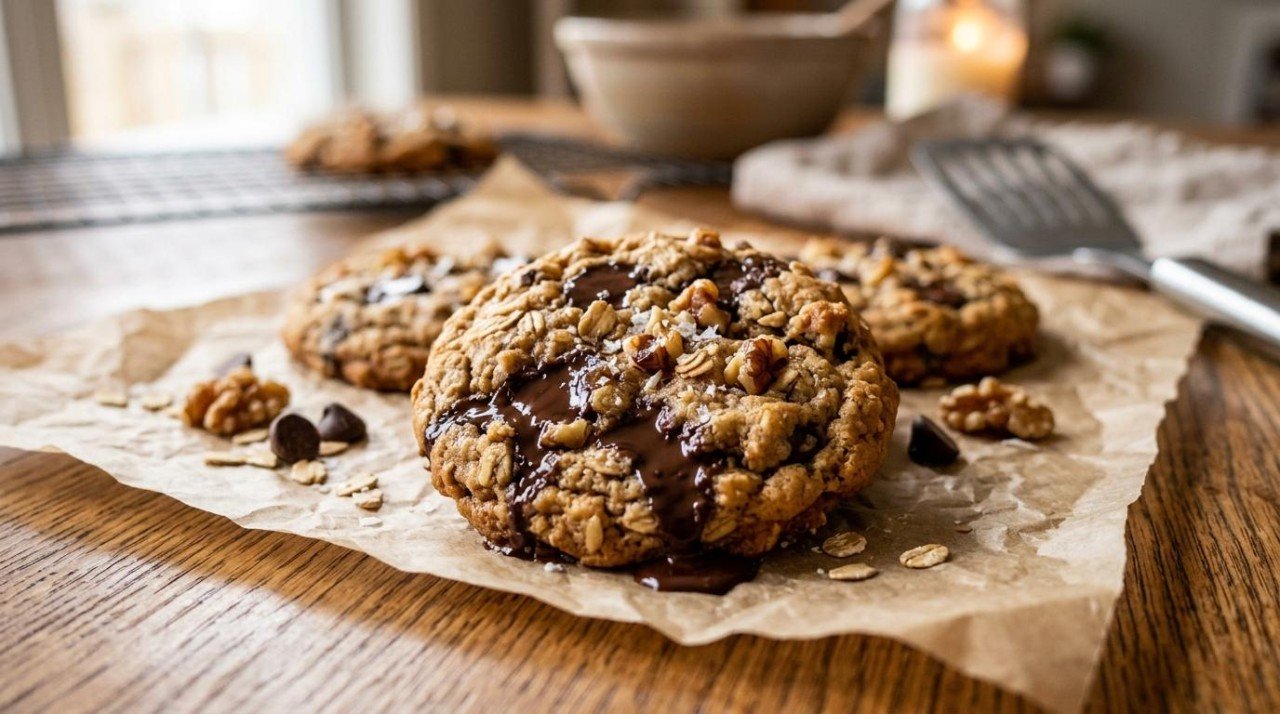
The honest thing first: this is a cookie. It was a cookie when Ruth Wakefield put chopped Nestle chocolate into her butter drop dough at the Toll House Inn in 1938 - deliberately, by the way, not by accident, whatever the back of the bag implies - and it will be a cookie when we are done with it.
But we were curious how far one could move, so we built the classic Toll House recipe in Eat Well Planner and ran it through the app's Nutrition Score. It came back at 18 out of 100 - the lowest number we have put through this series, below instant ramen and below a plate of fried chicken. Then we rebuilt it one verified swap at a time and got it to 37.
That is a 19-point jump, and it is also a 37, which is the point: there is a ceiling here and we will show you exactly where it is. One swap did almost three quarters of the work, and it is not the one everybody talks about. Here is every move, what it was really worth, and the two changes that scored better and we threw out anyway.
The original: what's in it and how it scores
We scored the recipe that has been on the back of the chocolate chip bag for decades: 2 1/4 cups all-purpose flour, 1 cup (2 sticks) butter, 3/4 cup granulated sugar, 3/4 cup packed brown sugar, 2 eggs, vanilla, baking soda, salt, and a 12-ounce bag of semi-sweet chips, minus the optional cup of nuts, because most people leave it out. The package claims 5 dozen cookies, which works out to a 21-gram cookie nobody actually bakes, so we scored the batch at 3 dozen - a standard 2-tablespoon scoop. That is the serving every number below refers to.
Nutrition Score: 18/100. Per cookie: about 158 calories, 1.6 g protein, 0.8 g fiber, 4.7 g saturated fat, and the number that sinks it, 13.6 g of added sugar - which the app flagged as very high, 51% of a day's reference in one cookie. The American Heart Association recommends no more than 25 g of added sugar a day for women and 36 g for men, so two cookies puts a woman over for the day. A large share of it is not even what you measured: semi-sweet chips are over half sugar by weight, so the bag brings its own 6-plus ounces. The other two weaknesses were high saturated fat (from two sticks of butter plus the cocoa butter in the chips) and zero plant diversity.
Plenty here is not the problem, and manufacturing extra guilt is not the point. At 158 calories a full-size cookie is no scandal, the sodium is fine, and the eggs and butter are real food. What holds this cookie at an 18 is the sugar, the emptiness of the flour, and the fact that not one ingredient is doing anything for you.
The upgrades
We applied these in order and re-scored after each one, so every number is what that swap was worth at that point in the build. They run cheapest-in-flavor first - and the first one is also by far the biggest, so if you make exactly one change, make that one.
1. Replace all the flour with white whole wheat and rolled oats
- Swap: 2 1/4 cups all-purpose flour → 1 3/4 cups white whole wheat flour + 1 cup rolled oats
- Score impact: +14 points (18 to 32) - roughly three quarters of the entire makeover, from one swap
- What it changes: Doubles the fiber (0.8 g to 1.6 g per cookie), takes plant diversity from zero to two, turns the biggest ingredient in the bowl from empty into whole grain
- What it costs you: Honestly, almost nothing - and the oats arguably improve the cookie
Fourteen points from the ingredient nobody thinks about. Flour is the largest thing in a cookie by volume and contributes nothing but starch - which matters when only 5% of American men and 9% of women hit the recommended fiber intake, and when a meta-analysis of more than 786,000 people found whole grain eaters had a 22% lower risk of total mortality.
Two notes make this work rather than ruin your cookies. Use white whole wheat, not red - King Arthur's testers found the difference much less noticeable. And the reason you can go to 100% when the usual advice caps cookies at 50% is the add-ins: King Arthur found graininess only shows up in plain, crisp cookies like shortbread, while oats, chips, and nuts hide it completely. Chill the dough so the bran hydrates and nobody will identify it as whole wheat. (Our flour substitutes guide covers the alternatives.)
2. Chopped 70% dark chocolate instead of semi-sweet chips
- Swap: 12 oz semi-sweet chocolate chips → 7 oz 70% dark chocolate, chopped into chunks
- Score impact: -1 point (32 to 31)
- What it changes: Added sugar from 13.8 g to 10.0 g per cookie, saturated fat from 4.7 g to 4.2 g
- What it costs you: Nothing, and most people prefer it - chunks give you melted pools instead of uniform pellets
This is the swap every "healthier cookie" article leads with, and on our scorecard it went the wrong way by a point. We kept it anyway rather than quietly reordering the list: that dip is noise, while what the swap actually did was strip 3.8 g of added sugar out of every cookie - more than the entire sugar reduction in the next section removes. The chocolate aisle is a bigger sugar lever than the sugar canister. Chop a bar unevenly for shards and melted pools instead of the waxy little cones chips are engineered to remain; if 70% is too bitter, 60% gets you most of the way.
3. Cut the sugar by about a third
- Swap: 3/4 cup granulated + 3/4 cup brown sugar → 1/4 cup granulated + 3/4 cup brown sugar
- Score impact: +3 points (31 to 34)
- What it changes: Added sugar from 10.0 g down to 7.2 g per cookie - about half what the original had
- What it costs you: Slightly less spread and slightly less crisp edge. Noticeable side by side; not noticeable on its own.
We cut the white sugar and left the brown alone, which is doing real work: brown sugar gives a chocolate chip cookie its chew and butterscotch depth, while white sugar is mostly there for spread and crisp edges, so cutting the white is the cheapest sweetness you can buy back. A third is where we stopped on purpose. King Arthur's testing found the less sugar in a cookie, the less it spreads, with reduced-sugar versions coming out softer and drier rather than crisp - though they also found chocolate and butter flavors step forward as sweetness drops, a genuine upgrade with good dark chocolate in the dough. Go much past a third and you are baking a scone. (Our white sugar and brown sugar guides cover swapping rather than reducing.)
4. Add ground flaxseed - and put the walnuts back
- Swap: Nothing → 3 tablespoons ground flaxseed + 1 cup chopped walnuts
- Score impact: +2 points net (34 to 36) - but the split is the interesting part: the flaxseed alone was worth +3, and adding the walnuts on top cost 1 point back
- What it changes: Fiber from 1.5 g to 1.8 g, protein from 1.6 g to 2.2 g, plant diversity from 2 to 4, and it makes the cookie what the app rates an excellent source of omega-3 ALA - 28% of a day's target
- What it costs you: One point of score for the nuts, plus the fact that nuts in cookies are divisive in some households
The flaxseed is the stealth win: three tablespoons across 36 cookies is completely undetectable and worth 3 points on its own, more than the sugar reduction. Grind it or buy it ground - whole flaxseed passes straight through you undigested. The walnuts are the honest part. Wakefield's original recipe had a cup of nuts in it and the version most people bake quietly dropped them, so we put them back - and the score went down a point, because a cup of walnuts brings real calories and fat with it. We kept them anyway: walnuts are the standout tree nut for plant omega-3s and the reason that highlight switches on at all. Take them out and it disappears, along with some fiber and protein. If your household is anti-nut, leave them out and keep the flax - you actually score two points higher, and we will not pretend otherwise.
5. Swap some of the butter for olive oil
- Swap: 1 cup (2 sticks) butter → 9 tablespoons butter + 3 tablespoons extra virgin olive oil
- Score impact: +1 point (36 to 37)
- What it changes: Saturated fat from 4.5 g to 3.4 g per cookie - about a quarter less - and calories back down to 149
- What it costs you: A slightly softer, less short crumb, and a faint fruity note if you use a strong oil
One point, worth taking because the saturated fat reduction is real even where the score barely notices. Use a mild oil rather than a peppery finishing one, and cream the butter with the sugars first, beating the oil in with the eggs - oil does not cream. Our butter substitutes guide has the full ratio table, but see the skipped swaps below before pushing further.
Take the Guesswork Out of Eating Well
Eat Well Planner helps you organize your favorite recipes, plan balanced meals, and automatically generate shopping lists — all in one place. Whether you're tracking macros, managing dietary restrictions, or just trying to stop asking "what's for dinner?", we've got you covered.
Our AI-powered tools can adapt any recipe to your dietary needs, help you discover new meals you'll love, and even log your nutrition effortlessly. It's meal planning made simple.
Start Organizing Your Meals — FreeWhat we kept, and where we stopped
We kept nine tablespoons of real butter, both kinds of sugar, two whole eggs, and seven ounces of actual chocolate. Those are the things that make a chocolate chip cookie taste like one, and recipes that get clever about them stop being what you searched for.
And we stopped at 37. The app still flags this cookie for high added sugar and high saturated fat and always will, because a cookie is a flour-butter-sugar-chocolate delivery system. A 37 is not a health food. It is a cookie with double the fiber, half the added sugar, a quarter less saturated fat, and four plants in it instead of none - a genuinely better cookie, not a different food.
The healthier version: full recipe
Final Nutrition Score: 37/100. Makes 36 cookies.
- 1 3/4 cups (210 g) white whole wheat flour
- 1 cup (90 g) old-fashioned rolled oats
- 3 tablespoons (20 g) ground flaxseed
- 1 teaspoon baking soda
- 1 teaspoon salt
- 9 tablespoons (128 g) unsalted butter, softened
- 3 tablespoons (40 g) extra virgin olive oil, mild
- 3/4 cup (165 g) packed dark brown sugar
- 1/4 cup (50 g) granulated sugar
- 2 teaspoons vanilla extract
- 2 large eggs
- 7 oz (200 g) 70% dark chocolate, chopped into rough chunks
- 1 cup (115 g) walnuts, chopped
- Whisk together the flour, oats, flaxseed, baking soda, and salt, and set aside.
- Beat the softened butter with both sugars until light and creamy, about 2 minutes. Beat in the eggs one at a time, then the olive oil and vanilla, until smooth.
- Add the dry ingredients and mix just until no streaks of flour remain - overmixing whole wheat dough makes cookies tough. Fold in the chopped chocolate and walnuts.
- Cover and chill the dough at least 30 minutes, or up to overnight. Do not skip this: the rest lets the bran fully absorb liquid, which is what keeps whole wheat cookies from tasting gritty.
- Heat the oven to 375°F and line two baking sheets with parchment. Scoop 2-tablespoon mounds about 2 inches apart.
- Bake 9 to 11 minutes, until the edges are set and browned and the centers still look slightly underdone. Cool on the sheet 5 minutes before moving them to a rack - they finish setting there, which keeps the middles chewy.
Per cookie, original vs. improved:
- Nutrition Score: 18 → 37
- Added sugar: about 13.6 g → about 7.2 g
- Fiber: about 0.8 g → about 1.8 g
- Saturated fat: about 4.7 g → about 3.4 g
- Protein: about 1.6 g → about 2.2 g
- Calories: about 158 → about 149
- Sodium: about 140 mg → about 130 mg
- Plant diversity: 0 → 4
Swaps we tested and skipped
Two of these scored higher than what we published and we left them out anyway. The score is a guide, not a boss, and a cookie nobody finishes is not an improvement.
- Making the cookies smaller. The most common healthier-cookie advice there is, and on the score it does nothing: the identical dough at 4 dozen instead of 3 came back at exactly 37. It does cut what you eat per cookie (149 calories down to 112, added sugar 7.2 g to 5.4 g) - real if you eat one, meaningless if you eat two. A portion decision, not a recipe improvement.
- Cutting the butter further. Dropping to 90 g butter with 55 g olive oil took saturated fat down another 0.4 g and moved the score not one point - still 37. It costs real structure and buys nothing.
- Applesauce for half the remaining butter. Scored 39, two points better than what we published, and rejected. Applesauce cookies do not spread and do not crisp: in side-by-side testing on this exact recipe, they lost the crunch and crumbly edge entirely and came out cakey. Not worth turning a cookie into a small muffin.
- Cutting the sugar in half instead of a third. Also scored 39, also rejected. King Arthur's testers found even heavily reduced-sugar cookies palatable, so this is no disaster - but the dough stops spreading and the texture turns dry and cakey. Two points for the chew is a bad trade, and the chew is the whole cookie.
Make it fit other diets
For gluten-free, use a 1:1 gluten-free baking blend plus certified gluten-free oats - the oats and add-ins carry the texture here, so this holds up better than most gluten-free cookies. For vegan, replace the butter with a vegan baking stick (keep the olive oil), use two flax eggs, and check your dark chocolate for milk solids; for dairy-free alone, the butter swap is the only change needed. In Eat Well Planner you can ask the AI to rewrite this exact recipe either way in one step, and it hands back the full version with the swaps worked in.
Do this to any recipe you love
Every number here came out of Eat Well Planner's Make It Healthier tool, not an estimate. Import a recipe from any website - or straight from a TikTok or Instagram video, which is where most cookie recipes live now - and the app scores it and tells you what is actually holding the number down. For chocolate chip cookies it was the flour, which is not where anyone looks. Test each swap in the Recipe Playground and watch the score move as you go.
Then bake the cookies. With whole wheat, oats, chopped dark chocolate, and a handful of walnuts, they are still the cookie you wanted - just doing a little more for you while they are at it. (We took the same approach to biscuits and sausage gravy, where the swap that mattered was also nowhere near the obvious culprit.)