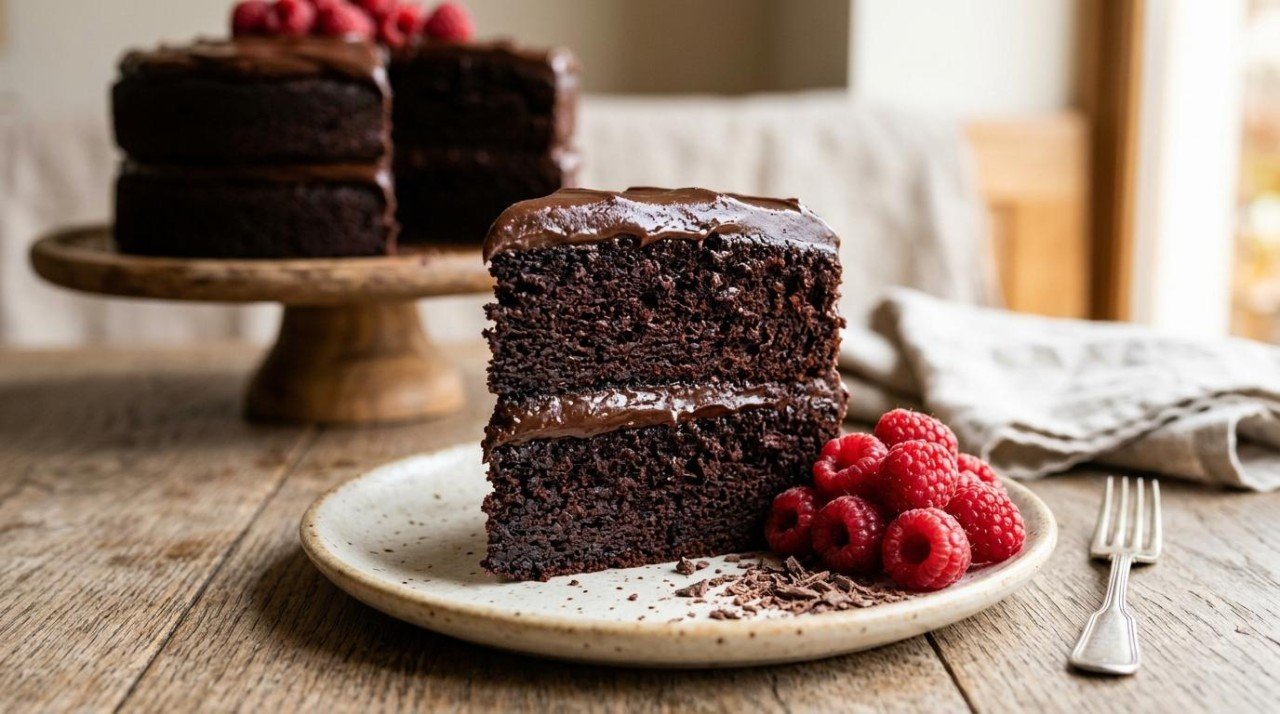
Chocolate cake is the birthday cake: two dark layers, a thick swirl of frosting, candles. If you searched for a healthier version, you don't want a different dessert. You want the same cake, made a little better.
So we built the classic Hershey's cocoa chocolate cake in Eat Well Planner and ran it through the app's Nutrition Score. It came back at 26 out of 100. We rebuilt it one swap at a time, scoring every change against the same production nutrition data, and finished at 50: 24 points higher, with 60 percent less added sugar, 45 percent less saturated fat, double the fiber, and 177 fewer calories a slice. It is still a dark, moist, two-layer chocolate cake.
Fair warning: rich desserts have a low ceiling on this score. Our tres leches topped out at 45 and our carrot cake at 44, so 50 is our best frosted layer cake yet. And the biggest single move was not part of the cake at all.
The classic chocolate cake: what is in it, and why it scores 26
Our baseline is Hershey's "Perfectly Chocolate" chocolate cake, one of the most popular chocolate cake recipes around and a template for countless homemade layer cakes. The cake is 2 cups of sugar, 1 3/4 cups of all-purpose flour, 3/4 cup of cocoa, baking powder, baking soda, 1 teaspoon of salt, 2 eggs, 1 cup of milk, 1/2 cup of vegetable oil, vanilla, and 1 cup of boiling water, baked in two 9-inch rounds. The matching frosting is a stick of butter, 2/3 cup of cocoa, 3 cups of powdered sugar, and 1/3 cup of milk. Cut into 12 slices.
That scores 26 out of 100. Per slice:
- Added sugar: 63.3 g. The American Heart Association suggests no more than 24 g of added sugar a day for most women and 36 g for most men. One slice is more than two and a half days' worth for a woman, and the app flags it at 239 percent of its daily reference.
- Saturated fat: 7.1 g (30 percent of a day), most of it from the butter in the frosting.
- Sodium: 470 mg (20 percent), which surprises people in a dessert. The teaspoon of salt and the baking soda split most of it.
- Plant points: zero, and 523 calories.
The surprise: the frosting carries 30 g of that added sugar per slice, but the cake under it carries 33 g. That is why skipping the frosting entirely only moved the original from 26 to 29.
What is already fine: cocoa powder gives the original slice 4.2 g of fiber and a third of a day's iron, and the oil adds plant omega-3s (ALA) at 45 percent of a day. Nothing here is ultra-processed. The cake is not broken. It is just very sweet, with no plants besides cocoa.
The upgrades
We applied these in order and re-scored after each one, so every point value is what that change was worth at that stage of the build. The six deltas add up exactly to 24. Where a swap was worth very different amounts early and late, we give both numbers.
1. Swap the buttercream for a thinner dark chocolate and Greek yogurt frosting (+6 points)
- Swap: Butter, cocoa, and 3 cups powdered sugar → 4 oz 70% dark chocolate melted into 1 cup plain Greek yogurt with 1/4 cup powdered sugar, spread between the layers and over the top
- Score impact: +6 points (26 to 32)
- What it changes: Added sugar drops from 63.3 g to 38.1 g per slice, saturated fat from 7.1 g to 4.4 g, about 125 fewer calories, and the saturated fat flag clears
- What it costs you: A thinner, glossy, ganache-like layer instead of a tall buttercream swirl, with a faint tang. It needs to live in the fridge.
Seventy percent dark chocolate carries real chocolate flavor with far less sugar, and the yogurt gives it body and a little protein. It chills into something between a ganache and a mousse. We made a smaller batch than the original, enough for a generous filling and a smooth top with the sides left bare. A bigger full-coverage batch scored 2 points lower on the finished cake. If you are short on the yogurt, our Greek yogurt substitutes guide covers what else works.
Melted chocolate can seize when it hits something cold and wet, so use room-temperature yogurt, let the chocolate cool until warm, and whisk the yogurt into the chocolate a few spoonfuls at a time rather than dumping the chocolate into the yogurt. If it does turn grainy, America's Test Kitchen's fix is to add boiling water 1 teaspoon at a time, stirring hard after each.
On the original cake, this frosting scored higher than no frosting at all (32 vs. 29): the dark chocolate and yogurt add iron, magnesium, protein, and B12.
2. Serve every slice with raspberries (+9 points)
- Swap: A bare slice (or a scoop of ice cream) → 1/2 cup of fresh raspberries alongside each slice
- Score impact: +9 points (32 to 41), the biggest single move
- What it changes: Fiber climbs from 3.2 g to 7.1 g per plate, adds vitamin C and the cake's first plant point
- What it costs you: Nothing. Tart berries next to dark chocolate is a classic pairing for a reason.
Our lava cake makeover taught the same lesson: what sits next to a dessert can move its score more than anything inside it. In the reverse test, the finished cake with a 1/2 cup scoop of vanilla ice cream instead of berries scored 38 instead of 50, a 12-point drop, and with nothing on the side it scored 43. Strawberries work nearly as well (49). A smaller 1/3 cup of raspberries scored 48, so even a small handful helps.
3. Make half the flour whole wheat pastry flour (+1 point here, +4 to +7 elsewhere)
- Swap: 1 3/4 cups all-purpose flour → half all-purpose, half whole wheat pastry flour (110 g each)
- Score impact: +1 point at this stage (41 to 42). Applied straight after the frosting swap, it was worth +4, and taking it back out of the finished cake costs 2
- What it changes: More fiber, magnesium, and the second plant point
- What it costs you: Close to nothing in a chocolate cake. The cocoa hides the color and the nutty flavor
The berries already closed much of the fiber gap, so the flour swap looks small here, but it is the easiest swap in the post. Whole wheat pastry flour is milled from soft, low-protein wheat, so it bakes up tender rather than chewy. In King Arthur's cupcake tests, a devil's food cupcake made with 100 percent whole wheat flour had no noticeable difference in batter, rise, or taste, just a slight graininess, because "chocolate cake benefits by its dark color." We stopped at half because King Arthur puts the optimum substitution for cakes at up to 50 percent, and its 100 percent whole wheat layers tended to crumble. Going all the way scored the same 50 anyway. Our all-purpose flour substitutes guide covers the other options.
4. Replace half the oil with beet puree (+4 points)
- Swap: 1/2 cup vegetable oil → 1/4 cup oil plus 1 cup of plain roasted beet puree (and 1/4 cup less boiling water)
- Score impact: +4 points (42 to 46)
- What it changes: Saturated fat down to 3.9 g, about 32 fewer calories, adds folate, potassium, and a third plant point
- What it costs you: A slightly denser, very moist crumb with a deep red-brown color. The beet flavor hides under the cocoa
Beet chocolate cake goes back at least to the mid-20th century, and is often linked to wartime "victory cakes," though the earliest published recipe the article cites dates from 1965. Beets keep the cake moist with less fat, and the article notes their earthy taste is subtle enough that you have to be looking for it.
Both halves of the swap count: on the finished cake, beets with the full oil scored 48, and full oil with no beets scored 45. Use plain roasted or vacuum-packed cooked beets, not pickled ones, which bring brine sodium with them. Our vegetable oil substitutes guide covers applesauce, yogurt, and the other usual stand-ins.
5. Cut the cake's sugar from 2 cups to 1 1/4 cups (+3 points)
- Swap: 2 cups (400 g) granulated sugar in the batter → 1 1/4 cups (250 g)
- Score impact: +3 points (46 to 49). On the original cake the same cut was worth only +2, and putting the full 2 cups back into the finished cake costs 4
- What it changes: Added sugar drops from 38.1 g to 25.6 g per slice, about 50 fewer calories
- What it costs you: A less sweet, more bittersweet cake, which suits the dark chocolate frosting
While the buttercream was still in place, trimming the batter barely registered. Once everything else was fixed, it was worth more. Sugar also holds moisture and keeps the crumb tender, so we stopped at 1 1/4 cups. Our white sugar substitutes guide explains why swapping in honey or coconut sugar would not have helped the score.
6. Halve the salt (+1 point)
- Swap: 1 teaspoon salt → 1/2 teaspoon
- Score impact: +1 point (49 to 50). It was worth +0 on the original
- What it changes: Sodium drops from 440 mg to 340 mg per slice
- What it costs you: Nothing you will notice. The baking soda still makes this cake taste properly seasoned
Leaving it out entirely also scored 50, but a little salt sharpens chocolate.
Take the Guesswork Out of Eating Well
Eat Well Planner helps you organize your favorite recipes, plan balanced meals, and automatically generate shopping lists — all in one place. Whether you're tracking macros, managing dietary restrictions, or just trying to stop asking "what's for dinner?", we've got you covered.
Our AI-powered tools can adapt any recipe to your dietary needs, help you discover new meals you'll love, and even log your nutrition effortlessly. It's meal planning made simple.
Start Organizing Your Meals — FreeWhat we kept (on purpose)
The whole milk stays (skim scored the same 50). The eggs stay, and so does 1/4 cup of oil for moisture and ALA. The cocoa stays at the full 3/4 cup, because it is one of the most nutrient-dense ingredients here.
We stopped at 50 because the remaining points are all in the sugar. At 25.6 g, a slice is still flagged "High Added Sugar," a little over the AHA's daily 24 g for women. That is the honest ceiling for a frosted layer cake: much better, still a celebration food.
The healthier version: full recipe
Final Nutrition Score: 50 out of 100, up from 26. Makes one two-layer 9-inch cake, 12 slices.
Ingredients
For the cake
- 1 1/4 cups (250 g) granulated sugar
- 3/4 cup plus 2 tablespoons (110 g) all-purpose flour
- 1 cup plus 2 tablespoons (110 g) whole wheat pastry flour
- 3/4 cup (64 g) unsweetened cocoa powder
- 1 1/2 teaspoons baking powder
- 1 1/2 teaspoons baking soda
- 1/2 teaspoon salt
- 2 large eggs
- 1 cup whole milk
- 1/4 cup (55 g) vegetable oil
- 1 cup (230 g) plain roasted beet puree (about 2 medium beets)
- 2 teaspoons vanilla extract
- 3/4 cup boiling water
For the frosting
- 4 oz (113 g) 70% dark chocolate, chopped
- 1 cup (227 g) plain nonfat or low-fat Greek yogurt, at room temperature
- 1/4 cup (30 g) powdered sugar
- 1 teaspoon vanilla extract
To serve
- 6 cups (about 1 1/2 lb) fresh raspberries, 1/2 cup per slice
Instructions
- Heat the oven to 350F. Grease and flour two 9-inch round cake pans.
- Puree the cooled roasted beets in a blender or food processor until completely smooth.
- In a large bowl, whisk together the sugar, both flours, cocoa, baking powder, baking soda, and salt.
- Add the eggs, milk, oil, beet puree, and vanilla. Beat on medium speed for 2 minutes. Stir in the boiling water. The batter will be thin.
- Divide the batter between the pans and bake 30 to 35 minutes, until a toothpick in the center comes out clean. Cool 10 minutes in the pans, then turn out onto a rack and cool completely.
- For the frosting, melt the chocolate in short bursts in the microwave, stirring until smooth, then let it cool for 5 minutes until warm but not hot. Whisk in the yogurt a few spoonfuls at a time, then whisk in the powdered sugar and vanilla until glossy. Refrigerate 20 to 30 minutes until thick enough to spread.
- Set one layer on a plate, spread half the frosting over it, add the second layer, and spread the rest over the top, leaving the sides bare. Refrigerate at least 30 minutes to set, and store the cake in the fridge.
- Serve each slice with 1/2 cup of raspberries alongside.
Beet tip: Wrap scrubbed beets in foil and roast at 400F for 45 to 60 minutes until a knife slides in easily, then cool, peel, and puree. Vacuum-packed cooked beets (not pickled) skip this step entirely.
Per slice: original vs. healthier
- Nutrition Score: 26 → 50
- Calories: 523 → 346 (including the raspberries)
- Added sugar: 63.3 g → 25.6 g
- Saturated fat: 7.1 g → 3.9 g
- Fiber: 4.2 g → 8.6 g
- Protein: 6.4 g → 8.2 g
- Sodium: 470 mg → 340 mg
- Plant points: 0 → 3
The finished slice is an excellent source of iron (35 percent of the Daily Value), fiber (29 percent), and magnesium (20 percent), and a good source of vitamin C, B12, and potassium.
Swaps we tested and skipped
- Black beans for the all-purpose flour: +2. Replacing the all-purpose half of the flour with a pureed can of no-salt-added black beans scored 52, the highest number we saw. We skipped it because bean-based cakes bake up dense and fudgy, closer to a flourless cake than a birthday layer. If that is what you want, our black beans guide covers bean baking too.
- Cutting the sugar to 3/4 cup: +2. It scored 52 but the slice was still flagged "High Added Sugar," and that little sugar against 3/4 cup of cocoa makes a bitter, drier cake. Going to 1 cup scored exactly the same 50 as 1 1/4 cups, so there is no reason to stop in between.
- Keeping the buttercream with half the powdered sugar: -7. On the finished cake, a reduced-sugar version of the original frosting scored 43, and the full original buttercream scored 40. The butter is what holds it down.
- A classic cream ganache: -6. Dark chocolate melted into heavy cream instead of yogurt scored 44. It is lovely, but the cream brings back the saturated fat.
- Buttermilk instead of milk: -1 on the original, with a little more sodium. Our buttermilk guide covers when it matters for texture.
- No frosting at all: +0. It scored the same 50, so have the frosting.
Make it fit other diets
For dairy-free, use an unsweetened oat or soy milk in the cake and a thick unsweetened dairy-free yogurt in the frosting, and check that the chocolate is dairy-free. For gluten-free, a measure-for-measure gluten-free flour blend can replace both flours, though you lose the whole grain. A truly egg-free version is closer to a different recipe. For any of these, the app's Recipe Variations can rewrite this exact cake in one step with the swaps already worked in.
Do this to any recipe
Every number here came from tools you can use on your own recipes. Import your family's chocolate cake into Eat Well Planner from a website, a photo of the recipe card, Instagram, or YouTube, and it gets a Nutrition Score right away. Tap Make It Healthier and the app suggests swaps like these, each one checked by a calculator before you see it. Want to keep your grandmother's buttercream? Open the recipe in the Playground, see exactly what it costs, and win those points back with the berries and the beets.