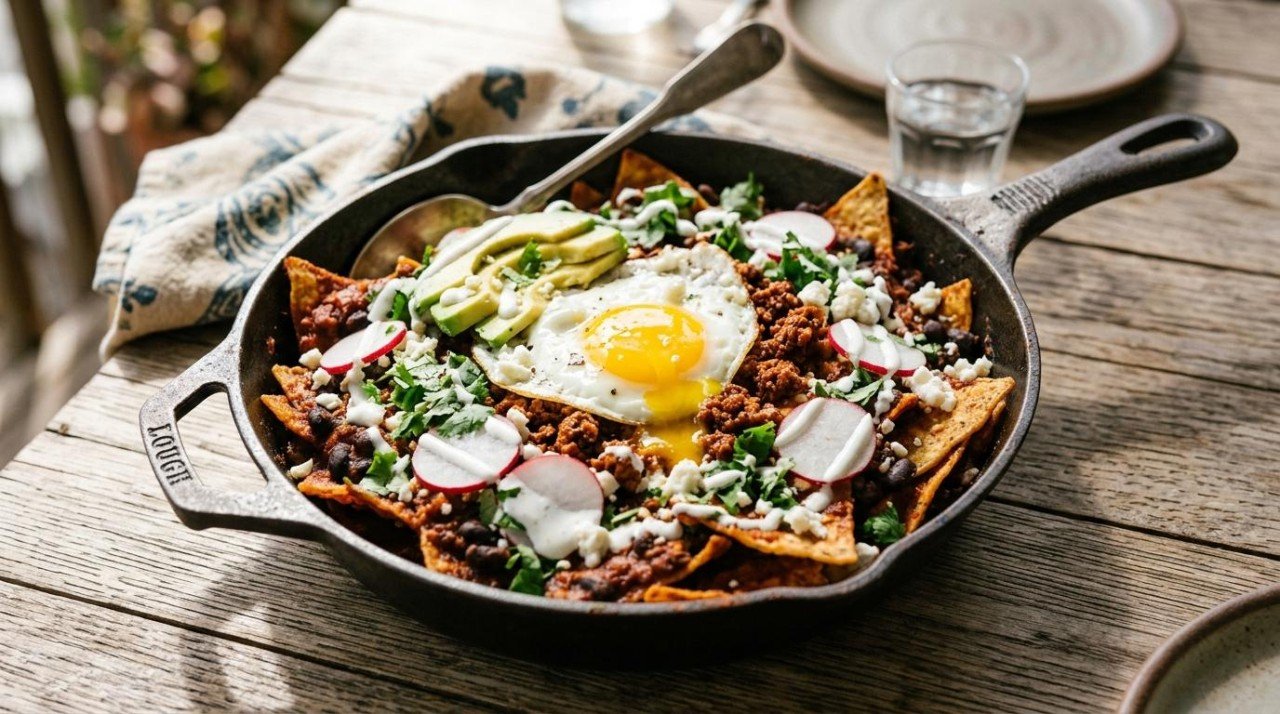
Chilaquiles are what happens when a kitchen refuses to waste yesterday's tortillas. Fry them into chips, simmer them in red or green salsa until they are half crisp and half soft, then pile on crema, crumbled cheese, a fried egg, and, in a lot of homes, some chorizo. It is a Mexican breakfast that also works as a hangover cure, a brunch centerpiece, and a 10 p.m. dinner, and it deserves every bit of its fan base.
We ran a standard version through Eat Well Planner's Nutrition Score - the same number a visitor sees on any public recipe page. It came back 41 out of 100. Not terrible, and the reason it is not terrible is worth knowing: the salsa, the eggs, and the corn are all pulling their weight.
Then we rebuilt it to 88 out of 100. Still a skillet of saucy chips with an egg on top, still with chorizo and queso fresco on it. That is 47 points, and every swap below carries the exact score change it earned. One of them was worth a single point when we made it - and cost ten points when we tried putting it back at the end. That is the most useful lesson in this post.
The original: what's in it and how it scores
Here is the version we scored, serving four:
- 8 oz bag of salted tortilla chips
- 2 cups jarred red salsa
- 6 oz pork chorizo
- 4 large eggs, fried in 1 tablespoon vegetable oil
- 1/2 cup Mexican crema
- 4 oz queso fresco, crumbled
- Chopped white onion and cilantro on top
Nutrition Score: 41/100. Per serving that is about 694 calories, 24.1 g protein, 5.3 g fiber, 44.5 g total fat, 15.5 g saturated fat, and 1,550 mg sodium. Two flags are doing most of the damage:
- Sodium, flagged very high - 1,550 mg per serving, 67% of the daily value. Federal guidance is no more than 2,300 mg a day for adults, and the same page notes that a lot of the sodium we eat comes from packaged, highly processed foods. That is exactly the story here: bagged chips, jarred salsa, chorizo, and cheese all arrive pre-salted, and nobody even picked up a salt shaker.
- Saturated fat, flagged very high - 15.5 g per serving, 66% of the daily value. Chorizo, crema, and queso fresco are three separate sources stacked on one plate. The Dietary Guidelines recommend getting less than 10 percent of daily calories from saturated fat, and this one breakfast is two thirds of the day's budget.
- Fiber is thin - 5.3 g, and the plate counts just 2.25 plant points (Eat Well Planner's tally toward the 30-plants-a-week goal).
Now what is already working, because we are not here to manufacture problems. The eggs, chorizo, and cheese carry real micronutrients: the original is already an excellent source of vitamin B12 (48% DV), choline (44%), riboflavin (41%), and vitamin B6 (39%). The corn and the salsa are real plant foods. Twenty-four grams of protein at breakfast is solid. The diagnosis is narrow: salt and dairy fat ride in on the packaged parts, and there is nothing on the plate for fiber.
The upgrades
Seven swaps, applied cumulatively in this order. Watch the pacing. While sodium and saturated fat both sit in the very high band, cutting one of them barely moves the score. The big jumps come when a flag finally drops a level - which means the order you make these changes in changes what each one looks like it is worth.
1. Stir in a can of black beans
- Swap: Add one 15-oz can of no-salt-added black beans, drained, simmered right in the salsa
- Score impact: +10 points (41 → 51)
- What it changes: Fiber from 5.3 g to 10.5 g per serving, protein from 24.1 g to 29.6 g, and zero added sodium
- What it costs you: Nothing. Beans in chilaquiles are common in plenty of kitchens already, and they soak up the salsa beautifully
Ten points for an addition that adds about 80 calories per serving - the score is not a calorie counter, and doubling a breakfast's fiber puts it in a different category. The no-salt-added part matters: sodium stayed flat at 1,550 mg after this step. If regular canned beans are what you have, drain and rinse them; University of Tennessee researchers found that draining canned beans cut sodium by 36%, and draining plus rinsing by 41%.
2. Use chorizo as a garnish, not a layer
- Swap: 6 oz pork chorizo → 2 oz, browned first and scattered on top
- Score impact: +1 point (51 → 52) at this point in the build - but putting the full 6 oz back at the end cost 10 points (88 → 78)
- What it changes: Sodium from 1,550 mg to 1,320 mg, saturated fat from 15.6 g to 13.2 g, and about 84 fewer calories per serving
- What it costs you: Less chorizo per bite, but its flavor is so concentrated that 2 oz still seasons the whole skillet
Here is the flag effect in plain view. One point for removing two thirds of the chorizo looks like a waste of effort - because both sodium and saturated fat were still deep in the very high band and nothing cleared. But once the rest of the dish is fixed, that same 4 oz is worth ten points. Do not judge a swap by how much it moves a recipe that still has other big problems.
The technique that makes the smaller amount work: brown the chorizo in the dry skillet first, lift it out, and then cook the salsa in the same pan so it picks up the chorizo's red fat and paprika. You get the flavor through the whole dish and the crispy bits on top. Our chorizo substitutes guide covers what to use if you cannot find it.
3. Make the salsa yourself, and salt it lightly
- Swap: 2 cups jarred salsa → charred Roma tomatoes, onion, garlic, and a jalapeño blended with low-sodium chicken broth and 1/4 teaspoon salt
- Score impact: +11 points (52 → 63) - the biggest single move in the makeover
- What it changes: Sodium from 1,320 mg to 830 mg per serving, takes sodium out of the very high band, clears the "low vitamin C" weakness, and adds plant points
- What it costs you: About 15 minutes, mostly under the broiler while you do something else
This is the swap we would fight for, because it is the one you will taste. Blistering the tomatoes, onion, and chile under the broiler gives the sauce a smoky depth no jar has. It also proved to be the most load-bearing change in the dish: when we put the jarred salsa back into the finished recipe, the score fell from 88 to 69, a 19-point drop, because nearly all of the remaining sodium headroom vanished at once.
We tested the salt level, too. A half teaspoon scored 83; a quarter teaspoon scored 88; no salt at all scored 88. So a quarter teaspoon is free to the score - season the salsa with it, then taste once the chips and chorizo are in, since both bring salt of their own. Want it hotter? Leave the seeds in the jalapeño; our jalapeño substitutes guide covers swapping in serranos or chipotles.
4. Swap the crema for lime-spiked Greek yogurt
- Swap: 1/2 cup Mexican crema → 1/2 cup plain Greek yogurt whisked with 1 tablespoon lime juice and a splash of water
- Score impact: +10 points (63 → 73)
- What it changes: Saturated fat from 13.2 g to 9.2 g per serving - dropping it out of the very high band - plus 2 g more protein and about 48 fewer calories
- What it costs you: Tangier and a little less rich. With lime and a pinch of salt, it reads as crema on hot chips
Ten points for a drizzle is a lot, and again it is about the flag: this is the step where saturated fat finally fell a level. Thin the yogurt with water until it pours, and drizzle it over the plated chilaquiles rather than stirring it into the hot skillet, so it stays smooth. Our sour cream substitutes guide has more crema stand-ins. And for the record, we tested leaving the drizzle off entirely: that scored 87, one point below the yogurt version. The yogurt earns its place.
5. Measure the queso fresco
- Swap: 4 oz queso fresco → 2 oz, crumbled over the top at the end
- Score impact: +6 points (73 → 79). Putting the full 4 oz back at the end cost 7 points
- What it changes: Saturated fat from 9.2 g to 7.2 g, sodium from 830 mg to 740 mg
- What it costs you: Very little, as long as it goes on last. Queso fresco is a bright, salty accent; it does not melt into the sauce, so a smaller amount scattered on top still lands on every forkful
6. Bake your own chips from corn tortillas
- Swap: 8 oz bag of tortilla chips → 10 corn tortillas cut into wedges, tossed with 1 tablespoon olive oil, and baked
- Score impact: +6 points (79 → 85)
- What it changes: About 93 fewer calories per serving, total fat from 28.2 g to 21.8 g, sodium from 740 mg to 590 mg, and it clears the "high omega-6" weakness that the frying oil was causing
- What it costs you: 15 minutes in the oven, and the chips soften a little faster in the sauce - so serve right away
Plain corn tortillas are one of the quietly great ingredients in this dish. Consumer Reports' comparison found a corn tortilla with 5 mg of sodium per ounce, and calls corn a good-for-you whole grain. The traditional alkali treatment that turns corn into masa matters too: the Whole Grains Council notes that it liberates the niacin in corn. Slightly stale tortillas crisp best, which is the whole origin of chilaquiles anyway. More on choosing them in our tortillas guide.
Does it matter whether you bake them or fry them yourself? Here, yes. With every other swap in place, home-frying the same tortillas (so they soak up about 4 tablespoons of oil) scored 82 against 85 baked, and brought the omega-6 flag back. Store-bought chips scored 83. The chips are not the biggest lever in this recipe, but they are a real one.
7. Top it with avocado and radish
- Swap: Add 1 sliced avocado and 4 thinly sliced radishes to the onion-and-cilantro garnish
- Score impact: +3 points (85 → 88)
- What it changes: Fiber from 11.0 g to 13.7 g, potassium from 820 mg to 1,040 mg, plant points from 5.5 to 7.5
- What it costs you: Nothing - avocado and radish are classic chilaquiles toppings
There is a bonus the score does not show directly. In an Ohio State study, adding avocado to salsa raised absorption of the tomato's lycopene and beta-carotene to 4.4 and 2.6 times the levels from avocado-free salsa, credited mainly to the avocado's fat. A red salsa and an avocado on the same plate is a genuinely good pairing.
Take the Guesswork Out of Eating Well
Eat Well Planner helps you organize your favorite recipes, plan balanced meals, and automatically generate shopping lists — all in one place. Whether you're tracking macros, managing dietary restrictions, or just trying to stop asking "what's for dinner?", we've got you covered.
Our AI-powered tools can adapt any recipe to your dietary needs, help you discover new meals you'll love, and even log your nutrition effortlessly. It's meal planning made simple.
Start Organizing Your Meals — FreeWhat we kept (on purpose)
The fried eggs stay whole, yolks and all - they are where the dish's B12, choline, and riboflavin come from. The chorizo and queso fresco stay too, in smaller amounts, because chilaquiles without them stop tasting like chilaquiles to a lot of people. We could have scored higher by removing them (see below). We stopped at 88 because the next points would have come out of the dish's identity, and the one remaining weakness, saturated fat at 31% of the daily value, comes almost entirely from ingredients we chose to keep.
Prefer more chorizo? That is your call, and the Recipe Playground in the app will show you exactly what it costs - and what you could change elsewhere to make it back.
The healthier version: full recipe
Nutrition Score: 88/100. Serves 4. Prep 15 minutes, cook 30 minutes.
Ingredients
- 10 corn tortillas (6-inch), each cut into 6 wedges
- 1 tablespoon olive oil
- 1 lb Roma tomatoes (about 5)
- 1/2 small white onion (about 2 oz), plus 1/3 cup finely chopped white onion for topping
- 2 garlic cloves, unpeeled
- 1 jalapeño
- 1/2 cup low-sodium chicken broth
- 1/4 teaspoon salt
- 2 oz pork chorizo, casing removed
- 1 can (15 oz) no-salt-added black beans, drained
- 1 tablespoon vegetable oil, for the eggs
- 4 large eggs
- 1/2 cup plain Greek yogurt
- 1 tablespoon lime juice
- 2 oz queso fresco, crumbled (about 1/2 cup)
- 1 avocado, sliced
- 4 radishes, thinly sliced
- 1/2 cup cilantro leaves
Instructions
- Heat the oven to 400°F. Toss the tortilla wedges with the olive oil, spread them on two baking sheets in a single layer, and bake 12 to 15 minutes, flipping halfway, until crisp and golden.
- Meanwhile, set the tomatoes, the half onion, the garlic, and the jalapeño on a foil-lined sheet and broil on high 8 to 10 minutes, turning once, until blackened in spots.
- Peel the garlic and stem the jalapeño (seed it for less heat). Blend everything from the broiler with the broth and salt until smooth.
- Brown the chorizo in a large skillet over medium heat, breaking it up, about 5 minutes. Lift it out with a slotted spoon and set aside.
- Pour the salsa into the same skillet, add the beans, and simmer 5 minutes, until slightly thickened.
- While the salsa simmers, fry the eggs in the vegetable oil in a separate pan to your liking. Whisk the yogurt with the lime juice and enough water to make it pourable.
- Add the baked chips to the salsa and toss for 1 to 2 minutes, just until coated and starting to soften at the edges.
- Divide among four plates. Top each with a fried egg, the chorizo, queso fresco, avocado, radish, chopped onion, and cilantro, then drizzle with the lime yogurt. Serve right away.
Original vs. healthier, per serving
- Nutrition Score: 41 → 88
- Calories: 694 → 565
- Protein: 24.1 g → 25.5 g
- Fiber: 5.3 g → 13.7 g
- Total fat: 44.5 g → 27.3 g
- Saturated fat: 15.5 g → 7.3 g
- Sodium: 1,550 mg → 600 mg
- Plant points: 2.25 → 7.5
Swaps we tested and skipped
- No chorizo at all (+3, to 91). Higher score, and a perfectly good vegetarian dish - but it is a different breakfast. If you want it meatless, see below.
- No queso fresco (+4, to 92). The highest score we hit. We kept the cheese; 2 oz across four plates is a fair price for that salty, milky contrast.
- Turkey chorizo, full 6 oz (-3, to 85). The usual "healthy" swap scored below just using less pork chorizo, and sodium went up to 790 mg, since the turkey version we scored was saltier. A little of the real thing beat a lot of the substitute.
- Egg whites instead of whole eggs (-3, to 85). The yolks carry the vitamin D, choline, and omega-3s; without them, "low vitamin D" and "low omega-3" weaknesses showed up. And a yolk breaking over saucy chips is half the point.
- Leaving the beans out (-6, to 82). Fiber drops back to 8.5 g. The beans stay.
Make it fit other diets
- Vegetarian: Skip the chorizo (it scored 91) and use vegetable broth in the salsa. A pinch of smoked paprika and cumin in the salsa brings back some of the chorizo's warmth.
- Gluten-free: It already is, as long as your corn tortillas are 100% corn and your chorizo is certified gluten-free.
- Dairy-free: Drop the queso fresco and use a mashed-avocado-and-lime drizzle in place of the yogurt.
In the app, Recipe Variations will rewrite the full recipe for any of these in one step, or you can ask the AI Recipe Chat with the recipe already in context.
Do this to any recipe
Everything above came out of the same tools anyone can use in Eat Well Planner. Import the chilaquiles recipe you actually make - from a website, an Instagram reel, or a YouTube video - and it gets a Nutrition Score. Hit Make It Healthier and the app proposes swaps like these, with each gain checked by a calculator before you see it. Then take it into the Recipe Playground to test your own ideas, one change at a time, the way we did here. The lesson from this skillet applies everywhere: fix the big flags, and the small swaps start to count.