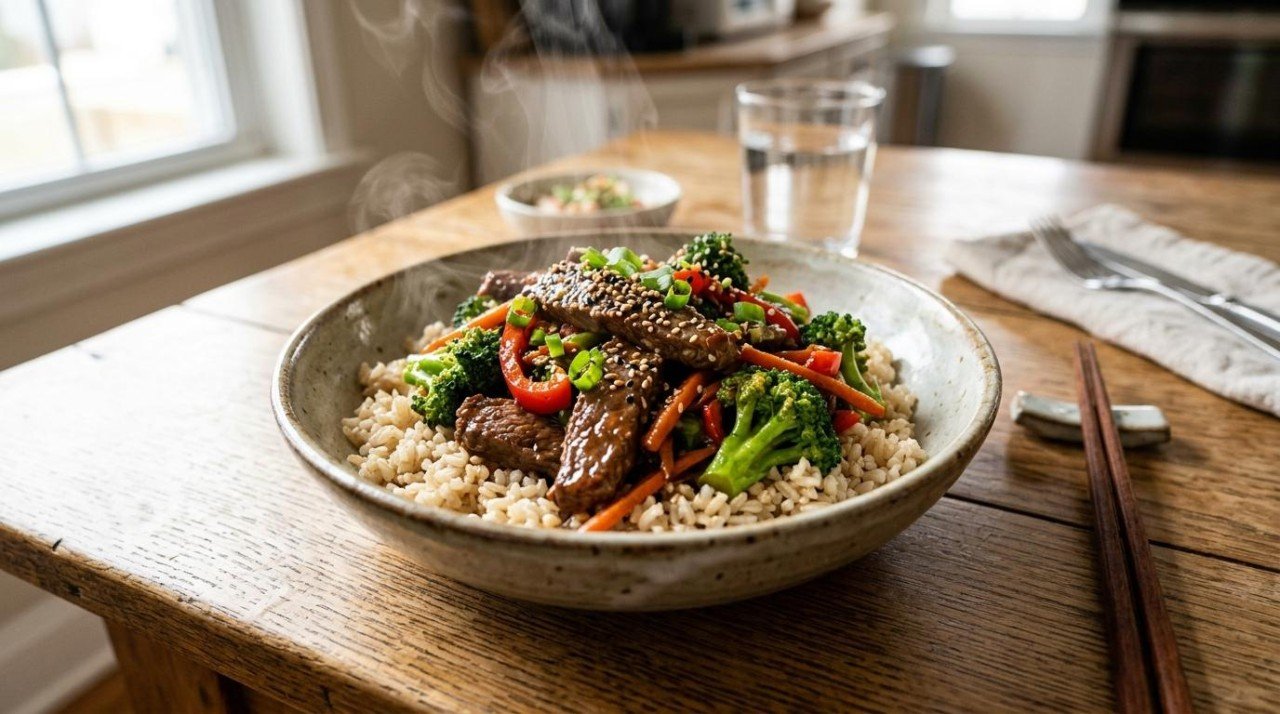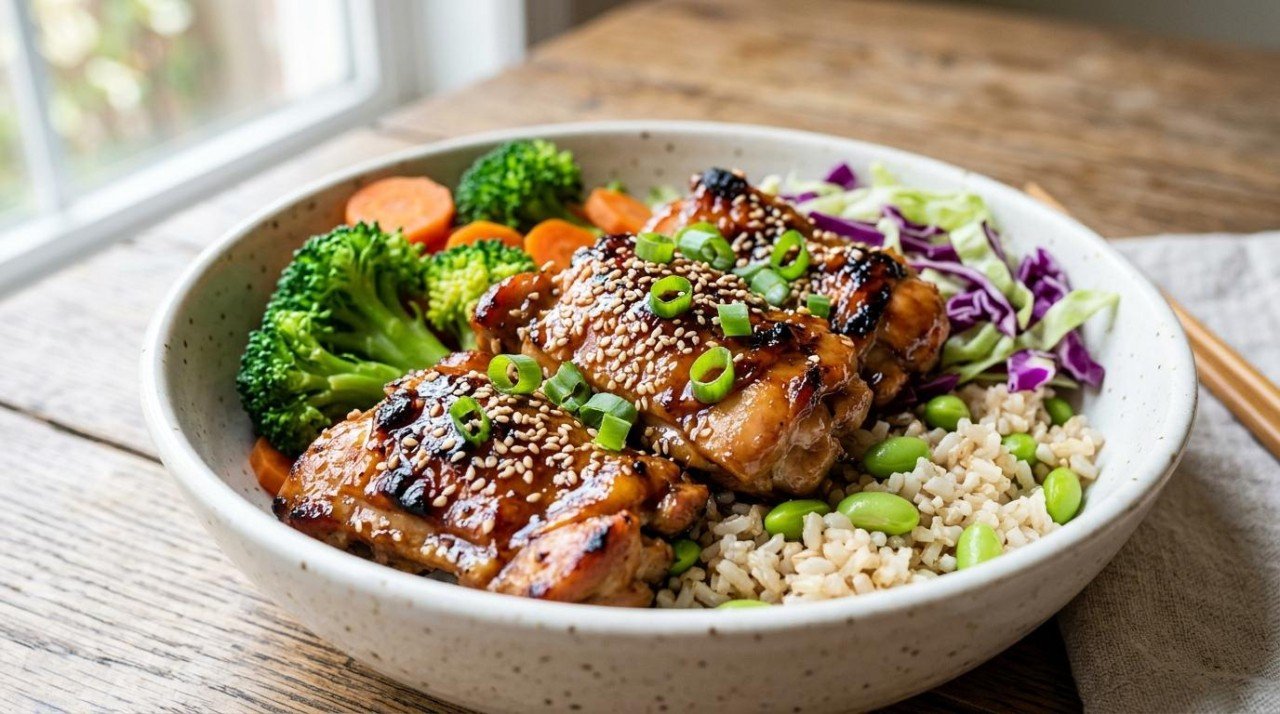
The chicken teriyaki bowl is the dish you order when you are trying to be good. It is chicken. It has rice. There is usually some cabbage on top. Next to the fried options on the same menu, it feels like the sensible choice.
So we built the standard version — thigh meat glazed in bottled teriyaki, over white rice, with a little shredded cabbage — and ran it through Eat Well Planner's Nutrition Score, the same number that shows up on any public recipe page. It came back 45 out of 100. Not a disaster, but a long way from what the plate looks like it should score.
Here is the promise. We kept the glossy sweet-savory glaze that makes teriyaki teriyaki, kept the rice, kept the bowl format, and got it to 92 out of 100. That is a 47-point jump, the biggest we have recorded in this series, and every swap below carries the real verified score change it earned.
The original: what's in it and how it scores
Here is the takeout-style version we scored, built for four people:
- 1 1/2 lb boneless, skinless chicken thighs
- 2/3 cup bottled teriyaki sauce
- 1 1/2 cups white rice (dry), cooked to serve
- 1 tablespoon vegetable oil
- 1 1/2 cups shredded green cabbage
- 1 tablespoon sesame seeds and a few sliced scallions
Nutrition Score: 45/100. Now the diagnosis, because knowing why a recipe scores the way it does is the skill that transfers to everything else you cook.
Start with what is already good, because there is real strength here. At about 40 g of protein per serving this bowl is an excellent source of protein, and it scores as an excellent source of vitamin B6 (99% of a day's value), niacin (97%), folate (88%), phosphorus, iron, and thiamine. The chicken is doing serious work, and skinless thigh meat is not the problem — saturated fat comes in at a modest 3.7 g per serving.
Three things pull it down:
- Sodium, mostly from the bottle. About 1,640 mg per serving, which is 71% of a day's worth in one bowl. The Chronic Disease Risk Reduction guideline is 2,300 mg a day, with an adequate intake closer to 1,500 mg — and most of the sodium in the American diet comes from commercially prepared foods, not the salt shaker. Bottled teriyaki is a textbook example.
- Almost no fiber, and almost no vegetables. 2.4 g of fiber per serving, against the 25 to 35 g a day adults need. The plant-diversity count is 3. That handful of raw cabbage is a garnish, not a vegetable serving, and it shows: the bowl is flagged for low vitamin A, and vitamin C lands at just 13% of a day's value.
- A refined base plus added sugar. White rice contributes starch and little else, and the bottled sauce brings 6.3 g of added sugar per serving, enough to register as a caution on its own.
The shape of the problem is clear: this is not a fatty-meat problem or a too-much-food problem. It is a sauce and vegetables problem, with the rice a distant third. So that is the order we fixed it in.
The upgrades
Four swaps, each scored on top of the one before it. If you only make one change this week, make the first one.
1. Build the bowl around vegetables, not rice
- Swap: A cabbage garnish → 1 lb broccoli, 2 carrots, and 1 1/2 cups shelled edamame (cabbage stays on top)
- Score impact: +20 points (45 → 65)
- What it changes: Fiber goes from 2.4 g to 9.0 g per serving, vitamin A from essentially none to 50% of a day's value, vitamin C from 13% to 132%, protein from 40 g to 50 g, and plant points from 3 to 6
- What it costs you: Ten minutes of chopping, and the bowl gets bigger — calories rise to about 838 at this stage, which the last two swaps more than reverse
This is the single biggest move in the entire makeover, and it is the one nobody makes, because the takeout version trained us to think of the vegetable as decoration. Flip the ratio so the vegetables are the bulk of the bowl and the chicken and rice share the rest, and you have changed the dish more than any sauce tweak can.
Edamame does the quiet heavy lifting. Soybeans are a complete protein containing all nine essential amino acids, plus fiber, potassium, and magnesium, and half a cup of boiled edamame brings about 11 g of protein. Add all three vegetables and the plate goes from one plant to four, which is exactly the variety the 30-plants-a-week research is about. Keep the broccoli crisp-tender rather than soft — how you cook it changes what you get out of it.
2. Make the sauce instead of pouring it
- Swap: 2/3 cup bottled teriyaki → 3 tablespoons low-sodium soy sauce, 2 tablespoons mirin, 2 teaspoons honey, fresh ginger and garlic, thickened with a cornstarch slurry
- Score impact: +16 points (65 → 81)
- What it changes: Sodium drops from about 1,710 mg to 580 mg per serving (74% of a day's value down to 25%) and the sodium warning disappears entirely
- What it costs you: Five minutes and four pantry items — and the glaze is lighter and less syrupy than the bottled kind, which most people read as fresher
A two-thirds cut in sodium is the kind of change your blood pressure actually responds to, and it costs nothing in flavor because the flavor was never really coming from the salt. Teriyaki means "teri," gloss or luster, plus "yaki," grilled — the point of the sauce is the shine, and the shine comes from sugar, not sodium. Fresh ginger and garlic do more for savory depth than another tablespoon of soy sauce ever will. To go further, our soy sauce substitutes guide covers coconut aminos and the rest.
One honest note on technique. A traditional Japanese teriyaki tare is soy sauce, sake, mirin, and sugar simmered down until it thickens on its own, and purists will tell you not to use cornstarch. They are right about the flavor, but reduction concentrates everything, including the salt and the sugar, which is exactly what we are trying to avoid. A cornstarch slurry gets you the glossy cling in 60 seconds without boiling the sauce down into candy. That is the trade we made, and we would make it again.
What this swap does not do is cut sugar. Added sugar came out at 6.3 g per serving both before and after, because the honey and mirin put back roughly what the bottle contributed. That was deliberate — see the rejected swaps below for what happens when you take the sugar out.
3. Chicken breast instead of thighs
- Swap: 1 1/2 lb boneless, skinless chicken thighs → the same weight of boneless, skinless breast
- Score impact: +7 points (81 → 88)
- What it changes: Saturated fat halves (4.2 g → 2.0 g per serving), calories drop from about 852 to 702, and protein climbs to 56 g
- What it costs you: This one has a real cost. Thigh meat is more forgiving, juicier, and more flavorful, and breast will go dry if you look away
This is the swap where honesty matters most, so here is the number for people who love thigh meat: keeping the thighs and making the other three changes scores 87, five points below our final version and still 42 points above where we started. If thighs are what get you cooking this on a Tuesday, keep the thighs. You are not losing the makeover.
If you do go with breast, cut it into 1-inch pieces rather than cooking whole cutlets, get the pan properly hot, and pull it at 165F. Small pieces cook in four or five minutes and the glaze goes on at the very end, which shields them. Our chicken thigh substitutes guide covers the swap in both directions.
4. Brown rice, and slightly less of it
- Swap: 1 1/2 cups white rice (dry) → 1 cup brown rice (dry)
- Score impact: +4 points (88 → 92)
- What it changes: Adds fiber and magnesium (now 43% of a day's value), adds a plant point, and brings calories down from about 702 to 596 per serving
- What it costs you: Brown rice takes 40 to 45 minutes instead of 18, and it is chewier — cook it ahead
Two changes are bundled here, and the scores separate them: switching type alone was worth +2, and right-sizing the portion took it to +4. That second half only works because swap one filled the bowl with something else. Refining grain strips more than half of the B vitamins, 90% of the vitamin E, and virtually all of the fiber, and Harvard's researchers estimate that replacing white rice with whole grains is associated with a 36% lower risk of type 2 diabetes. Our white rice substitutes guide covers the alternatives — and cooking the rice a day ahead and chilling it adds resistant starch for free.
What we kept (on purpose)
The sugar stays. Honey and mirin are not contaminants in this recipe, they are the mechanism — without them there is no glaze, no gloss, no teriyaki. The bowl still carries an added-sugar caution at 6.3 g per serving, and we are fine with that, because the alternative is a different dish.
Real soy sauce stays, just the low-sodium kind. Sesame seeds and scallions stay. The raw cabbage on top stays, because the cold crunch against the hot glaze is half of why this bowl is satisfying. And we stopped at four swaps, at the exact point where the next change would have started making something that is no longer chicken teriyaki.
Take the Guesswork Out of Eating Well
Eat Well Planner helps you organize your favorite recipes, plan balanced meals, and automatically generate shopping lists — all in one place. Whether you're tracking macros, managing dietary restrictions, or just trying to stop asking "what's for dinner?", we've got you covered.
Our AI-powered tools can adapt any recipe to your dietary needs, help you discover new meals you'll love, and even log your nutrition effortlessly. It's meal planning made simple.
Start Organizing Your Meals — FreeThe healthier version: full recipe
Nutrition Score: 92/100. Serves 4.
- 1 cup brown rice (dry)
- 1 1/2 lb boneless, skinless chicken breast, cut into 1-inch pieces
- 1 tablespoon vegetable oil
- 1 lb broccoli florets (about 6 cups)
- 2 medium carrots, sliced on the diagonal
- 1 1/2 cups frozen shelled edamame
- 3 tablespoons low-sodium soy sauce
- 2 tablespoons mirin
- 2 teaspoons honey
- 1 tablespoon cornstarch
- 1/3 cup water
- 1-inch piece fresh ginger, grated (about 2 tablespoons)
- 3 cloves garlic, minced
- 1 1/2 cups shredded green cabbage, to serve
- 1 tablespoon sesame seeds
- 3 scallions, thinly sliced
- Start the brown rice first — it needs 40 to 45 minutes and everything else takes 20. Or cook it the day before.
- Whisk the sauce together in a small bowl: low-sodium soy sauce, mirin, honey, cornstarch, water, grated ginger, and minced garlic. Whisk until no cornstarch settles at the bottom and set it aside.
- Heat the oil in a large skillet or wok over high heat. Add the chicken in a single layer, working in two batches so it browns instead of steaming, and cook 4 to 5 minutes per batch until just cooked through (165F). Move it to a plate.
- Add the broccoli and carrots to the same hot pan with a splash of water. Cover and cook 3 to 4 minutes, until the broccoli is bright green and crisp-tender. Add the edamame and cook 1 minute more.
- Return the chicken to the pan. Give the sauce a quick re-whisk and pour it in. Toss constantly for 1 to 2 minutes, until it thickens and everything is coated in a glossy glaze.
- Spoon over the brown rice. Top each bowl with shredded cabbage, sesame seeds, and scallions.
Per serving, original versus improved:
- Nutrition Score: 45 → 92
- Calories: about 725 → about 596
- Protein: 40 g → 54 g
- Fiber: 2.4 g → 9.4 g (8% → 32% of a day's value)
- Sodium: about 1,640 mg → about 590 mg (71% → 25% of the daily limit)
- Saturated fat: 3.7 g → 2.0 g
- Added sugar: 6.3 g → 6.3 g (unchanged, on purpose)
- Vitamin A: essentially none → 50% of a day's value
- Vitamin C: 13% → 132% of a day's value
- Plant points: 3 → 7.5
Swaps we tested and skipped
Cauliflower rice instead of brown rice: scored 86, six points lower. This is the swap everyone expects a healthy-teriyaki article to make, and the numbers say no. Dropping the grain costs the magnesium, the B vitamins, and the steady energy that make the bowl a meal rather than a large side dish, and it takes the serving down to about 451 calories, which is not enough dinner for most people. It also is not a teriyaki bowl anymore.
A savory sauce with no honey or mirin: scored 93, one point higher. Soy sauce, rice vinegar, ginger, and cornstarch, no sweetener at all. It clears the added-sugar caution and gains a single point — and it produces a thin brown sauce with no gloss, no cling, and none of the sweet-savory tension the dish is built on. One point is not worth deleting the reason the recipe exists.
A fourth tablespoon of soy sauce: scored 89, three points lower. We tested this because the homemade glaze is genuinely lighter than the bottle, and some people will want it saltier. That extra tablespoon takes sodium from about 590 mg to 720 mg per serving. If that is the trade you want, make it knowingly — 89 is still an excellent bowl.
Make it fit other diets
- Gluten-free: Swap the soy sauce for gluten-free tamari, one for one. Check the mirin label, since some brands add wheat-based seasonings.
- Vegan or vegetarian: Replace the chicken with 1 1/2 lb extra-firm tofu, pressed and cubed, and brown it hard before glazing. Use maple syrup in place of the honey.
- Lower carb: Halve the rice rather than removing it, and add another half pound of broccoli — you keep the grain's nutrients without the full portion.
You do not have to work these out by hand. Eat Well Planner's Recipe Variations rewrites the whole recipe as a gluten-free or vegan version in one step, substitutions already worked into the ingredients and instructions.
Do this to any recipe you love
Nothing here required guessing. Every score and delta came out of tools that are in the app right now: we imported the recipe, read the Nutrition Score, and used Make It Healthier, which proposes ingredient swaps and runs each one through a calculator to verify the real nutritional gain before showing it to you. Then we tested each change in the Recipe Playground, where you edit an ingredient and watch the score move with a per-edit delta — which is exactly how we knew that keeping the thighs costs five points and cauliflower rice costs six.
That is the part worth stealing. Import the teriyaki bowl you actually make, or the video you saved on Instagram, score it, and let the app show you which change is worth 20 points and which is worth 1. The dish you love does not have to change. Usually, only two or three things about it do.