Shawarma is one of the great pieces of street food engineering. A stack of marinated meat turns against a vertical broiler for hours, the outside crisping while the drippings baste everything below it, and the cook shaves off the edge to order. The technique first appeared in the Ottoman Empire in the 19th century as doner kebab, and the Levantine version that traveled the world with it is still, at its best, a genuinely great dinner.
So we ran a standard takeout chicken shawarma wrap through the Eat Well Planner Nutrition Score. It came back at 39 out of 100. Then we rebuilt it one swap at a time, rescoring after each change. The rebuilt version scores 71.
The interesting part is where those 32 points came from. Everyone assumes the garlic sauce is the villain — it is a sauce made mostly of oil, after all. It was worth 5 points. The two changes worth 10 points each were putting a real salad in the wrap and cutting the salt roughly in half.
The original: what is in it, and why it scores 39
The version we scored is the one handed across a counter. For two wraps: about 11 ounces of boneless skinless chicken thigh in a spiced oil marinade, two white pitas, roughly 3 tablespoons of toum per wrap, a few slices of tomato, dill pickles, paprika and cumin. Toum is the Lebanese garlic sauce that comes with shawarma almost by default — garlic, oil, lemon and salt whipped into a stiff white emulsion. A traditional ratio runs about one head of garlic to 1 3/4 cups of oil, so we actually modeled it garlic-heavier than the real thing. The authentic ratio would score worse, not better.
Per serving: 881 calories, 36.6 g protein, 53.2 g total fat, 8.1 g saturated fat, 2.7 g fiber, 1,850 mg sodium. The score flagged three weaknesses:
- Sodium at 80% of the Daily Value in one sandwich. Harvard's nutrition source puts the adequate intake at 1,500 mg a day and the chronic disease risk reduction ceiling at 2,300 mg, with most Americans already around 3,300 mg. One wrap taking 80% of the ceiling leaves nothing for the rest of the day.
- An omega-6 load of 22.6 g per serving. That is the toum plus the marinade oil — roughly 5 tablespoons of refined neutral oil across two sandwiches. To be clear, omega-6 fat is not dangerous, and Harvard's fats page recommends olive and canola oil for cooking. The issue is quantity and one-sidedness: 22 grams in a sandwich is a lot of fat doing very little besides carrying calories.
- Almost no fiber and almost no plants. 2.7 g of fiber against a 25 to 35 g daily target, and 2.75 plant points against a weekly goal of 30.
What is already fine, and worth saying: 36.6 g of protein is good, the chicken is genuinely nutrient-dense, and the spicing is doing real work. This is not a disaster. It is a good idea buried under salt and oil, with the vegetables treated as garnish.
The upgrades
Five changes, roughly in order of what each bought against what it cost at the table. The deltas are cumulative — each is measured with the previous swaps already applied — and they add up to exactly the 32 points between 39 and 71.
1. Put an actual salad in it
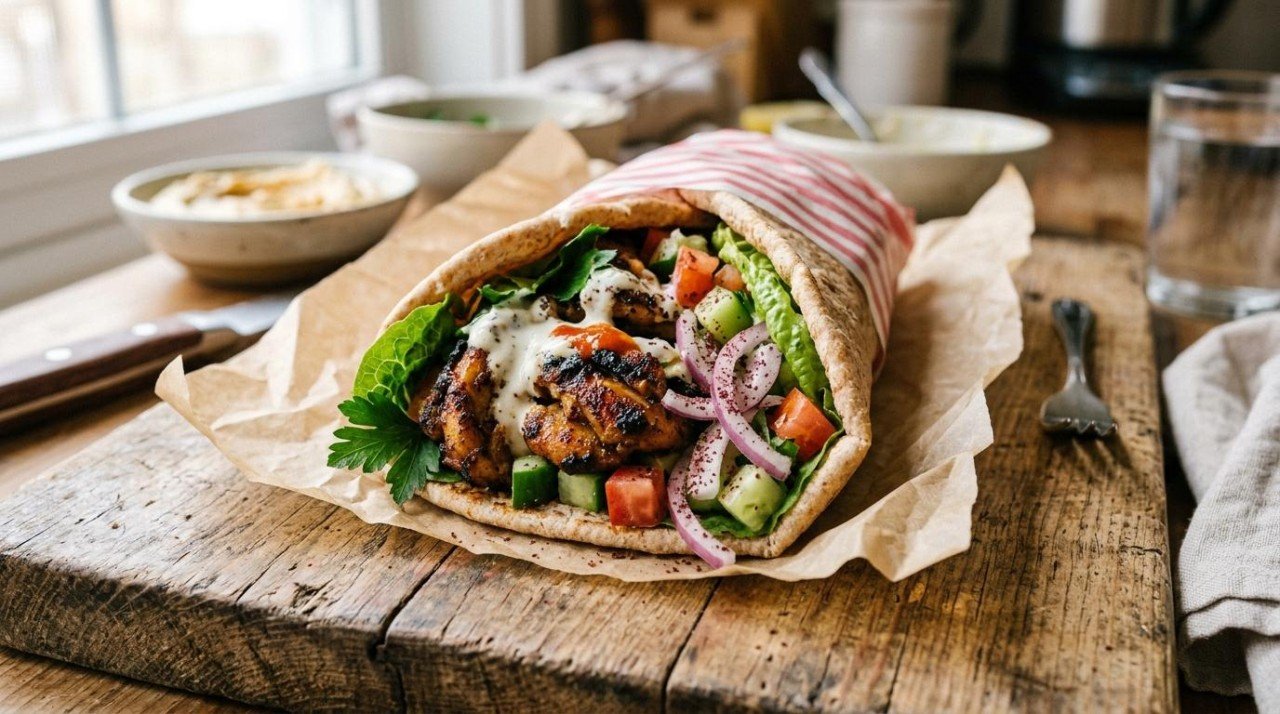
- Swap: Two slices of tomato as garnish → a real salad inside the wrap: cucumber, romaine, flat-leaf parsley, red onion, dressed with lemon and sumac
- Score impact: +10 points (39 → 49)
- What it changes: Fiber from 2.7 g to 4.9 g, plant points from 2.75 to 6.25, vitamin K to 212% DV
- What it costs you: Nothing. It is additive, and a properly stuffed shawarma is supposed to look like this
This was the surprise of the session. The least glamorous advice in food writing outperformed every clever substitution we tried, and it works precisely because it is additive — you remove nothing, so there is no flavor to lose. Plant variety is its own lever, too: the American Gut Project found the number of distinct plant species someone eats per week predicted gut microbial diversity better than diet labels like vegan or omnivore, comparing people eating more than 30 plant types a week against fewer than 10. Dice the cucumber and tomato instead of slicing, shred the romaine fine, and toss with lemon and sumac right before assembly. Sumac is what makes this taste like shawarma rather than like a salad someone put in bread.
2. Cut the salt roughly in half
- Swap: A heaping teaspoon of salt across the recipe → 1/2 teaspoon, with lemon and sumac carrying more of the seasoning
- Score impact: +10 points (49 → 59)
- What it changes: Sodium from 1,850 mg to 1,180 mg per serving — from 80% of the daily ceiling to 51%
- What it costs you: Genuinely noticeable on the first bite if you come straight from takeout. Two or three wraps in, you stop registering it
Ten points from half a teaspoon keeps happening in these makeovers, and the reason is structural: a single sandwich eating 80% of the 2,300 mg ceiling is a problem for the whole day, not a rounding error. Harvard also notes that the sodium-to-potassium ratio matters, not sodium alone, which is a second reason this step and the salad reinforce each other. What makes the cut survivable is acid and aroma — lemon, sumac, raw garlic and the pickles all read as "seasoned" to your palate. Toast the cumin and paprika in a dry pan for thirty seconds first; bloomed spices taste stronger, so the salt has less work to do.
3. Rebuild the garlic sauce on a yogurt base
- Swap: Toum (a garlic and oil emulsion) → thick Greek yogurt whipped with raw garlic, lemon, and one tablespoon of olive oil
- Score impact: +5 points (59 → 64)
- What it changes: 117 calories off per serving, total fat from 53.5 g to 36.8 g, omega-6 from 22.6 g to 10.4 g, protein up 6 g
- What it costs you: The texture. Toum is stiff and whipped and clings; yogurt sauce is looser and cooler. The garlic hit is fully preserved
The change everyone expects to be the hero of this post is worth 5 points. It moved the raw nutrition numbers more than anything else we did — nearly all the calorie and fat reduction came from here — but by the time we reached it, the sodium and the missing plants had already been fixed. That gap between "changes the nutrition most" and "changes the score most" is the whole reason we test instead of guessing.
It is also not a diet compromise. Yogurt is one of the traditional shawarma sauces, alongside toum and tahini-based tarator. To keep the punch, mash four large cloves to a paste with a pinch of salt before they meet the yogurt, so you get sharp raw garlic rather than gritty chunks, and keep the tablespoon of olive oil for the richness the toum was providing. Our Greek yogurt and olive oil guides cover what to do if you are short on either.
4. Whole wheat pita instead of white
- Swap: White pita → 100% whole wheat pita
- Score impact: +6 points (64 → 70)
- What it changes: Fiber from 4.9 g to 7.3 g per serving, plus a plant point and a jump in iron
- What it costs you: A denser, nuttier bread that is less pliable cold. Warm it properly and this mostly disappears
Refining wheat strips away more than half of its B vitamins, 90% of the vitamin E, and virtually all of the fiber, and the same page ties regular whole grain intake to meaningfully lower cardiovascular and type 2 diabetes risk. One technique note matters here: cold whole wheat pita cracks and confirms every prejudice people hold about it. Warm it over a gas flame or in a dry skillet for about 20 seconds a side, or foil-wrap the stack in a 350F oven for five minutes, and it folds like any other bread.
5. Marinate the chicken in yogurt instead of oil
- Swap: Spiced oil marinade → spiced Greek yogurt marinade with one tablespoon of olive oil
- Score impact: +1 point (70 → 71)
- What it changes: Omega-6 from 10.1 g to 3.4 g, protein from 44.4 g to 49.5 g, about 30 calories off
- What it costs you: Nothing at all. It makes the chicken better
One point, and we are keeping it anyway — this is a cooking upgrade that happens to be roughly score-neutral, not a nutrition win, and we would rather say so. A yogurt marinade sits at pH 4.2 to 4.6, gentle enough to tenderize without the mushiness a straight lemon or vinegar marinade causes at pH 2, and the lower pH helps the meat hold moisture. It also clings where oil slides off, so the spices stay on the meat, and it chars beautifully — the same reason tandoori chicken is marinated this way.
Take the Guesswork Out of Eating Well
Eat Well Planner helps you organize your favorite recipes, plan balanced meals, and automatically generate shopping lists — all in one place. Whether you're tracking macros, managing dietary restrictions, or just trying to stop asking "what's for dinner?", we've got you covered.
Our AI-powered tools can adapt any recipe to your dietary needs, help you discover new meals you'll love, and even log your nutrition effortlessly. It's meal planning made simple.
Start Organizing Your Meals — FreeWhat we kept on purpose, and where we stopped
The chicken thighs stay. So do the pickles, the raw garlic, the olive oil, and real bread. Shawarma without pickles is not a health food, it is just a worse sandwich — and when we actually tested pulling them out, the score came back a point lower than leaving them in, because the salad and pickles bring more than the sodium they cost.
We stopped at 71 with half a teaspoon of salt in the whole recipe. Cut that to a quarter teaspoon and the score goes to 78, with sodium down to 860 mg per serving. We left it out of the recipe because at that level, with these ingredients, it starts tasting like something is missing. If your palate has already adjusted to lower sodium, take the seven points.
One more thing worth saying plainly: at 762 calories this is still a substantial meal, not a light lunch. It is a complete dinner with 49 g of protein, 7.3 g of fiber and six different plants in it, which is a different goal than being low-calorie, and a better one.
The healthier chicken shawarma: full recipe
Nutrition Score: 71/100. Serves 2. About 25 minutes of work, plus marinating time.
For the chicken
- 11 oz (320 g) boneless skinless chicken thighs, trimmed
- 1/2 cup (100 g) plain Greek yogurt
- 1 tablespoon (14 g) olive oil
- 1 1/4 teaspoons (3 g) paprika
- 1 1/2 teaspoons (3 g) ground cumin
- 1/2 teaspoon (3 g) fine sea salt, divided across the whole recipe
For the garlic yogurt sauce
- 1/2 cup (120 g) plain Greek yogurt
- 4 large cloves (15 g) garlic, mashed to a paste
- 1 tablespoon (15 g) lemon juice
- 1 tablespoon (15 g) olive oil
For the salad and assembly
- 1 small cucumber (120 g), diced
- 2 cups (60 g) shredded romaine lettuce
- 1 small tomato (60 g), diced
- 1/2 small red onion (50 g), thinly sliced
- 1/2 cup (20 g) chopped flat-leaf parsley
- 1/4 cup (40 g) sliced dill pickles
- 1 tablespoon (15 g) lemon juice
- 1 teaspoon (2 g) ground sumac
- 2 whole wheat pitas (120 g total)
- Toast the paprika and cumin in a dry skillet over medium heat for about 30 seconds, until they smell strong. Tip them into a bowl and cool for a minute.
- Whisk the toasted spices into the 1/2 cup of Greek yogurt with the tablespoon of olive oil and half the salt. Add the chicken thighs and turn to coat. Marinate at least 30 minutes at room temperature, or up to overnight in the refrigerator.
- Make the sauce: mash the garlic to a paste with a pinch of the remaining salt, then whisk it into the second 1/2 cup of yogurt with the lemon juice and tablespoon of olive oil. Set aside so the garlic mellows slightly.
- Toss the sliced red onion with the sumac and let it sit for 10 minutes. Combine the cucumber, romaine, tomato, parsley and sumac onion in a bowl, add the tablespoon of lemon juice and the last of the salt, and toss.
- Heat a heavy skillet or grill pan over medium-high until properly hot. Cook the chicken without crowding, about 5 to 6 minutes per side, until deeply charred in spots and cooked through to 165F. Do not scrape the marinade off; those charred bits are the point.
- Rest the chicken 5 minutes, then slice it thin against the grain.
- Warm the pitas 20 seconds a side in a dry skillet or over a flame until soft and pliable.
- Spread each pita generously with the garlic yogurt sauce, load with the sliced chicken, pile on the salad, tuck in the pickles, and roll tightly. Eat immediately.
Per serving, original versus improved:
- Nutrition Score: 39 → 71
- Calories: 881 → 762
- Protein: 36.6 g → 49.5 g
- Fiber: 2.7 g → 7.3 g
- Total fat: 53.2 g → 30.8 g
- Saturated fat: 8.1 g → 6.0 g
- Sodium: 1,850 mg → 1,160 mg
- Plant points: 2.75 → 7.25
The improved version comes back as an excellent source of vitamin K (184% DV), vitamin B6 (99%), phosphorus (88%), niacin (82%), iron (67%) and protein (61%).
Swaps we tested and skipped
Chicken breast instead of thighs: +1 point. The swap everyone expects, and it is nearly worthless here. It does cut 142 calories per serving and clears the saturated fat caution, but one point is a bad trade when thigh meat is what survives high heat without turning to sawdust — the reason shawarma is traditionally lamb or thigh is that it has enough fat to sit against a broiler for hours. The Academy of Nutrition and Dietetics puts the real difference at 140 calories and 3 g of fat for a 3 oz breast against 170 calories and 9 g for thigh, and calls both good sources of lean protein. If you want the calories, take them — just know what you paid. Our chicken thighs guide covers the cooking adjustments.
Dropping the pita and eating it as a bowl: +1 point, and it costs 3 g of fiber. This one genuinely surprised us. Bread-free scored 72 instead of 71, but fiber fell from 7.3 g to 4.3 g, because by that point the whole wheat pita was one of the biggest fiber contributors in the dish. Going bread-free undid most of what swap 4 bought. The bowl is a fine dinner; it is not a healthier one.
Stuffing fries in, the Lebanese way: +1 point. Out of curiosity we added 120 g of french fries to the original. The score moved from 39 to 40. They add about 135 calories per serving, but what was dragging that wrap down was already the salt and the oil. The fries were never the story.
Make it fit other diets
For dairy-free, a thick unsweetened coconut or almond yogurt works in both the marinade and the sauce; the marinade loses some tenderizing power, so add an extra tablespoon of lemon juice and cut marinating time to an hour. For gluten-free, serve it over rice or in gluten-free flatbread, and remember from the bowl test above that you will lose fiber, so bump up the salad. If you want it fully plant-based, the honest answer is that it becomes a different sandwich, and you are better served by our healthier falafel wrap, which was built for exactly that.
In the app any of these is one step: ask Recipe Variations to make this dairy-free and it rewrites the whole recipe with the substitutions worked in and quantities adjusted, rather than leaving you to work out the ratios.
Do this to any recipe you love
Nothing here required guessing. Every number came out of the same two tools you have: import a recipe, look at what the Nutrition Score flags, then run Make It Healthier, which proposes ingredient changes and verifies with a calculator that each one actually improves the numbers before showing it to you. The Recipe Playground is where the per-swap deltas in this post came from — change one ingredient, watch the score move.
That is the part worth taking away. Had we guessed, we would have spent this entire post on the toum and never touched the salt. Import the shawarma from whatever takeout place you love, or the version you already make, and let the numbers tell you which change is actually worth making.