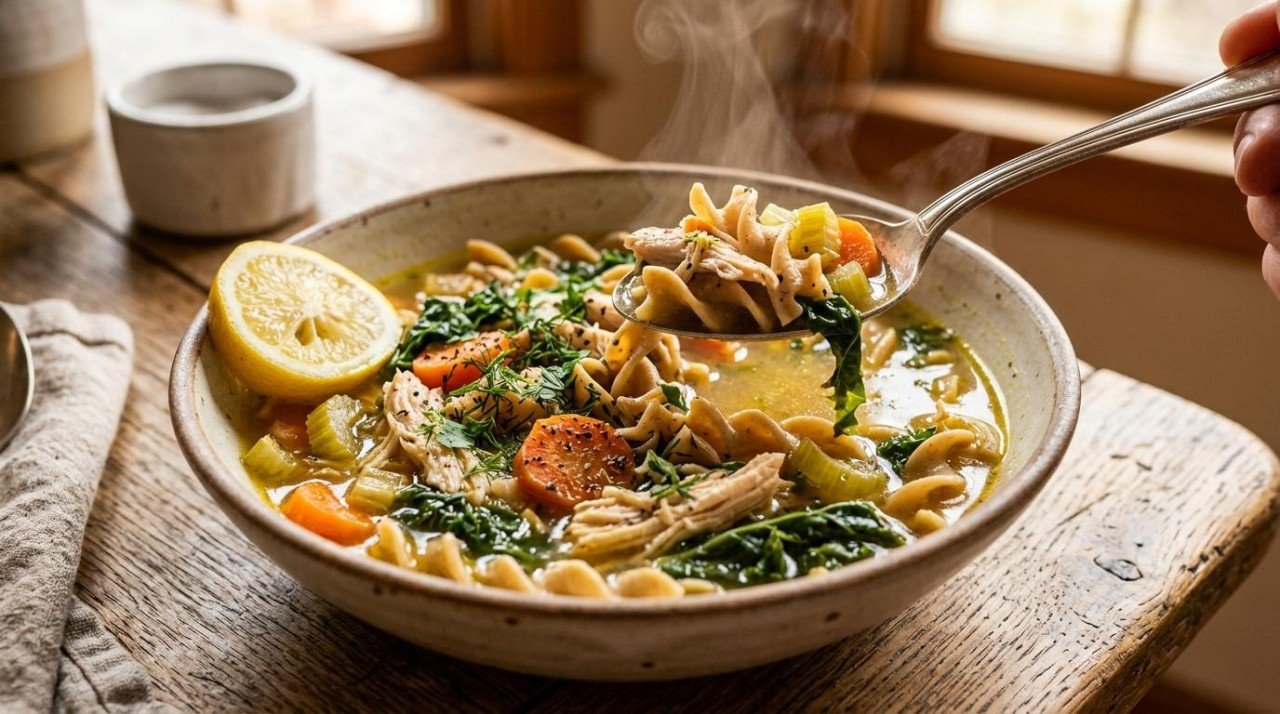
Chicken noodle soup is the one recipe almost nobody feels guilty about. It is what you make when someone is sick, when it is raining, when you cannot face cooking anything with a technique in it. It is broth, chicken, noodles, and whatever is left in the crisper drawer, and it has been quietly forgiven by every diet trend of the last forty years.
So we scored it. We built the version most people actually make — a carton of store-bought broth, a couple of carrots, a couple of celery stalks, an onion, a pound of chicken breast, a bag of egg noodles, a knob of butter, a teaspoon of salt — and ran it through Eat Well Planner's Nutrition Score, the same number that shows on any public recipe page. It came back 52 out of 100. Respectable. Not the hero we expected.
We got it to 92. And the shape of that climb is the strangest one we have measured yet. Cutting two thirds of the sodium out of the pot was worth 2 points. The last half teaspoon of salt was worth 11.
The original: what's in it and how it scores
Here is the version we scored, sized for six bowls:
- 8 cups store-bought chicken broth (regular, not low sodium)
- 2 tablespoons butter
- 1 medium onion, 2 medium carrots, 2 celery stalks
- 1 lb boneless, skinless chicken breast
- 6 oz dried egg noodles
- 1 teaspoon salt, black pepper, a little chopped parsley
Nutrition Score: 52/100. Per bowl: about 305 calories, 23.6 g protein, 25.6 g carbohydrate, 2.1 g fiber, 7.3 g total fat, 2.8 g saturated fat, 1,680 mg sodium, and 520 mg potassium.
Start with what is genuinely good here, because it is a long list. One bowl delivers 75% of a day's niacin, 47% of the vitamin B6, 37% of the phosphorus, 33% of the folate, and 29% of the protein target, for 305 calories. Saturated fat is 2.8 g — a rounding error next to most comfort food. There is no added sugar at all. Chicken breast poached in broth is one of the most efficient protein deliveries in home cooking, and the score sees it.
There is also a reason to keep making it that has nothing to do with the score. The most-cited piece of research on this dish, Rennard and colleagues in Chest in 2000, found that a traditional chicken soup inhibited neutrophil migration in a concentration-dependent way — a mild anti-inflammatory effect that could plausibly explain why it eases cold symptoms. Worth noting what was in the soup they tested: onions, sweet potato, parsnips, turnips, carrots, celery, and parsley. Every one of those vegetables showed inhibitory activity on its own. The vegetables were not the garnish in that experiment. They were most of the experiment. Hold that thought.
Now the problems, and there are really only three:
- Sodium, flagged very high at 1,680 mg a bowl — 73% of a day's value in one course. Harvard's Nutrition Source puts the ceiling at 2,300 mg a day against an American average of roughly 3,400 mg. Almost all of this is the carton. Regular store-bought chicken broth runs close to 900 mg of sodium per cup, and this recipe uses eight of them.
- 2.1 g of fiber, from two carrots, two celery stalks, one onion, and a refined-flour noodle. That is not really a vegetable soup. It is a broth with two vegetables doing cameos.
- 3.25 plant points against a weekly target of 30. Very little about this bowl is feeding your gut bacteria.
Here is the comparison that made the rest of this post make sense. We also scored a two-cup bowl of canned condensed chicken noodle soup, prepared as directed. It came back 55 — three points higher than the homemade one.
That is not a defense of the can. It is a diagnosis. The canned bowl scores well on one dimension only, weight management, because it contains 115 calories and 5.7 g of protein. It carries 1,630 mg of sodium to deliver that — essentially the same salt load as the homemade bowl, for a quarter of the protein and zero plant points. To get as much protein from the can as one bowl of the homemade soup gives you, you would need to eat more than three cans of it, and about 6,800 mg of sodium along with them.
So the homemade version is already winning on everything that matters. It just inherited the can's sodium without needing to. That is the whole problem, and it starts with one shopping decision.
The upgrades
Seven changes, each scored cumulatively on top of the last, listed in the order you would actually cook them. If you make only one, make the first one — but read the last one too, because those two are really the same swap split in half, and neither pays off without the other.
1. Unsalted broth instead of regular
- Swap: 8 cups regular chicken broth to 8 cups unsalted chicken broth (or homemade stock)
- Score impact: +2 points (52 to 54)
- What it changes: Sodium from 1,680 mg to 590 mg a bowl; potassium up from 520 mg to 730 mg
- What it costs you: Nothing at the store. A lot at the stove, if you do not re-season deliberately
Two points. For taking 1,090 mg of sodium out of every bowl. We ran it three times because we did not believe it either.
What is happening is that the sodium penalty was already maxed out at 1,680 mg, and 590 mg is still enough to keep the caution flag lit. You have carried the load most of the way up the hill and gotten no credit for it. The credit arrives in swap 7. Nutritionally, though, this is the most important line in the post: the 2023 CARDIA-SSBP crossover trial in JAMA found that a low-sodium diet lowered systolic blood pressure by about 8 mm Hg compared with a high-sodium one across 213 adults, in roughly 75% of participants — an effect the authors described as comparable to a common first-line blood pressure medication. The score understates this swap. We are telling you so.
Buy cartons labeled unsalted or no salt added rather than low sodium — the reduced-sodium broth in our ingredient database still lands around 670 mg per cup, against roughly 70 mg for an unsalted one. If you make your own stock, you are already there. Our chicken broth substitutes guide covers what to use when you have none of the above.
2. Double the carrot and celery, and add garlic
- Swap: Carrots from 2 to 5, celery from 2 stalks to 5, onion up to 1 large, plus 3 cloves of garlic
- Score impact: +6 points (54 to 60)
- What it changes: Fiber from 2.1 g to 3.5 g, vitamin A from 24% to 52% DV, potassium to 910 mg
- What it costs you: Nothing. It tastes more like chicken soup, not less
The standard recipe treats mirepoix as seasoning. Treat it as an ingredient instead. Five carrots and five stalks of celery in a six-serving pot still makes a soup rather than a stew, and the sweetness the extra carrot gives up to the broth is exactly what you need when there is less salt in it.
This is also where the Rennard study quietly earns its keep. The vegetables were not decoration in the soup they tested. They were where most of the measured activity lived.
3. A big handful of greens, wilted in at the end
- Swap: Add 5 oz of kale, stemmed and chopped, stirred in for the last two minutes
- Score impact: +9 points (60 to 69)
- What it changes: Vitamin K from 34% to 110% DV, vitamin C from 10% to 34%, fiber to 4.5 g, plant points 3.5 to 4.5
- What it costs you: A slightly less clear, golden broth. Some people mind. Most do not
This was the biggest single jump in the build, and it costs about ninety seconds of work. Two minutes in hot broth is enough to collapse kale without turning it gray, and the stems soften just enough to stop being a nuisance.
We tested baby spinach in the same slot: 67 instead of 69. Two points behind, still an excellent swap, and worth taking if it is what you have. Kale wins for a practical reason beyond the score, though — it survives a second day in the fridge, where spinach turns slippery and starts dissolving into the broth.
4. Whole wheat egg noodles
- Swap: 6 oz regular egg noodles to 6 oz whole wheat egg noodles
- Score impact: +2 points (69 to 71)
- What it changes: Fiber from 4.5 g to 5.3 g; folate drops from 40% to 16% DV
- What it costs you: A firmer, nuttier noodle, and a real trade-off worth knowing about
Modest, and honest about why. Regular egg noodles are enriched, which means folic acid is added back into them, and whole wheat versions usually are not. You gain fiber and lose most of the folate. In this particular pot that is a fair trade, because the doubled vegetables and the greens bring folate of their own and the soup still finishes at 17% DV.
Whole wheat noodles also go from firm to mush faster than white ones, so pull them a minute before the package says. If your store does not carry them, whole wheat spaghetti snapped into short lengths works; the pasta substitutes guide has the rest of the options.
5. Olive oil instead of butter
- Swap: 2 tablespoons butter to 2 tablespoons olive oil for softening the vegetables
- Score impact: +9 points (71 to 80)
- What it changes: Saturated fat from 3.3 g to 1.9 g a bowl; the low-ALA flag clears entirely; the heart-health dimension goes 62 to 74 and brain health 65 to 81
- What it costs you: The faint dairy roundness butter gives the broth. Genuinely noticeable, genuinely worth it
Two tablespoons, spread across six bowls, worth more than cutting 1,090 mg of sodium and tied for the biggest swap in the post. This one surprised us more than anything else we scored.
It is not really about the saturated fat, which was never high here. It is that swapping butter for olive oil changes what kind of fat the bowl is built on, and the score weighs that heavily across the heart, brain, and longevity dimensions. The epidemiology points the same way: in a 28-year analysis of two large US cohorts, replacing 10 g a day of butter with the equivalent amount of olive oil was associated with about 14% lower total mortality. If you want butter's flavor without butter's fat profile, our butter substitutes guide works through the alternatives.
6. Herbs and lemon at the finish
- Swap: Parsley up to 1/3 cup, plus 1/3 cup fresh dill and 2 tablespoons lemon juice, all off the heat
- Score impact: +1 point (80 to 81)
- What it changes: Vitamin K to 138% DV, vitamin C to 41%, plant points to 4.75
- What it costs you: Nothing, and it is what makes the next swap survivable
One point is a small return, and we are including it anyway, because this is the swap that makes the salt cut possible. Acid and aromatics do not replace salt, but they do occupy the space it leaves — a principle we have written about at length in salt, fat, acid, heat. A soup with a third of a cup of dill and a squeeze of lemon in it tastes finished. The same soup without them tastes like it is missing salt, because it is.
Add all three off the heat. Dill's flavor compounds are volatile and simmer away; the fresh dill guide covers what to use if you cannot find it.
7. Cut the added salt in half
- Swap: 1 teaspoon salt down to 1/2 teaspoon, for the whole pot
- Score impact: +11 points (81 to 92)
- What it changes: Sodium from 620 mg to 420 mg a bowl — 18% DV — and the sodium caution disappears completely
- What it costs you: More than any other swap here. This is the one you will actually notice
Two hundred milligrams. Eleven points. The same soup that earned 2 points for shedding 1,090 mg of sodium earned 11 for shedding the next 200, because that is where it finally stopped being flagged. Sodium behaves like a wall in this score rather than a slope: almost nothing for climbing most of it, everything for getting over.
We scored the middle ground too. Three quarters of a teaspoon lands at 520 mg a bowl and scores 87. That is a perfectly good place to stop, and it is where we would tell a first-timer to start.
Be honest with yourself about this one. Half a teaspoon across six servings is genuinely restrained seasoning, and it only works because of everything above it — the concentrated vegetables, the garlic, the dill, the lemon. Serve the soup with lemon wedges and let people add a pinch at the table if they want it; salt landing on the surface reads stronger than salt stirred through a whole pot, so a small correction in the bowl costs less than you would think. And if you do season it to your usual taste, you land back around 87 or 81 — still an enormous improvement on where we started.
What we kept (on purpose)
The noodles stayed. All six ounces of them. This is chicken noodle soup, and we did not find a version without noodles that we would rather eat.
The chicken breast stayed whole and poached rather than browned first, because browning buys flavor the herbs are already providing. The butter is gone but the fat is not — see the rejected swaps below for what happened when we tried taking it out.
We stopped at 92 because the two entries left on the score's weakness list are vitamin D and, still, sodium. The sodium caution is gone at 420 mg a bowl, so that entry is now a relative ranking rather than a warning: a soup is a seasoned liquid, and it is never going to be the strongest thing on the plate on that axis. Vitamin D is the real dead end. There is no way to put it into a chicken noodle soup without turning it into a different dish.
Take the Guesswork Out of Eating Well
Eat Well Planner helps you organize your favorite recipes, plan balanced meals, and automatically generate shopping lists — all in one place. Whether you're tracking macros, managing dietary restrictions, or just trying to stop asking "what's for dinner?", we've got you covered.
Our AI-powered tools can adapt any recipe to your dietary needs, help you discover new meals you'll love, and even log your nutrition effortlessly. It's meal planning made simple.
Start Organizing Your Meals — FreeThe healthier version: full recipe
Nutrition Score: 92/100. Serves 6.
- 2 tablespoons olive oil
- 1 large yellow onion (about 6 oz), diced
- 5 medium carrots (about 10 oz), sliced into coins
- 5 celery stalks (about 7 oz), sliced
- 3 cloves garlic, minced
- 8 cups unsalted chicken broth or homemade unsalted stock
- 1 lb boneless, skinless chicken breast
- 6 oz whole wheat egg noodles
- 5 oz kale (about 1 bunch), stemmed and roughly chopped
- 1/2 teaspoon salt
- 1/3 cup chopped fresh parsley (about 20 g)
- 1/3 cup chopped fresh dill (about 12 g)
- 2 tablespoons lemon juice, plus wedges to serve
- Black pepper
- Heat the olive oil in a large pot over medium heat. Add the onion, carrots, and celery and cook, stirring now and then, until the onion is translucent and the carrots have started to soften at the edges, 8 to 10 minutes. Add the garlic and cook 1 minute more, until it smells like garlic rather than raw garlic.
- Pour in the broth and bring it to a bare simmer.
- Slide in the whole chicken breasts. Hold the pot at a lazy simmer — small bubbles at the edge, never a rolling boil — and poach until cooked through, 15 to 18 minutes depending on thickness. A hard boil here is what makes chicken breast stringy. Lift the chicken out onto a plate.
- Add the noodles to the simmering broth and cook them 1 minute short of the package time. Whole wheat noodles turn soft quickly, and they keep cooking in the hot broth.
- Shred the chicken with two forks and return it to the pot along with any juices left on the plate.
- Stir in the kale and cook until it collapses and turns deep green, about 2 minutes.
- Take the pot off the heat. Stir in the salt, the lemon juice, the parsley, and the dill, then grind in black pepper.
- Taste. It should read bright and herbal rather than salty — that is the point. Serve with lemon wedges, and let anyone who wants more salt add a pinch at their own bowl.
Per serving, original versus improved:
- Nutrition Score: 52 to 92
- Calories: 305 to 373 — it went up, because the bowl got bigger and more filling
- Protein: 23.6 g to 29.3 g
- Fiber: 2.1 g to 5.4 g
- Saturated fat: 2.8 g to 1.9 g
- Sodium: 1,680 mg to 420 mg
- Potassium: 520 mg to 1,020 mg — the other half of the salt equation, which we have written about here
- Plant points: 3.25 to 4.75, against a weekly target of 30
The finished bowl is an excellent source of thirteen nutrients — 138% DV vitamin K, 106% niacin, 60% vitamin B6, 56% vitamin A, 41% vitamin C, 36% protein, 34% iron and six more — plus a good source of eight others, including fiber, magnesium, folate, zinc, and vitamin E. It carries no cautions at all.
Swaps we tested and skipped
- Leaving the fat out entirely: 88, four points worse. The intuitive healthy move — skip the oil, sweat the vegetables in a splash of broth — scored lower than cooking them in olive oil. Some of that is the fat quality the score rewards, and some of it is real absorption: a 2004 study in the American Journal of Clinical Nutrition found essentially no carotenoid absorption from salads eaten with fat-free dressing, and substantially more with full-fat. A pot full of carrots and kale needs some fat in it to give up what it has.
- Pearl barley instead of noodles: 91, one point worse. This one stung, because barley took the fiber from 5.4 g to 8.1 g a bowl. It still scored a point lower, and more to the point, it stops being chicken noodle soup. Make it as chicken and barley soup on its own terms if you like it. It is very good. It is not this.
- Chicken thigh instead of breast: 89, three points worse. Thigh brings more zinc and more iron and clears every flagged weakness in the score, but costs 3 points on saturated fat and calories (406 versus 373 a bowl). If you prefer the flavor and the fact that thighs forgive overcooking, take the trade — 89 is a very good bowl of soup. Our chicken thigh guide covers the swap in both directions.
- Baby spinach instead of kale: two points worse at the point we tested it, and it does not survive reheating. Perfectly fine if it is what is in the fridge.
Make it fit other diets
- Gluten-free: brown rice noodles or chickpea pasta in place of the whole wheat egg noodles. Add them at the very end and undercook them; both go soft fast in hot broth.
- Egg-free: egg noodles contain egg, so use whole wheat spaghetti snapped into short lengths instead.
- Vegetarian: unsalted vegetable broth and a can of drained cannellini beans in place of the chicken. It stops being chicken soup, but the beans push the fiber and the plant points past this version's.
In the app, any of these is one sentence to the AI recipe chat, or a single tap on Recipe Variations, which rewrites the whole recipe with the substitution worked through the method rather than just swapped in the ingredient list.
Do this to your own recipes
Everything in this post came out of Eat Well Planner's Make It Healthier tool and the Recipe Playground. Import a recipe — from a URL, an Instagram reel, a YouTube video, or a photo of a cookbook page — and it comes back with a Nutrition Score and a list of proposed swaps, each one already run through the calculator so you see the verified gain before you decide anything. The Playground is where the per-swap numbers above came from: change one ingredient, watch the score move, keep what earns its place.
The reason to do this to your own soup rather than copy ours is that your version has its own answer. Maybe you use bone-in thighs and would rather keep them. Maybe there is a parsnip in your family recipe that we never tested. Score it, change one thing, and look. That is the entire method, and it took a beloved bowl of chicken noodle soup from 52 to 92 without taking a single noodle out of it.