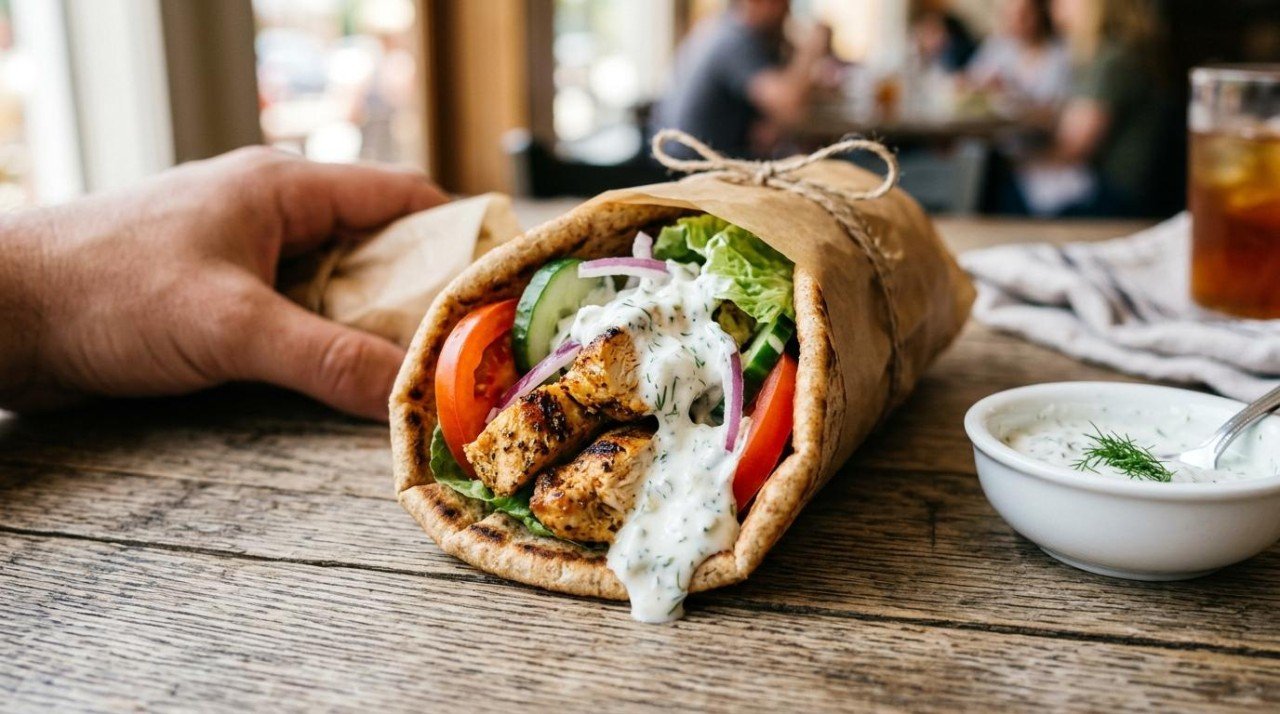
There is a specific kind of hunger that only a gyro fixes. Warm bread, meat shaved off a turning cone with the edges gone crisp, cold garlicky yogurt sauce running down your wrist, a slice of tomato that is somehow the best tomato you have had all week. It is street food doing exactly what street food is supposed to do.
It also has a longer passport than most people realize. The vertical rotisserie was developed in nineteenth-century Bursa, and Greeks from Asia Minor brought their version with them after the 1922-23 population exchange; by 1970 gyros were a fixture in Athens, Chicago, and New York. And the fried potatoes people think of as an American shortcut? They are in the traditional wrap, alongside the tomato, onion, and tzatziki. Hold that thought, because the fries turn out to be the most surprising number in this whole post.
We scored a standard takeout chicken gyro with the app's Nutrition Score. It came back at 39 out of 100. Then we rebuilt it one swap at a time, scoring after every single change, and finished at 81. Here is what actually moved the number, what each change costs you at the table, and the two things everybody blames that turned out to be innocent.
The original: what's in it and how it scores
The version we scored makes two gyros, and it is what you get handed at a Greek counter: about 10 oz of seasoned chicken shaved off the cone, two white pitas, a few tablespoons of tub tzatziki, sliced tomato and red onion, and a quarter teaspoon of salt over the meat on the flat top.
Per gyro that lands at 550 calories, 39.3 g protein, 23.2 g total fat, 6.6 g saturated fat, 1,670 mg sodium, and 3.1 g fiber, with 2 plant points. Nutrition Score: 39.
What drags it down is not complicated:
- Sodium, and then everything else. 1,670 mg in one sandwich is 73% of the day's 2,300 mg limit, and the score flags it as very high. Harvard's Nutrition Source puts the adequate-intake target at 1,500 mg, meaning one gyro can clear a whole day's ideal intake, and links each extra 1,000 mg of daily sodium to an 18% higher risk of cardiovascular disease.
- A refined pita. 3.1 g of fiber for the entire meal, against the 25 to 35 g a day adults actually need.
- Not much of a vegetable. Two slices of tomato and a few rings of onion is 2 plant points out of a weekly target of 30.
And here is what is already fine, because a makeover that manufactures problems is not worth reading. The chicken gyro is genuinely nutrient-dense meat: 39 g of protein, 49% of a day's worth, plus 90% of your niacin, 61% of your B6, 41% of your iron, and a quarter of your zinc. The saturated fat is a little high at 6.6 g, but it is not the story. Compared with the American lamb-and-beef cone, which is typically finely ground beef mixed with lamb rather than stacked slices, the chicken version is already ahead: we scored the identical sandwich with lamb-beef gyro meat and got 35, with 14.3 g of saturated fat instead of 6.6. Ordering chicken was your first upgrade, and you made it before you read this.
Two experiments before we start swapping, because both taught us something.
We asked for it without the salt. We rescored the original with every grain of added salt removed. It scored 39. Not one point. Sodium fell to 1,380 mg and was still flagged very high, because the salt is not on top of the gyro, it is inside the cone meat and inside the bread. Harvard's estimate that about 75% of dietary sodium comes from commercially prepared food, with sandwiches near the top of the list, is this sandwich in one line.
We tucked the fries in. Adding 150 g of french fries to the two gyros scored 41 - two points better than the fries-free version, at 719 calories. Potatoes brought potassium (20% to 30% of a day), vitamin K from zero to 26%, vitamin C, magnesium, vitamin E, and another 1.3 g of fiber, and on a plate that empty, that outweighed the extra sodium and fat. This flips later, and the flip is the interesting part.
The upgrades
Everything below was built in the app's Recipe Playground, scoring after each change. The deltas are cumulative - each one is measured on top of the last - and they are in order of what they are worth, so if you only do one thing, do the first one.
Upgrade 1: Roast your own chicken instead of buying it off the cone
- Swap: Cone gyro meat → boneless skinless chicken thighs marinated in Greek yogurt, lemon, garlic, and oregano, roasted hot and sliced thin
- Score impact: +10 points (39 to 49)
- What it changes: Sodium 1,670 to 1,150 mg a gyro, saturated fat 6.6 to 4.4 g, and the saturated-fat caution clears entirely
- What it costs you: An hour of marinating you spend doing something else, and about 25 minutes of oven time
The cone is a commercial product built to be sliced, stacked, and held on a hot surface all day, and it is seasoned accordingly. Your oven is not. Swapping in plain chicken thighs takes 520 mg of sodium out of each sandwich before you have changed anything else about the meal.
Use the yogurt marinade, not a lemon-only one. Yogurt sits at pH 4.2 to 4.6, far gentler than the pH 2 of straight lemon juice or vinegar, so it tenderizes without the chalky, half-cooked texture a strong acid gives poultry, and it clings instead of running off. For the crisped-edge effect you are actually chasing, cut the thighs into strips, roast them on a rack at 425F so the air gets underneath, then run them under the broiler for two or three minutes at the end. That is the closest a home kitchen gets to the shaved outside of a cone.
Upgrade 2: Make it mostly vegetables
- Swap: Two tomato slices and some onion → a whole large tomato, more red onion, a cup of sliced cucumber, and a couple of handfuls of shredded romaine per pair of gyros
- Score impact: +10 points (49 to 59)
- What it changes: Fiber 2.9 to 4.5 g, plant points 2.5 to 4.5, potassium 730 to 1,020 mg, vitamin K to nearly half a day's worth
- What it costs you: Nothing at all. It is a better sandwich - more crunch, more cold against the hot meat
Ten points for vegetables you were going to buy anyway. The potassium is the underrated half of it: Harvard notes that the combination of high sodium and low potassium carries roughly double the risk of dying from a heart attack, so loading a salty sandwich with produce is not just padding - it is working on the same problem from the other side. We wrote about that trade-off in more depth in potassium, the other half of the salt equation.
Practically: salt the tomato slices and let them drain on a paper towel for five minutes, and slice the red onion paper-thin and rinse it under cold water. Both keep the pita from going soggy, which is the real reason most people under-fill a gyro.
Upgrade 3: Make the tzatziki yourself
- Swap: Tub tzatziki → plain nonfat Greek yogurt with grated cucumber, garlic, lemon, dill, and a teaspoon of olive oil - and twice as much of it
- Score impact: +8 points (59 to 67)
- What it changes: Protein 39.2 to 45.0 g a gyro, vitamin B12 from 10% to 31% of a day, calcium from 18% to 25%, and the sodium caution finally drops out of the "very high" band
- What it costs you: Five minutes and a box grater
This is the swap that already agrees with tradition. Tzatziki is strained yogurt with cucumber, garlic, salt, olive oil, and herbs like dill or mint - which is to say, it is already essentially Greek yogurt. What the tub adds is stabilizers, more oil, and salt. Making it yourself turns the sauce from a condiment into a protein source, which is why we doubled the amount.
One technique note that decides whether yours is good: grate the cucumber, then squeeze it hard in a clean towel until you have wrung out a surprising amount of water. Skip that and you get a thin sauce that slides straight out of the bread.
Upgrade 4: Whole wheat pita
- Swap: White pita → 100% whole wheat pita
- Score impact: +7 points (67 to 74)
- What it changes: Fiber 4.6 to 7.1 g a gyro (a quarter of a day), magnesium up by a third, plant points 4.75 to 5.75
- What it costs you: A nuttier, slightly sturdier bread. Warm it or it will crack when you fold it
Refining wheat strips away more than half its B vitamins, 90% of the vitamin E, and virtually all the fiber, and the same page cites a meta-analysis of over 786,000 people linking 70 g of whole grains a day to a 22% lower risk of total mortality. Seven points is a lot for a swap made at the shelf.
The catch is that "wheat pita" on the front of the bag means nothing. Check that the first ingredient reads whole wheat flour, not enriched wheat flour with caramel color doing the work - our guide to buying bread that is actually whole grain covers the label tricks. Thirty seconds in a dry skillet or a damp paper towel in the microwave makes whole wheat pita fold like white.
Upgrade 5: Halve the salt in the marinade
- Swap: 1/2 teaspoon salt → 1/4 teaspoon, across the whole recipe
- Score impact: +6 points (74 to 80)
- What it changes: Sodium 980 to 690 mg a gyro - 30% of the daily limit, down from 73% - and every flagged weakness on the recipe disappears
- What it costs you: Genuinely very little, because the lemon, garlic, and oregano are carrying the flavor now
Remember experiment one, where removing the salt from the takeout gyro was worth exactly zero points? Once you are cooking the meat yourself, the salt shaker goes from irrelevant to the single biggest remaining lever. That is the whole sodium lesson in two numbers: you cannot season your way out of a commercial product, and you absolutely can over-season your way back into the same problem at home.
The reason a quarter teaspoon is enough here is acid. Lemon juice in the marinade and again in the sauce makes food read as seasoned without sodium doing the work, and a heavy hand with dried oregano and raw garlic finishes the job.
Upgrade 6: Raid the spice rack
- Swap: Oregano alone → oregano plus cumin, smoked paprika, and coarse black pepper
- Score impact: +1 point (80 to 81)
- What it changes: Iron from 48% to 58% of a day, plant points 5.75 to 6.5, another 0.4 g of fiber
- What it costs you: Nothing, and it tastes considerably more like a gyro
One point is small, but it is free, and the plant points are the real prize - dried spices count toward the 30 different plants a week that gut research keeps pointing at. Cumin is also unexpectedly iron-dense, which is where most of that 10-point iron jump comes from.
Take the Guesswork Out of Eating Well
Eat Well Planner helps you organize your favorite recipes, plan balanced meals, and automatically generate shopping lists — all in one place. Whether you're tracking macros, managing dietary restrictions, or just trying to stop asking "what's for dinner?", we've got you covered.
Our AI-powered tools can adapt any recipe to your dietary needs, help you discover new meals you'll love, and even log your nutrition effortlessly. It's meal planning made simple.
Start Organizing Your Meals — FreeWhat we kept, on purpose
The bread. We scored the whole thing as a bowl with no pita at all: 79, two points worse than the gyro, with fiber down from 7.5 g to 3.7 g and iron falling from 58% of a day to 34%. The whole wheat pita is not a compromise you are tolerating; it is contributing.
Thighs, not breast. The identical build with chicken breast scores 86, five points above ours, on 62 fewer calories and 8 g less fat. It is a legitimately good choice. It is also drier, it drops zinc from 37% of a day to 28%, and - oddly - it picks up three flagged weaknesses where our thigh version has none. We stayed with thighs because a gyro that dries out is not a gyro, but if you prefer breast, take the five points.
The olive oil. Leaving it out entirely scores 84, three points higher - but it flags low omega-3 ALA, and it makes the marinade run off the chicken and the tzatziki taste like plain yogurt. That is three points we spent on purpose. Buying oil worth spending them on is a separate skill; see the olive oil guide.
Where we stopped. The only moves left that scored higher were switching to breast and taking the olive oil out - one drier gyro and one blander one. A makeover that guts the dish is a failed makeover, so 81 with the bread, the thigh meat, and the oil in it is where we stopped.
The healthier version: full recipe
Final Nutrition Score: 81 out of 100 (up from 39). Makes 2 gyros.
Ingredients
- 10 oz (280 g) boneless skinless chicken thighs, cut into 1/2-inch strips
- 1/4 cup (60 g) plain nonfat Greek yogurt, for the marinade
- 2/3 cup (150 g) plain nonfat Greek yogurt, for the tzatziki
- 2 tablespoons lemon juice, divided
- 4 teaspoons olive oil, divided
- 5 cloves garlic (about 15 g), grated, divided
- 2 teaspoons dried oregano
- 1 teaspoon ground cumin
- 1/2 teaspoon smoked paprika
- 1/2 teaspoon coarsely ground black pepper
- 1/4 teaspoon salt, for the whole recipe
- 1 tablespoon (4 g) chopped fresh dill
- 2 whole wheat pitas (about 62 g each)
- 1 large tomato (160 g), sliced
- 1/2 small red onion (60 g), sliced paper-thin
- 1 medium cucumber (180 g), divided - most sliced, a piece grated for the sauce
- 2 cups (60 g) shredded romaine lettuce
Instructions
- Marinate the chicken: stir together the 1/4 cup of yogurt, 1 tablespoon lemon juice, 1 tablespoon (3 teaspoons) olive oil, 3 grated cloves of garlic, the oregano, cumin, smoked paprika, black pepper, and the 1/4 teaspoon salt. Toss with the chicken strips and refrigerate at least 1 hour, or overnight.
- Make the tzatziki: grate about a quarter of the cucumber and squeeze it hard in a clean kitchen towel until it stops dripping. Stir it into the 2/3 cup of yogurt with the remaining 2 grated garlic cloves, 1 tablespoon lemon juice, 1 teaspoon olive oil, and the dill. Chill until you need it.
- Heat the oven to 425F. Set a wire rack over a baking sheet so hot air can get under the chicken.
- Shake the excess marinade off the chicken and spread the strips out on the rack in a single layer, not touching. Roast 15 to 18 minutes, until cooked through at 165F.
- Switch on the broiler and give the chicken 2 to 3 minutes on the top rack, until the edges char in spots. This is what gives it the shaved-off-the-cone texture. Rest 5 minutes, then slice any thick pieces thin.
- Meanwhile, slice the tomato and salt it lightly on a paper towel for 5 minutes. Slice the red onion paper-thin and rinse it under cold water to take the harsh edge off. Slice the remaining cucumber.
- Warm the pitas 30 seconds in a dry skillet or 15 seconds in the microwave under a damp paper towel so they fold without cracking.
- Build: a spoonful of tzatziki on the bread first so it does not slide, then romaine, chicken, tomato, cucumber, onion, and the rest of the tzatziki over the top. Fold, wrap the bottom half in foil, and eat it standing up.
Per gyro, original vs. improved
- Nutrition Score: 39 → 81
- Calories: 550 → 674
- Protein: 39.3 g → 45.7 g
- Fiber: 3.1 g → 7.5 g (25% of a day)
- Saturated fat: 6.6 g → 4.1 g
- Sodium: 1,670 mg → 690 mg (73% → 30% of the daily limit)
- Potassium: 690 mg → 1,210 mg
- Plant points: 2 → 6.5
- Flagged weaknesses: three → none
The calories went up, and we are not going to pretend otherwise. The meat weight is identical; the extra 124 calories are more vegetables, twice as much yogurt sauce, and four teaspoons of olive oil. It is a bigger, more filling sandwich that happens to carry less than half the sodium.
Swaps we tested and skipped
- Crumbled feta. An ounce and a half in the wrap scored 76, five points down, putting the High Sodium weakness flag back on the recipe and adding a saturated-fat caution - sodium goes from 690 to 920 mg a gyro. Feta is delicious and it is also brine. If you want it, use half as much and drop the marinade salt to nothing; the feta substitutes guide has lower-sodium options.
- Full-fat Greek yogurt in the marinade and the sauce: 73, an 8-point drop, with saturated fat going from 4.1 g to 9.2 g and the saturated-fat flag back on the recipe. This is the one place in the build where nonfat genuinely earns its keep.
- The fries, again. Tucked into the finished gyro they scored 77 - four points down, where the same fries were worth +2 in the takeout version. Once the plate already has the potassium, vitamin C, and fiber covered, potatoes fried in oil only add calories, fat, and sodium, and the saturated-fat caution comes back. Worth knowing that a 2021 Heart meta-analysis pooling 562,445 people found each extra weekly serving of fried food raised heart failure risk by 12%. Four points is also not a catastrophe, so if the fries are the point of the gyro for you, put them in and spend the points knowingly.
- Going bowl-style instead of using pita: 79, two points worse. See above.
Make it fit other diets
The two questions this dish always gets: gluten-free, where a good gluten-free pita or big lettuce leaves work but the bread swap costs you most of that 7-point fiber gain, so add a scoop of chickpeas to the wrap to get it back; and vegetarian, where thick-sliced roasted mushrooms or chickpeas take the same yogurt-lemon-oregano marinade beautifully and the tzatziki carries the protein. In the app you can skip the guesswork - ask the AI recipe chat to make this gluten-free or vegetarian and Recipe Variations rewrites the whole recipe with the substitutions worked in, then rescores it so you can see what the change actually cost.
Do this to any recipe you love
Nothing here required giving up the dish. The gyro is still a gyro: bread, meat with charred edges, garlic yogurt, cold vegetables, eaten with both hands. What changed is that we measured instead of guessed - which is how we found out that holding the salt was worth nothing, that the fries were briefly an improvement, and that shredded lettuce was worth as much as roasting your own chicken.
That process is a feature, not a one-off. Import any recipe into Eat Well Planner - from a URL, an Instagram reel, or a YouTube video - and it scores instantly. Make It Healthier then proposes swaps like these, with a calculator verifying the actual nutritional gain before a suggestion is ever shown to you, and the Recipe Playground lets you test your own ideas and watch the number move per edit. Keep the bacon, keep the fries, keep whatever makes the dish yours. Just find out what it costs, and make it up somewhere else.
Hungry for the same treatment on the rest of the takeout menu? The chicken teriyaki bowl makeover ran into the same sodium problem from a different direction.