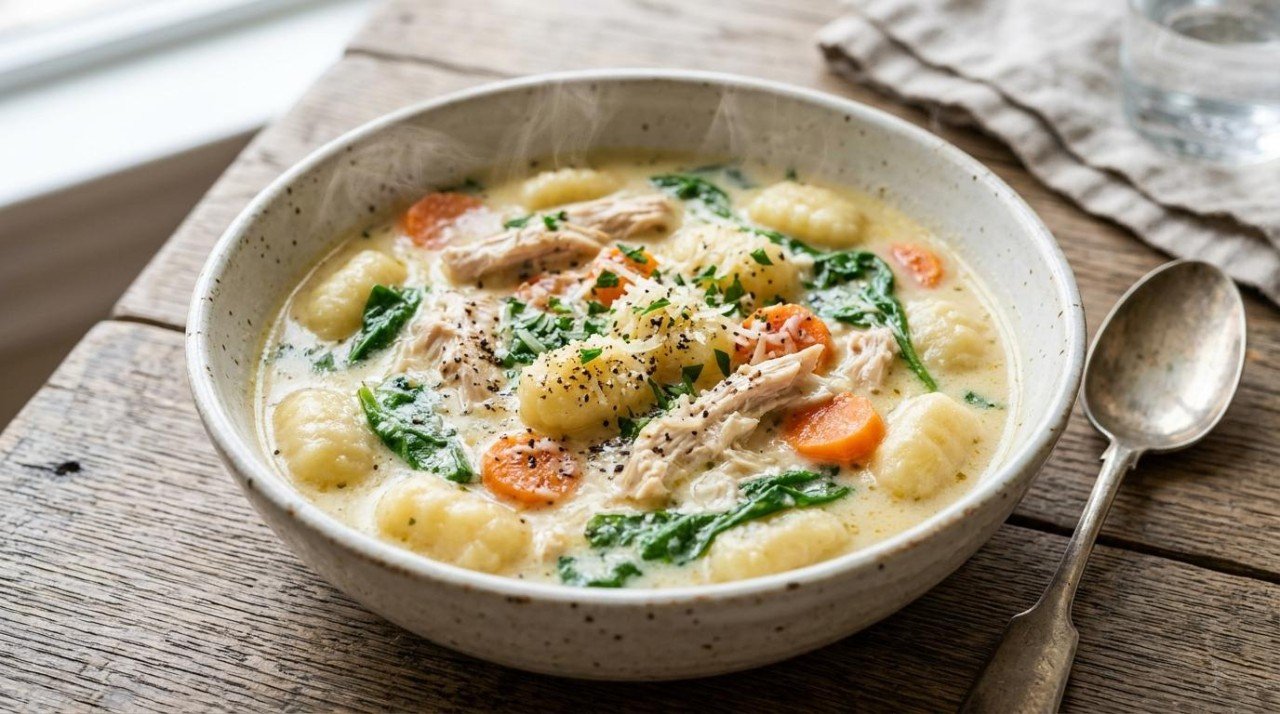
Chicken gnocchi soup is the reason a lot of people order the soup-and-salad deal at Olive Garden. Soft potato dumplings, shredded chicken, carrots and celery and a handful of spinach, all in a creamy, peppery broth. It is one of the most-searched copycat recipes online, and as soon as the weather turns, it is on a lot of stovetops.
We made a standard homemade copycat and ran it through Eat Well Planner's Nutrition Score, which is the same number a visitor sees on any public recipe page. It scored 47 out of 100. That is respectable for a cream soup. The gnocchi is not the problem, and neither is the chicken. The score comes down to two numbers: saturated fat and sodium.
We rebuilt it to 84 out of 100. It is still creamy, still has gnocchi in every spoonful and still tastes like the bowl you order. Every swap below carries the exact score change it earned. One of them, the broth, was worth zero points when we tried it first and 15 points by the end.
The original: what's in it and how it scores
Copycat versions split into two camps: a butter-and-flour roux with milk and cream, like Cooking Classy's, or broth enriched with half-and-half and thickened with cornstarch, like Spend With Pennies'. Our standard version takes the most common elements of both. It serves six:
- 4 tablespoons butter plus 1 tablespoon olive oil
- 1/4 cup flour for the roux
- 1 cup each diced onion, carrot and celery, plus 3 cloves garlic
- 4 cups regular chicken broth
- 2 cups half-and-half
- 1 lb boneless skinless chicken breast
- 1 (16 oz) package shelf-stable potato gnocchi
- 2 cups fresh spinach
- Dried thyme and oregano, black pepper, 1/2 teaspoon salt
- 1/4 cup grated Parmesan on top
Nutrition Score: 47/100. Each bowl has about 483 calories, 27.2 g protein, 3.8 g fiber, 22.7 g total fat, 11.3 g saturated fat and 1,330 mg sodium. Two flags hold it down:
- Sodium, flagged very high. 1,330 mg is 58% of the daily value in one bowl. The FDA sets the limit at less than 2,300 mg a day and links higher-sodium diets to high blood pressure. It also notes that over 70% of the sodium Americans eat comes from packaged and prepared foods. That matches this soup. About 590 mg per bowl comes from the regular broth and about 300 mg from the packaged gnocchi. The salt shaker adds less than either.
- Saturated fat, flagged high. 11.3 g is 48% of the 20 g daily value. The half-and-half and the butter account for nearly all of it.
The original also does a lot right, and the score shows it. The chicken makes it an excellent source of niacin and vitamin B6 (64% and 61% of the daily value), and the carrots and spinach already supply 53% of your vitamin K and 38% of your vitamin A. The protein is solid too. The base is good, so this makeover needs fewer fixes than most.
The upgrades
We made seven swaps, applied cumulatively in this order. The first three fix the fat and add body, and the next two fix the sodium. The last two are smaller adjustments that change the proportions of the bowl.
1. 2% milk instead of half-and-half
- Swap: 2 cups half-and-half → 2 cups 2% milk
- Score impact: +7 points (47 → 54)
- What it changes: Saturated fat drops from 11.3 g to 6.6 g a bowl, and about 65 calories come off
- What it costs you: A thinner, less rich broth on its own. Swap 2 brings the richness back
Because this soup starts with a roux, it does not need cream to be creamy. Butter, flour and milk make a bechamel, and a bechamel is creamy all by itself. Cooking Classy's well-loved version uses 2 cups of milk and only 1/3 cup of cream for this reason. Half-and-half does add richness, though, and that is what the next swap replaces. Our half-and-half substitution guide covers more options. If you want to see the cost: putting the half-and-half back into the finished soup drops it 13 points (84 → 71).
2. Blend in a can of white beans
- Swap: Add one 15 oz can of no-salt-added cannellini beans, drained, blended smooth with a cup of the milk
- Score impact: +9 points (54 → 63)
- What it changes: Fiber jumps from 3.8 g to 6.9 g and protein from 27.4 g to 31.4 g a bowl
- What it costs you: Nothing you will taste. Blended cannellini are mild and creamy, and they give back the body the half-and-half took with it
This is the swap we would make first if you only make one. Puree the beans with some of the milk until completely smooth and stir it in at the end. The soup turns thicker and silkier, and nobody will know it is beans. This also worked in our loaded baked potato soup makeover. Fiber is the main thing this soup was missing. A large Lancet review of fiber research found that people who ate the most fiber had a 15-30% lower risk of heart disease, stroke, type 2 diabetes and early death than people who ate the least, with the greatest benefit at 25 to 29 g a day.
Buy no-salt-added beans. Regular canned beans come pre-salted, and in the finished soup they scored 3 points lower. Our cannellini beans guide lists the best stand-ins if your store is out.
3. One tablespoon of butter, not four
- Swap: 4 tablespoons butter + 1 tablespoon olive oil → 1 tablespoon butter + 2 tablespoons olive oil
- Score impact: +5 points (63 → 68)
- What it changes: Saturated fat goes from 6.6 g to 3.7 g a bowl, and the saturated fat flag clears completely
- What it costs you: Very little. You still need fat for the roux, and the one tablespoon of butter keeps that buttery note
A roux needs fat, but the fat does not have to be all butter. Three tablespoons of fat still cook the vegetables and the flour just as well. A Cochrane review of randomized trials found that cutting saturated fat for at least two years lowered combined cardiovascular events by 21%, and that replacing it with unsaturated fat appears to be a useful strategy. Putting all 4 tablespoons of butter back into the finished soup costs 7 points. More options are in our butter substitution guide.
4. Unsalted stock instead of regular broth
- Swap: 4 cups regular chicken broth → 4 cups unsalted chicken stock
- Score impact: +10 points (68 → 78)
- What it changes: Sodium drops from 1,280 mg to 730 mg a bowl
- What it costs you: Nothing, as long as you season to taste at the end
This swap teaches the most. On the untouched original, it was worth +0. That is not a typo: it cut 550 mg of sodium per bowl and did not move the score at all. Saturated fat was still flagged, and while one flag is up, fixing the other cannot lift the score much. In the finished soup, putting the regular broth back costs 15 points (84 → 69). The swap stayed the same, but its value changed because of everything around it. We see this in almost every recipe in this series: fix the fat first, and then the sodium cut pays off.
Check the label for "unsalted" or "no salt added." "Reduced sodium" can still mean several hundred milligrams a cup. Our chicken broth substitution guide has more swaps.
5. Halve the salt
- Swap: 1/2 teaspoon salt → 1/4 teaspoon, added at the end and adjusted to taste
- Score impact: +4 points (78 → 82)
- What it changes: Sodium goes from 730 mg to 630 mg a bowl
- What it costs you: Taste before you add more. The gnocchi and the Parmesan are already salty
On the original, leaving out the salt entirely was worth 0 points. Here, cutting just a quarter teaspoon is worth 4. Leaving it out of the finished soup scores 89. That is a real option if your gnocchi brand is on the salty side, but we kept the quarter teaspoon because it makes the broth taste like broth.
6. Use 12 ounces of gnocchi, not the whole package
- Swap: 16 oz gnocchi → 12 oz (three-quarters of a standard package)
- Score impact: +2 points (82 → 84)
- What it changes: About 30 fewer calories and 70 mg less sodium a bowl
- What it costs you: A few fewer dumplings per bowl. The beans and extra vegetables make up the volume
Packaged gnocchi is mostly potato with some flour and salt, and it is fine. But it brings little fiber and a fair amount of sodium, so less of it means more room in the bowl for the ingredients that score better. We tested going further: 10 oz scored 85 and 8 oz scored 87. At 8 oz, though, it stops feeling like gnocchi soup. Twelve ounces still puts gnocchi in every spoonful.
7. Double the carrots, and add a whole clamshell of spinach
- Swap: 1 cup carrots → 2 cups; 2 cups spinach → 5 oz (one standard clamshell)
- Score impact: +0 points (84 → 84)
- What it changes: Fiber goes from 6.4 g to 7.2 g a bowl, and the finished soup has 59% of your vitamin A and 118% of your vitamin K
- What it costs you: Nothing. The spinach wilts down to almost nothing, and the extra carrots make it sweeter
This step earns zero points, and we included it anyway. On the original, the same vegetables were worth +1 to +2. In the finished soup, the score is already crediting everything they add, so it barely moves. The fiber and vitamins are still real, and so is the extra color in the bowl. Think of it as a free upgrade the score cannot capture.
What we kept (on purpose)
- The roux. Cutting the flour in half did not change the score. Without the full roux, though, the soup loses the velvety texture of the restaurant version.
- A tablespoon of butter. Leaving it out entirely scored 85, one point more. One point is not worth losing the buttery flavor.
- Parmesan on top. Leaving it off scored 85, also one point more. A spoonful per bowl is the finishing touch.
- Real potato gnocchi. It is in the name.
Take the Guesswork Out of Eating Well
Eat Well Planner helps you organize your favorite recipes, plan balanced meals, and automatically generate shopping lists — all in one place. Whether you're tracking macros, managing dietary restrictions, or just trying to stop asking "what's for dinner?", we've got you covered.
Our AI-powered tools can adapt any recipe to your dietary needs, help you discover new meals you'll love, and even log your nutrition effortlessly. It's meal planning made simple.
Start Organizing Your Meals — FreeThe healthier version: full recipe
Nutrition Score: 84/100 (up from 47). Serves 6, about 2 cups per bowl.
Ingredients
- 1 tablespoon butter
- 2 tablespoons olive oil
- 1 cup diced yellow onion (about 1 medium)
- 2 cups diced carrots (about 4 medium)
- 1 cup diced celery (about 2 ribs)
- 3 cloves garlic, minced
- 1 teaspoon dried thyme
- 1 teaspoon dried oregano
- 1/4 cup all-purpose flour
- 4 cups unsalted chicken stock
- 1 lb boneless skinless chicken breasts
- 1 (15 oz) can no-salt-added cannellini beans, drained and rinsed
- 2 cups 2% milk, divided
- 12 oz shelf-stable potato gnocchi (three-quarters of a 16 oz package)
- 5 oz fresh spinach, roughly chopped
- 1/2 teaspoon black pepper
- 1/4 teaspoon salt, plus more to taste
- 1/4 cup grated Parmesan, for serving
Instructions
- Melt the butter with the olive oil in a large pot or Dutch oven over medium heat. Add the onion, carrots and celery and cook, stirring now and then, until softened, 6 to 8 minutes. Add the garlic, thyme and oregano and cook 1 minute.
- Sprinkle the flour over the vegetables and stir constantly for 1 to 2 minutes, until it smells toasty and no dry flour remains.
- Slowly whisk in the stock, scraping up the bottom of the pot so no lumps form. Add the whole chicken breasts and bring to a boil. Reduce the heat, cover and simmer until the chicken reaches 165°F in the center, 12 to 15 minutes.
- While the chicken cooks, blend the beans with 1 cup of the milk until completely smooth.
- Move the chicken to a cutting board and shred it with two forks. Bring the soup back to a simmer, add the gnocchi and cook until they float and are tender, 3 to 5 minutes.
- Turn the heat to low. Stir in the bean puree, the remaining 1 cup of milk, the shredded chicken and the spinach. Heat until steaming and the spinach has wilted, about 2 minutes, without letting the soup boil hard.
- Season with the pepper and 1/4 teaspoon salt, then taste and add more only if it needs it. Ladle into bowls and top each with Parmesan.
Gnocchi keep soaking up broth as the soup sits, so leftovers thicken overnight. Add a splash of milk or stock when you reheat.
Per bowl: original vs. healthier
- Nutrition Score: 47 → 84
- Calories: 483 → 441
- Saturated fat: 11.3 g → 3.9 g
- Total fat: 22.7 g → 12.1 g
- Sodium: 1,330 mg → 590 mg
- Fiber: 3.8 g → 7.2 g
- Protein: 27.2 g → 32.5 g
- Potassium: 910 mg → 1,260 mg
- Plant points: 6 → 7
The finished soup is an excellent source of fiber (24% of the daily value), protein (40%), vitamin A (59%), iron (40%), folate (34%), potassium (37%) and calcium (25%). The only caution flag left is sodium, at 26% of the daily value, labeled "high" instead of "very high." Calories barely change, which is normal for this kind of makeover. The beans add back most of what the half-and-half and butter took out, but they bring fiber and protein instead of saturated fat.
Swaps we tested and skipped
- Evaporated skim milk instead of 2% milk. This was the best single swap on the original (+10, compared with +7 for milk). In the finished soup, though, it scored 81, three points below milk, because evaporated milk carries more sodium. It is a good example of why we score swaps in context. Our evaporated milk guide covers when it is the right call.
- Whole wheat gnocchi. Modeled with whole wheat flour, it scored 85, one point more. We could not find a widely available store-bought version, and one point is not worth making gnocchi from scratch for a weeknight soup.
- Kale instead of spinach. It scored 85, one point more, and holds up better in leftovers. Every copycat we looked at uses spinach, so we kept it. If you prefer kale, use it.
- Canola oil instead of olive oil. It scored 86, two points more, because canola is lower in saturated fat and higher in plant omega-3. We kept olive oil for flavor, but either one works.
- No salt at all. It scored 89. This is the easiest extra 5 points if your palate is fine with it. For us, the broth tasted flat.
Make it fit other diets
- Gluten-free: Use gluten-free gnocchi, and in place of the flour roux, thicken with 1 tablespoon cornstarch whisked into a little cold milk. The blended beans already add most of the body.
- Dairy-free: Use olive oil only, unsweetened plain soy milk for the milk, and skip the Parmesan.
- Vegetarian: Use unsalted vegetable stock and a second can of no-salt-added white beans (left whole) instead of the chicken.
Eat Well Planner's Recipe Variations can rewrite this exact recipe for any of these in one step, or you can ask the AI recipe chat for the swap you need.
Do this to any recipe
Everything above came out of a workflow you can run on your own recipes. Import a recipe from any website, Instagram reel or YouTube video, see its Nutrition Score and tap Make It Healthier. The app suggests swaps like these and checks each gain with a calculator before showing it to you. Want to keep the half-and-half? Open the recipe in the Recipe Playground to see what it costs, then make up the points somewhere else. It is your soup and your call, just with the numbers in front of you.