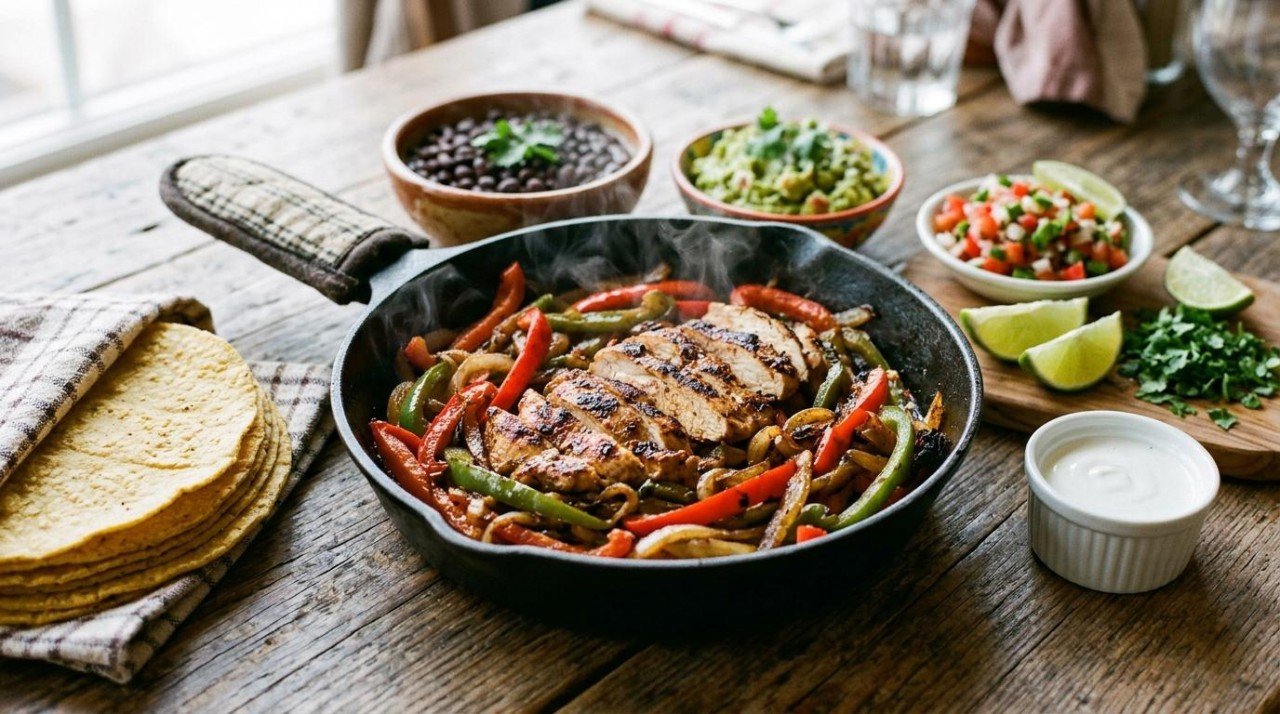
Chicken fajitas arrive at the table still hissing on a cast iron platter, and for a lot of us that sound is the whole point of going out for Tex-Mex. The dish started with beef, not chicken. According to its history, Texas ranch hands were cooking scrap skirt steak during cattle roundups by the 1930s, and the sizzling platter is credited to Otilia Garza, who served fajitas that way at the Round-Up Restaurant in Pharr, Texas, starting in 1969. Chicken came later, and now it is the version most of us order and cook at home.
We expected fajitas to score well, because they are mostly grilled chicken and peppers. The full restaurant-style plate came back at 56 out of 100. That is a decent start, but sodium alone was flagged at 111% of a day's worth. Our rebuilt version scores 87. It keeps the sizzle, the guacamole and the pico, and it has more fiber than the original. The biggest single gain came from the tortillas, not the sour cream. Here is every swap and what it is worth, plus how to use the numbers when you order out.
The original: what's in it and how it scores
We modeled a typical restaurant-style fajita plate for four. That is 1.5 lb of chicken breast marinated in lime juice, oil and 1.5 packets of store-bought fajita seasoning. The chicken is cooked with two bell peppers and an onion, then served with eight flour tortillas, 1/2 cup of sour cream, a cup of shredded Mexican-blend cheese, guacamole and pico de gallo. Each plate also comes with Mexican rice and refried beans, the way most restaurants serve it.
Scored per serving against our default nutrition profile, that plate is a 56:
- 1,139 calories
- 2,540 mg sodium, 111% of the Daily Value in one meal, flagged "very high"
- 13.5 g saturated fat, 57% of a day's worth, also flagged "very high"
- 12.5 g fiber, which is already good
- 64 g protein
- 9.5 plant points
Fajitas get real credit here. The plate is an excellent source of vitamin C, B6, niacin, iron and folate, and peppers, onions, avocado, tomato, beans and cilantro already add up to more plants than most takeout. The score is not complaining about the chicken or the vegetables.
The problem is sodium, and it comes from all over the plate. The FDA's Daily Value for sodium is under 2,300 mg, and it notes that diets higher in sodium are linked to high blood pressure. This plate goes past that in one sitting. Roughly, per serving: about 650 mg from the seasoning packet, 630 mg from the flour tortillas, 420 mg from the refried beans, 370 mg from the salted rice and 200 mg from the cheese. The salt in the guac and pico and the chicken itself make up most of the rest. Saturated fat is the second flag, and more than three-quarters of it comes from the cheese, sour cream and flour tortillas.
The upgrades
Eight changes, scored cumulatively in the order below. The first four are things you can ask for at a restaurant tonight. The rest happen in your own kitchen. The deltas add up to exactly the 31 points between 56 and 87, and one of them is negative. We left it in because that is what the score said.
1. Corn tortillas instead of flour
- Swap: 8 flour tortillas → 12 small corn tortillas (three per person)
- Score impact: +13 points (56 to 69), the biggest single jump
- What it changes: About 590 mg less sodium and 2 g less saturated fat per serving, plus more fiber
- What it costs you: Corn tortillas are smaller and more fragile. Warm them properly (see the recipe) and they fold without cracking
Flour tortillas are made with refined flour, fat and a fair amount of salt. In the app's data they carry about 700 mg of sodium per 100 g, while corn tortillas carry 50. Corn tortillas also have almost twice the fiber per gram. This is the same lesson our fish taco makeover taught us: the tortilla is often the biggest lever on the plate. Most Tex-Mex restaurants will bring corn if you ask. Our tortilla substitutes guide covers the other options.
2. Hold the sour cream and cheese
- Swap: 1/2 cup sour cream + 1 cup shredded cheese → none at the restaurant (keep the guacamole and pico)
- Score impact: +2 points (69 to 71)
- What it changes: Saturated fat drops from 11.2 g to 3.4 g per serving, and about 160 calories go with it
- What it costs you: Less richness. The guacamole is there to take over that job
The saturated fat drop is huge, so why only 2 points? Sodium is still flagged at this stage, and the score keeps holding the plate back for it no matter what else improves. On the original plate, holding the sour cream and cheese alone was worth +6. One transparency note: part of this +2 is a technicality. Cheese and sour cream carry a trace of vitamin D. The score treats a trace as "low" but ignores a nutrient that isn't there at all, so removing the dairy cleared a "low vitamin D" note. The saturated fat cut is real. At home, we bring the creaminess back in step 8.
3. Black beans instead of refried
- Swap: Canned refried beans → whole canned black beans, drained
- Score impact: +0 points (71 to 71)
- What it changes: Fiber climbs from 14.3 g to 18.3 g per serving, and saturated fat drops a little more
- What it costs you: Nothing. Whole beans stand up better next to sizzling chicken anyway
This one scored zero, and we are keeping it in the list because the reason is useful. Regular canned black beans carry about as much sodium as refried beans, so while sodium is still the main flag, the extra fiber doesn't move the score. On the original plate the same swap was worth +5. It pays off later, when we switch to no-salt-added beans in step 7. More bean options are in our black bean substitutes guide.
4. Skip the rice
- Swap: 3/4 cup Mexican rice per person → none
- Score impact: +2 points (71 to 73)
- What it changes: About 190 fewer calories and 360 mg less sodium per serving
- What it costs you: Very little. Three tortillas and a scoop of beans are already plenty of starch
Restaurant rice is usually cooked in salted broth with tomato sauce, so it adds sodium along with the starch. On a plate with tortillas and beans, it is the easiest side to skip. If you want rice at home, see "Swaps we tested and skipped" below for what it costs. Our Mexican rice makeover has a lower-sodium version.
Stop here and you have the best version most restaurants can serve you: 73, against 56 for the standard plate.
5. Mix your own seasoning, and measure the salt
- Swap: 1.5 packets of fajita seasoning → a scratch blend of ancho chile powder, smoked paprika, cumin, garlic powder, onion powder and oregano, plus 1/2 tsp salt
- Score impact: +10 points (73 to 83)
- What it changes: About 360 mg less sodium per serving, and the cornstarch and sugar filler are gone
- What it costs you: Two minutes with six jars. The flavor is smokier and more like actual chiles
Read the label on a seasoning packet and you will see what you are paying for. Old El Paso's fajita mix lists corn starch first, then salt, sugar and a second kind of salt before any spice. Each 1-ounce packet holds six servings at 290 mg of sodium each, about 1,740 mg in all. We modeled the packet from that label. A scratch blend keeps the flavor and puts the salt where you can see it. Ancho chile powder is pure ground chile. Don't swap in the "chili powder" blend sold for chili con carne, which is often salted. Our taco seasoning substitutes guide covers more homemade blends.
This swap scored +4 on the original plate and +10 here. That pattern shows up in almost every makeover we score: a sodium fix is worth much more once the other sodium sources are already handled.
6. Double the peppers and onions
- Swap: 2 bell peppers + 1 onion → 3 bell peppers + 2 onions
- Score impact: +1 point (83 to 84)
- What it changes: More fiber and potassium, and a fuller tortilla
- What it costs you: Nothing, as long as you cook the vegetables in batches so they char instead of steaming
The score barely notices this one, and we are doing it anyway. The plate already had plenty of vegetables by the score's measure, so a second onion adds volume and fiber more than points. The practical reason matters more: with three tortillas per person, more vegetables means every one of them gets a full share.
7. No-salt-added black beans
- Swap: Regular canned black beans → no-salt-added canned black beans
- Score impact: +6 points (84 to 90)
- What it changes: Sodium drops from 1,050 mg to 600 mg per serving, and the "high sodium" flag goes away
- What it costs you: Nothing you'll notice. The beans get warmed with a spoonful of the spice blend
Two cans of regular black beans carry nearly 1,800 mg of sodium. The no-salt-added kind is usually on the same shelf. If all you have is regular beans, drain and rinse them. Food scientists at the University of Tennessee found that draining canned beans cut sodium by 36%, and draining plus rinsing cut it by 41%. That helps, but no-salt-added beans start much lower.
8. A Greek yogurt lime crema
- Swap: No creamy topping → 1/2 cup plain nonfat Greek yogurt stirred with a little lime juice
- Score impact: -3 points (90 to 87)
- What it changes: About 3 g more protein per serving, and the cool, tangy topping that fajitas need
- What it costs you: Three points on the score, for a reason that has nothing to do with yogurt
Fajitas without anything creamy aren't the dish anymore, so we added a topping back. The score dropped, and here is why. The app's chicken data has no recorded vitamin B12. Yogurt adds a small amount, and the score flags a small amount as "low" while it ignores a nutrient that isn't there at all. We checked this: a single teaspoon of yogurt cost 4 points. The full half cup scored a point higher than the teaspoon, so more yogurt actually helped. Real chicken does contain B12, so the dip comes from the data, not from the food. We kept the crema. If you prefer the original, see what sour cream scored below.
Take the Guesswork Out of Eating Well
Eat Well Planner helps you organize your favorite recipes, plan balanced meals, and automatically generate shopping lists — all in one place. Whether you're tracking macros, managing dietary restrictions, or just trying to stop asking "what's for dinner?", we've got you covered.
Our AI-powered tools can adapt any recipe to your dietary needs, help you discover new meals you'll love, and even log your nutrition effortlessly. It's meal planning made simple.
Start Organizing Your Meals — FreeWhat we kept (on purpose)
The guacamole stayed. Avocado fat is mostly unsaturated, and avocado gives the creaminess that people miss when the cheese goes.
The sizzle stayed. We kept 3 tablespoons of oil for a pound and a half of chicken and a big pan of vegetables. You need that to get a real sear.
The salt stayed. We kept a measured half teaspoon in the chicken and a pinch each in the guac and pico. Unsalted fajitas taste flat, and this amount keeps the sodium at about a quarter of the Daily Value per plate.
The healthier version: full recipe
This plate scores 87 out of 100, up 31 points from the restaurant version. It serves 4.
For the spice blend:
- 1 tbsp ancho chile powder
- 2 tsp smoked paprika
- 2 tsp ground cumin
- 1 tsp garlic powder
- 3/4 tsp onion powder
- 1 tsp dried oregano
- 1/2 tsp salt
For the fajitas:
- 1.5 lb boneless skinless chicken breasts
- 2 tbsp lime juice, divided, plus lime wedges to serve
- 3 tbsp canola or avocado oil, divided
- 2 red bell peppers and 1 green bell pepper, sliced into strips
- 2 large yellow onions, sliced
- 12 small (6-inch) corn tortillas
- 2 cans (15 oz each) no-salt-added black beans, drained
For the toppings:
- 1/2 cup plain nonfat Greek yogurt
- 1 small avocado
- 1 medium tomato, diced
- 2 tbsp finely diced onion
- 1/2 jalapeño, minced
- 2 tbsp chopped fresh cilantro
- 1/4 tsp salt, divided
- Stir all the spice blend ingredients together. Set aside 1 teaspoon for the beans.
- Slice the chicken breasts in half horizontally so they are an even 1/2 inch thick. Rub them with 5 teaspoons of the lime juice, 1 tablespoon of the oil and the rest of the spice blend. Marinate for 20 minutes at room temperature or up to 8 hours in the refrigerator.
- Make the toppings. Stir the remaining 1 teaspoon of lime juice into the Greek yogurt. Mash the avocado with 1/8 teaspoon of the salt. Toss the tomato, diced onion, jalapeño and cilantro with the other 1/8 teaspoon of salt for the pico.
- Warm the beans in a small pot with the reserved teaspoon of spice blend and a splash of water. Keep them warm over low heat.
- Heat a large cast iron skillet over medium-high heat until very hot. Add 1 tablespoon of oil and cook the chicken for 5 to 7 minutes per side, until it reads 165°F in the thickest part. Rest it on a board for 5 minutes, then slice it thin.
- Add the last tablespoon of oil to the hot skillet. Cook the peppers and onions in two batches for 6 to 8 minutes each, stirring only occasionally, until they are charred in spots but still a little crisp. Return the chicken to the pan and toss.
- While the vegetables cook, warm the tortillas one at a time in a dry skillet or directly over a gas flame, about 30 seconds per side, until soft and lightly toasted. Stack them in a clean towel to stay soft.
- Bring the skillet to the table and serve with the tortillas, beans, crema, guacamole, pico and lime wedges.
Per serving, restaurant plate vs. this version:
- Nutrition Score: 56 → 87
- Calories: 1,139 → 767
- Sodium: 2,540 mg → 610 mg (76% less)
- Saturated fat: 13.5 g → 2.5 g
- Fiber: 12.5 g → 19.1 g
- Protein: 63.9 g → 58.8 g
- Added sugar: 2.8 g → 0 g
- Plant points: 9.5 → 9.75
The finished plate is an excellent source of vitamin C, B6, fiber, iron, folate, magnesium and potassium.
Swaps we tested and skipped
- Whole wheat tortillas instead of corn. 83 instead of 87. They had the most fiber of any version we tested (23 g per serving), but the tortillas we scored carry more sodium and saturated fat than corn. On the original plate they were worth +4, against +13 for corn. Still a good pick if your family won't eat corn tortillas.
- Flour tortillas, put back. 79 (-8). Even with everything else fixed, flour tortillas are the most expensive thing on this plate.
- Sour cream instead of the yogurt crema. 86, one point under. Saturated fat more than doubles (2.5 g to 5.5 g per serving), but on the score it's close. If sour cream is what makes fajitas feel like fajitas to you, use it.
- Half a cup of shredded cheese on top. 86 (-1). A small cost if cheese is non-negotiable in your house.
- Rice on the side. Brown rice cooked without salt scored 85 (-2), and salted restaurant-style white rice scored 84 (-3). Neither one is a disaster. Skip it when you have tortillas and beans.
- The seasoning packet, put back. 84 (-3). If you love your brand, look for a salt-free fajita blend and add the half teaspoon of salt yourself.
- Refried beans, put back. 81 (-6). Regular black beans scored 82 (-5). In the finished recipe, the beans make the biggest sodium difference.
- More salt. 3/4 teaspoon in the chicken instead of 1/2 still scored 87, with sodium at 750 mg per serving. We kept the half teaspoon. Lime does the rest.
How to order fajitas at a restaurant
The scores make an easy ordering guide. All of these use the restaurant seasoning:
- Flour tortillas, sour cream, cheese, rice, refried beans: 56
- Same plate, hold the sour cream and cheese: 62
- Corn tortillas, everything else the same: 69
- Corn tortillas, no sour cream or cheese: 71
- Corn tortillas, no sour cream or cheese, black beans, no rice: 73
If you only make one change, ask for corn tortillas. That one request is worth more than every other change on this list combined. After that, trade the sour cream and cheese for extra guacamole and pico. For the same idea with a burrito bowl, see our Chipotle bowl makeover.
Make it fit other diets
- Vegetarian or vegan: Swap the chicken for thick slices of portobello mushroom or extra-firm tofu with the same spice rub. For vegan, use the guacamole as the only creamy topping.
- Dairy-free: Skip the crema, or stir lime juice into unsweetened plain soy or coconut yogurt.
- Gluten-free: Already done, as long as your corn tortillas are labeled gluten-free.
In Eat Well Planner, Recipe Variations or the AI recipe chat can rewrite this exact recipe for any of these in one step, with the swaps already worked into the ingredients and method.
Do this to any recipe you love
Every score in this post came from the app. We built the restaurant plate, let the Nutrition Score show where the points were going, and tested each change the way Make It Healthier does: it suggests swaps and checks the real nutritional gain before it shows them to you. The Recipe Playground lets you change one ingredient and watch the score move. That is how we learned that the tortillas mattered more than the sour cream, and that switching to no-salt-added beans moved the score three times as much as holding the sour cream and cheese.
Have a fajita recipe you already love, from a blog, an Instagram reel or a YouTube video? Paste the link into Eat Well Planner. It imports the recipe, scores it, and shows you which swaps are worth making before you heat the skillet.