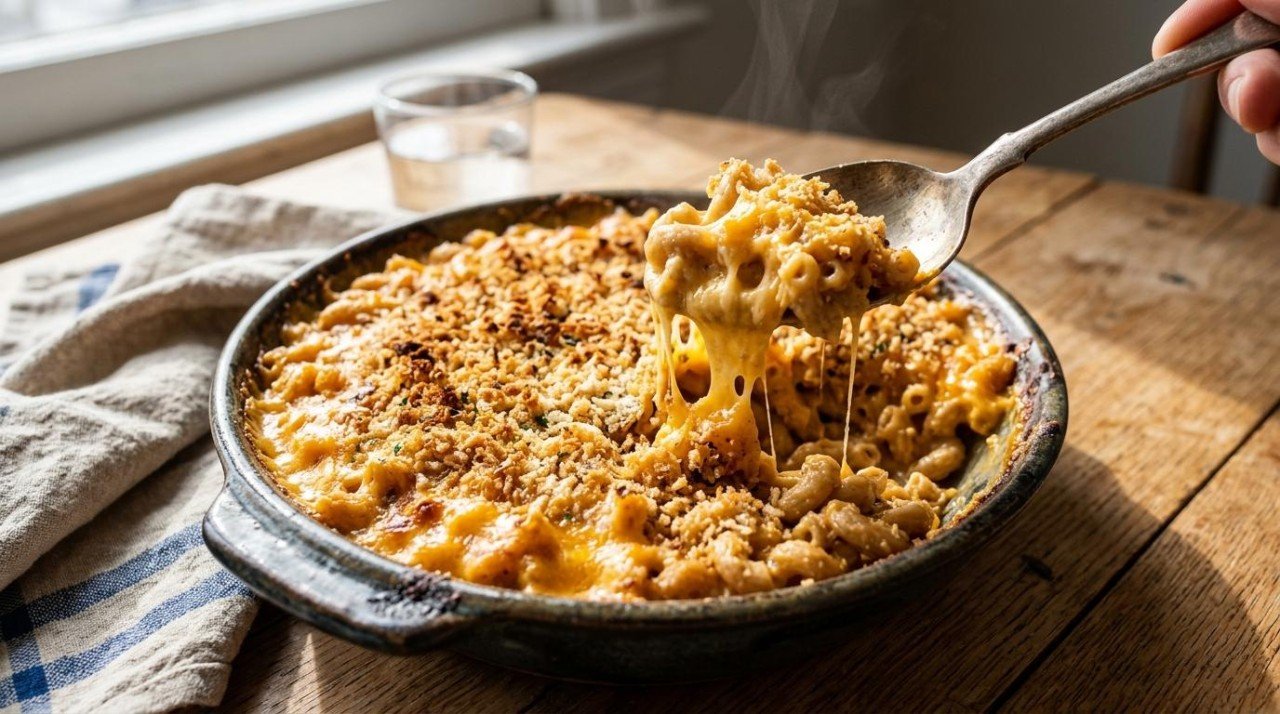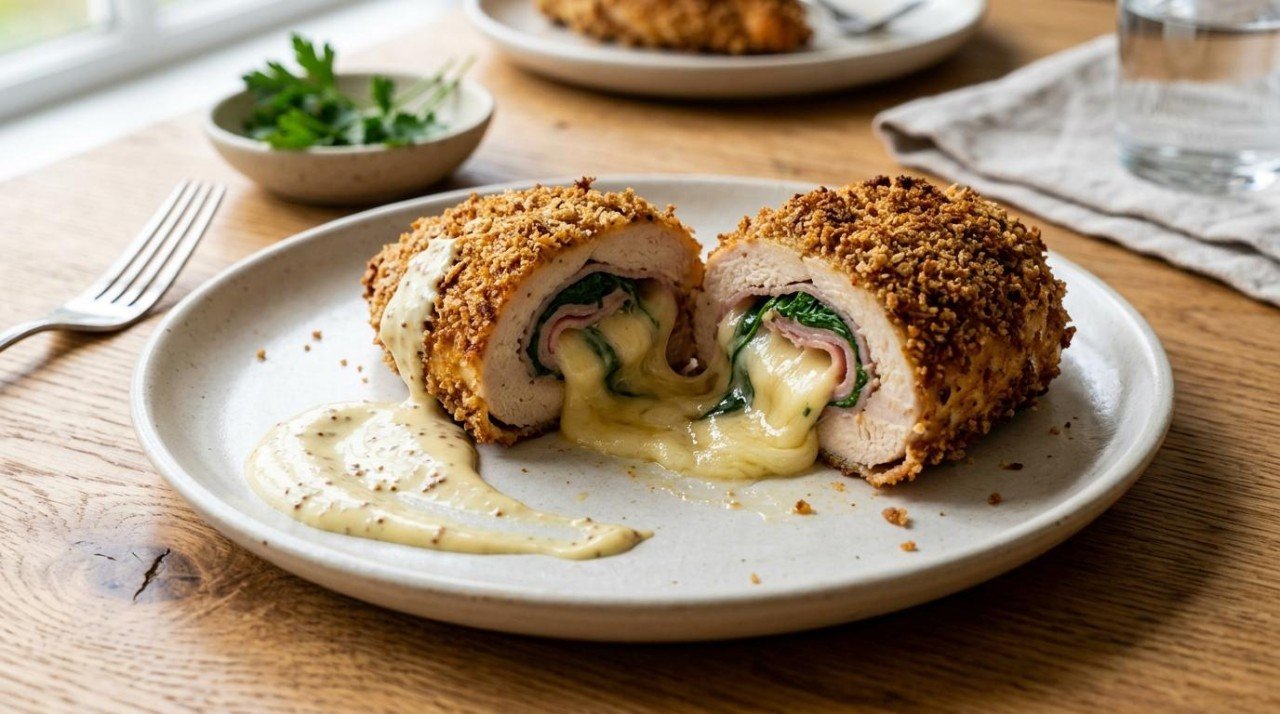
Chicken cordon bleu is one of those dishes that feels fancier than it is. A chicken breast pounded thin, wrapped around ham and Swiss, breaded, fried until the crust crackles, and — in most versions — finished with a cream sauce. Cut into it and the cheese runs out. That moment is the point of the dish, and nothing here is going to take it away from you.
We scored a standard version in Eat Well Planner and it came back at 37 out of 100. Not a disaster, but the numbers behind it are worth looking at: 949 calories a serving, 29.4 g of saturated fat, and 1,250 mg of sodium — in one piece of chicken.
Then we rebuilt it one swap at a time, scoring every change against production nutrition data. The finished version scores 61, and it still has ham, real Swiss and a crunchy crust. Here is every swap, what it was worth, and what it costs you — including the one we tested and threw out, and the one that made things worse.
The original: what is in it and how it scores
The version we scored is the one you find on most recipe sites, built for four:
- 1 1/2 lb (680 g) boneless, skinless chicken breasts, pounded thin
- 4 oz (120 g) deli ham, about 8 thin slices
- 6 oz (168 g) Swiss cheese, about 8 slices
- A standard breading station: 1/3 cup flour, 2 eggs, 1 cup dry white bread crumbs
- Butter and oil in the skillet — we counted 2 tablespoons of butter and 4 teaspoons of oil as actually absorbed by the crust, not the full amount that goes into the pan
- A cream sauce: 1 cup heavy cream, 2 tablespoons butter, 2 teaspoons Dijon, 1/4 cup Parmesan
- 3/4 teaspoon (4 g) salt across the dish
Score: 37/100. Per serving: 949 calories, 66 g protein, 1.6 g fiber, 29.4 g saturated fat, 1,250 mg sodium, 380 mg cholesterol.
The diagnosis. The biggest problem is saturated fat: 29.4 g per serving is 125% of the FDA Daily Value of 20 g (see the FDA's Daily Value reference) — a whole day's worth in one dinner. And most of it is not the cheese: the cup of heavy cream contributes about 12 g per serving on its own, more than the Swiss does, poured over a filling that was already rich.
Second: sodium. At 1,250 mg, one serving is 54% of the 2,300 mg daily limit, and the FDA notes that Americans already average about 3,400 mg a day. Deli ham is a concentrated source, roughly 890 mg per 100 g on its own.
Third: there is nothing in this dish but animal protein, refined flour and fat. Fiber comes in at 1.6 g, and plant diversity is zero — not a single plant food in the whole recipe, which drags the gut health dimension down to 22/100.
What is already fine, because we are not manufacturing problems: the protein is excellent (66 g per serving, 81% of the Daily Value), and the B vitamins and phosphorus are genuinely strong. The chicken breast at the center is one of the leanest proteins in the kitchen. The bones of this dish are good — it is the wrapping that needs work.
So the target is clear: cut the saturated fat, get some plants in there, and chip away at the sodium without gutting what the dish is.
The upgrades, in the order we applied them
Each score below is the real number the app returned after that swap was applied on top of the previous ones. The deltas add up to the full 24-point move.
1. Roll spinach in with the cheese
- Swap: Add 5 oz (150 g) fresh spinach, wilted and squeezed dry, inside the roll
- Score impact: +6 points (37 to 43)
- What it changes: Takes the recipe from zero plant foods to one, adds fiber, and puts Vitamin K at the top of the strengths list
- What it costs you: Nothing, if you squeeze it properly
The biggest single win in the rebuild, and it is an addition, not a subtraction. The gut health and longevity dimensions both weight plant diversity heavily, and going from zero plants to one is the steepest part of that curve. It does something for the dish too: a thin dark green layer between the ham and the cheese cuts the richness and makes each slice look like it came out of a restaurant kitchen. The one rule is to wilt the spinach and squeeze it genuinely dry first, or you get steam inside the roll that pushes the cheese out.
2. Trade the cream sauce for a Dijon-yogurt sauce
- Swap: 1 cup heavy cream + 2 tbsp butter → 200 g nonfat Greek yogurt, more Dijon, lemon, garlic and parsley (the Parmesan stays)
- Score impact: +5 points (43 to 48)
- What it changes: Cuts saturated fat from 29.4 g to 14.1 g per serving and calories from 959 to 737, while adding about 4 g of protein
- What it costs you: This is a genuinely different sauce — bright and tangy instead of silky and rich. It is the biggest flavor change in the post.
A Greek yogurt sauce is not heavy cream in disguise, and anyone who says otherwise is selling something. What makes it work here is that the thing it goes on is already rich: melted Swiss, ham and a crisp crust do not need more fat poured over them, they need acid and sharpness. Dijon, lemon and garlic do that job, and the Parmesan keeps the savory depth the cream sauce was carrying.
One technique note: do not simmer it. Yogurt's proteins are already fragile from the lactic acid in it, and they clump and form lumps when exposed to heat — the fat in cream is exactly what keeps cream sauces from doing the same. Serve it at room temperature; if you want it warm, whisk in a teaspoon of cornstarch first and take it no further than barely steaming. If you would rather rebuild a lighter cream sauce instead, our heavy cream substitutes guide covers what holds up to heat, and the Greek yogurt substitutes guide covers the reverse problem.
3. Bake it instead of pan-frying it
- Swap: Butter and oil in a skillet → toasted crumbs and a 400°F oven
- Score impact: +3 points (48 to 51)
- What it changes: Drops 74 calories and 3.4 g of saturated fat per serving
- What it costs you: A small amount of crust. Done right, less than you would expect.
Baked breaded chicken usually disappoints because a short bake never gives raw crumbs enough time or fat to brown, so you get a pale, splotchy shell. The fix is to brown the crumbs before they ever touch the chicken: toss the panko with a teaspoon or two of oil in a skillet over medium heat and stir until properly golden, about 4 to 5 minutes. RecipeTin Eats calls this the path to truly golden, truly crunchy baked breaded chicken, and it is. The oven then only has to cook the chicken. Bake on a wire rack set inside a sheet pan, or the bottom of the roll steams in its own juices.
4. Whole wheat crumbs instead of white
- Swap: 1 cup dry white bread crumbs → the same weight of whole wheat panko or whole wheat crumbs
- Score impact: +3 points (51 to 54)
- What it changes: Fiber per serving goes from 2.4 g to 3.6 g, and it drops about 70 mg of sodium
- What it costs you: A nuttier, slightly darker crust. Most people read it as more flavorful.
Refined crumbs are the invisible half of this recipe — you never think about them, and they contribute nothing but starch. Whole wheat crumbs weigh the same, coat the same, toast the same, and carry roughly twice the fiber. The 2019 Lancet review of 185 observational studies and 58 trials found 15 to 30% lower all-cause and cardiovascular mortality among the highest fiber consumers versus the lowest, with benefits concentrated around 25 to 29 g a day; Americans average about 15 g. Nobody hits that through a cordon bleu, but the crumbs are free real estate. If you cannot find whole wheat panko, our bread crumb substitutes guide covers coating specifically.
5. Slightly less Swiss
- Swap: 6 oz (168 g) Swiss → 4 oz (120 g), sliced thin
- Score impact: +4 points (54 to 58)
- What it changes: Saturated fat from 10.6 g to 8.4 g per serving, and 48 fewer calories
- What it costs you: Real, but manageable — roughly 1 oz of cheese per person instead of 1 1/2 oz
We did not swap the cheese. Reduced-fat Swiss and part-skim substitutes melt differently and taste like a compromise, and the melt is why anyone makes this dish. We used less of the real thing, cut thinner so it still covers the full surface: thin slices give you cheese in every bite, where a thick block gives you a molten core and two dry ends. If you want the flavor back, buy a more aggressively aged Swiss or a Gruyère — stronger cheese means the smaller amount reads as more.
6. Less ham, and make it a low-sodium one
- Swap: 4 oz (120 g) regular deli ham → 3 oz (80 g) low-sodium deli ham
- Score impact: +3 points (58 to 61)
- What it changes: Cuts 140 mg of sodium per serving, from 1,150 mg to 1,010 mg
- What it costs you: Less ham flavor, and low-sodium ham is milder. The Dijon in the sauce covers the gap.
Ham is the flavor signature of cordon bleu, so we kept it — one good slice per breast instead of two. Beyond sodium, there is a reason not to make cured meat the bulk of a dish: the WHO classifies processed meat as a Group 1 carcinogen, with roughly an 18% higher colorectal cancer risk per 50 g eaten daily. That is about daily habits, not a Saturday dinner, but a thinner slice keeps the flavor and shrinks the exposure. If your store has no low-sodium version, our deli ham substitutes guide covers what works in a melt.
Take the Guesswork Out of Eating Well
Eat Well Planner helps you organize your favorite recipes, plan balanced meals, and automatically generate shopping lists — all in one place. Whether you're tracking macros, managing dietary restrictions, or just trying to stop asking "what's for dinner?", we've got you covered.
Our AI-powered tools can adapt any recipe to your dietary needs, help you discover new meals you'll love, and even log your nutrition effortlessly. It's meal planning made simple.
Start Organizing Your Meals — FreeSwaps we tested and skipped
Deli turkey instead of ham. Every lighter cordon bleu recipe reaches for this one, and the numbers do not support it. Swapping the ham for the same weight of sliced deli turkey moved the score by 1 point and sodium by 30 mg per serving — deli turkey is cured lunch meat too, around 810 mg of sodium per 100 g against ham's 890. Using less ham was worth three times as much as changing the animal, and it keeps the dish tasting like cordon bleu.
Dropping the breading altogether. We tested a naked, unbreaded version of the finished recipe expecting it to score higher. It scored 48 — thirteen points below the breaded one. Once the crumbs are whole wheat they carry most of the fiber in the recipe: fiber falls from 3.6 g to 0.9 g per serving without them, and the score punishes that harder than it rewards the 190 calories saved. A crust is not automatically the villain.
What we kept, on purpose
Real Swiss cheese. Real ham. A real breaded crust with real oil in it. Two whole eggs in the breading station. Enough salt in the crumbs to taste like something.
And here is where we stopped: at 61 points the remaining ceiling is sodium, still 1,010 mg per serving, or 44% of a day's limit. Getting meaningfully below that means removing the ham or the Parmesan, and at that point you are cooking stuffed chicken breast, not cordon bleu. Better to pair it with something unsalted — plain roasted vegetables, a plain grain — than to squeeze it out of the recipe itself.
The healthier version: full recipe
Nutrition Score: 61/100 (up from 37). Serves 4.
For the chicken
- 1 1/2 lb (680 g) boneless, skinless chicken breasts (4 breasts), butterflied and pounded to 1/4 inch
- 5 oz (150 g) fresh spinach
- 3 oz (80 g) low-sodium deli ham, thinly sliced (4 slices)
- 4 oz (120 g) Swiss cheese, sliced thin
- 1/3 cup (40 g) all-purpose flour
- 2 large eggs, beaten
- 1 3/4 cups (108 g) whole wheat panko, or 1 cup whole wheat bread crumbs
- 1 1/2 teaspoons (7 g) canola or olive oil
- 3/4 teaspoon (4 g) fine salt, divided
- Black pepper
For the Dijon-yogurt sauce
- Generous 3/4 cup (200 g) plain nonfat Greek yogurt
- 4 teaspoons (20 g) Dijon mustard
- 1 tablespoon (15 g) lemon juice
- 2 large cloves garlic (9 g), grated
- 1/4 cup (20 g) finely grated Parmesan
- 2 tablespoons (8 g) chopped fresh parsley
- Heat the oven to 400°F. Set a wire rack inside a rimmed baking sheet.
- Wilt the spinach in a dry skillet over medium heat, 2 to 3 minutes. Tip it into a colander, cool briefly, then squeeze it very dry in a clean kitchen towel and chop roughly. This step is not optional — wet spinach makes a soggy roll.
- In the same skillet, warm the oil over medium heat, add the panko and 1/4 teaspoon of the salt, and stir constantly until the crumbs are evenly golden, 4 to 5 minutes. Tip onto a plate to cool.
- Butterfly each chicken breast and pound it between sheets of plastic wrap to an even 1/4 inch. Season both sides with the remaining salt and plenty of black pepper.
- Lay one slice of ham on each breast, then a quarter of the spinach, then a quarter of the cheese, keeping everything 1/2 inch clear of the edges. Roll up from a short side, tucking the sides in as you go, and secure with two toothpicks.
- Set out three shallow dishes: flour, beaten egg, toasted panko. Roll each bundle in flour, shake off the excess, dip in egg, then press firmly into the panko all over.
- Arrange seam side down on the rack and bake 22 to 27 minutes, until the crust is deep golden and the center of the chicken reads 165°F on an instant-read thermometer.
- While it bakes, stir all the sauce ingredients together. Taste and adjust with lemon or pepper. Keep it at room temperature and do not heat it.
- Rest the chicken 5 minutes, pull the toothpicks, slice each roll on a slight angle, and spoon the sauce alongside.
Per serving, original vs. improved:
- Nutrition Score: 37 → 61
- Calories: 949 → 610
- Protein: 66 g → 67 g
- Saturated fat: 29.4 g → 8.6 g (125% → 36% of the Daily Value)
- Sodium: 1,250 mg → 1,010 mg (54% → 44% of the Daily Value)
- Fiber: 1.6 g → 3.6 g
- Cholesterol: 380 mg → 270 mg
- Plant points: 0 → 2.5
Make it fit other diets
Gluten-free: a cup-for-cup gluten-free blend for the flour and gluten-free panko for the crumbs, toasted the same way but watched closely, because it browns faster. Pork-free: skip the ham entirely and double the spinach with smoked paprika in the crumbs, rather than reaching for deli turkey, which buys almost nothing. Dairy-free is the one this dish resists, since both the melt and the sauce depend on it. In the app, Recipe Variations rewrites a saved recipe for a given diet in one step and you can score the result before you cook it.
Do this to any recipe you love
Nothing here required guessing. Every number came from importing the recipe, reading its Nutrition Score, and testing swaps in the Recipe Playground until the score moved — including the two that did not work.
That is what Make It Healthier does in Eat Well Planner. Import a recipe from any URL, an Instagram reel or a YouTube video, and the app proposes ingredient swaps with the nutritional gain verified by a calculator before you ever see the suggestion. Apply them as a new variation and the original stays untouched. The recipe you love stays on the menu — it just gets better numbers.