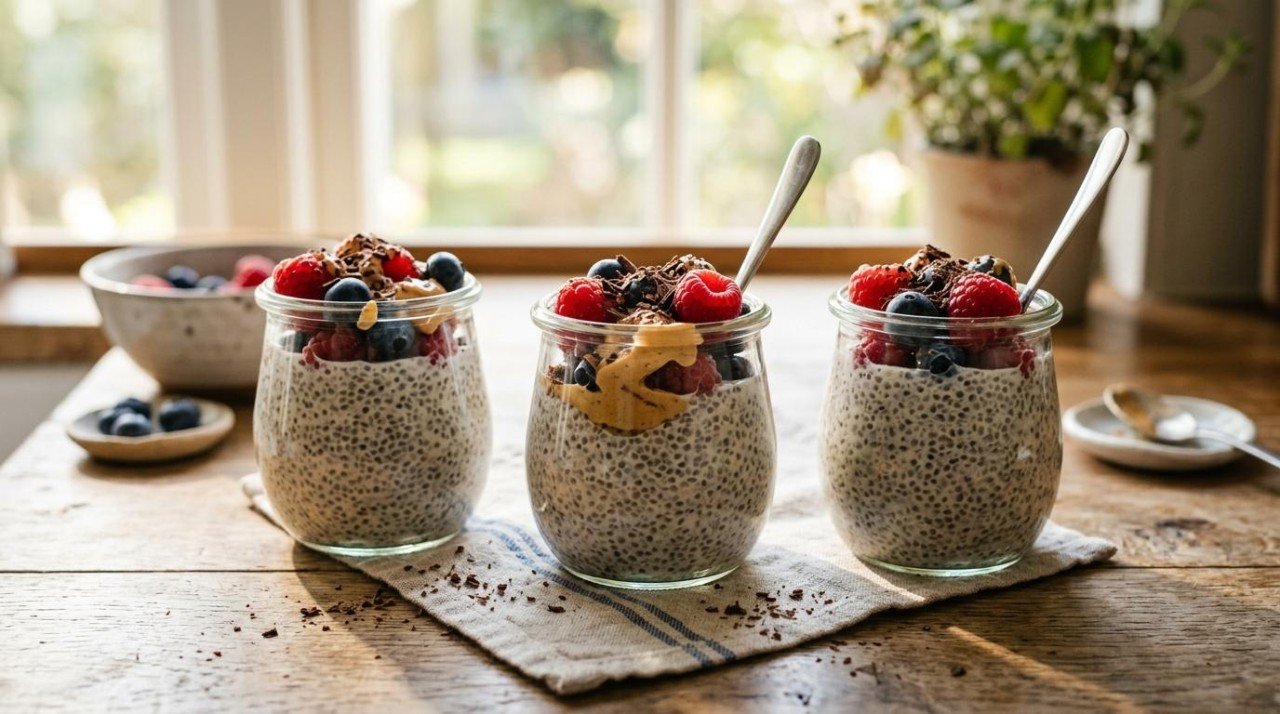
Chia pudding is one of the few breakfast trends that deserves its reputation. You stir a few spoonfuls of tiny seeds into milk, leave the jar in the fridge overnight, and wake up to something thick, spoonable and genuinely good for you. Two tablespoons of chia carry about 11 g of fiber, 4 g of protein and 18% of a day's calcium. No other plant food gives you more omega-3.
So we expected the classic version to score well when we built it in Eat Well Planner and ran it through the app's Nutrition Score. That's the coconut milk version, sweetened with maple syrup and loaded with the toppings it usually gets online. It came back at 40 out of 100, with two caution flags. The surprise is that the chia isn't why. Chia seeds stirred into unsweetened soy milk with a splash of vanilla, and nothing else, score 84. The other 44 points go to what's in the jar around the seeds.
We rebuilt it one verified swap at a time and got it to 96. It's still a creamy, sweet, chocolate-and-berry jar you look forward to. It has 320 fewer calories, and saturated fat drops from about 30 g to about 3 g. Here's every swap and what it was worth.
The original: what's in it and how it scores
The standard coconut chia pudding is close to a one-line recipe. Kath Eats' version is typical: a full can of full-fat coconut milk, 6 tablespoons of chia seeds, 2 tablespoons of maple syrup, vanilla and a pinch of salt, serving two to three. We scored it as three jars. Then we added what the jar usually gets before it's photographed: a tablespoon of honey drizzled over the three, 1/4 cup of granola, a tablespoon of peanut butter and a tablespoon of semisweet chocolate chips per jar.
Nutrition Score: 40/100. Per jar, that's about 691 calories, 13.2 g protein, 14.5 g fiber, 29.6 g saturated fat and 24.9 g added sugar. Both of those last two are flagged very high. Plant points: 2.
The credit comes first, because there's a lot of it. Even at 40, this jar is an excellent source of plant omega-3 (276% of a day), phosphorus, magnesium, iron and fiber. That's the chia doing its job, and nothing we change below touches it.
What holds it down
- The coconut milk. A third of a can per jar is about 25 g of saturated fat on its own. That's well past the FDA's 20 g Daily Value before you've added a single topping. Coconut fat is mostly saturated, and in controlled trials coconut oil raised LDL cholesterol compared with nontropical vegetable oils.
- Three sweeteners stacked on one another. There's maple syrup in the pudding, honey on top and sugar hidden in the granola and chocolate chips. Together they come to 24.9 g per jar. The American Heart Association's limit is 24 g of added sugar a day for women and 36 g for men. Honey and maple syrup count, however natural they sound.
- Less protein than you'd guess. Without the toppings, the coconut pudding has just 6.8 g of protein per jar. Chia sounds like a protein food, but two tablespoons carry about 4 g.
The toppings deserve a sentence of their own. The plain coconut pudding scores 41, and the loaded jar scores 40. They cost only one point, yet they add 273 calories per jar and triple the added sugar (8.1 g to 24.9 g). The score barely moves because the coconut milk already has it pinned. It's the same "just one point" trap you'll see in the upgrades below, and it runs the other way once the coconut is gone.
The upgrades
We applied these in order and re-scored after each one. Every number below is what that change was worth at that point in the build. The order matters a lot here: the topping swap was worth 4 points against the original and 41 points in the order below.
1. Unsweetened soy milk instead of canned coconut milk
- Swap: 1 can (400 g) full-fat coconut milk to 1 1/2 cups unsweetened soy milk
- Score impact: +10 points (40 to 50)
- What it changes: Saturated fat drops from 29.6 g to 4.7 g per jar and calories from 691 to 474, while protein rises slightly (13.2 g to 14.8 g)
- What it costs you: The coconut flavor and some richness. This is the one swap you'll taste on the first spoonful
Ten points sounds modest for removing 25 g of saturated fat. It's modest because the added-sugar flag is still lit, so the score has a second problem to grade. The receipt for this swap shows up at the end. When we put the canned coconut milk back into the finished 96-point jar, it fell to 59. That's a 37-point price for one ingredient.
Soy won, but only just. In the finished recipe, unsweetened almond milk scored 95 and skim milk 94, against soy's 96. Use whichever of the three you already buy. Soy gives the most protein, while almond is the lightest and has the most neutral taste. We compared them all in Oat, Almond, Soy, or Dairy, and our coconut milk substitutes guide covers the cases where you need the richness, like curries and desserts.
2. A mashed banana instead of maple syrup and honey
- Swap: 2 tablespoons maple syrup plus the honey drizzle to 1 medium ripe banana, mashed into the pudding
- Score impact: +4 points (50 to 54)
- What it changes: Added sugar drops from 24.9 g to 11.1 g per jar, and you gain a plant point and some potassium
- What it costs you: A gentle banana flavor running through the pudding. Most people like it, and berries cover the rest
The score counts a mashed banana's sugar as part of the fruit, not as added sugar, which is why this swap scores well. To be fair, the jar's total sugar doesn't fall as much as the added sugar does. What you gain is fiber, potassium and a lower added-sugar figure. Medjool dates did nearly as well. So did using no sweetener at all, which scored 94 in the finished jar against the banana's 96. If your palate is ready for an unsweetened jar, it works.
Only 4 points, because the toppings are still carrying 11 g of added sugar. Putting just one tablespoon of maple syrup back into the finished recipe (a teaspoon per jar) drops it from 96 to 88 and turns the added-sugar flag back on. For other ways to sweeten, see our maple syrup and honey substitute guides.
3. Berries and dark chocolate instead of granola and chips
- Swap: 3/4 cup granola and 3 tablespoons semisweet chips (across three jars) to 1 cup raspberries, 1 cup blueberries and 1/2 oz dark chocolate (70-85%), shaved
- Score impact: +41 points (54 to 95)
- What it changes: Added sugar drops to 2.0 g per jar and both caution flags clear. Fiber goes from 12.2 g to 14.0 g and plant points from 3 to 5
- What it costs you: The crunch. Granola is the only crunchy thing in the jar, and berries don't replace that. The dark chocolate is more bitter than chips, but a little goes a long way
This is where it all happens. The two toppings were the last source of added sugar, and the soy milk had already dealt with the saturated fat. Taking them off left nothing for the score to flag. Each half helps on its own: berries for granola scored 86, and dark chocolate for chips scored 73. Both together scored 95.
Now the order effect. We made this exact topping swap on the original coconut milk jar too, and it scored 44. That's four points, for the same berries and the same chocolate. With the coconut milk still in, the score had no room to reward it. If you try the topping swap first and wonder why the number hardly moved, that's the reason. Putting the granola back on the finished jar costs 8 points (96 to 88). If you can't live without crunch, use a tablespoon rather than a quarter cup. If you make your own, our healthier granola has much less sugar.
4. Measure the peanut butter
- Swap: 1 tablespoon of peanut butter per jar to 1/2 tablespoon, swirled
- Score impact: +0 points (95 to 95)
- What it changes: Saves about 48 calories per jar, and protein dips from 13.2 g to 11.5 g
- What it costs you: Half the peanut butter, though a swirl across the top tastes like more than it is
We're including a zero because it's useful to know. The score doesn't penalize peanut butter, and it isn't a problem ingredient. This step is purely about calories, and a heaping spoonful from the jar is easily two tablespoons. If you'd rather keep the full tablespoon, that's fine. It scored 94 in the finished recipe. Almond butter scored the same as peanut butter.
5. Stir in Greek yogurt for protein
- Swap: Add 3/4 cup plain nonfat Greek yogurt to the pudding base
- Score impact: +1 point (95 to 96)
- What it changes: Protein goes from 11.5 g to 17.3 g per jar, with B12 and calcium added
- What it costs you: A slight tang, which the banana covers. It also makes the pudding thicker and silkier, which most people prefer
One point is all the score gives it, but this is the swap that addresses the protein gap. Without it, the finished jar has 11.5 g of protein. With it, the jar has 17.3 g, which is more than the 13.2 g in the original loaded jar, and on about half the calories. If you're making this to stay full until lunch, don't skip this step. Our Greek yogurt substitutes guide covers alternatives, including plant-based ones.
What we kept (on purpose)
The chia, at full strength. Six tablespoons across three jars works out to two tablespoons each, the same serving Harvard's figures are based on. We didn't cut it to save calories, because it's the reason to eat this at all. Chia seeds absorb up to 10 times their weight in liquid and turn into the gel that gives the pudding its texture. Harvard says the slower digestion may help you feel full, but that evidence is early. Controlled human trials haven't yet shown a heart benefit from chia on its own.
The chocolate. A small amount of real dark chocolate costs nothing on the score and is what makes this feel like a treat. The peanut butter, measured but still there. Sweetness, from the banana.
We stopped at 96. The only things left to change were the ones that make it worth eating.
Take the Guesswork Out of Eating Well
Eat Well Planner helps you organize your favorite recipes, plan balanced meals, and automatically generate shopping lists — all in one place. Whether you're tracking macros, managing dietary restrictions, or just trying to stop asking "what's for dinner?", we've got you covered.
Our AI-powered tools can adapt any recipe to your dietary needs, help you discover new meals you'll love, and even log your nutrition effortlessly. It's meal planning made simple.
Start Organizing Your Meals — FreeThe healthier version: full recipe
Nutrition Score: 96/100 (up from 40). No caution flags and no flagged weaknesses. It's an excellent source of plant omega-3 (273% of a day), phosphorus, fiber, magnesium, iron, vitamin B12 and calcium.
Makes 3 jars. Prep 10 minutes, plus at least 2 hours to set.
Ingredients
For the pudding:
- 1 medium ripe banana (about 4 oz)
- 1 1/2 cups unsweetened soy milk (or unsweetened almond or skim milk)
- 3/4 cup plain nonfat Greek yogurt
- 1 teaspoon vanilla extract
- 6 tablespoons chia seeds
For the toppings:
- 1 cup raspberries
- 1 cup blueberries
- 1 1/2 tablespoons peanut butter
- 1/2 oz dark chocolate (70-85%), shaved or finely chopped
Instructions
- Mash the banana in a mixing bowl until it is as smooth as you can get it. A few small lumps are fine. For a completely smooth pudding, blend the banana with the milk instead.
- Whisk in the soy milk, Greek yogurt and vanilla until smooth.
- Whisk in the chia seeds. Let the mixture stand for 10 minutes, then whisk again to break up any clumps of seeds. This second stir is what keeps the pudding from setting in clumps.
- Divide among three jars, cover and refrigerate for at least 2 hours, or overnight for the thickest set. If it's thicker than you like, loosen it with a splash of milk.
- To serve, top each jar with about 1/3 cup each of raspberries and blueberries, swirl 1/2 tablespoon of peanut butter over the top and finish with a few shavings of dark chocolate. Add the toppings just before eating so the berries stay fresh and the chocolate doesn't soften.
Per jar: original vs. healthier
- Nutrition Score: 40 to 96
- Calories: 691 to 371
- Saturated fat: 29.6 g to 3.2 g
- Added sugar: 24.9 g to 1.6 g
- Protein: 13.2 g to 17.3 g
- Fiber: 14.5 g to 13.6 g
- Plant points: 2 to 5
Fiber stays about the same, and that's expected. The chia supplies most of it in both versions, and the coconut milk and granola we removed carried a couple of grams themselves. This makeover isn't about adding fiber. It's about cutting the saturated fat and sugar that had built up around a high-fiber food.
Swaps we tested and skipped
- Light canned coconut milk: 85. If you love the coconut flavor, this is the compromise to try, and it's better than we expected. The light coconut milk in our nutrition database is leaner than many canned light versions, so treat 85 as the best case. A few drops of coconut extract give you the flavor with none of the fat.
- Half coconut milk, half soy: 67. Even a third of a can brings the saturated fat flag back.
- A sprinkle of unsweetened coconut flakes: 86. Just 15 g across three jars, and it's enough to cost 10 points. Coconut costs a lot of points in any form.
- Cacao nibs instead of dark chocolate: 88. We tried these first because they have no sugar. The 8-point drop comes from a quirk in our nutrition database, not the nibs themselves: their entry carries a trace of fish-type omega-3, which the score then rates as too low. If you like nibs, use them.
- Dates instead of banana: 94. They're a good choice, just slightly behind the banana here, and they give a caramel flavor if you prefer that.
Make it fit other diets
Vegan or dairy-free: Swap the Greek yogurt for an unsweetened soy yogurt and the rest of the recipe already works. Check the label, because a sweetened plant yogurt puts back much of the sugar this makeover took out. Nut-free: Use sunflower seed butter instead of peanut butter, and soy milk rather than almond. If you want a version that fits your diet without working out the swaps yourself, Eat Well Planner's Recipe Variations can rewrite this exact recipe in one step.
Do this to any recipe
Chia pudding shows how a genuinely healthy ingredient can end up in a jar that scores 40. A seed that scores 84 on its own got lost under coconut milk, maple syrup, honey and toppings, and each one seemed reasonable when it went in. You couldn't see any of that from the recipe. It only showed up once the recipe was scored.
That's what Eat Well Planner is built to show you. Import a recipe from any website, Instagram reel or YouTube video, and it gets a Nutrition Score. Make It Healthier then suggests swaps like the ones above, each one checked by a calculator before you see it. To see whether one ingredient matters as much as you think, the Recipe Playground re-scores the recipe live as you change it. That's how we found the coconut milk was worth 37 points and the peanut butter was worth almost nothing. The overnight oats and yogurt parfait makeovers are good next reads if you want to see the same approach on other breakfasts.