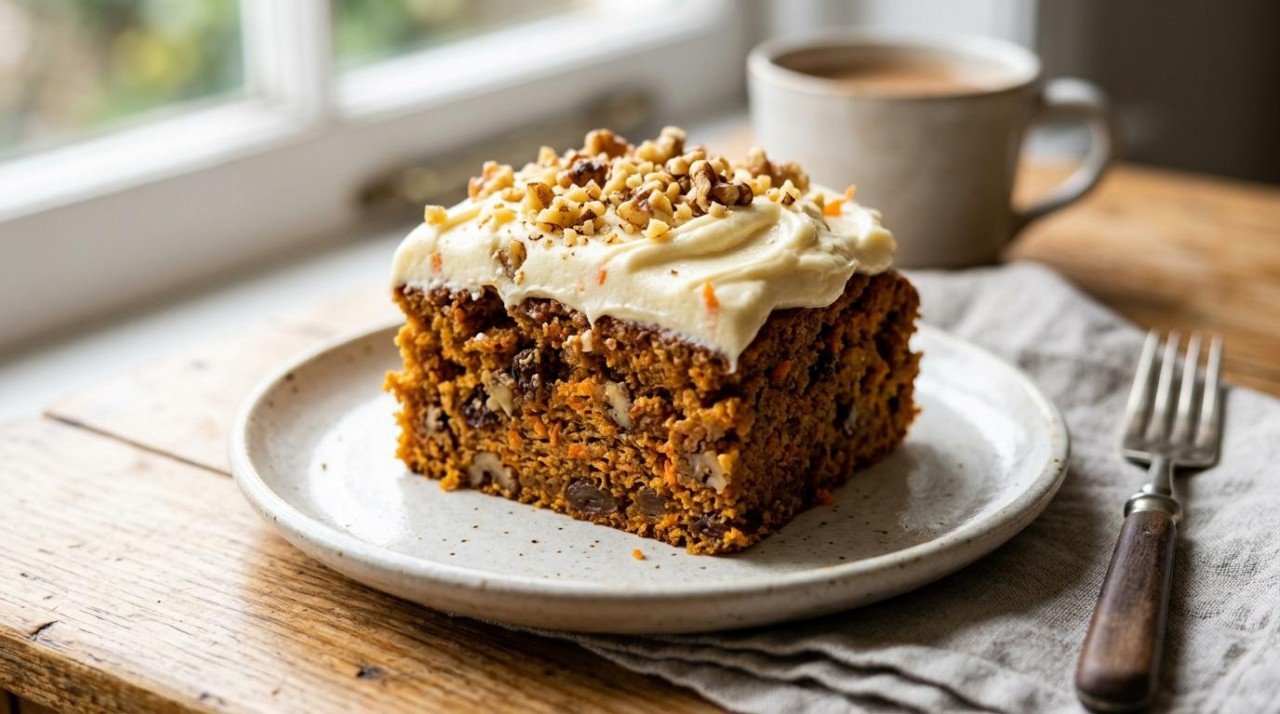
Carrot cake is the dessert people order when they are being good. It has a vegetable in the name. It usually has nuts and raisins in it. It arrives looking rustic and beige and vaguely wholesome, next to a chocolate cake that is not pretending to be anything.
That reputation is not an accident. Carrot cake descends from medieval carrot puddings, when sugar was expensive and cooks used carrots as a sweetener, and it came back into British kitchens during Second World War rationing. But the version Americans eat now is a 1970s creation, and it went mainstream partly because people believed the carrots, raisins and nuts made it a healthier dessert than the alternatives.
So we built a standard American carrot cake in Eat Well Planner and ran it through the app's Nutrition Score. It came back at 18 out of 100 - the lowest opening score we have recorded in this series. Then we rebuilt it one verified swap at a time and got it to 44. This post is the receipt for all 26 points, and also for the most useful thing we learned: the carrot was never the problem, and adding more of it barely helped.
The original: what's in it and how it scores
There is no single canonical carrot cake, so we scored the version that shows up over and over: 2 cups (240 g) all-purpose flour, 2 cups (400 g) granulated sugar, 1 1/2 cups (300 g) vegetable oil, 4 eggs, 2 teaspoons baking soda, 2 teaspoons cinnamon, 1 teaspoon salt, 3 cups (330 g) grated carrot and 1 cup (120 g) walnuts, baked in a 9x13. On top, the standard cream cheese frosting: 8 oz cream cheese, 1/2 cup (113 g) butter and 4 cups (480 g) powdered sugar. Cut into 12 squares. Every number below is one square.
Nutrition Score: 18/100. Per serving: 825 calories, 7.6 g protein, 2.0 g fiber, 12.5 g saturated fat, about 580 mg sodium, and the number that sinks the whole thing - 73.2 g of added sugar, which the app flags as very high at 277% of a day's reference. The American Heart Association's limit is 24 g of added sugar a day for women and 36 g for men. One square of carrot cake is three days' worth for a woman.
Here is the part worth sitting with. Of those 73 g, 40 g come from the frosting and 33 g from the cake. The frosting on a carrot cake contains more added sugar than the cake it is sitting on. Four cups of powdered sugar is not a garnish; it is the largest single ingredient in the recipe by weight, larger than the flour, larger than the carrots.
The second flag was saturated fat at 53% of a day's reference, almost entirely the butter and cream cheese in that frosting. Sodium came in third at 25%, and we will come back to that one because the answer is not what you would guess.
Now the honest other side, because plenty here is genuinely fine. This is real food. The eggs, carrots, walnuts and cream cheese are all whole ingredients, and the cake is already an excellent source of omega-3 ALA (176% DV, from the walnuts), vitamin A (43%, from the carrots) and vitamin E. The carrots are doing exactly what carrots do. It is just that 880 g of sugar and 300 g of oil have outvoted them roughly 4 to 1 by weight.
The upgrades
We applied these in order and re-scored after each one, so every delta is what that swap was worth at that point in the build. The order below is the order we applied them. If you only make one change, make the third one - swapping most of the oil out was the single biggest mover at 8 points.
1. Rebuild the frosting around cream cheese instead of sugar
- Swap: 8 oz cream cheese + 1/2 cup butter + 4 cups powdered sugar → 8 oz cream cheese + 1/2 cup plain Greek yogurt + 2/3 cup powdered sugar, no butter
- Score impact: +5 points (18 to 23)
- What it changes: Added sugar from 73.2 g to 40.0 g per serving, calories from 825 to 631, saturated fat from 12.5 g to 8.2 g
- What it costs you: A thinner, softer, tangier frosting that has to stay in the fridge. It will not hold a piped rosette.
Cutting 83% of the powdered sugar sounds brutal until you taste it, and America's Test Kitchen makes the case better than we can: standard cream cheese frostings veer into sugar bomb territory, so overly sweet and cloying that the cream cheese tang is lost. Four cups of powdered sugar is not making the frosting taste like cream cheese. It is burying it. At two-thirds of a cup you can actually taste the cheese, which is the flavor the cake was pairing with in the first place.
Two technique notes, because this frosting is less forgiving than the original. Use a full-fat 8 oz brick, never the tub spread - that is the number one reason cream cheese frosting turns out runny, and low-fat versions go soupy. And beat the yogurt in last, on low, for about 30 seconds; cream cheese releases water the longer it is whipped. Chill the finished frosting 20 to 30 minutes before spreading. (Our cream cheese substitutes guide and Greek yogurt substitutes guide cover what to do if you are short on either.)
2. Cut the cake's sugar from 2 cups to 3/4 cup
- Swap: 2 cups granulated sugar → 3/4 cup packed dark brown sugar
- Score impact: +2 points (23 to 25)
- What it changes: Added sugar from 40.0 g to 18.8 g per serving, calories from 631 to 545
- What it costs you: Real sweetness and some tenderness. This is the swap with an actual price tag, and the pineapple in step 3 is what pays it.
Two points for removing more than half the remaining sugar is a terrible exchange rate, and it is worth explaining why rather than hiding it. At this stage the cake is still 1 1/2 cups of oil and 2 cups of white flour, so the score has plenty else to complain about. The sugar cuts in steps 1 and 2 together moved the needle only 7 points - but they took added sugar from 73.2 g to 18.8 g, a 74% reduction, and that is what makes every later swap worth what it is worth. You cannot see the fiber gain in step 4 through a sugar flag that large.
We went to dark brown rather than white because molasses carries flavor that plain sweetness does not, and it helps the crust brown when there is much less sugar available to do it. If you want to understand how much sugar is hiding in things generally, our post on the many names for added sugar is a useful next read. (Our white sugar substitutes guide covers swapping rather than cutting.)
3. Replace two-thirds of the oil with crushed pineapple
- Swap: 1 1/2 cups vegetable oil → scant 1/2 cup (100 g) oil + 1 cup (8 oz) drained canned crushed pineapple
- Score impact: +8 points (25 to 33) - the biggest single move in the makeover
- What it changes: Calories from 545 to 406, saturated fat from 8.2 g to 6.0 g, and adds a plant point
- What it costs you: Almost nothing. The crumb gets slightly softer and slightly more fragrant. Most people will not identify the pineapple.
This is not a diet hack bolted onto the recipe - crushed pineapple is already a classic carrot cake ingredient, and bakers use it precisely because it acts more like a wet ingredient than an add-in. Drain it well; you want it at the consistency of applesauce, not swimming. All we did was let it take over a job the oil was doing.
We stopped at two-thirds rather than going further, and the reason is structural. Fat contributes to tenderness because it prevents flour from absorbing water - take all of it out and the gluten develops fully and the cake turns tough. Illinois Extension's standard advice is to cut fat by a third and replace half of what remains; we pushed harder than that because between the pineapple and 4 1/2 cups of carrot this batter has moisture to spare. There is a second reason to keep real oil in there, and it is the one nobody expects: beta-carotene needs fat to be absorbed. In lab work, beta-carotene micellarization from carrots rose from 4.8% with no fat to 26.2% with fat added. A fat-free carrot cake would waste its own carrots. (Our vegetable oil substitutes guide covers the rest of the options.)
4. Swap all the flour for white whole wheat
- Swap: 2 cups all-purpose flour → 2 cups white whole wheat flour
- Score impact: +7 points (33 to 40)
- What it changes: Fiber from 2.3 g to 4.4 g per serving, plus another plant point
- What it costs you: Very little. A spiced, nut-studded, heavily fruited cake is the easiest place in baking to go 100% whole wheat.
Refining wheat strips away more than half of its B vitamins, 90% of the vitamin E, and virtually all of the fiber. That matters when Americans need 25 to 35 g of fiber a day and average about 15 g, and when a meta-analysis of more than 786,000 people linked whole grain intake to a 22% lower risk of total mortality.
Use white whole wheat rather than traditional red - it is the same whole grain milled from a paler wheat, and it disappears into a cake this assertive. Let the batter sit 15 minutes before it goes in the pan so the bran hydrates. If you want to get better at spotting real whole grain elsewhere, we wrote a whole guide on how to buy bread that is actually whole grain. (Our all-purpose flour substitutes guide covers the alternatives.)
5. Add more carrot and more walnuts - and watch almost nothing happen
- Swap: 3 cups (330 g) carrot → 4 1/2 cups (500 g); 1 cup (120 g) walnuts → 1 1/4 cups (150 g)
- Score impact: +1 point (40 to 41)
- What it changes: Fiber from 4.4 g to 4.9 g, vitamin A up, and the cake tastes noticeably more of carrot
- What it costs you: Nothing, which is sort of the point.
We increased the carrot by 52% and got one point. That is the whole thesis of this post in a single line. The vegetable in the name is not what is holding carrot cake back and never was - you cannot out-carrot a cup and a half of oil, and you certainly cannot out-carrot four cups of powdered sugar. Do it anyway: it costs nothing, it makes the cake taste more like itself, and grated carrot behaves as a wet ingredient too. Grate your own, because bagged pre-shredded carrots are noticeably drier.
6. Three tablespoons of ground flaxseed
- Swap: Add 3 tablespoons (25 g) ground flaxseed to the dry ingredients
- Score impact: +2 points (41 to 43)
- What it changes: Fiber from 4.9 g to 5.4 g, another plant point, and more omega-3
- What it costs you: Nothing detectable under this much cinnamon.
Among plant foods, ground flaxseed and flaxseed oil have the highest amounts of ALA, the plant-form omega-3 - and it has to be ground, because whole seeds pass straight through. It also absorbs some of the moisture that the pineapple added, which helps a batter this wet set properly.
7. Half a cup of raisins
- Swap: Add 1/2 cup (80 g) raisins
- Score impact: +1 point (43 to 44)
- What it changes: Fiber to 5.7 g, protein to 9.0 g, and the sixth plant point
- What it costs you: Nothing, unless you are on the anti-raisin side of a very old argument.
Worth one point, and worth including for a reason the score does not capture: raisins are dried fruit, so their sugar is not counted as added sugar, and they put back some of the pockets of sweetness that step 2 removed. They also carry the finished cake to 6.25 plant points, which counts toward the 30-different-plants-a-week target the app's Plant Points tracker is built around.
Take the Guesswork Out of Eating Well
Eat Well Planner helps you organize your favorite recipes, plan balanced meals, and automatically generate shopping lists — all in one place. Whether you're tracking macros, managing dietary restrictions, or just trying to stop asking "what's for dinner?", we've got you covered.
Our AI-powered tools can adapt any recipe to your dietary needs, help you discover new meals you'll love, and even log your nutrition effortlessly. It's meal planning made simple.
Start Organizing Your Meals — FreeWhat we kept, and where we stopped
The finished cake still contains real cream cheese, real oil, four eggs, brown sugar and powdered sugar. Those are not oversights. Here is what each one costs, measured:
- The frosting costs 3 points. Serving the cake bare scores 47 instead of 44. We are not doing that, because carrot cake without cream cheese frosting is carrot bread.
- The cream cheese costs 5 points. Building the topping from Greek yogurt alone scores 49 and clears the saturated fat flag entirely. It also stops being cream cheese frosting, so no.
- The 3/4 cup of brown sugar costs 5 points on its own - and if you also drop the frosting's powdered sugar to a third of a cup, the added sugar flag disappears completely and the score jumps to 56. That is 12 points sitting on the table.
- Everything at once - no batter sugar, minimal frosting sugar, yogurt instead of cream cheese - scores 71.
So the honest ceiling is 71, and we are publishing 44. A 71 is a spiced carrot loaf with sweetened yogurt on it. It is a genuinely nice thing to eat and it is not what anyone means when they say carrot cake. This series only counts a makeover as a success if the dish survives it, and 44 is where this one stops being a compromise and starts being a different dessert.
One more thing we could not fix: the sodium flag, at 24% of a day's reference. We tried halving the salt and it was worth exactly zero points, because the salt is not the problem. Two teaspoons of baking soda contribute about 2,740 mg of sodium to this cake - slightly more than the teaspoon of salt does. Cut the leavening and you get a dense, pale cake. That flag stays.
The healthier version: full recipe
Nutrition Score: 44/100. Serves 12.
For the cake:
- 2 cups (240 g) white whole wheat flour
- 3 tablespoons (25 g) ground flaxseed
- 2 teaspoons baking soda
- 2 teaspoons ground cinnamon
- 1 teaspoon salt
- 3/4 cup packed (150 g) dark brown sugar
- Scant 1/2 cup (100 g) vegetable oil
- 4 large eggs
- 2 teaspoons vanilla extract
- 1 cup (8 oz / 225 g drained) canned crushed pineapple in juice, drained well
- 4 1/2 cups (500 g) freshly grated carrot, about 8 medium carrots
- 1 1/4 cups (150 g) chopped walnuts
- 1/2 cup (80 g) raisins
For the frosting:
- 8 oz (226 g) full-fat block cream cheese, room temperature
- 2/3 cup (80 g) powdered sugar
- 1/2 cup (115 g) plain whole-milk Greek yogurt
- 1 teaspoon vanilla extract
- Heat the oven to 350F. Grease a 9x13 pan.
- Whisk the flour, ground flaxseed, baking soda, cinnamon, and salt together in a bowl.
- In a large bowl, whisk the brown sugar, oil, eggs, and vanilla until smooth, then stir in the drained pineapple.
- Add the dry ingredients to the wet and stir just until no dry flour remains.
- Fold in the grated carrot, walnuts, and raisins. The batter will look more like a vegetable mixture than a cake batter. That is correct.
- Let the batter rest 15 minutes so the bran and flaxseed hydrate, then scrape it into the pan and level the top.
- Bake 40 to 45 minutes, until a tester in the center comes out with no wet batter on it. Cool completely in the pan - frosting a warm cake melts it straight off.
- For the frosting, beat the cream cheese alone until smooth, then beat in the powdered sugar and vanilla. Add the Greek yogurt last and beat on low for about 30 seconds, just until combined; overbeating thins it out.
- Chill the frosting 20 to 30 minutes, then spread it over the cooled cake. Cut into 12 squares and keep the cake refrigerated.
Per serving, original vs. improved:
- Nutrition Score: 18 → 44
- Calories: 825 → 454
- Added sugar: 73.2 g → 18.8 g
- Saturated fat: 12.5 g → 6.3 g
- Fiber: 2.0 g → 5.7 g
- Protein: 7.6 g → 9.0 g
- Plant points: 2.25 → 6.25
The upgraded square is a good source of fiber, magnesium, zinc, potassium and protein, and an excellent source of omega-3 ALA (139% DV), vitamin A (48%), phosphorus and iron. It is still cake. Added sugar is still flagged. Nobody should eat this instead of lunch.
Swaps we tested and skipped
- Coconut oil for the vegetable oil: 42, two points worse. The swap that feels healthiest is the worst one here - it more than doubles saturated fat, from 6.3 g to 12.1 g per serving, and puts the very-high flag straight back on. It also works against the carrots, since unsaturated oils outperform saturated fat at getting carotenes into micelles.
- Almond flour instead of white whole wheat: 42, two points worse - and calories go up, from 454 to 503. Almond flour is a fine ingredient with a real purpose; making a cake healthier is not it.
- Cutting the frosting's powdered sugar from 2/3 cup to 1/3: zero points. Identical score, less pleasant frosting. Keep the sweetness.
- Reduced-fat (Neufchatel) cream cheese: 44, no change at all. Not worth hunting for at the store, and it makes the frosting looser.
- Leaving out the walnuts: also 44 - but fiber drops to 5.1 g, protein to 7.2 g, and you lose a plant point. The score is indifferent; we are not. Keep them.
- Applesauce instead of crushed pineapple: 44, exactly the same. Use whichever you have. Pineapple tastes better in this particular cake.
Make it fit other diets
For a gluten-free version, a cup-for-cup gluten-free blend works here better than most cakes because the carrot and pineapple carry the structure - expect a slightly more delicate crumb and cool it fully in the pan. For dairy-free, the frosting is the only thing to solve: a cultured cashew or coconut cream cheese plus a dairy-free thick yogurt gets close, though you will lose the specific tang. In the app, you do not have to work either of these out yourself - Recipe Variations rewrites the whole recipe with the substitutions already worked in, and the AI recipe chat will answer follow-ups with the full ingredient list in context.
Do this to your own recipes
Nothing in this post required us to guess. We built the original in Eat Well Planner, read its Nutrition Score, and used Make It Healthier to propose swaps - the app runs each one through a calculator and verifies the actual nutritional gain before it ever shows you the suggestion. The per-swap deltas came from the Recipe Playground, where you can change one ingredient at a time and watch the score move, which is exactly how we found out that more carrot was worth one point and coconut oil was worth minus two.
You can do the same thing to the carrot cake your grandmother wrote on an index card. Import it from a URL, an Instagram reel, a YouTube video or a photo, score it, and see what the app suggests. Then decide for yourself which points are worth taking and which ones you are happy to leave on the table - because now you know what each one actually costs.