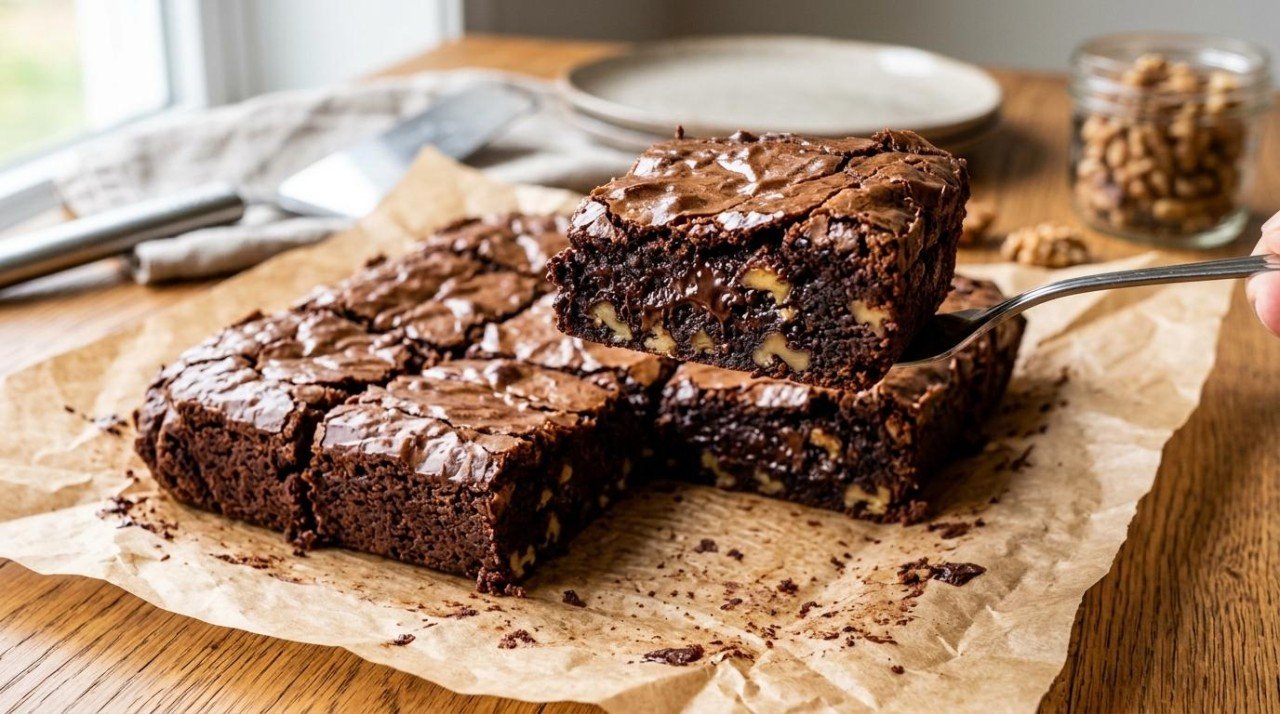
A fudgy brownie is a near-perfect thing: a shiny, crackly top that shatters into a dense, gooey middle, with enough chocolate to make the rest of the day easier. Nobody searches for a healthier brownie because they have fallen out of love with brownies. They search because they would like to eat this exact thing a little more often without it being a whole daily sugar budget in one square.
So we ran a classic homemade fudgy brownie through the app's Nutrition Score. It came back at 23 out of 100 — low, but honestly not as low as its reputation, and for reasons that turn out to be very fixable. We rebuilt it swap by swap, scoring each change against the same production nutrition data, and landed at 36: thirteen points higher, with more than double the fiber and roughly 40 percent less added sugar, still fudgy, still crackly on top.
And then one swap we fully expected to reject scored higher than everything else. More on that surprise below — first, the diagnosis.
The classic fudgy brownie: what is in it, and why it scores 23
The version we scored is the standard fudgy formula, the one most boxed mixes and beloved from-scratch recipes land on: about 1/2 cup of butter and 6 ounces of semisweet chocolate melted together, 1 1/2 cups of sugar (a mix of white and brown), three eggs, a little cocoa powder for depth, and 3/4 cup of all-purpose flour to just barely hold it together. Baked in an 8x8 pan and cut into 16, it scores 23 out of 100.
Here is what drags that number down, per brownie:
- Added sugar: 24.4 g. This is the whole story. The American Heart Association suggests a daily added-sugar ceiling of 25 g for women and 36 g for men. One of these brownies is a woman's entire day of added sugar, or two-thirds of a man's. That single line is 92 percent of the score's daily-value reference and the biggest reason it sits at 23.
- Saturated fat: 5.95 g (25 percent of a day's worth), almost all of it from the butter and the fat in the chocolate.
- Fiber: 1.4 g, and zero plant diversity. Refined flour and sugar bring nothing to your gut here.
Now the part most "healthy brownie" articles skip: what is already fine. At about 214 calories a brownie, the portion is not outrageous. The cocoa and chocolate make it a genuine source of iron (14 percent of a day's worth) and give it real, deep chocolate flavor from actual chocolate. This is not a junk concept — it is real food. The problem is narrow and specific: too much sugar, and flour that does nothing. Fix those two things and you have kept everything that makes a brownie a brownie.
The upgrades
We applied these in order, scoring cumulatively after each one, so the point values below are exactly what each change was worth at the moment we made it. They are ordered by impact and honesty: the first swap is the biggest mover and costs you nothing, so if you only make one change, make that one.
1. Swap the flour for white whole wheat (+5 points)
- Swap: All-purpose flour → white whole wheat flour, 1:1
- Score impact: +5 points (23 to 28), the single biggest move
- What it changes: Nearly four times the fiber, plus B vitamins and minerals
- What it costs you: Essentially nothing — you will not taste it
A brownie is the single best baked good to make this swap in. There is very little flour to begin with, and what there is sits under a flood of cocoa and melted chocolate, so the faint nuttiness of whole wheat simply disappears. White whole wheat flour is milled from a paler wheat, so it is even milder and lighter in color than regular whole wheat — you get the whole grain (close to four times the fiber of white flour) with no visible or noticeable difference in the pan. This is the highest-value, lowest-risk swap in baking, and it earns the biggest jump on the board. If you bake a lot, our guide to all-purpose flour substitutes covers when whole wheat works and when it does not.
2. Cut the sugar by a third (+3 points)
- Swap: 1 1/2 cups sugar → 1 cup total (about 300 g down to 200 g)
- Score impact: +3 points (28 to 31)
- What it changes: Drops added sugar from 24.4 g to 18.2 g per brownie
- What it costs you: A slightly less shiny top and a touch less gooey — barely noticeable
Classic brownies are sweeter than they need to be, and dark-chocolate-forward ones especially so. Pulling a third of the sugar still leaves them plenty sweet, and the chocolate flavor actually reads clearer without as much sugar competing with it. Sugar is not only sweetness in a brownie — it holds moisture and helps build that crackly top — so there is a floor here, which is exactly why we stopped at a third and not more. (We tested going further; see where that broke, below.) If you have absorbed the idea that sugar is simply poison, it is worth reading why the amount and the context matter more than the word itself.
3. Trade semisweet for 70% dark chocolate and more cocoa (+3 points)
- Swap: 6 oz semisweet chocolate → 4 oz 70% dark chocolate + an extra tablespoon of cocoa
- Score impact: +3 points (31 to 34)
- What it changes: Cuts added sugar again (to 14.2 g), more cocoa solids, more iron and magnesium
- What it costs you: A deeper, less sweet chocolate flavor — most brownie lovers call this an upgrade
Semisweet chocolate is roughly half sugar. Moving to 70% dark chocolate and letting a little extra cocoa powder do more of the lifting means more actual chocolate and less sugar riding along with it. You also get more cocoa solids, which carry the flavanols dark chocolate is known for. Be honest about the size of that benefit, though: the research on cocoa flavanols shows a reliable effect on blood-vessel function, but at doses far larger than a brownie delivers, and the blood-pressure evidence is mixed. This swap is worth making because it deepens the flavor and trims the sugar, not because a brownie is now heart medicine.
4. Add a handful of walnuts (+1 point, punching above its number)
- Swap: Add 1/2 cup chopped walnuts
- Score impact: +1 point (34 to 35)
- What it changes: Adds omega-3 (an "excellent source" chip appears), a plant point, and a little protein
- What it costs you: Nuts in brownies are polarizing — this one is genuinely optional
This is the swap where the score understates the nutrition. Walnuts move the number only one point, but they are the only tree nut that is an excellent source of plant-based omega-3 (ALA), at about 2.5 g per ounce, and adding them tips the brownie into an "excellent source of omega-3" on the highlights. They also add your first plant beyond the wheat — a point toward the 30 different plants a week that gut research keeps pointing to. If you are firmly team no-nuts, skip them; you lose one point and some omega-3, and the brownie is otherwise identical.
5. Swap half the butter for mild olive oil (+1 point)
- Swap: Replace half the butter with mild extra virgin olive oil (3 tablespoons)
- Score impact: +1 point (35 to 36)
- What it changes: Drops saturated fat from 26 to 20 percent of a day's worth
- What it costs you: Nothing, if you use a mild oil — keep the other half butter for flavor
Fudgy brownies do not need to be all butter; plenty of great ones are made entirely with oil. Replacing half the butter with a mild extra virgin olive oil swaps saturated fat for monounsaturated fat and, again, disappears into the chocolate — the one rule is to use a mild or "light-tasting" bottle, not a grassy, peppery finishing oil. We kept the other half as butter because butter is doing real flavor work here, and there was no reason to lose it. Our butter substitutes guide has the full ratios if you want to push the oil further.
Take the Guesswork Out of Eating Well
Eat Well Planner helps you organize your favorite recipes, plan balanced meals, and automatically generate shopping lists — all in one place. Whether you're tracking macros, managing dietary restrictions, or just trying to stop asking "what's for dinner?", we've got you covered.
Our AI-powered tools can adapt any recipe to your dietary needs, help you discover new meals you'll love, and even log your nutrition effortlessly. It's meal planning made simple.
Start Organizing Your Meals — FreeWhat we kept — and where we stopped
A makeover that guts the dish is a failed makeover, so it is worth naming what stayed on purpose: half the butter, a real cup of sugar, three whole eggs, and actual chocolate. Nothing was replaced with a diet-food stand-in, because the whole point is that this still tastes like the brownie you already love.
We also stopped short deliberately on the sugar. Cutting it by a third to 200 g was the sweet spot; when we tested cutting all the way down to about 3/4 cup, the score climbed two more points (to 38) but the brownies turned dry and cakey and lost their crackly top. That is not a fudgy brownie anymore, and two points is not worth trading away the thing you came for. The score is a guide, not a boss.
The swap that surprised us: avocado (36 to 43)
Here is the one we were ready to make fun of. The card for this post literally said to test an avocado version and reject it honestly if it tasted like a salad. So we swapped all of the butter for mashed ripe avocado, expecting a grassy green mess — and it came back at 43, the highest brownie score we have produced, with saturated fat cut to 2.6 g and its caution flag gone entirely.
It works for the same reason every other swap here works: the bake is so overwhelmingly chocolate that a mild ingredient just vanishes into it. Blended completely smooth and buried under dark chocolate and cocoa, ripe avocado is undetectable as anything but richness. The honest trade-off is texture — the brownies come out softer and denser, closer to a chocolate truffle than a chewy, crackly-topped brownie. That is the only reason it is not in our main recipe: it nudges the dessert past "classic fudgy brownie" and into something a little different.
But if you care more about the number than about the exact chew, do it: swap all of the butter (and skip the olive oil) for about 1/2 cup of mashed ripe avocado, roughly one small avocado, blended totally smooth. This is exactly the kind of counterintuitive, verified swap the app's Make It Healthier tool surfaces — and the kind of trade-off you can test yourself in the Recipe Playground, watching the score move as you go.
The healthier fudgy brownies: full recipe
This is the 36-point version — the one that stays unmistakably a fudgy brownie. Makes 16 brownies in an 8x8 inch pan.
- 4 tablespoons (56 g) unsalted butter
- 3 tablespoons (42 g) mild extra virgin olive oil
- 4 oz (120 g) 70% dark chocolate, chopped
- 2/3 cup (130 g) granulated sugar
- 1/3 cup packed (70 g) light brown sugar
- 3 large eggs
- 2 teaspoons vanilla extract
- 1/3 cup plus 1 tablespoon (35 g) unsweetened cocoa powder
- 3/4 cup (95 g) white whole wheat flour
- 1/2 teaspoon salt
- 1/2 cup (70 g) chopped walnuts (optional)
- Heat the oven to 350F. Line an 8x8 inch pan with parchment, leaving an overhang on two sides.
- Melt the butter, olive oil, and chopped dark chocolate together — over a double boiler or in the microwave in short bursts — and stir until glossy and smooth. Let it cool for a few minutes so it is warm, not hot.
- In a separate bowl, whisk the granulated sugar, brown sugar, eggs, and vanilla hard for a full 1 to 2 minutes, until the mixture is pale and slightly thickened. This whipping is what gives you the shiny, crackly top, so do not rush it.
- Whisk the warm chocolate mixture into the eggs until the batter is smooth and glossy.
- Sift in the cocoa powder, then add the flour and salt. Fold gently, just until no dry streaks remain — do not overmix. Fold in the walnuts if using.
- Scrape into the pan and spread level. Bake 22 to 27 minutes, until the top is set and crackly and a toothpick in the center comes out with a few moist crumbs, not wet batter.
- Cool completely in the pan before lifting out by the parchment and cutting into 16 squares. Fudgy brownies finish setting as they cool, so patience here is the difference between gooey and raw.
Per brownie, here is the classic version next to this one:
- Nutrition Score: 23 → 36
- Added sugar: 24.4 g → 14.2 g
- Saturated fat: 5.95 g → 4.6 g
- Fiber: 1.4 g → 2.4 g
- Protein: 2.8 g → 3.3 g
- Plant points: 0 → 2
- Calories: 214 → 208
The improved version now earns "good source" chips for iron, magnesium, and phosphorus, and an "excellent source" chip for omega-3 — none of which the original had. Same brownie, better receipts.
Swaps we tested and set aside
Black bean brownies. We scored a flourless black bean version too, and — like the avocado — it beat the classic, landing at 39 with nearly 3 g of fiber and 4 g of protein per brownie. It is a genuinely good bake. But it is not a swap you make to your brownie; it is a different, flourless recipe with a denser, more truffle-like set, and it carries a real risk of tasting faintly of beans if you do not puree them completely smooth and lean hard on dark chocolate. We set it aside not because it failed, but because it is its own thing rather than a healthier version of this one. If you want it as its own post, it earns the spot.
Cutting the sugar to the floor. As noted above, dropping to about 3/4 cup of sugar scored two points higher but cost the brownies their fudge and their crackly top. Rejected — the point of the exercise is a brownie you still want to eat.
Make it fit other diets
Brownies are forgiving because the flour does so little work, which makes them easy to adapt:
- Gluten-free: Swap the white whole wheat flour for a 1:1 gluten-free baking blend — the low flour ratio makes brownies one of the most reliable gluten-free bakes. Or make the flourless black bean version, which is naturally gluten-free.
- Dairy-free: Use all olive oil in place of the butter and a dairy-free dark chocolate.
- Vegan: Do the dairy-free swaps above, then replace the eggs — the harder part in a fudgy brownie, since eggs build the structure and the crackly top.
You do not have to work these out by hand. Eat Well Planner's Recipe Variations and AI chat can rewrite this exact recipe as gluten-free, dairy-free, or vegan in one step, with the substitutions already worked in.
Do this to any recipe you love
Everything above came from the app's own tools: we imported a brownie recipe, let the Nutrition Score show us exactly what was dragging it down, and used Make It Healthier to propose swaps — each one checked by a calculator that verifies the real nutritional gain before it ever suggests it. That is why the avocado swap made the cut and the sugar-to-the-floor swap did not.
You can do the same with the recipe you actually make on repeat. Saw a fudgy brownie on TikTok? Import the video straight into the app and score it before you turn on the oven. Then keep the dish you love, and let the numbers show you the few changes that are genuinely worth it. If you liked this one, our healthier chocolate chip cookies got the same treatment.