In 1972, a McDonald's franchisee named Herb Peterson decided he wanted eggs Benedict he could eat in a car. He built a Teflon ring to hold a cracked egg in a perfect circle, put it on a toasted English muffin with Canadian bacon and a slice of American cheese, and served it at his restaurant in Goleta, California. It went national by the mid-1970s and more or less invented fast-food breakfast.
Half a century later it is still the sandwich most of us picture when we picture breakfast: bread, egg, cheese, a little cured pork. Scored per serving against our default profile, the standard build lands at 39 out of 100 on our Nutrition Score.
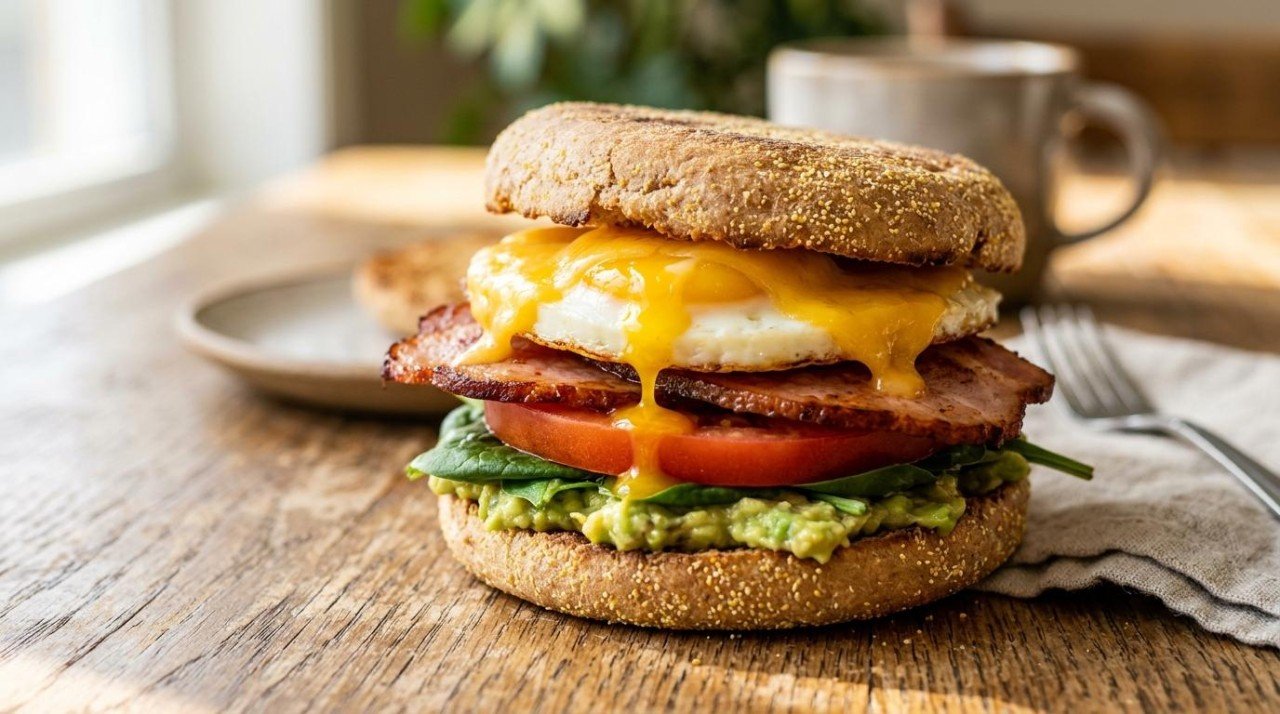
Five swaps took it to 74 — a 35-point jump — and it is still an English muffin with an egg, cheese, and Canadian bacon on it. Every number below is real. We scored the original, then applied each change one at a time on top of the last and measured what it was actually worth. One swap was worth nothing at all until we made it last. Two popular "healthy" swaps made the score worse. That is all in here too.
The original: what is in it and how it scores
The version we scored is the one everybody knows, built for two sandwiches:
- 2 white English muffins (about 2 oz each)
- 2 large eggs
- 2 oz Canadian bacon
- 2 slices American cheese (about 1 1/3 oz total)
- 2 teaspoons butter, for the muffin and the griddle
That scores 39/100. Per sandwich:
- Calories: about 336
- Protein: 20.2 g
- Sodium: about 810 mg — 35% of a full day's Daily Value, flagged high
- Saturated fat: 7.5 g — 32% DV, flagged high
- Fiber: 2.0 g, against a Daily Value of 28 g
- Plant points: 0
Before the diagnosis, the fair part: those numbers land within a few percent of the sandwich's published label — about 300 calories, 6 g saturated fat, and 760 mg sodium — which tells us our reconstruction is honest. And 336 calories with 20 grams of protein is a genuinely reasonable breakfast. The score even calls out real strengths: excellent phosphorus (48% DV), iron (42%), thiamine (38%), vitamin B12 (38%), choline (37%), riboflavin (35%), and calcium (32%). The whole egg is doing a lot of that work. This is not a bad sandwich.
It has three specific problems, and only three. The app flags high sodium, high saturated fat, and low plant diversity.
The sodium is structural: the muffin, the cured pork, the process cheese, and the salted butter are all salty, and none of them is optional in the original design. That matters because Americans already average about 3,400 mg of sodium a day against a 2,300 mg ceiling, and most of it comes from commercially prepared food rather than the salt shaker. One breakfast sandwich is more than a third of the day's allowance before you have eaten anything else.
The plant problem is the biggest one, and it is a problem of absence. There is not one vegetable, fruit, nut, seed, or whole grain in this sandwich — zero plant points, 2 grams of fiber, and vitamin C and vitamin K both under 10% of the Daily Value. Most Americans get about 15 grams of fiber a day against the 25 to 35 grams we actually need, and breakfast is where that gap usually opens.
One thing worth saying out loud, since people order it: we also scored the sausage version of this sandwich, and it came in at 36 — with 445 calories, 11.1 g of saturated fat, and 950 mg of sodium. The Canadian bacon build is already the smarter order. We are improving the good one.
The upgrades
Five swaps, applied in this order, each scored on top of the last. They are ordered by how much they move the number for how little they cost you at the table, so if you only make the first one, you have already captured almost half the gain.
1. Put vegetables in it
- Swap: Add 2 packed cups baby spinach (wilted) and 4 thick slices of tomato
- Score impact: +15 points (39 → 54)
- What it changes: Plant points 0 → 2, vitamin K from under 10% DV to 125%, fiber 2.0 → 3.0 g, and it clears the low-plant-diversity flag
- What it costs you: Two minutes and a slightly taller sandwich. Nothing on the flavor side — this is a deli egg sandwich, not a compromise
This is the single biggest move in the post, and it is also the easiest one, which almost never happens. Nothing was removed. The sandwich you love is entirely intact underneath. We just stopped treating a breakfast sandwich as a place where vegetables are not allowed.
The technique that matters: wilt the spinach in the pan for about a minute, then turn it onto a paper towel and press. Wet spinach is what makes a muffin go limp, and two packed cups collapses into about two tablespoons, so it disappears into the sandwich rather than sitting on top of it like a salad. Salt the tomato if you like, but you do not need to — there is plenty of salt in here already.
2. Whole wheat English muffin
- Swap: White English muffin → 100% whole wheat
- Score impact: +3 points (54 → 57) — but +6 if it is the only change you make
- What it changes: Plant points 2 → 3, plus the bran and germ: B vitamins, vitamin E, magnesium
- What it costs you: A nuttier, slightly denser muffin. It toasts a shade darker and holds up better under a runny yolk
Be honest about what this swap does and does not do: it adds roughly 0.6 g of fiber per sandwich. It is not a fiber transformation, and anyone telling you a whole wheat muffin triples your fiber is selling something. What it actually buys is everything refining takes out. Milling wheat strips more than half its B vitamins, 90% of the vitamin E, and virtually all the fiber, and in the research Harvard summarizes, women eating two to three servings of whole grains a day were 30% less likely to have a heart attack or die of heart disease over a decade than women who rarely ate them.
The catch is the label. "Wheat," "multigrain," and "made with whole grain" are mostly white flour with coloring; you want whole wheat flour as the first ingredient. We wrote a whole guide on reading bread labels without getting fooled, and it applies to muffins exactly the same way.
3. Half an avocado
- Swap: Add 1/2 medium avocado, sliced or mashed onto the bottom half
- Score impact: +4 points (57 → 61)
- What it changes: Fiber 3.6 → 5.9 g, plant points 3 → 4, and it swaps in monounsaturated fat
- What it costs you: About 55 calories per sandwich, and it is messier to eat. Worth it
The avocado is the fiber. It alone contributes 2.3 of the finished sandwich's 5.9 grams, and it doubles as the spread — mashed on the bottom half it does the job the butter was doing, but with monounsaturated fat, which improves cholesterol ratios and lowers heart disease risk when it replaces saturated fat.
This is the one swap where calories go up rather than down, and we are not going to pretend otherwise. The finished sandwich has about 86 more calories than the drive-thru one. It is also a bigger sandwich with nearly four more grams of fiber and four plant points in it, which is a trade most people are happy to make at 7 a.m.
4. Cook the egg in olive oil instead of butter
- Swap: 2 teaspoons butter → 1 tablespoon olive oil
- Score impact: +5 points (61 → 66)
- What it changes: Saturated fat drops from 8.0 g to 6.8 g per sandwich — even though this is more fat by weight
- What it costs you: The specific dairy smell of a buttered griddle. You will notice it on the first bite and not on the second
That detail is the whole point of the swap and it surprises people: we used a full tablespoon of oil in place of two teaspoons of butter, more total fat, and saturated fat still fell. Butter is roughly two-thirds saturated; olive oil is mostly monounsaturated. The fat here is doing a job — cooking the egg, keeping it from sticking — and the job does not care which fat does it.
If you want the buttered-muffin flavor back, our butter substitutes guide walks through what actually carries that taste and what does not. But once the avocado is on the muffin, most people stop missing it.
5. Less cheese, but sharper
- Swap: 1 slice American cheese (about 2/3 oz) → a scant 1/2 oz sharp cheddar, thinly sliced
- Score impact: +8 points (66 → 74)
- What it changes: Sodium drops from about 790 mg to 600 mg per sandwich, saturated fat from 6.8 to 6.5 g
- What it costs you: American cheese melts into a glossy sheet in a way aged cheddar does not, and the score shows vitamin D slipping from 16% DV to under 10%
Sharp cheddar is the swap that lets you use a quarter less cheese without noticing, because aged cheese is louder. The trick is thickness: slice it thin with a vegetable peeler and lay it straight onto the hot egg the second it comes out of the pan, so the residual heat melts it and it hits your tongue first.
Now the finding that made us re-run everything. This exact cheese swap is worth zero points if you make it first. We tested it against the untouched original: 39 before, 39 after, despite sodium falling by 180 mg. We tested it again in the middle of the build: 57 before, 57 after. Made last, on top of the other four swaps, the identical change was worth 8 points.
Nothing about the cheese changed. What changed is that the rest of the sandwich was no longer dragging the same dimensions down, so the score could finally register the improvement. The practical lesson is worth more than the swap itself: if a single change to a recipe seems to do nothing, that is often a sign the change is being masked, not that it is worthless. Make them all and you land at 74 no matter which order you go in. Our cheddar substitutes guide covers what else melts like this if sharp cheddar is not your thing.
Take the Guesswork Out of Eating Well
Eat Well Planner helps you organize your favorite recipes, plan balanced meals, and automatically generate shopping lists — all in one place. Whether you're tracking macros, managing dietary restrictions, or just trying to stop asking "what's for dinner?", we've got you covered.
Our AI-powered tools can adapt any recipe to your dietary needs, help you discover new meals you'll love, and even log your nutrition effortlessly. It's meal planning made simple.
Start Organizing Your Meals — FreeWhat we kept (on purpose)
The Canadian bacon. This is where we stopped, and it was the hardest call. Taking the pork out entirely scores 80 — six more points, and 210 mg less sodium. But protein falls from 22.1 g to 16.4 g, and more to the point, an English muffin with egg, cheese, avocado and spinach is a very nice sandwich that is no longer the sandwich anyone searched for. Canadian bacon is also the lean end of cured pork: it is a loin cut, not belly, so it brings salt without much fat. It is still processed meat, which the WHO classifies as a group 1 carcinogen, with every 50 g eaten daily associated with about an 18% higher risk of colorectal cancer — we use 1 oz per sandwich, and if you buy it, buy the lowest-sodium one on the shelf. Our deli ham substitutes guide has the leaner options if you want to keep the meat but change what it is.
The whole egg, yolk included. Non-negotiable, and the numbers back it up below.
Real cheese. Cutting it entirely scores 86, twelve points higher, and drops saturated fat to 3.8 g. It also makes it not a breakfast sandwich.
At 74, the app still flags high saturated fat (28% DV) and high sodium (26% DV). That is the honest ceiling for cured pork and cheese on bread, and we would rather show you a 74 you will actually eat every week than an 86 you make once.
The healthier version: full recipe
Nutrition Score: 74/100. Makes 2 sandwiches. About 20 minutes.
- 2 whole wheat English muffins, split
- 1 tablespoon olive oil, divided
- 2 packed cups baby spinach (about 2 oz)
- 2 oz Canadian bacon (about 4 thin slices)
- 2 large eggs
- 1 oz sharp cheddar, sliced thin
- 1/2 medium avocado (about 2 1/2 oz)
- 4 thick slices from 1 medium tomato (about 3 oz)
- Black pepper; no added salt
- Toast the English muffin halves until well browned and set them aside.
- Heat half the olive oil in a nonstick skillet over medium heat. Add the Canadian bacon and cook about 1 minute a side, until the edges curl and brown. Move to a plate.
- Add the spinach to the same pan with a splash of water and toss 60 to 90 seconds, just until wilted. Turn it onto a paper towel, press gently to squeeze out the water, and season with black pepper.
- Wipe the pan, add the remaining oil, and set it over medium-low heat. Crack the eggs into 3-inch metal rings, or free-form and fold the edges under to keep them round. Cook 2 minutes, then add a tablespoon of water to the pan, cover, and steam 1 to 2 minutes, until the whites are set and the yolk is where you want it.
- Lay the sliced cheddar directly on the hot eggs so it melts from the residual heat.
- Mash or spread the avocado on the bottom muffin halves. Layer on the tomato, a grind of pepper, the pressed spinach, the Canadian bacon, and the cheesy egg. Add the top half and press gently for about 20 seconds.
Per sandwich, original against improved:
- Nutrition Score: 39 → 74
- Calories: 336 → 422
- Protein: 20.2 g → 22.1 g
- Fiber: 2.0 g → 5.9 g (under 10% DV → 20% DV)
- Saturated fat: 7.5 g → 6.5 g (32% → 28% DV)
- Sodium: 810 mg → 600 mg (35% → 26% DV)
- Plant points: 0 → 4
- Vitamin K: under 10% DV → 132% DV
- Vitamin C: under 10% DV → 20% DV
The finished sandwich clears the FDA's "excellent source" bar of 20% of the Daily Value for twenty-one separate nutrients — vitamin K, phosphorus, riboflavin, iron, thiamine, choline, vitamin B12, folate and protein among them, and now also fiber, vitamin C, magnesium, potassium and vitamin E, not one of which the original could claim. Four plant points before 8 a.m. is a real head start on 30 different plants a week. Adding a few rings of thin-sliced red onion takes it to 5 plant points and 76, if you want one more.
Swaps we tested and skipped
Turkey bacon instead of Canadian bacon: 69, five points worse. This is the swap everyone expects to work and it is the clearest failure we found. Against the finished sandwich, turkey bacon added 32 calories, pushed saturated fat from 6.5 g to 7.6 g, and put sodium back up to 690 mg. Turkey bacon is ground, re-formed, heavily salted and often fattier than the lean pork it replaces. Our bacon substitutes guide goes into which options genuinely help.
Egg whites instead of whole eggs: 71, three points worse. Saturated fat did fall, to 4.9 g. But choline dropped out of the sandwich's strengths entirely, vitamin B12 fell from 32% DV to 12%, vitamin A from 25% to 15%, and the app raised new flags for low vitamin D and low omega-3. Nearly everything interesting in an egg lives in the yolk, and most people are already below the recommended intake for choline, which the body uses to make acetylcholine for memory and muscle signaling. The score says the yolk is worth more than its saturated fat costs.
Making the cheese swap first: worth 0 points. Covered above, and the most useful thing we learned all week.
Make it fit other diets
- Vegetarian: drop the Canadian bacon and the sandwich scores 80. Add a second egg or a spoon of white beans mashed with the avocado to bring the protein back.
- Gluten-free: a gluten-free English muffin works, but most are low in fiber — look for one with sorghum, buckwheat, or teff rather than starch alone.
- Dairy-free: skip the cheese and lean harder on the avocado and a smear of harissa or pesto for richness; the score goes up, the melt does not survive.
If you want the whole recipe rewritten rather than patched, Eat Well Planner's Recipe Variations does it in one step — ask for a dairy-free or vegetarian version and you get a full rewrite with the substitutions already worked in, scored.
Do this to your own recipes
Nothing here required a nutritionist. We imported a recipe, looked at the score and the flags underneath it, and worked down the list of what the app said was wrong — testing each change, keeping the ones that paid, and throwing out two that everybody recommends.
That is exactly what Make It Healthier does inside Eat Well Planner. Import any recipe from a website, an Instagram reel, or a YouTube video, and the app scores it, tells you what is dragging it down, and proposes concrete swaps — with a calculator verifying the actual nutritional gain before a suggestion is ever shown to you. If you want to poke at it yourself, the Recipe Playground lets you change one ingredient and watch the score move in real time, which is where every delta in this post came from.
Keep the sandwich. Change five things. Start with a recipe you already love.