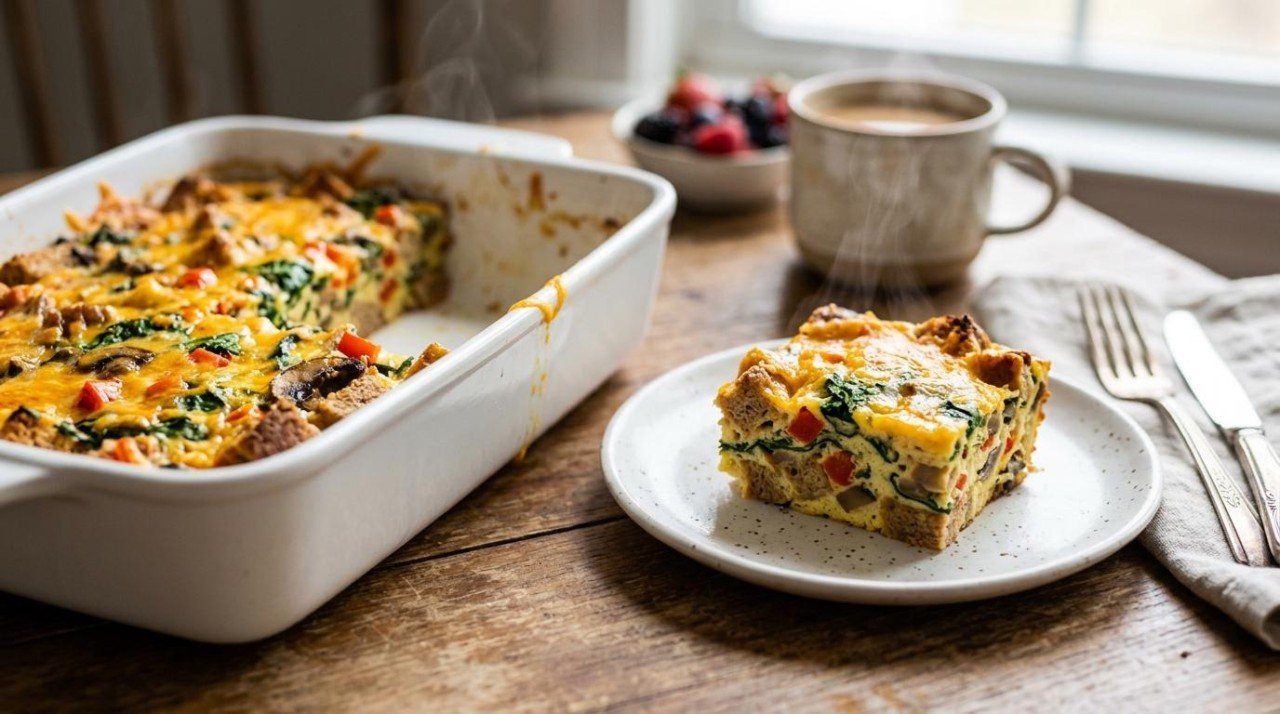
Breakfast casserole is the dish you make when people are staying over. You assemble it the night before, it sits in the fridge soaking, and in the morning you slide it into the oven and go back to your coffee. Sausage, cubed bread, eggs, cream, and a blanket of cheddar. Nobody has ever left the table disappointed.
Built the standard way — a pound of pork sausage, eight slices of white sandwich bread, eight eggs, milk and a cup of heavy cream, two cups of cheddar — and scored per serving against our default profile, it lands at 32 out of 100 on our Nutrition Score. One serving carries 85% of a day's saturated fat and just under a gram of fiber.
Six changes took it to 60, and it is still a make-ahead casserole with real sausage, real cheddar, and a custard that sets. Every number below is real: we scored the original, applied each change on top of the last, and measured what it was actually worth. The single biggest one was worth half the total gain, and it is not a swap at all. It is an addition.
The original: what is in it and how it scores
The version we scored is a standard 9x13 casserole cut into 8 servings:
- 1 lb (454 g) pork breakfast sausage
- 8 slices (about 250 g) white sandwich bread, cubed
- 8 large eggs
- 1 1/2 cups whole milk and 1 cup heavy cream
- 2 cups (226 g) shredded cheddar
- 1 teaspoon salt, 1/2 teaspoon black pepper, 1 tablespoon butter for the dish
That scores 32/100. Per serving:
- Calories: about 600
- Saturated fat: 20.0 g — flagged at 85% of a day's Daily Value, the app's most severe caution level
- Sodium: about 1,190 mg — 52% DV, also flagged
- Protein: 28.2 g
- Fiber: 0.9 g
- Plant points: 0.25
Start with what is already good, because a dish built on eggs and dairy has more going for it than the score suggests. The original clears the "excellent source" bar of 20% of the Daily Value for fifteen separate nutrients, including vitamin B12 (67%), phosphorus (57%), riboflavin (48%), choline (41%), vitamin A (36%), protein (35%), and calcium (35%). The eggs are the best thing in this pan and they are not the problem.
The problem is everything around them. A pound of pork sausage, a cup of heavy cream, and half a pound of cheddar are all in the same dish, and all three are mostly saturated fat. Twenty grams a serving is most of a day in one square, against a ceiling the Dietary Guidelines put at under 10 percent of daily calories. The sodium is structural rather than shaken on — commercial sausage and aged cheese are salty before you season anything — and it matters when the FDA notes Americans already average about 3,400 mg a day against a 2,300 mg Daily Value.
The app flags exactly three weaknesses: high saturated fat, low vitamin C, and low plant diversity. The last two are the interesting ones. There is no plant in this casserole except the bread, which is why it scores 0.25 plant points and 0.9 grams of fiber. That absence turns out to be worth more than any of the swaps.
The upgrades
Six changes, applied in this order, each one scored on top of the last. They are ordered by what they were worth, so if you only make one, make the first.
1. Fold a pound and a half of vegetables into it
- Swap: Nothing removed — add 10 oz cremini mushrooms, 7 oz spinach, 1 red bell pepper, and 1 onion
- Score impact: +14 points (32 to 46)
- What it changes: Plant points from 0.25 to 4.25 — and in the finished dish, vitamin C goes from a flagged weakness to 39% DV and vitamin K lands at 104% DV
- What it costs you: Ten minutes of sauteing the night before, and the casserole is no longer beige
This is the biggest single move in the post and it removes nothing. Half of the total 28-point gain came from adding vegetables to a dish that had none. Two of the original's three flagged weaknesses — low vitamin C and low plant diversity — are absences, and you cannot fix an absence by taking something else away.
Plant variety is worth chasing for its own sake. The American Gut Project found that people eating more than 30 different plant types a week had significantly more diverse gut microbiomes than people eating 10 or fewer, and the effect tracked the actual count of plants rather than any diet label. Four plants in a breakfast casserole is four of your thirty, in a meal that previously contributed none.
The technique matters or you will get a wet casserole. Cook the mushrooms first in a hot pan and leave them alone until they release their water and it boils off, then brown them — that browning is where the savory depth comes from that lets you get away with less sausage in step 2. Add the onion and pepper, then the spinach in handfuls, and tip the whole lot into a colander and press. Raw spinach and raw mushrooms in a strata release their liquid into the custard overnight, and it never sets properly.
2. Turkey sausage, and half as much of it
- Swap: 1 lb pork breakfast sausage → 8 oz turkey breakfast sausage
- Score impact: +3 points (46 to 49)
- What it changes: Saturated fat 20.0 g to 15.8 g, sodium 1,220 mg to 960 mg, about 125 fewer calories a serving
- What it costs you: Real fat and real flavor — the browned mushrooms have to earn their place here
Worth being honest about how small this is. Three points, for the swap most people assume is the whole makeover. We tested the pork-to-turkey swap on its own against the original and it was worth 2 points; halving the pork on its own was worth 1. Sausage is dense in both the good (B12, zinc, protein) and the bad (saturated fat, sodium), so pulling it out takes nutrients with it and the score barely moves.
What makes the halving survive at the table is the mushrooms from step 1. Deeply browned creminis bring the same meaty, savory register that sausage does, which is why 8 oz reads as enough. Buy turkey sausage in bulk rather than in links if you can — it browns and crumbles the same way. If you would rather keep pork and make the difference up elsewhere, our ground pork substitutes guide and ground turkey substitutes guide both cover what changes in fat, moisture, and seasoning when you switch.
3. Whole wheat bread for white
- Swap: 8 slices white sandwich bread → 8 slices 100% whole wheat
- Score impact: +4 points (49 to 53)
- What it changes: Fiber 2.5 g to 3.5 g a serving, plus a fifth plant point and more magnesium and B vitamins
- What it costs you: A nuttier, slightly denser custard — genuinely hard to notice under sausage and cheese
Refining wheat strips out more than half of its B vitamins, 90 percent of the vitamin E, and virtually all of the fiber, which is exactly why the white-bread version has under a gram. The same page notes that eating 70 grams of whole grains a day is associated with a 22% lower risk of total mortality in pooled analyses.
One practical note: cube the bread and leave it out overnight, or dry the cubes in a 300°F oven for 10 minutes. Whole wheat is a bit denser than white, and dry cubes drink the custard instead of collapsing into it. Day-old bread is the traditional answer for a reason.
4. Milk instead of the heavy cream
- Swap: 1 1/2 cups whole milk + 1 cup heavy cream → 2 1/2 cups whole milk
- Score impact: +4 points (53 to 57)
- What it changes: Saturated fat 15.8 g to 10.3 g, about 85 fewer calories a serving
- What it costs you: Slightly less silk in the custard. With eight eggs in the pan, less than you would think
Heavy cream is roughly 36% fat and most of it saturated; whole milk is about 3.5%. Swapping a cup of one for a cup of the other is the highest-leverage fat change in the dish, and it does not break the custard, because the custard is not held together by the cream. It is held together by eight eggs. This is the same lesson that showed up in our quiche Lorraine makeover: the eggs do the setting, the cream just makes it richer.
Do not go further than whole milk here — we tested that, and it is in the skipped list below. If you want the full range of what can stand in for cream in a baked custard, our heavy cream substitutes guide and milk substitutes guide cover which ones hold up under heat and which ones split.
5. Half the cheese, and all of it on top
- Swap: 2 cups shredded cheddar mixed through → 1 cup sharp cheddar, scattered on top before baking
- Score impact: +2 points (57 to 59)
- What it changes: Saturated fat 10.3 g to 7.6 g, sodium down about 100 mg a serving
- What it costs you: Nothing you can see. You still get a browned cheese lid
Cheese buried in the middle of a casserole is cheese you pay for nutritionally and never taste. Cheese on top browns, blisters, and is the first thing anyone notices. Use sharp or extra-sharp cheddar rather than mild — aged cheddar carries far more flavor per gram, so half the amount does not read as half the cheese. If you want to push the flavor-per-gram idea further, our cheddar substitutes guide covers which cheeses melt and which just go greasy.
Worth flagging: this swap was worth zero points when we tested it on the original casserole on its own. It only pays once the cream and half the sausage are already gone. That is the whole argument for scoring changes in sequence instead of guessing at them.
6. Half the added salt
- Swap: 1 teaspoon salt → 1/2 teaspoon
- Score impact: +1 point (59 to 60)
- What it changes: Sodium 850 mg to 710 mg a serving, 31% DV instead of 37%
- What it costs you: Very little, because sausage and sharp cheddar are already salty
One point, and we are including it because the sodium number moved even when the score barely did. Tested on the original casserole by itself, cutting the salt in half was worth nothing at all — the sausage and the two cups of cheddar were doing the salting. Only after those came down did the teaspoon you actually control start to matter.
Take the Guesswork Out of Eating Well
Eat Well Planner helps you organize your favorite recipes, plan balanced meals, and automatically generate shopping lists — all in one place. Whether you're tracking macros, managing dietary restrictions, or just trying to stop asking "what's for dinner?", we've got you covered.
Our AI-powered tools can adapt any recipe to your dietary needs, help you discover new meals you'll love, and even log your nutrition effortlessly. It's meal planning made simple.
Start Organizing Your Meals — FreeWhat we kept on purpose
All eight whole eggs, with the yolks. Egg yolk is one of the richest food sources of choline, and the Adequate Intake is 550 mg a day for men and 425 mg for women, with most Americans falling short. The finished casserole delivers 42% of the Daily Value per serving. It also lands 44% DV vitamin B12, 51% biotin, and 30% vitamin A, and the eggs are the main reason for all of it.
Real cheddar, real sausage, and the half teaspoon of salt. And this is where we stopped: cutting the cheese out entirely scores 65, five points better than what we published. We are not publishing that one, because a breakfast casserole with no cheese on top is a different dish, and the version nobody makes twice is worth zero points in real life.
The healthier version: full recipe
Nutrition Score: 60/100, up from 32. Serves 8. Assemble the night before, bake in the morning.
Ingredients
- 8 slices (about 250 g) 100% whole wheat sandwich bread, cut into 1-inch cubes and left out overnight to dry
- 1 tablespoon butter
- 10 oz (300 g) cremini mushrooms, sliced
- 1 medium yellow onion (about 110 g), diced
- 1 large red bell pepper (about 150 g), diced
- 7 oz (200 g) fresh spinach
- 8 oz (227 g) bulk turkey breakfast sausage
- 8 large eggs
- 2 1/2 cups (about 600 g) whole milk
- 1/2 teaspoon salt
- 1/2 teaspoon black pepper
- 1 cup (113 g) shredded sharp cheddar
Instructions
- Cook the turkey sausage in a large skillet over medium heat, breaking it into crumbles, until browned, about 6 minutes. Transfer to a bowl.
- Add most of the butter to the same skillet over medium-high heat, holding back a little to grease the baking dish. Add the mushrooms and leave them alone until they release their liquid and it cooks off, then stir and brown them, 8 to 10 minutes total. Do not crowd them or stir them early — browning is the point.
- Add the onion and bell pepper and cook until softened, about 5 minutes. Add the spinach in handfuls and stir until wilted, about 2 minutes more.
- Tip the vegetables into a colander and press firmly with a spatula to squeeze out the liquid. This step is what keeps the casserole from going watery overnight.
- Grease a 9x13-inch baking dish with the reserved butter. Scatter in the bread cubes, then the sausage and the drained vegetables, tossing gently so everything is distributed.
- Whisk the eggs, milk, salt, and pepper until completely smooth, then pour evenly over the dish. Press the bread down with a spatula so every cube is submerged.
- Cover and refrigerate at least 1 hour, ideally overnight.
- Heat the oven to 350°F. Uncover the dish, scatter the cheddar evenly over the top, and bake 45 to 55 minutes, until puffed, browned, and set in the center with no liquid wobble.
- Rest 10 minutes before cutting into 8 squares.
Per serving, original vs. improved
- Nutrition Score: 32 → 60
- Calories: 600 → 354
- Saturated fat: 20.0 g (85% DV, flagged) → 7.6 g (32% DV)
- Sodium: 1,190 mg (52% DV) → 710 mg (31% DV)
- Fiber: 0.9 g → 3.5 g
- Protein: 28.2 g → 22.8 g
- Plant points: 0.25 → 5.25
Protein is the one number that went down, by about 5 grams, and that is the honest cost of halving the sausage and the cheese. At 22.8 g a serving it is still 28% of the Daily Value, and it is now sitting next to 3.5 grams of fiber instead of none.
Leftovers keep 4 days covered in the fridge and reheat well in a 325°F oven or a toaster oven — a covered square for 15 minutes, uncovered for the last few so the top crisps again. Baked on Sunday, this is five breakfasts.
Swaps we tested and skipped
- Egg whites for half the eggs — scored 59, one point lower. The most recommended healthy-casserole swap there is, and on the improved version it made the score go down. Yolks carry the choline, the vitamin D, the vitamin A, and most of the B12; pulling four of them removes more nutrition than the 0.6 g of saturated fat it saves is worth.
- Skim milk instead of whole — scored 61, one point higher. Real but tiny, and it costs the custard its body. If you already drink skim, use skim. It is not worth buying a carton for.
- No added salt at all — scored 61, one point higher. Same story. We kept the half teaspoon, because a casserole with half the sausage and half the cheese needs the seasoning it has left.
- Cutting the cheese entirely — scored 65, five points higher. The one genuinely large gain we turned down, for the reason above.
Make it fit other diets
For a vegetarian version, drop the sausage and take the mushrooms to a full pound, browned hard, with a teaspoon of smoked paprika and extra black pepper — the mushrooms were already carrying most of the savory load. For gluten-free, use a sturdy gluten-free sandwich loaf and dry the cubes in the oven rather than on the counter; softer GF breads collapse in an overnight soak. For dairy-free, unsweetened soy milk sets closest to dairy in a baked custard, and you will want a strongly flavored vegan cheddar on top rather than more of a mild one. In the app, Recipe Variations will rewrite the whole recipe for any of these in one step, and the AI recipe chat will talk a swap through with the full ingredient list in front of it.
Do this to your own casserole
Every number in this post came out of Eat Well Planner. We scored the original, changed one thing, scored it again, and kept a running tally — which is exactly what the Recipe Playground does, showing you the score delta for each edit as you make it, and what Make It Healthier automates: import a recipe you love, and the app proposes swaps like these with the nutritional gain verified by a calculator before it ever shows them to you.
The lesson this casserole taught us is the one worth taking to your own recipes. We came in expecting the sausage swap to be the story, and it was worth three points. The vegetables nobody puts in a breakfast casserole were worth fourteen. Before you take anything out of a dish you love, check what happens when you put something in.