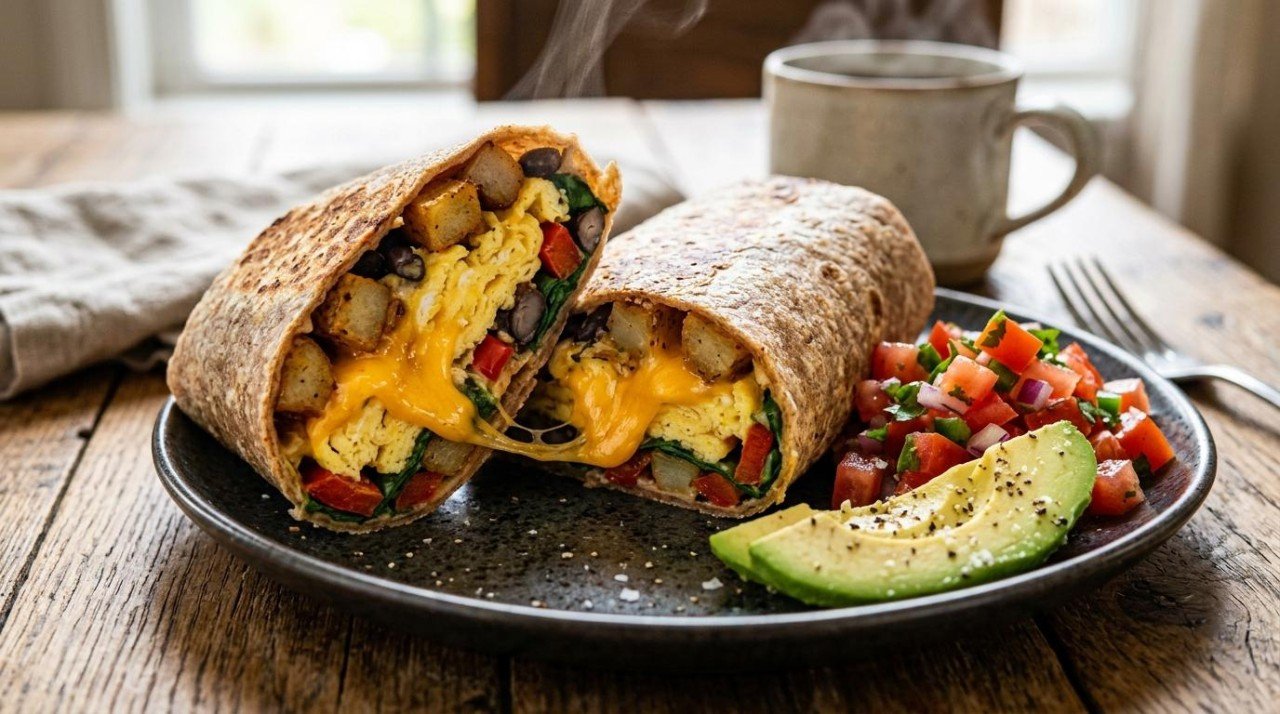
A breakfast burrito is one of the great portable meals. Eggs, something savory, something starchy, cheese, all of it wrapped in a warm tortilla you can eat with one hand on the way out the door. Diners, taquerias, gas stations at 6 a.m., freezer aisles — everybody makes a version, and almost all of them are good.
The standard build is a large white flour tortilla, scrambled eggs, breakfast sausage, a fistful of shredded cheddar, fried hash browns, and a spoon of sour cream. Scored per serving against our default profile, that burrito lands at 38 out of 100 on our Nutrition Score.
Six swaps took it to 72 — a 34-point jump — and it is still unmistakably a breakfast burrito: eggs, sausage, cheese, potatoes, wrapped and griddled. Every number below is real. We scored the original, applied each change one at a time on top of the last, and measured what each one was actually worth. A couple of them were worth much less than we expected, and one popular "healthy" swap made the score worse. All of that is in here.
The original: what is in it and how it scores
The version we scored is the diner-style burrito most people picture, built to make two generous burritos:
- 2 large white flour tortillas (about 5 oz total)
- 4 large eggs
- 6 oz pork breakfast sausage
- 3 oz shredded cheddar
- 6 oz frozen hash browns, fried in 2 tablespoons vegetable oil
- 1 tablespoon butter for the eggs
- 2 tablespoons sour cream
That scores 38/100. Per burrito, the numbers behind it:
- Calories: about 1,096
- Saturated fat: 27.8 g — 118% of a full day's Daily Value, and more than twice the roughly 13 grams the American Heart Association suggests as a target
- Sodium: about 1,670 mg — 72% DV, and already past the AHA's ideal 1,500 mg for a whole day
- Fiber: 3.7 g, against a Daily Value of 28 g
- Protein: 46 g
- Plant points: 1
The app flags three weak spots: high saturated fat, low plant diversity, and low vitamin C. The saturated fat and sodium are the same story told twice — pork sausage and cheddar are both rich and both salty, with butter and frying oil piled on top. The fiber problem is everything that is not in there: a refined white tortilla, potatoes as the only vegetable, nothing green anywhere. Refining wheat strips the bran and germ, taking more than half the B vitamins, 90% of the vitamin E, and virtually all the fiber with it.
Here is what is genuinely good about it, because plenty is. Forty-six grams of protein is a real breakfast. The eggs bring excellent vitamin B12 (96% DV), riboflavin (79%), biotin, and choline. There is meaningful iron, phosphorus, and zinc. This is not junk — it is a satisfying, nutrient-dense meal with three specific problems. We only want to fix those three.
The upgrades
Six swaps, applied one at a time in this order, each scored on top of the one before it. They are roughly ordered by how much they move the number for how little they cost you at the table — so if you only make the first two, you have already captured more than half the gain.
1. Halve the sausage, make it chicken, and fill the gap with black beans
- Swap: 6 oz pork breakfast sausage → 3 oz chicken sausage + 3/4 cup black beans
- Score impact: +9 points (38 → 47)
- What it changes: Saturated fat drops from 27.8 g to 22.2 g, sodium from 1,670 to 1,410 mg, and fiber more than doubles to 9 g — while protein barely moves (46 g to 44 g)
- What it costs you: Less rendered pork fat coating everything. Chicken sausage is leaner and drier, so it needs the pan fat from the vegetables to carry it
The biggest single move, because pork sausage was doing three jobs badly: fat, salt, and calories. Halving it and switching to chicken keeps the savory, seasoned, flecks-of-meat quality that makes this taste like a breakfast burrito, while the beans take over the bulk and bring the thing the original had almost none of — fiber, which Harvard notes most Americans fall short on by 10 to 20 grams a day.
We tested going all the way, too: no sausage, just beans. That scored 49 — only two points better for losing the meat entirely. Half is where the value is. Buy a chicken sausage with a real spice profile (chipotle, apple sage, andouille), and rinse the beans well so they do not water down the filling.
2. Add a half pound of vegetables
- Swap: Add 1 large red bell pepper, 1/2 onion, and 2 cups spinach
- Score impact: +9 points (47 → 56)
- What it changes: Plant points go from 1 to 5, and it clears the low vitamin C flag outright
- What it costs you: Ten minutes of chopping, and that is genuinely it — sauteed peppers and onions in a breakfast burrito is a taqueria standard, not a compromise
Tied for the biggest point-mover, and the one that tastes like an upgrade rather than a subtraction. Sweet peppers and browned onion add the aromatic backbone the original was getting entirely from sausage grease, and spinach wilts down to almost nothing visually while still counting.
The plant-diversity angle matters more than it sounds. The American Gut Project found that people eating more than 30 different plant types a week had measurably more diverse gut microbiomes, with more of the bacteria that ferment fiber into short-chain fatty acids — and plant variety predicted this better than any diet label did. We wrote more about that in 30 plants a week. One technique note: cook the vegetables until the pan is dry, because wet filling is the number one cause of a soggy burrito.
3. Whole wheat tortilla instead of white
- Swap: Large white flour tortilla → 100% whole wheat
- Score impact: +5 points (56 → 61)
- What it changes: Fiber jumps from 10.8 g to 15.4 g, plus B vitamins, magnesium, and vitamin E that refining removes
- What it costs you: A slightly nuttier, chewier wrap. Whole wheat tortillas are also a little less stretchy, so warm them properly or they crack when you roll
Straightforward and worth doing. The one thing that matters is buying a real one: the label should say 100% whole wheat, or list a whole grain first. Plenty of brown-looking tortillas are white flour with caramel color and a token amount of bran. Our tortilla substitutions guide covers what actually swaps for what, and the same label-reading logic applies as in our guide to buying genuinely whole grain bread.
Warm each tortilla about 30 seconds a side in a dry skillet before rolling. A cold whole wheat tortilla will split down the seam every time.
4. Fresh pico and avocado instead of sour cream
- Swap: 2 tablespoons sour cream → fresh pico de gallo (tomato, cilantro, lime) + 1/2 avocado
- Score impact: +4 points (61 → 65)
- What it changes: Fiber to 18.7 g, plant points to 8.25, and swaps a saturated-fat topping for a monounsaturated one
- What it costs you: The cool, tangy richness sour cream gives. Avocado covers the richness and lime covers the tang, but they are not the same thing — this is the swap most likely to be a matter of taste
The interesting part is what we found when we tested the lazy version. Using jarred salsa instead of fresh pico, from the identical starting point, scored +0. Fresh pico scored +5 from that same point. The entire difference was sodium: the jar added about 290 mg per serving, which cancelled out every gain the tomatoes made. Same vegetables, same fiber, five points apart.
Chopping a tomato with cilantro and lime takes two minutes and is the difference between this swap being worth something and worth nothing. If you would rather keep a creamy topping, our sour cream substitutions guide runs through the options, and plain Greek yogurt is the closest one nutritionally.
5. Cut the cheese in half — and make it sharp
- Swap: 3 oz shredded mild cheddar → 1.5 oz sharp cheddar
- Score impact: +6 points (65 → 71)
- What it changes: Saturated fat from 22.9 g to 18.9 g, sodium down about 140 mg, and roughly 85 fewer calories
- What it costs you: Genuinely less cheese. This is the swap you will notice most, and the sharpness is what makes it survivable
Cheese is calorie-dense and salty, and in the original it was the second-largest saturated fat source after the sausage. But cheese is also the glue and the melt, and a breakfast burrito without it is a different food. So the move is not less flavor, it is more flavor per gram: aged sharp cheddar carries far more punch than mild, so half the amount still reads clearly as cheese. Our cheddar substitutions guide has more on which cheeses trade well here.
One practical trick that does double duty: lay the cheese directly on the tortilla before any filling. It melts into a thin sealing layer that keeps moisture off the wrap, and putting it where your tongue hits first makes a smaller amount taste like more.
6. Roast the potatoes instead of frying hash browns
- Swap: 6 oz frozen hash browns fried in 2 tablespoons vegetable oil + 1 tablespoon butter → 7 oz fresh potatoes roasted in 1 tablespoon olive oil
- Score impact: +1 point (71 → 72)
- What it changes: 58 fewer calories and 3 g less saturated fat per serving
- What it costs you: Nothing at the table, but it costs you a sheet pan and 25 minutes of oven time
An honest result: made last, this moved the score by a single point. Applied earlier in the build it was worth two. Either way it is the smallest swap here, and we would rather say so plainly — frying versus roasting matters far less than what you fry or roast.
We kept it anyway, because 58 calories and 3 grams of saturated fat are real even when the score shrugs, and because roasted potato cubes hold their texture inside a wrapped burrito where hash browns go limp. Using olive oil instead of neutral vegetable oil is a free upgrade at the same volume.
Take the Guesswork Out of Eating Well
Eat Well Planner helps you organize your favorite recipes, plan balanced meals, and automatically generate shopping lists — all in one place. Whether you're tracking macros, managing dietary restrictions, or just trying to stop asking "what's for dinner?", we've got you covered.
Our AI-powered tools can adapt any recipe to your dietary needs, help you discover new meals you'll love, and even log your nutrition effortlessly. It's meal planning made simple.
Start Organizing Your Meals — FreeWhat we kept, and where we stopped
The whole eggs stayed, all four of them. So did real cheddar, real sausage, real potatoes, and a real flour-based tortilla. Nothing here is a substitute pretending to be the thing.
And we stopped on purpose. We scored the version with no cheese at all: it comes out at 79, seven points above where we finished. That is a real, verified number, and we did not take it, because a breakfast burrito without cheese is a vegetable wrap. That is the honest edge of this makeover — you now know exactly what the next step is worth, and you can decide for yourself.
Two flags also survive the makeover, and it would be dishonest not to say so. The finished burrito still reads high saturated fat (68% DV) and high sodium (59% DV). That is the ceiling for eggs, sausage, and cheese in a tortilla. We got it from 118% and 72% down to 68% and 59%, which is most of the distance, but a breakfast burrito is never going to be a low-sodium food.
The healthier breakfast burrito: full recipe
Final score: 72/100, up from 38. Makes 2 large burritos.
One honest note on size before you cook it: this is a big burrito, at about 966 calories. So was the original, at 1,096. It is a full meal rather than a light breakfast — and if that is more than you want in the morning, the filling divides cleanly into three smaller burritos at about 640 calories each.
Ingredients
- 2 large burrito-size 100% whole wheat tortillas (about 2.5 oz each)
- 7 oz Yukon gold or russet potatoes (about 2 small), cut into 1/2-inch dice
- 1 tablespoon olive oil, divided
- 1/2 teaspoon smoked paprika
- 1 large red bell pepper (about 4 oz), diced
- 1/2 medium onion (about 3 oz), diced
- 3 oz fully cooked chicken sausage (about 2 links), sliced into half-moons
- 1/2 teaspoon ground cumin
- 2 cups packed baby spinach (about 2 oz)
- 3/4 cup canned black beans, drained and rinsed
- 4 large eggs, beaten
- 1.5 oz sharp cheddar, shredded (a scant 1/2 cup)
- 1 medium tomato (about 3 oz), seeded and diced
- 2 tablespoons chopped fresh cilantro
- 1 tablespoon lime juice
- 1/2 medium avocado (about 3 oz), sliced
- Black pepper, and salt to taste
Instructions
- Heat the oven to 425°F. Toss the diced potatoes with half the olive oil, the smoked paprika, and plenty of black pepper. Spread on a sheet pan in a single layer and roast 25 to 30 minutes, turning once, until browned and crisp at the edges.
- Meanwhile, heat the remaining olive oil in a large nonstick skillet over medium heat. Cook the bell pepper and onion, stirring occasionally, 6 to 8 minutes, until soft and lightly browned.
- Add the chicken sausage and cumin and cook 3 minutes more, until the sausage is heated through and starting to color.
- Add the spinach a handful at a time, stirring until wilted, then stir in the black beans. Cook 1 to 2 minutes, until the beans are hot and the pan looks dry rather than wet. Scrape everything into a bowl.
- Wipe out the skillet and set it over medium-low heat. Add the beaten eggs and cook slowly, pushing them gently across the pan with a spatula, until just set but still glossy. Pull them off the heat while they look slightly underdone.
- Stir the diced tomato, cilantro, and lime juice together with a pinch of salt and pepper to make the pico.
- Warm each tortilla about 30 seconds a side in a dry skillet, until soft and pliable.
- Build each burrito with the cheddar directly on the tortilla first, then the eggs, then the vegetable and bean mixture, then the roasted potatoes. Fold the sides in, then roll tightly from the bottom.
- Set the burritos seam-side down in the dry skillet and toast 1 to 2 minutes a side, until browned and sealed. Serve with the pico and sliced avocado on top.
Per serving, original vs. improved:
- Nutrition Score: 38 → 72
- Calories: 1,096 → 966
- Fiber: 3.7 g → 18.9 g (13% DV → 64% DV)
- Saturated fat: 27.8 g → 15.9 g (118% DV → 68% DV)
- Sodium: about 1,670 mg → about 1,360 mg
- Protein: 46 g → 43 g
- Plant points: 1 → 8.25
Protein is the one number that went slightly down, by three grams, and 43 g is still a lot for a breakfast. The finished burrito is now an excellent source of vitamin K (158% DV), vitamin C (137%), vitamin B6, folate, iron, riboflavin, and fiber. Neither score includes salt added at the stove, so both are comparable — the sodium you see comes from the ingredients themselves.
To meal-prep these, follow the freezer rules: let the filling cool to room temperature before rolling, keep the pico and avocado out of the wrap and add them fresh when you eat, then wrap each burrito in foil and freeze for up to three months. Reheat 1 to 2 minutes in the microwave or 10 to 15 minutes at 350°F. Rolling hot filling is what makes frozen burritos soggy. If batch mornings are your thing, batch cooking without a free Sunday has more on fitting this into a real week.
Swaps we tested and skipped
Egg whites instead of whole eggs. The classic diet-column swap, and it made the score worse — 68 versus 71 at the point we tested it. Saturated fat did drop, but the yolks are where most of the nutrition lives: choline fell from 80% DV to 19%, vitamin B12 from 77% to 39%, vitamin A from 53% to 33%, and vitamin D and the EPA/DHA omega-3s went to zero outright. Choline is used to make acetylcholine, a neurotransmitter involved in memory and muscle contraction, and most Americans already fall short of the recommended intake. Throwing out the yolks trades a lot of nutrition for a little saturated fat. Keep them.
Jarred salsa instead of fresh pico. Covered above, but it earns its place here: from an identical starting point, jarred salsa scored +0 and fresh pico scored +5. About 290 mg of added sodium per serving ate the entire benefit of the tomatoes.
Dropping the sausage entirely. All beans, no meat, scored 49 against 47 for the half-and-half version. Two points, for removing the meat from a breakfast burrito. Not a trade we would make, though it is a perfectly good option if you want a vegetarian version anyway.
Make it fit other diets
The two most-asked versions of this dish are easy. For a vegetarian burrito, drop the chicken sausage and take the black beans up to a full cup — we scored that path too, and swapping all the pork for beans came out at 49 before any of the other changes, so it holds up. For gluten-free, the tortilla is the only thing standing in the way: use large corn tortillas (warm them well, they crack) or a certified gluten-free wrap, and note you lose the whole grain fiber the wheat version was contributing.
For dairy-free, low-sodium, or anything else, Eat Well Planner's Recipe Variations will rewrite this entire recipe in one step with the substitutions already worked in, and the AI recipe chat will talk through swaps with the full recipe in front of it.
Do this to your own recipes
Every number in this post came out of the app. We built the original, scored it, then used Make It Healthier to work through candidate swaps — it proposes concrete changes and a calculator verifies the actual nutritional gain before you ever see a suggestion, which is why we could tell you that egg whites lose points and jarred salsa is worth nothing. The per-swap deltas came from the Recipe Playground, where you can edit ingredients and watch the score move on every change.
You can do exactly this to whatever you already cook. Import a recipe from any website, Instagram reel, or YouTube video, see what it actually scores, and let Make It Healthier show you which changes are worth making and which ones are not. Then keep the swaps you like, ignore the ones you do not, and save it as a healthier version of your own recipe. Eat Well Planner is free to use.