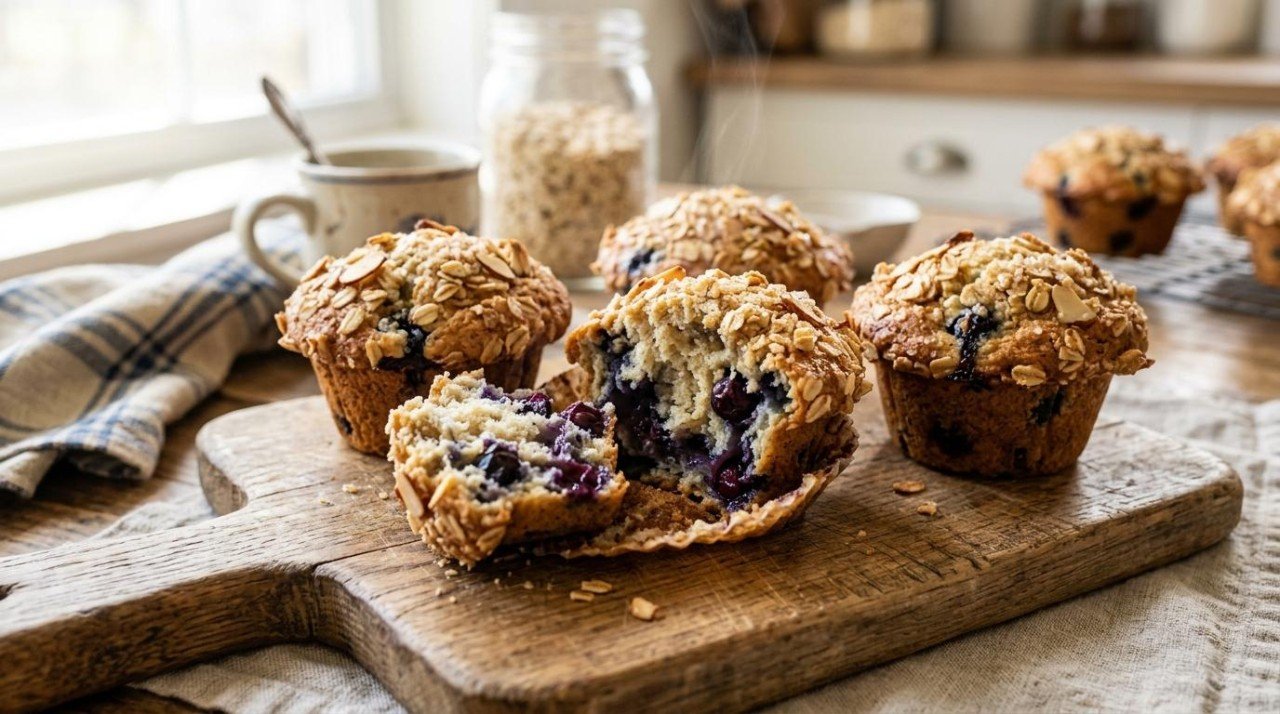
The blueberry muffin has spent a century getting away with something. It is sold next to the coffee, not next to the cake. It has fruit in the name. Nobody has ever apologized for eating one at 8 a.m.
So we built a standard bakery-style blueberry muffin in Eat Well Planner and ran it through the app's Nutrition Score. It came back at 23 out of 100, with 24 g of added sugar in one muffin. Then, because we wanted to know how bad that really was, we scored a frosted vanilla cupcake the same way. It scored 14 - on 359 calories against the muffin's 361.
Then we rebuilt it, one verified swap at a time, and got it to 72: a 49-point jump, every caution flag cleared, four times the fiber, and three cups of actual blueberries in the pan. Along the way we tested the swap everyone recommends first and found it made the score worse. Here is all of it.
The original: what's in it and how it scores
Bakery-style is a specific thing. It means a tall domed top, a cake-like crumb, and a crunchy sugar crust - what you get by filling the cups to the brim and blasting the oven at 425°F for five minutes before dropping to 350°F, a technique Sally's Baking Addiction and most bakery-style recipes share. We scored the composite those recipes converge on: 2 1/2 cups (313 g) all-purpose flour, 1 1/4 cups (250 g) granulated sugar, 1/2 cup (113 g) melted butter, 1/4 cup oil, 3/4 cup (180 g) sour cream, 1/2 cup whole milk, 2 eggs, a tablespoon of baking powder, 2 cups (300 g) blueberries, and 3 tablespoons of coarse sugar over the tops. Twelve muffins. Every number below is one muffin.
Nutrition Score: 23/100. Per muffin: about 361 calories, 5.5 g protein, 1.3 g fiber, 7.5 g saturated fat, 290 mg sodium, and the number that sinks it - 24 g of added sugar, flagged as very high at 91% of a day's reference. The American Heart Association recommends no more than 25 g of added sugar a day for women and 36 g for men. One homemade muffin is a woman's entire daily allowance, and it is still morning. The store-bought version is bigger: a Costco blueberry muffin runs 460 calories with 25 g of added sugar and 15 g of saturated fat.
The second flag was saturated fat at 32% of a day's limit, from the butter and sour cream together. The third problem is not a flag, just an absence: 1.3 g of fiber, from a food most people file under wholesome. Plant points came to 1. The vitamins the app did surface - thiamine, iron, niacin - are not the blueberries doing anything. That is enriched white flour, put back by law after being milled out.
Plenty here is genuinely fine and we will not invent problems. The sodium is unremarkable, the eggs and butter and berries are real food, and two cups of blueberries is a real quantity of fruit. What holds this muffin at a 23 is that a cup and a quarter of sugar and two and a half cups of white flour have quietly outvoted the fruit on the label - which is exactly why it landed within nine points of a cupcake.
The swap that does not work: making it smaller
The first thing everyone says about muffins is that they are too big, so we tested it before anything else. Same batter, same everything, divided into 14 instead of 12. The score went down, from 23 to 20.
That is not a bug. The Nutrition Score scales its targets and its limits to the calories a portion actually costs you, so a smaller muffin gets a proportionally smaller sugar allowance along with its smaller sugar load. Shrinking the portion shrank the good things too - thiamine and iron dropped out of the highlights entirely - while the added sugar stayed very high per calorie. The score is not measuring how much you ate. It is measuring what you got for the calories, and a smaller cupcake is still a cupcake.
Eating less of something is a fine real-world strategy and we are not talking anyone out of it. But it does not fix the recipe. Everything below does.
The upgrades
We applied these in order and re-scored after each, so every number is what that swap was worth at that point in the build. If you only make two changes, make the flour swap and the dairy swap - 29 points between them.
1. Cut the sugar to 2 tablespoons and let the fruit carry it
- Swap: 1 1/4 cups granulated sugar → 2 tablespoons brown sugar + 1/2 cup unsweetened applesauce, blueberries from 2 cups to 3 cups, no coarse sugar on top
- Score impact: +11 points (23 to 34)
- What it changes: Added sugar from 24 g to 2.4 g per muffin - a 90% cut - and the very-high sugar flag clears completely
- What it costs you: The sugar crust, and real sweetness. This is the swap with an actual price tag, and the one to argue with.
Two tablespoons across twelve muffins sounds absurd until you look at what replaces it. Three cups of blueberries is 37 g of fruit per muffin, and half a cup of unsweetened applesauce adds fruit sugar, moisture, and a background sweetness that reads as sugar without counting as added sugar. The applesauce is doing a job it cannot do in most bakes: it is not standing in for fat here, it is standing in for part of the milk.
We tested this level carefully, because it is the swap that will lose people. At 1/4 cup of sugar the same muffin scores 62. At 2 tablespoons it scores 72. At zero it also scores 72 - so those last two tablespoons are, on the scorecard, free. Take them. We kept brown rather than white sugar because molasses carries flavor that plain sweetness does not, and it helps the tops brown now that no sugar crust is doing it. (Our brown sugar substitutes guide covers swapping rather than cutting.)
2. Send all the flour to white whole wheat
- Swap: 2 1/2 cups all-purpose flour → 2 1/2 cups white whole wheat flour
- Score impact: +14 points (34 to 48)
- What it changes: Fiber from 1.7 g to 4.4 g per muffin, plant points from 1 to 2, and turns the biggest ingredient in the pan from empty into whole grain
- What it costs you: Very little in this particular batter, for reasons worth understanding
Fourteen points from the ingredient nobody inspects. Flour is the largest thing in the muffin by weight, and in its white form it contributes starch plus the vitamins added back after milling. That matters when only 5% of American men and 9% of women hit the recommended fiber intake, and when a Harvard meta-analysis of more than 786,000 people found 70 g of whole grains a day associated with a 22% lower risk of total mortality.
Use white whole wheat, not traditional red - same whole grain, paler wheat, and King Arthur's bakers describe it as much less noticeable in the finished bake. Their general guidance caps muffins at 50% whole wheat, which is honest advice for a plain muffin - but they also publish a 100% whole wheat blueberry muffin of their own, because berries are what make it work. This batter is unusually wet: three cups of fruit, applesauce, and yogurt all releasing moisture into a flour that wants more of it. Rest the batter 20 minutes so the bran hydrates and any grittiness disappears. If you would rather hedge, half and half scored 69. (Our flour substitutes guide has the other options.)
3. Greek yogurt for the sour cream, and half the butter out
- Swap: 3/4 cup sour cream → 3/4 cup plain Greek yogurt, and 1/2 cup butter → 4 tablespoons
- Score impact: +15 points (48 to 63) - the biggest single move, and the last caution flag comes off
- What it changes: Saturated fat from 7.5 g to 3.6 g per muffin, calories from 278 to 225, protein from 4.5 g to 5.6 g
- What it costs you: A little richness. You get a better rise in exchange.
This is the swap that clears the board - after it the muffin has no caution flags at all. Greek yogurt goes in one-for-one against sour cream, so there is nothing to calculate: same cup, same tang, roughly half the saturated fat, noticeably more protein. The acid also gives the leavening more to work with, which matters when you are asking a whole wheat batter to climb.
Four tablespoons of butter is not a token amount, and melting rather than creaming it puts all that flavor straight into the crumb. Use plain yogurt, never vanilla or honey-flavored - that would put back a chunk of the sugar we just spent a section removing. Full-fat and 2% both work. (See our sour cream and butter substitutes guides for the rest of the ratios.)
4. An oat-and-almond top instead of a sugar crust
- Swap: Coarse sugar topping → rolled oats and sliced almonds, plus ground flaxseed, lemon zest and cinnamon in the batter
- Score impact: +9 points (63 to 72)
- What it changes: Omega-3 ALA from 0.37 g to 0.70 g per muffin (44% of a day's target), fiber to 5.9 g, protein to 7.3 g, plant points from 2 to 6.25
- What it costs you: About 50 calories, and the crackly sugar top is gone for good
Something has to happen on top of a bakery-style muffin, and once the coarse sugar is out, oats and almonds are the obvious answer: they toast, they crunch, and they make the muffin look like it cost more. The flaxseed is the stealth win - three tablespoons across a whole batch is undetectable, and it must be ground. A trial comparing forms found that milled flaxseed and flax oil both raised plasma ALA significantly while whole flaxseed did not, because the intact hull passes straight through you.
The lemon zest costs nothing and does the most work of anything here. It sharpens the berries and makes a barely-sweetened muffin read as brighter rather than plainer - which, after a 90% sugar cut, is not garnish, it is structural. Between the oats, almonds, flax, zest, cinnamon, wheat, apple and berries, plant points went from 1 to 6.25 - a fifth of a week's 30-plant target in one muffin.
Take the Guesswork Out of Eating Well
Eat Well Planner helps you organize your favorite recipes, plan balanced meals, and automatically generate shopping lists — all in one place. Whether you're tracking macros, managing dietary restrictions, or just trying to stop asking "what's for dinner?", we've got you covered.
Our AI-powered tools can adapt any recipe to your dietary needs, help you discover new meals you'll love, and even log your nutrition effortlessly. It's meal planning made simple.
Start Organizing Your Meals — FreeWhat we kept on purpose, and where we stopped
We kept 4 tablespoons of real butter, real oil, two whole eggs, and real sugar. No sugar substitute, no protein powder, no almond flour, no dates blitzed into paste. Three cups of blueberries is more fruit than the original had, not less. At 275 calories a muffin this is not a diet food and was never trying to be.
We stopped at the sugar crust, and that is a genuine loss worth naming. A bakery muffin has a crunchy, glittering lid and this one does not - it has a toasted oat lid instead. If that crust is the whole reason you love the muffin, put the 3 tablespoons of coarse sugar back: we scored that too, and it lands at 56, with the added sugar flag creeping back on at 5.6 g a muffin. Sixteen points is a real price for a lid, but it is still 33 points up on where we started, and it is your muffin. What we would not do is the full crumb streusel, and the skipped section explains why.
The healthier version: full recipe
Final Nutrition Score: 72/100, with no caution flags. An excellent source of fiber, iron and omega-3 ALA. Makes 12 muffins.
- 2 1/2 cups (313 g) white whole wheat flour
- 3 tablespoons (20 g) ground flaxseed
- 1 tablespoon baking powder
- 3/4 teaspoon (2 g) ground cinnamon
- 1/2 teaspoon salt
- 2 large eggs
- 3/4 cup (180 g) plain Greek yogurt
- 1/2 cup (120 g) unsweetened applesauce
- 1/4 cup (60 g) whole milk
- 4 tablespoons (57 g) unsalted butter, melted
- 3 1/2 tablespoons (50 g) neutral oil
- 2 tablespoons (30 g) packed brown sugar
- 2 teaspoons vanilla extract
- Finely grated zest of 2 lemons (about 6 g)
- 3 cups (450 g) blueberries, fresh or frozen
- 2/3 cup (60 g) old-fashioned rolled oats
- 1/2 cup (40 g) sliced almonds
- Heat the oven to 425°F. Line a 12-cup muffin pan with paper liners, or grease it well.
- Toss the oats and almonds with 1 tablespoon of the melted butter and a pinch of the cinnamon. Set this topping aside.
- Whisk the flour, ground flaxseed, baking powder, remaining cinnamon, and salt together. Scoop out 2 tablespoons of the mixture and toss it with the blueberries - the flour coating absorbs the juice they release and holds them in place until the crumb sets.
- In a large bowl, whisk the eggs, Greek yogurt, applesauce, milk, remaining melted butter, oil, brown sugar, vanilla, and lemon zest until smooth.
- Fold the dry ingredients into the wet just until no dry flour remains, then fold in the floured blueberries. Overmixing a whole wheat batter makes tough, tunneled muffins.
- Let the batter rest 20 minutes. Do not skip this: it lets the bran and the flaxseed absorb liquid, which is what keeps a 100% whole wheat muffin from tasting gritty.
- Divide the batter among the 12 cups, filling each right to the top - that is what gives you a domed muffin rather than a flat one. Scatter the oat and almond topping over each.
- Bake 5 minutes at 425°F, then reduce to 350°F without opening the door and bake another 16 to 20 minutes, until a skewer in the center comes out clean. The initial blast is what sets the dome.
- Cool in the pan 5 minutes, then move to a rack. If you used frozen berries, add 2 to 3 minutes and do not thaw them first.
Per muffin, original vs. improved:
- Nutrition Score: 23 → 72
- Added sugar: about 24 g → about 2.4 g
- Fiber: about 1.3 g → about 5.9 g
- Saturated fat: about 7.5 g → about 3.8 g
- Protein: about 5.5 g → about 7.3 g
- Calories: about 361 → about 275
- Omega-3 ALA: about 0.40 g → about 0.70 g
- Potassium: about 110 mg → about 250 mg
- Plant points: 1 → 6.25
- Caution flags: very high added sugar, high saturated fat → none
Swaps we tested and skipped
- Making the muffins smaller. Worth repeating because it is the most common muffin advice there is: 14 muffins instead of 12 took the original from 23 to 20. Applied to the finished recipe it changed nothing at all - 72 either way.
- Half white whole wheat instead of all of it. Offered rather than skipped: 1 1/4 cups each of white whole wheat and all-purpose scored 69, three points below, and costs you 1.4 g of fiber a muffin. If 100% whole wheat is a step too far in your house, this is cheap.
- Putting the crumb streusel back. The classic bakery crumb top - 1/2 cup flour, 1/3 cup brown sugar, 4 tablespoons butter - dropped the finished muffin from 72 to 47 and put both caution flags straight back on, at 349 calories. It is the single most expensive thing you can do to a muffin, which is why we replaced it rather than shrinking it.
- Keeping 1/4 cup of sugar. Scored 62 against 72 - ten points for an extra half teaspoon of sugar per muffin. A legitimate choice if 2 tablespoons is too austere for your household, but a steep price for a very small taste difference.
- Cutting the sugar to zero. Scored 72 - identical. Going fully sugar-free buys nothing on the score and costs you what little browning and sweetness the 2 tablespoons provide. Useful to know before anyone talks you into it.
Make it fit other diets
For dairy-free, use a thick unsweetened coconut or almond yogurt, swap the butter for more neutral oil, and use any unsweetened plant milk. For vegan, do that and replace the eggs with two flax eggs - the ground flaxseed is already on the counter. For gluten-free, use a 1:1 gluten-free baking blend and cut the rest to 10 minutes, since there is no bran to hydrate. In Eat Well Planner you can ask the AI to rewrite this exact recipe any of those ways in one step, and it hands back the full version with the swaps worked in.
Do this to any recipe you love
Every score in this post came out of Eat Well Planner's Make It Healthier tool, not an estimate. Import a recipe from any website - or straight from the reel you saved it from - and the app scores it and tells you what is actually holding the number down. For the blueberry muffin the answer was the sugar, which everyone suspects, and the flour, which nobody checks. Then use the Recipe Playground to test swaps one at a time and watch the score move before you commit. Want the sugar crust back? Put it in, see what it costs, then decide.
The lesson worth carrying around is the one the muffin taught us early: you cannot shrink your way to a better recipe. Making it smaller made the score worse, because the score asks what you got for the calories, not how many calories you had. Changing what was in it moved 49 points. We found the same shape of answer rebuilding classic banana bread, where the flour was also the swap nobody expects.
And the berries turn out to be doing more than decorating. A research review found that even moderate daily intake - about a third of a cup - is associated with reduced cardiovascular and type 2 diabetes risk. Harvard's own take is more measured, noting that while blueberries are rich in anthocyanins and antioxidants, nobody can say for certain they beat other fruits and vegetables - which is the right way to hold it. They are not medicine. They are just fruit, and in the original recipe they were badly outnumbered.