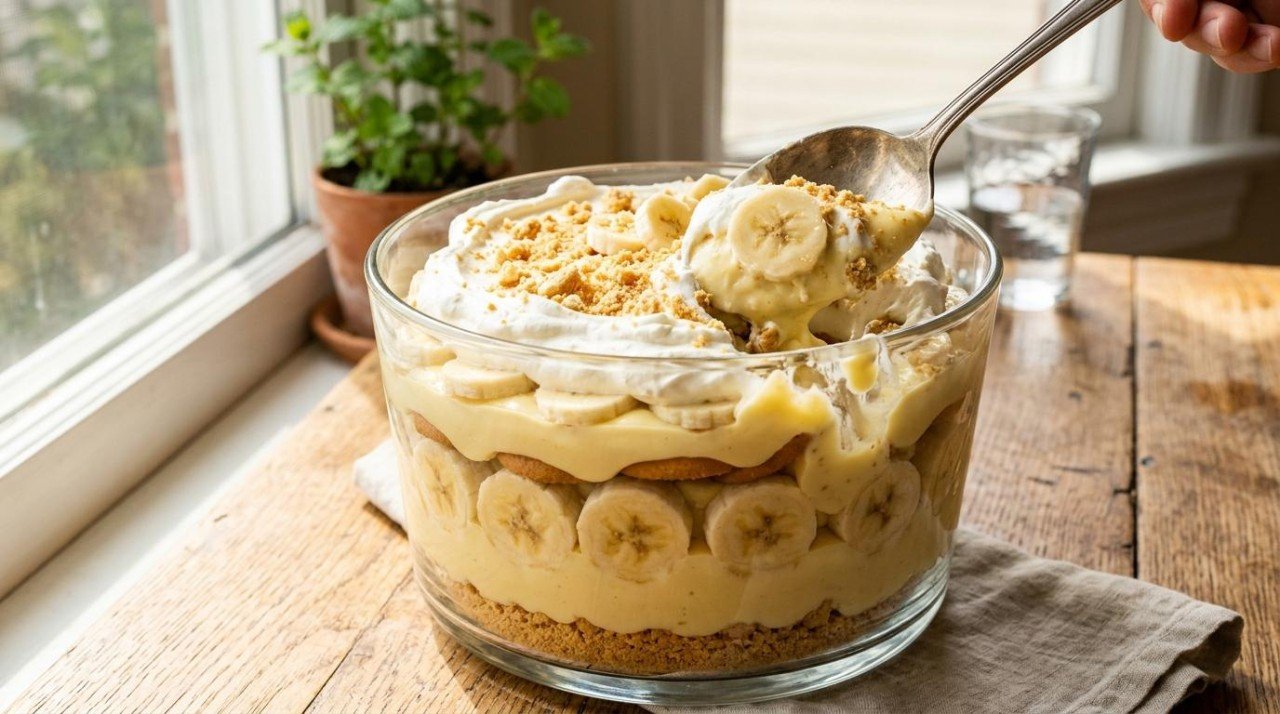
Banana pudding is the dessert that shows up at every cookout, church supper, and holiday table in the South, usually in a big glass dish so everyone can see the layers. Soft cookies, sliced bananas, cold vanilla pudding, a cloud on top. Nobody brings home leftovers, because there aren't any.
The version most of us grew up with is the no-bake potluck one: a can of sweetened condensed milk, a box of instant vanilla pudding, a tub of whipped topping, and a box of vanilla wafers. We ran that classic through the app's Nutrition Score and it came back at 24 out of 100. Then we rebuilt it one swap at a time, scoring every change against the same production nutrition data, and finished at 41: 17 points higher, with about half the added sugar, less saturated fat, more fiber, and more protein.
It is still banana pudding. It is still sweet, still layered, still served cold out of a big dish. And the single biggest move was not the pudding at all. It was the cookie.
The classic banana pudding: what is in it, and why it scores 24
Banana pudding is older than its Southern reputation. According to the Museum of the New South, the earliest recipe appeared in Good Housekeeping in 1888, made with sponge cake, and cooks switched to vanilla wafers in the 1920s. Nabisco started printing a banana pudding recipe on the wafer box in the 1940s, and that box recipe (a cooked custard) is what made it a classic. The shortcut version with instant pudding and condensed milk came later, and it took over because it needs no stove.
For a 9x13 dish, about 12 servings, the no-bake version looks like this:
- 1 can (14 oz) sweetened condensed milk
- 1 1/2 cups cold water
- 1 box (3.4 oz) instant vanilla pudding mix
- 1 tub (8 oz) whipped topping, thawed
- 1 box (12 oz) vanilla wafers
- About 5 bananas
That scores 24 out of 100. Here is what pulls it down, per serving:
- Added sugar: 34.4 g. That is 69 percent of the FDA's 50 g Daily Value for added sugars in one scoop. It comes from four directions at once: the condensed milk, the pudding mix, the whipped topping, and the wafers. The pudding mix is mostly sugar and modified starch, per its own ingredient list.
- Saturated fat: 5.0 g, mostly from the whipped topping and the condensed milk.
- Fiber: 1.3 g and protein: 4.9 g. The bananas are the only whole food in the dish, and there are not many of them.
Now what is already fine. At 356 calories per serving it is a normal dessert, not an outlier. Sodium is a modest 250 mg. The condensed milk brings real calcium and riboflavin. Nothing here is a disaster on its own. The problem is that four sweet, processed ingredients are stacked on top of each other, and the bananas get outnumbered.
One note on method: we scored the pudding mix as what its label says it is, sugar plus starch plus salt, in the proportions on the box.
The upgrades
We applied these in order and re-scored after each one, so every point value is what that change was worth at that stage of the build. The six deltas add up exactly to the 17-point total.
1. Graham crackers instead of vanilla wafers (+9 points)
- Swap: 12 oz vanilla wafers → 12 oz graham crackers
- Score impact: +9 points (24 to 33), the biggest single move
- What it changes: More fiber (1.3 g to 1.8 g per serving), less saturated fat (5.0 g to 4.2 g), more protein and iron, and plant omega-3 from the oil in the crackers
- What it costs you: A honey-graham flavor instead of buttery vanilla. It reads as a slightly different banana pudding, not a worse one
We expected the pudding to be the big lever. It wasn't. Graham crackers are made partly with graham flour, a coarse whole wheat flour, and they carry about twice the fiber of vanilla wafers with less sugar and fat. Swapped into the original recipe with nothing else changed, they were worth 9 points on their own.
Texture-wise they behave like wafers. After a few hours in the fridge they soak up moisture from the custard and turn soft and cakey, the same way they do in an icebox cake. Break the sheets in half so they tile the dish neatly, and save a couple to crush over the top.
2. Scratch custard instead of condensed milk and pudding mix (+2 points)
- Swap: Condensed milk + water + instant pudding mix → a stovetop custard of milk, 4 egg yolks, cornstarch, 3/4 cup sugar, and vanilla
- Score impact: +2 points at this stage (33 to 35). On the original recipe by itself, the same swap was worth +5
- What it changes: Added sugar drops from 32.8 g to 25.3 g per serving, sodium from 310 mg to 210 mg, and the yolks add vitamin B12, choline, and biotin
- What it costs you: About 15 minutes at the stove and an hour of cooling. It tastes better, so that is the whole cost
A can of condensed milk is more than 40 percent added sugar by weight, and the box mix adds about another 1/3 cup on top of that. Replacing both with a real custard means you decide exactly how much sugar goes in. This is also the original way banana pudding was made, so if anything, this swap makes it more traditional. (Our sweetened condensed milk substitutes guide covers other ways around the can.)
The one technique point that matters: once the custard starts to bubble, keep it at a boil for a full minute while you whisk. Egg yolks contain an enzyme, amylase, that breaks down starch, and it is only switched off near boiling. Pull the pot too early and your thick custard can turn soupy overnight in the fridge. Our cornstarch guide explains why it thickens better than flour here.
3. Cut the custard sugar to 1/2 cup (+2 points)
- Swap: 3/4 cup (150 g) sugar → 1/2 cup (100 g)
- Score impact: +2 points (35 to 37)
- What it changes: Added sugar drops from 25.3 g to 21.2 g per serving
- What it costs you: The custard tastes less sweet on a spoon by itself. Layered with ripe bananas and graham crackers, it doesn't
Custard tasted alone always seems like it needs more sugar. Custard eaten with bananas and grahams in the same bite does not, because both bring their own sweetness. Taste the dish assembled, not the pot. If you want to explore other sweeteners, our white sugar substitutes guide compares them.
4. More bananas: 8 instead of 5 (+1 point)
- Swap: About 600 g of sliced banana → about 900 g (roughly 8 medium bananas)
- Score impact: +1 point (37 to 38)
- What it changes: Fiber goes from 1.8 g to 2.3 g per serving and potassium from 330 mg to 410 mg
- What it costs you: Nothing. It is banana pudding
This is the easiest swap on the list. More banana means more fruit in every scoop and less room for everything else. Use bananas that are fully yellow with a few brown freckles: sweet enough to cover the sugar cut, firm enough to slice cleanly. Slice them right before layering and make sure the custard covers them completely, which keeps them from browning.
5. Half whipped cream, half Greek yogurt on top (+1 point)
- Swap: 8 oz whipped topping → 1/2 cup heavy cream whipped with 1 tablespoon sugar, then 1 cup plain nonfat Greek yogurt folded in
- Score impact: +1 point (38 to 39)
- What it changes: Protein goes from 5.9 g to 7.5 g per serving, calcium goes up, and the added sugar from the topping drops sharply
- What it costs you: A light tang under the sweetness. It holds its shape and it tastes like dairy, not like oil and corn syrup
This swap is worth only one point, and that is the interesting part. Swapping the tub of topping for a full cup of real cream, whipped, scored zero on the original recipe. Heavy cream is a real ingredient, but it is a lot of saturated fat per spoonful, and the score weighs that heavily. Folding Greek yogurt into a smaller amount of cream is what makes the topping score better and not just more natural. For more ways to use each, see our heavy cream and Greek yogurt substitution guides.
6. 2% milk in the custard (+2 points)
- Swap: Whole milk → 2% milk, same 3 cups
- Score impact: +2 points (39 to 41)
- What it changes: Saturated fat drops from 4.3 g to 3.8 g per serving
- What it costs you: Barely anything. The four yolks already make the custard rich, and the cornstarch does the thickening
In a dessert this layered, nobody can taste the difference between a whole milk and a 2% milk custard. Your score can.
What we kept (on purpose)
Real heavy cream stays in the topping, because a topping made of yogurt alone is not a whipped topping. All four egg yolks stay, because they make it a custard and not a cornstarch pudding. Half a cup of sugar stays, because banana pudding is a dessert and should taste like one. And the full cookie layer stays: we tested using half the graham crackers and it actually scored a point lower, since the grahams carry fiber the rest of the dish lacks. We stopped at 41 because every swap past this point either did nothing or turned the dish into something else.
Take the Guesswork Out of Eating Well
Eat Well Planner helps you organize your favorite recipes, plan balanced meals, and automatically generate shopping lists — all in one place. Whether you're tracking macros, managing dietary restrictions, or just trying to stop asking "what's for dinner?", we've got you covered.
Our AI-powered tools can adapt any recipe to your dietary needs, help you discover new meals you'll love, and even log your nutrition effortlessly. It's meal planning made simple.
Start Organizing Your Meals — FreeThe healthier banana pudding: full recipe
This version scores 41 out of 100, up from 24. Makes one 9x13 dish, about 12 servings.
For the custard:
- 1/2 cup (100 g) granulated sugar
- 1/4 cup (32 g) cornstarch
- 1/8 teaspoon salt
- 4 large egg yolks
- 3 cups (720 ml) 2% milk
- 2 teaspoons vanilla extract
For the topping:
- 1/2 cup (120 ml) cold heavy cream
- 1 tablespoon granulated sugar
- 1 cup (227 g) plain nonfat Greek yogurt
For layering:
- 12 oz (340 g) graham crackers, about 22 full sheets
- About 8 medium ripe bananas (900 g peeled)
- In a medium saucepan, whisk together the sugar, cornstarch, and salt. Whisk in the egg yolks and about 1/2 cup of the milk until smooth, then whisk in the rest of the milk.
- Cook over medium heat, whisking constantly and scraping the bottom and corners of the pan, until the custard thickens and starts to bubble, about 8 to 10 minutes. Keep it at a gentle boil for 1 full minute, still whisking, so it stays thick after chilling.
- Take the pan off the heat and stir in the vanilla. Pour the custard into a bowl, press plastic wrap directly onto the surface, and let it cool to room temperature, about 1 hour (or 20 minutes with the bowl set in ice water).
- Whip the cream with the 1 tablespoon of sugar to soft peaks. Gently fold in the Greek yogurt until smooth. Refrigerate until needed.
- Break the graham crackers in half and set 2 halves aside for the top. Peel and slice the bananas into 1/4-inch rounds.
- Cover the bottom of a 9x13 dish with a layer of graham crackers, then a layer of bananas, then a third of the custard. Repeat twice more, ending with custard, and make sure every banana slice is covered.
- Spread the cream and yogurt topping over the custard. Crush the reserved graham crackers and scatter them over the top.
- Cover and refrigerate for at least 4 hours, or overnight, so the graham crackers soften. Serve cold. It keeps for 2 days in the fridge.
Per serving, original vs. healthier:
- Nutrition Score: 24 → 41
- Calories: 356 → 338
- Added sugar: 34.4 g → 17.7 g
- Saturated fat: 5.0 g → 3.8 g
- Fiber: 1.3 g → 2.3 g
- Protein: 4.9 g → 7.5 g
- Sodium: 250 mg → 210 mg
- Potassium: 330 mg → 430 mg
Notice the calories barely move. This is not a lighter dessert. It is a better-built one: the same amount of food, with half the added sugar and more of what the bananas, eggs, and yogurt bring.
Swaps we tested and skipped
- All whipped cream on top, no yogurt: −4. An all-cream topping scored 37 instead of 41. It is a real ingredient, and you can absolutely use it, but it was the one "real food" swap that cost points because of the saturated fat.
- All Greek yogurt on top, no cream: +2. It scored 43, the highest of anything we tried. But yogurt alone doesn't whip, so you get a tangy, dense layer instead of a cloud. We'd rather have the banana pudding.
- Cutting the custard sugar to 1/3 cup: +0. Same 41 as the half cup, with a flatter custard. Not worth it.
- Half the graham crackers: −1. Fewer calories per serving (277), but a lower score, because the crackers were doing real work on the fiber.
- Toasted pecans on top: +0. A Southern touch that adds crunch, a little protein, and an extra plant, but also 38 calories per serving, and the score stayed at 41. Add them because you like them, not for the numbers.
Make it fit other diets
- Gluten-free: Use gluten-free graham-style crackers; the custard is already gluten-free.
- Dairy-free: Make the custard with unsweetened oat or soy milk, and use whipped coconut cream folded with a dairy-free yogurt on top.
- Egg-free: Skip the yolks and increase the cornstarch to 1/3 cup. It will be a pudding rather than a custard, but it sets well.
For any of these, the app's Recipe Variations can rewrite this exact recipe in one step, with the swaps already worked in.
Do this to any recipe
Every number on this page came from the same tools you can use on your own recipes. Import your family's banana pudding into Eat Well Planner from a website, Instagram, or YouTube, and it gets a Nutrition Score right away. Tap Make It Healthier and the app suggests swaps like these, each one checked by a calculator before you see it. Love vanilla wafers too much to give them up? Open the recipe in the Playground, see what keeping them costs, and earn the points back with more bananas and a lighter custard.