You have tried everything. You have blended vegetables into sauces, cut sandwiches into star shapes, and delivered your most persuasive "just try one bite" speeches. Your child still won't touch the broccoli. And somewhere between the untouched plate and the rising frustration, a thought creeps in: is something wrong with my child?
The short answer is no. What you are seeing at the dinner table is almost certainly not a behavioral problem, a failure of parenting, or a sign that your child is destined for a lifetime of beige food. It is biology — a deeply embedded survival mechanism that kept human children alive for hundreds of thousands of years. Understanding why your child refuses new foods changes everything about how you respond to it.
The Evolutionary Logic of Refusing New Food
Imagine you are a toddler in the Paleolithic era. You have just learned to walk. The world is full of colorful berries, unfamiliar leaves, and interesting-looking mushrooms. Some of them are food. Some of them will kill you. You cannot read labels, you have no concept of poison, and your parents are not always within arm's reach. What keeps you alive?
Food neophobia — the fear of new or unfamiliar foods — is the answer evolution came up with. Research published in Nutrients describes it as an adaptive trait that "protected mammals from consuming potentially poisonous food." Children who were cautious about unfamiliar food — especially anything bitter, which often signals toxic compounds in plants — were more likely to survive long enough to pass on their genes.
The timing is not random either. Food neophobia is minimal during weaning, when babies are still closely supervised and dependent on caregivers for every mouthful. It intensifies between 18 and 24 months — precisely when children become mobile enough to find and put things in their mouths independently. Studies show that it peaks between the ages of two and six, then gradually declines. This is not a coincidence. It is a calibrated defense system, ramping up exactly when children are most vulnerable to accidental poisoning and winding down as they develop the cognitive ability to learn which foods are safe.
So when your three-year-old pushes away a plate of unfamiliar vegetables, they are not being defiant. They are running software that was written tens of thousands of years ago, and until very recently in human history, it worked extremely well.
Their Mouths Literally Work Differently
It is not just psychology. Children experience food differently at a physical level. A study comparing taste anatomy in children aged eight to nine with adults found that children have significantly higher densities of fungiform papillae — the small structures on the tongue that house taste buds — and much higher taste pore densities than adults. Their individual papillae are smaller, but there are more of them packed into a smaller surface area.
The practical result: children taste things more intensely than you do. The mild bitterness you barely notice in spinach or Brussels sprouts may genuinely taste unpleasant to a child whose tongue is more densely wired for taste detection. Research from Chemical Senses found that fungiform papillae density does not stabilize until around age 11 or 12. Until then, children are tasting the world through a more sensitive instrument than adults use.
On top of this, genetics play a role. The TAS2R38 gene determines how strongly a person perceives bitter compounds. About 25% of the population are so-called "supertasters" who experience bitterness especially intensely. Children who carry the bitter-sensitive variant of this gene may find certain vegetables genuinely overwhelming — not because they are fussy, but because the flavor is, to them, authentically unpleasant.
How Common Is Picky Eating — Really?
If it feels like every parent you know is dealing with a fussy eater, that is because most of them are. A 2024 review in Nutrients found that picky eating affects an estimated 13 to 50% of children, depending on how it is defined, with a meta-analysis placing the overall prevalence at around 22%. Food neophobia specifically — the rejection of unfamiliar foods — affects 40 to 60% of children.
These numbers tell an important story: picky eating is not unusual behavior. It is the norm. The majority of children go through a phase where they resist new foods, prefer familiar options, and have strong reactions to certain textures or flavors. And for most of them, it resolves on its own. The same review found that by late childhood, only 3.7% still exhibit persistent pickiness, and most have grown out of it by adolescence.
There is also a strong genetic component. Twin studies cited in the research show food neophobia has a heritability of around 78% in children aged four to seven. If one or both parents were picky eaters as children, their child is substantially more likely to be one too. The research found that the risk of a child being a picky eater increases 2.85 times when the mother is a picky eater, 5.99 times when the father is, and a striking 22.79 times when both parents are.
What Actually Works: Evidence-Based Strategies
Understanding the biology is reassuring, but it does not make dinnertime any easier. The good news is that decades of research have identified strategies that genuinely help children expand their diets — and most of them involve doing less, not more.
Repeated Exposure (Without Pressure)
This is the single most consistently supported strategy in the research. Offering the same food again and again — without pressure, coercion, or commentary — gradually reduces neophobia and increases acceptance. Research suggests that young infants typically need 8 to 10 exposures to a new food before accepting it, but for preschoolers and older children, the number may be closer to 15 or 20.
An "exposure" does not mean the child has to eat the food. It means the food is present — on the table, on their plate, being eaten by someone else. Seeing it, smelling it, and eventually touching it all count. The key is that each exposure happens without any pressure to taste or eat. Over time, familiarity reduces the perceived threat, and curiosity takes over.
Stop the Pressure
This one is counterintuitive for most parents, but the research is clear: pressuring children to eat specific foods backfires. A Dutch study tracking more than 4,800 children found that kids who were pressured to eat at age four became fussier by age six, even after controlling for initial levels of picky eating (Jansen et al., 2017).
In another study, preschoolers who were given eating prompts every 60 seconds consumed less food and were twice as likely to make negative comments about it (Galloway et al., 2006). And a survey of more than 19,000 self-identified picky-eating adults found that parental coercion had not helped them overcome their food aversions (Kim et al., 2022).
The message from the research is consistent: "just try one bite" might feel harmless, but it registers as pressure, and pressure creates negative associations with food that can persist for years.
The Division of Responsibility
Dietitian Ellyn Satter's Division of Responsibility model is one of the most widely recommended frameworks in paediatric feeding. The principle is simple: parents decide what is served, when it is served, and where it is eaten. The child decides whether to eat and how much.
This is not permissive parenting — parents still control the menu, the structure, and the boundaries. But within that structure, the child has autonomy over their own appetite. Research shows that when parents follow this approach, children develop healthier relationships with food, have lower BMIs, and are less likely to eat in the absence of hunger.
Food Chaining: Building Bridges from Familiar to New
Food chaining is a strategy developed by paediatric feeding specialists Cheri Fraker and colleagues that works with a child's existing preferences rather than against them. The idea is to find links — in flavor, texture, color, or shape — between foods a child already accepts and new foods you would like to introduce.
For example, if your child loves buttered toast, the next link might be toast with a thin layer of peanut butter. From there, peanut butter on apple slices. Then apple slices alone. Then a different fruit. Each step is small enough that it does not trigger neophobia, but over time the chain leads to genuinely new territory.
This approach is now widely used by speech therapists, occupational therapists, and dietitians working with children who have very limited diets, and the principle works just as well for everyday picky eating at home.
Cook Together
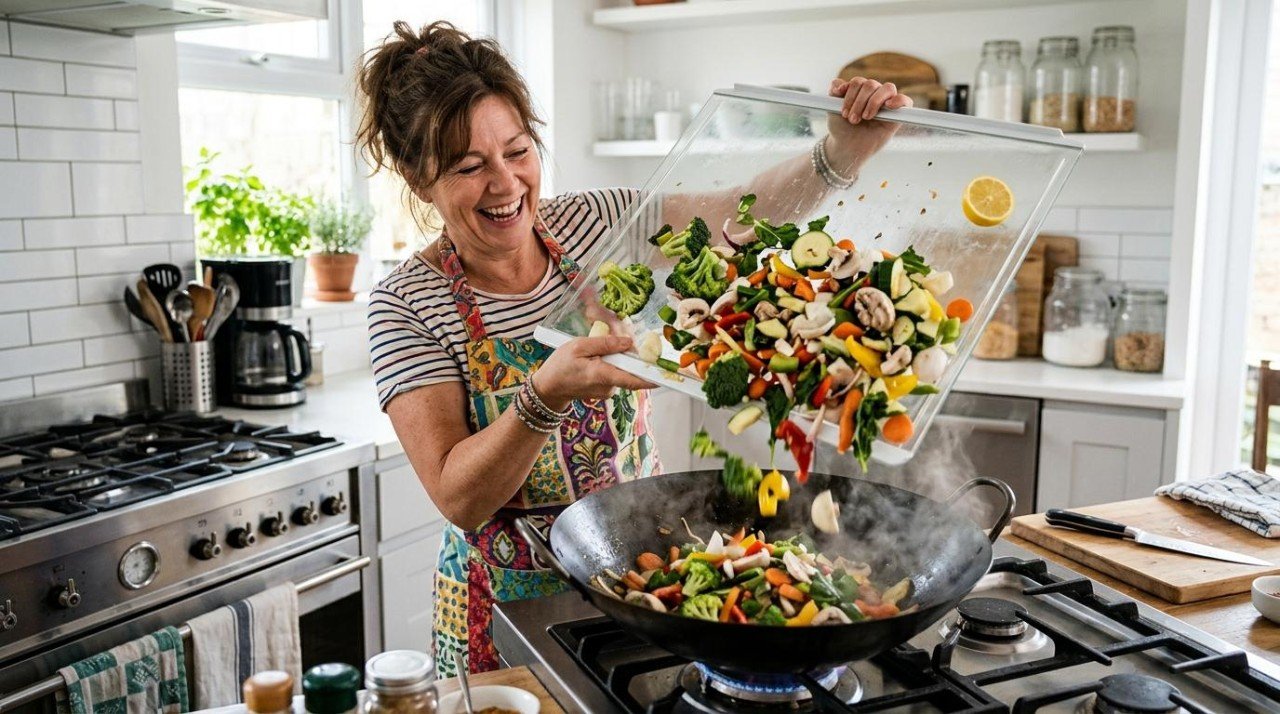
Getting children involved in the kitchen is one of the most effective ways to increase their willingness to try new foods. A 2020 study of 121 parent-child pairs (children aged three to five) found that those who attended a four-week cooking program showed significantly reduced food fussiness scores — dropping from 3.0 to 2.6 on standardised scales — while the comparison group showed no change. The cooking group also showed significantly higher willingness to taste both raw and cooked vegetables.
The mechanism makes sense through an evolutionary lens: a child who has touched, smelled, and handled a food during preparation has already gathered sensory information about it. By the time it reaches the plate, it is no longer truly unfamiliar.
Sensory Play
For younger children especially, non-taste sensory exposure can be a powerful stepping stone. Research has found that children who participate in sensory play with fruits and vegetables — touching, smelling, squishing, sorting — try more of those foods than children who only see them or engage in non-food sensory activities.
This works because it lets children investigate food on their own terms, without any expectation of eating. Squashing a blueberry between their fingers, pulling apart a piece of broccoli, or pouring lentils through a funnel builds familiarity through safe, low-stakes interaction.
Role Modelling and Family Meals
Children learn what is safe to eat by watching other people eat it. This is another evolutionary mechanism — if someone else eats something and does not get sick, it provides social proof that the food is safe. Research cited by Parenting Science shows that children show stronger acceptance of new foods when they see peers eating them, compared to adult demonstrators (Frazier et al., 2012).
Family meals where everyone eats the same food — rather than a separate "children's meal" — give repeated, low-pressure opportunities for this social learning to happen. A child who sees their parent or sibling eating and enjoying a food session after session will eventually become curious.
Take the Guesswork Out of Eating Well
Eat Well Planner helps you organize your favorite recipes, plan balanced meals, and automatically generate shopping lists — all in one place. Whether you're tracking macros, managing dietary restrictions, or just trying to stop asking "what's for dinner?", we've got you covered.
Our AI-powered tools can adapt any recipe to your dietary needs, help you discover new meals you'll love, and even log your nutrition effortlessly. It's meal planning made simple.
Start Organizing Your Meals — FreeDon't Label the Problem
One of the most important things parents can do is resist the urge to call their child a "picky eater" — especially in front of the child. Research and feeding specialists consistently warn that the label can become a self-fulfilling prophecy. When a child hears themselves described as someone who does not eat vegetables, they absorb that as part of their identity, making it harder for them to see themselves as someone who might.
Many of the behaviors we label as "picky" are developmentally normal. A child who rejects unfamiliar food is not picky — they are running a perfectly calibrated evolutionary safety check. Framing it that way, even just in your own mind, changes the emotional temperature at the table. Instead of a battle, it becomes a process — one that takes time, patience, and repetition, but that the vast majority of children grow through naturally.
When Picky Eating Is Something More
For a small number of children, restrictive eating goes beyond typical neophobia. Avoidant Restrictive Food Intake Disorder (ARFID) is a clinical diagnosis — recognized in the DSM-5 since 2013 — that describes extreme food restriction severe enough to cause real harm.
According to the Child Mind Institute, ARFID differs from normal picky eating in its severity and consequences. Children with ARFID are not worried about weight or body image — instead, they may avoid foods based on extreme sensitivity to taste, texture, color, or appearance, or they may have an intense fear of choking or vomiting, or they may simply have so little interest in food that they consistently fail to eat enough.
Research estimates ARFID affects 3 to 5% of the general paediatric population. Warning signs that suggest something beyond normal pickiness include:
- Restriction to fewer than 10 to 15 accepted foods
- Weight loss, or failure to gain weight as expected
- Nutritional deficiencies (such as iron-deficiency anaemia)
- Significant anxiety at mealtimes
- Avoidance of social situations involving food
- Elimination of entire food groups
- No improvement over time despite a supportive mealtime environment
If your child shows several of these signs, it is worth speaking to your GP or a paediatric dietitian. ARFID responds well to treatment — including cognitive behavioral therapy adapted for children and family-based approaches — but early intervention makes a real difference. The key distinction is impact: typical picky eating is inconvenient but does not harm a child's health or development. ARFID does.
Playing the Long Game
The hardest part of feeding a picky eater is that progress is slow and rarely linear. Your child might lick a piece of pepper one week, ignore it for a month, then suddenly eat three slices. The research timeline backs this up: acceptance often takes 15 to 20 exposures spread over weeks or months, and setbacks are normal.
But the trajectory is overwhelmingly positive. Most children grow out of peak neophobia by school age. Their taste buds physically mature, their fungiform papillae density decreases to adult levels by age 11 or 12, and their cognitive development allows them to override the ancient "unfamiliar means unsafe" instinct with learned knowledge about food.
What you do in the meantime matters — not because you need to fix anything, but because the mealtime environment you create shapes your child's long-term relationship with food. A home where meals are relaxed, new foods appear without fanfare, and nobody is forced to eat anything gives neophobia the space to wind down naturally, on the timetable evolution intended.
Practical Toolkit: A Summary
If you take one thing from the research, let it be this: your child's biology is not broken. Their reluctance to eat new foods is a feature, not a bug. Here is what the evidence says actually helps:
- Keep offering without pressure. Put new foods on the table repeatedly. Do not comment, bribe, or negotiate. Let familiarity do the work.
- Use food chains. Start from what they already eat and build outward in small, logical steps — same flavor, different shape; same texture, different color.
- Cook together. Even small children can wash vegetables, tear lettuce, or stir a pot. Involvement builds familiarity.
- Let them play with food. Sensory exploration without any expectation of eating reduces fear and builds comfort.
- Eat together. Family meals where everyone eats the same thing provide social proof that food is safe and enjoyable.
- Drop the label. Avoid calling your child a "picky eater," especially in their hearing. Frame the behavior as normal development, not a problem to solve.
- Watch for red flags. If your child's diet is extremely restricted, they are losing weight, or mealtimes cause significant distress, talk to a professional.
One thing that can make the whole process easier is having a plan. When you know what meals are coming up this week, you can build in repeated exposures to a new food across several days. You can plan a cooking session around a recipe that lets your child get hands-on with an unfamiliar ingredient. And you can make sure the family meal includes both something familiar your child will eat and something new they can explore at their own pace. Eat Well Planner can help with exactly this — it generates weekly meal plans tailored to your family's preferences, creates shopping lists automatically, and lets you save and organize recipes so you always have a plan that balances nutrition with what your household will actually eat. When healthy meals are already planned, gradual food introduction becomes part of the routine rather than another thing to think about.