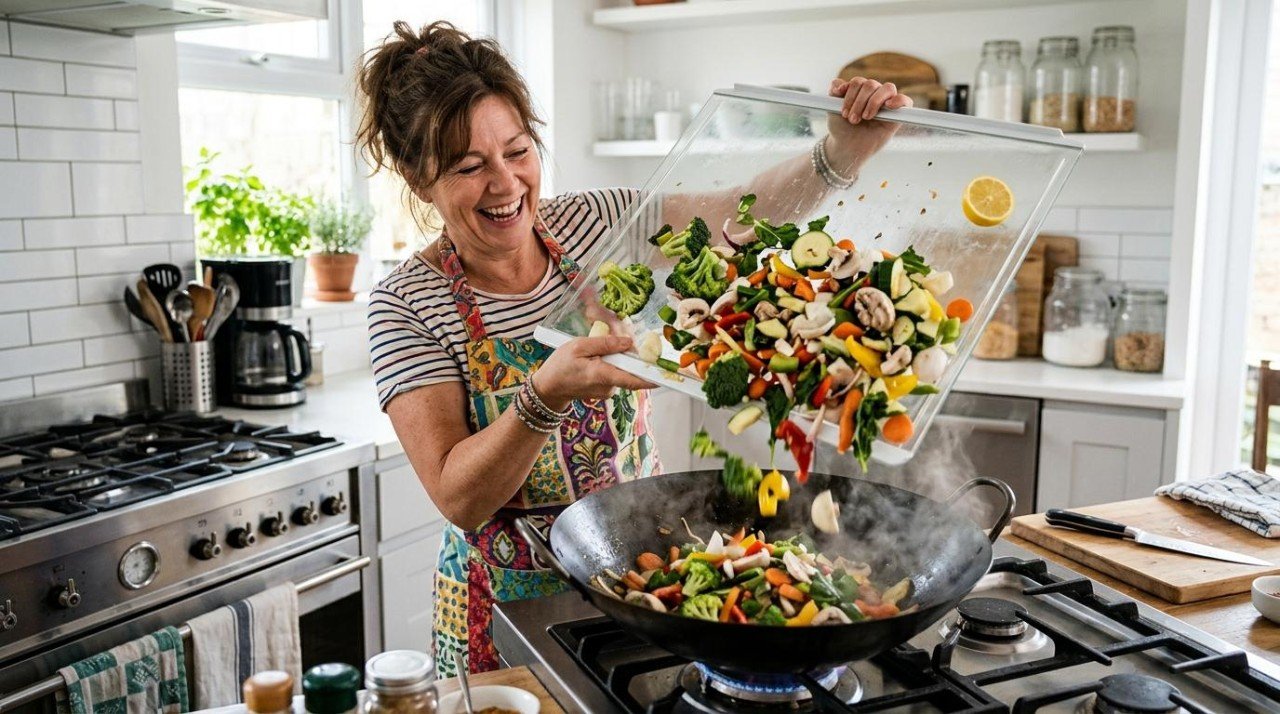
It is 6 p.m., you are tired, and the fridge is a museum of good intentions: half a bell pepper, a fistful of wilting spinach, three scallions past their prime, a wedge of cabbage, and a container of rice from a takeout order you barely remember. Most nights, that is how dinner quietly turns into another delivery order or a bowl of cereal. But those exact odds and ends are the perfect raw material for one of the most forgiving, fast, and genuinely healthy dinners you can make: a stir-fry.
Here is the thing about stir-frying that home cooks often miss. It is not really a recipe. It is a formula — a repeatable structure you can pour almost anything into. Once you internalize the shape of it, you stop needing a recipe at all, and the daily question of what to cook starts answering itself with whatever is already on hand.
The Formula: Five Parts, Endless Dinners
Every good stir-fry, no matter the cuisine it borrows from, is built from the same five components. Learn the slots and you can fill them forever:
- A protein — chicken, beef, pork, shrimp, tofu, tempeh, eggs, or a can of drained chickpeas. Roughly a palm-sized portion per person.
- Vegetables — this is where the fridge cleanout happens. Bell peppers, broccoli, carrots, cabbage, snap peas, mushrooms, zucchini, bok choy, green beans, spinach, leftover roasted vegetables. Aim for two or three, and lean on volume here.
- Aromatics — garlic, ginger, scallions, chili, shallot. Small amounts, huge payoff. This is the layer that makes a pile of vegetables taste like a dish instead of a side.
- A sauce — the part most people overcomplicate. We will break down a base ratio below that you can memorize and riff on endlessly.
- Something starchy to serve it over — steamed rice, leftover grains, rice noodles, or even just more vegetables if you are keeping it light. This is where yesterday's forgotten rice earns its second life.
That is the whole architecture. Protein plus vegetables plus aromatics plus sauce over a starch. It naturally lands you a balanced plate — lean protein, a generous load of plants, and a controlled portion of carbohydrates — and it comes together in under 20 minutes once your knife work is done.
Why the Stir-Fry Is a Food-Waste Hero
The stir-fry deserves more credit as a household money-saver than it gets. Americans throw away a staggering amount of food: the EPA estimates that roughly one-third of all food in the United States goes uneaten, and the average family of four spends almost $3,000 a year on food that never gets eaten. And it is overwhelmingly the fresh stuff that gets tossed. According to ReFED, more than 80% of surplus food comes from perishables, with fruits and vegetables alone making up more than a third of total food waste — largely because produce has the shortest shelf life and is the easiest to forget in a drawer.
A stir-fry is the direct antidote. It is one of the few cooking methods that actively wants slightly tired vegetables. That bendy carrot, the broccoli that is a day from sad, the half-bag of spinach — high heat and a glossy sauce forgive all of it. The method is designed to rescue exactly the ingredients that would otherwise become the $3,000 problem in your trash can. Learn to reach for the wok instead of the delivery app, and the fridge cleanout becomes dinner instead of garbage.
The catch, of course, is remembering what you have and having a rough plan for using it up before it turns. This is where a little organization pays off. In Eat Well Planner, the AI recipe chat is genuinely useful here: tell it what is languishing in your fridge — "I have half a cabbage, two carrots, some tofu, and leftover rice" — and it can turn those specific odds and ends into a stir-fry with a sauce to match. And when you plan your week, working versatile pantry staples (soy sauce, garlic, rice, a bag of frozen stir-fry vegetables) into the rotation means you always have the bones of a fridge-clearing dinner on hand, no recipe hunt required.
Take the Guesswork Out of Eating Well
Eat Well Planner helps you organize your favorite recipes, plan balanced meals, and automatically generate shopping lists — all in one place. Whether you're tracking macros, managing dietary restrictions, or just trying to stop asking "what's for dinner?", we've got you covered.
Our AI-powered tools can adapt any recipe to your dietary needs, help you discover new meals you'll love, and even log your nutrition effortlessly. It's meal planning made simple.
Start Organizing Your Meals — FreeThe Five Keys to a Stir-Fry That Actually Tastes Good
The formula tells you what goes in the pan. Technique is what separates a bright, savory stir-fry from a gray, soggy pile of steamed vegetables. The good news: there are only a handful of rules, and they are all easy.
1. Prep everything first
This is the single most important habit, and the one beginners skip. Stir-frying is fast — often two to five minutes of actual cooking. There is no time to chop garlic while the chicken sears; it will burn. Chefs call this mise en place, and for a stir-fry it is non-negotiable. Cut all your vegetables, mince the aromatics, slice the protein, and mix the sauce in a small bowl before you turn on the heat. Line the bowls up next to the stove in the order they will go in. Once cooking starts, it is all hands, no chopping.
2. Use high heat
A stir-fry needs a hot pan — hotter than most people are comfortable with. High heat is what evaporates moisture on contact and lets the food sear and brown instead of stew in its own juices. It is also the source of that smoky, savory depth restaurant stir-fries have, sometimes called wok hei (the "breath of the wok"). You do not need an actual wok; a wide, heavy skillet works. But get it properly hot before the oil goes in, and use an oil with a high smoke point — a neutral oil like avocado, peanut, or refined canola — so it can take the heat without turning acrid.
3. Do not crowd the pan
This is the rule that trips up almost everyone, because our instinct is to save time by dumping everything in at once. Do not. Every ingredient you add is full of water. When the pan is hot and food has room, that water flashes instantly to steam and escapes, and the food browns. When you overcrowd, the pan temperature plunges, the water pools instead of evaporating, and you end up boiling your vegetables in their own liquid — pale, limp, and watery. The browning reactions that create flavor only fire above roughly 285°F, so a cold, crowded pan simply cannot develop that taste. If you are cooking for more than two, work in batches: sear the protein, set it aside, cook the vegetables, then bring everything back together at the end.
4. Add ingredients in order of cook time
Not everything cooks at the same rate, so the sequence matters. A rough order:
- Protein first, while the oil is hottest, to sear it. Then remove it and set it aside.
- Aromatics next — garlic and ginger only need 15 to 30 seconds, and they burn fast, so they go in briefly once the pan is back to temperature.
- Hard vegetables like carrots, broccoli stems, and green beans, which need a couple of minutes.
- Softer, quicker vegetables like peppers, mushrooms, snap peas, and cabbage.
- Leafy greens and delicate items like spinach or bean sprouts last — they wilt in seconds.
- The protein returns, then the sauce goes in to finish.
You do not need to be precious about this. The principle is simple: dense, slow things early; tender, fast things late; anything that only needs to warm through goes in at the end.
5. Sauce goes in at the very end
Add your sauce in the last minute, once everything else is cooked. Pour it around the edge of the hot pan rather than dumping it in the center, then toss to coat as it bubbles and thickens into a glaze. Done too early, the sauce reduces to a salty, burnt mess; done at the end, it clings to everything with a glossy shine.
The Base Sauce Ratio You Can Memorize
Bottled stir-fry sauce is convenient but often loaded with sugar, sodium, and additives — the very ultra-processed profile a home-cooked meal is supposed to help you sidestep. Making your own takes 60 seconds and gives you full control. Nearly every stir-fry sauce is a balance of four elements:
- Salty / savory: soy sauce or tamari (use tamari to keep it gluten-free) — the backbone, about 3 tablespoons.
- Acid: rice vinegar, lime juice, or a splash of Shaoxing wine — about 1 tablespoon, to brighten and balance.
- A little sweetness: honey, maple syrup, or brown sugar — 1 to 2 teaspoons, just enough to round the edges (not to make it dessert).
- A thickener: a cornstarch slurry — about 1 to 2 teaspoons of cornstarch stirred into 2 tablespoons of cold water or broth.
From there, layer in whatever you like: grated ginger and garlic, a spoon of chili crisp, a drizzle of toasted sesame oil at the end, a splash of fish sauce or oyster sauce for depth. The four-part skeleton stays the same; the accents make it Thai one night, Chinese-inspired the next, gingery and bright the night after.
The cornstarch slurry is the small piece of food science worth understanding, because it is what gives restaurant stir-fries their signature glossy cling. Cornstarch has to be dissolved in cold liquid first — if you sprinkle dry starch into a hot pan, it seizes into lumps instantly. Suspended in cold water, the granules stay separate until they hit the heat, where they absorb liquid and swell in a process called gelatinization, thickening the sauce into a silky glaze in under a minute. A little goes a long way; too much and you get glue, so start with a teaspoon or two.
It Is Not Just Fast — It Is Genuinely Good for You
Stir-frying is not a nutritional compromise you make for speed. In several ways it is one of the better things you can do to a vegetable. Because the food barely touches water and cooks quickly, it holds onto nutrients that other methods leach away. Boiling is especially rough on water-soluble vitamins: one analysis found vitamin C losses from boiling ranging up to about 74%, precisely because the vitamins dissolve into the cooking water you pour down the drain. Methods that minimize water contact hold onto far more.
Stir-frying takes that advantage further. In one study, stir-frying Chinese cabbage and pak choi preserved their health-promoting glucosinolates — the sulfur compounds in cruciferous vegetables tied to their protective effects — even at high temperatures, because there is no separate water phase for the compounds to leach into. The quick heat actually deactivates the enzyme that would otherwise break them down. Boiling the same vegetables would have washed much of that benefit away.
Then there is the oil. It is easy to think of the splash of oil in a stir-fry as the "unhealthy" part, but for a vegetable-heavy dish, a bit of fat is doing real work. Many of the most valuable compounds in vegetables — the carotenoids that give carrots, peppers, and leafy greens their color, plus fat-soluble vitamins — are absorbed far better in the presence of fat. In one striking study, adding a fat source to salad boosted the absorption of carotenoids like beta-carotene by more than 15-fold and lutein about 5-fold compared to a fat-free version. A follow-up study found the effect scales with the amount of fat, with absorption of carotenoids and fat-soluble vitamins highest at the larger oil doses tested. The tablespoon of oil in your pan is not just carrying flavor — it is helping you actually use the nutrients in all those vegetables.
That vegetable load matters more than most of us like to admit. The CDC has found that only about 9% of American adults eat the recommended amount of vegetables each day. A stir-fry is one of the easiest ways to move that number, because it makes eating three or four different vegetables in a single meal feel effortless and delicious rather than dutiful.
That variety is worth chasing for its own sake, too. Gut-health researchers point to the diversity of plants you eat — a popular target is 30 different plant foods a week — as one of the strongest levers for a healthy microbiome, since different fibers feed different beneficial bacteria. A stir-fry is a diversity machine: five vegetables, some garlic and ginger, a scatter of sesame seeds, and cashews on top can knock out eight or nine distinct plants in one pan. If you want to make that concrete, Eat Well Planner's Plant Points tracker turns your weekly plant variety into a running score, so a habit of "throw in one more vegetable" becomes visible progress instead of a vague intention.
Make It Yours
The whole point of a formula is that it frees you from recipes. Once the structure is second nature, you can build a stir-fry around almost anything:
- Gingery chicken and broccoli — chicken, broccoli, carrots, ginger, garlic, soy-vinegar-honey sauce over rice.
- Tofu fried rice — cubed tofu, peas, carrots, scallions, egg, and yesterday's cold rice tossed right in the pan.
- Beef and pepper — thin-sliced beef, bell peppers, onion, a little extra sweetness and chili.
- Clean-out-the-crisper — whatever is left, plus chickpeas or a couple of eggs for protein and the base sauce to tie it together.
None of those are really separate recipes. They are the same five slots, filled differently. That is the quiet power of learning a method instead of memorizing dishes: one technique, endlessly adaptable, that turns "there's nothing to eat" into a hot, balanced dinner in the time it would take to scroll a delivery menu.
If you want a little help closing the gap between "I have random ingredients" and "dinner is on the table," that is exactly what Eat Well Planner is built for. Use the AI recipe chat to spin your leftovers into a stir-fry on the fly, save the combinations that work into your recipe book, plan a week that keeps flexible pantry staples on hand, and let the app build your shopping list around them. The formula is simple enough to keep in your head — the app just makes it even easier to actually cook it, week after week.