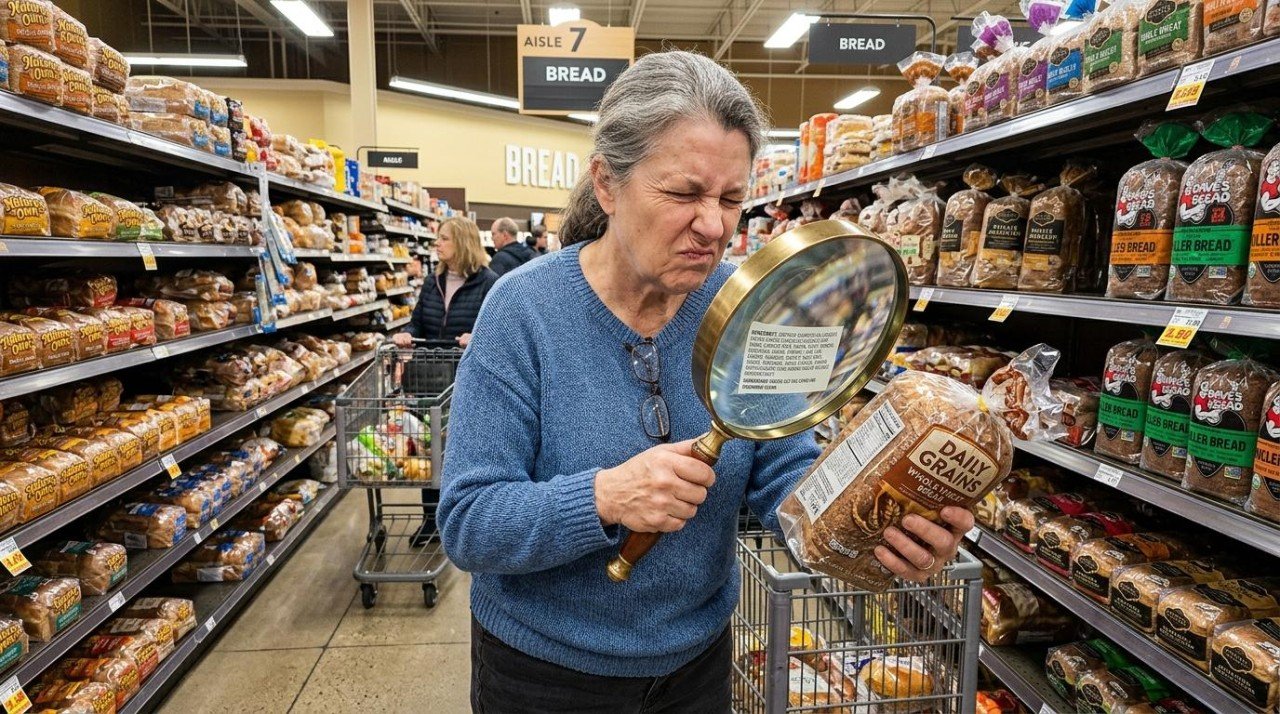
If you've been reaching for the "wheat bread" for years because it felt like the responsible choice, there's a good chance you've been buying refined white bread with a tan. You're not being careless. The bread aisle is one of the most quietly misleading corners of the grocery store, and the labels are doing exactly what they were designed to do: make a refined loaf look wholesome.
The good news is that once you know the handful of tricks manufacturers use, spotting genuinely whole-grain bread takes about ten seconds. This is a practical guide to reading past the front of the package so the "healthy" bread in your cart is actually healthy.
Why the Bread Aisle Is Built to Confuse You
Front-of-package claims on bread are marketing, not nutrition information. And they work disturbingly well. When Consumer Reports looked at how shoppers interpret bread labels, it cited research in which 47% of participants incorrectly chose the mostly-refined-grain product as the healthier option based on the front label. Nearly half of us are getting it wrong, and it's not because we don't care.
Here are the terms that sound healthy but tell you almost nothing:
- "Wheat bread" or "wheat flour." This is the big one. Nearly all bread in America is made from wheat, so "wheat" describes the plant, not the processing. As the Tufts Health & Nutrition Letter puts it plainly, "wheat bread is not the same as whole wheat bread." On an ingredient list, plain "wheat flour" (sometimes "enriched wheat flour") means the bran and germ have been stripped out. That's refined white flour by another name.
- "Multigrain." This only means the bread contains more than one type of grain. It says nothing about whether any of them are whole. Tufts notes that "a product made from refined wheat and refined rice flours can market itself as multigrain, but has no whole grains." It's often marketing code for multiple refined grains.
- "Made with whole grains." Technically true, practically meaningless. A loaf can contain a token sprinkle of whole grain and still earn this phrase. Harvard Health warns that products saying "made with whole grains" may still be "mostly enriched white flour."
- "7-grain," "cracked wheat," "stone-ground," "double fiber," "fortified." Harvard groups all of these together as terms that may be mostly enriched white flour. "Stone-ground," in particular, describes a milling method, not whether the grain is whole.
The Brown Color Trick
Here's the one that catches the most careful shoppers: a darker loaf is not necessarily a healthier one. Manufacturers routinely darken bread with molasses or caramel coloring to give refined bread that rustic, whole-grain look. The International Food Information Council says it bluntly: "Just because a bread is brown doesn't mean it's whole grain." Color is decoration. Ignore it entirely.
The Reliable Checks That Actually Work
Now the useful part. You don't need to memorize regulations. You need four quick checks, and any bread that passes them is the real thing.
1. Look for the word "100%"
The single most reliable claim on the front of the package is "100% whole wheat" or "100% whole grain." That "100%" is doing real work. Under FDA definitions, "100% whole grain" means all the grain in the product is whole grain. Drop the "100%" and the protection largely disappears: a plain "whole grain" claim can legally apply to a bread that's only 51% whole-grain flour, with the rest refined.
2. Check that a whole grain is the first ingredient
The front of the package can lie by omission; the ingredient list is where the truth lives. Ingredients are listed in order of weight, so you want a whole grain sitting at the very top. Look for the word "whole" right there in the first ingredient: "whole wheat flour," "whole grain oats," "whole rye flour." Harvard's rule of thumb is that a whole grain should be the first ingredient, or the second after water. If the first ingredient is "enriched wheat flour" and the whole grain is buried three lines down, it's mostly refined bread.
3. Aim for 3+ grams of fiber per slice
Whole grains keep the bran, which is where most of the fiber lives, so real whole-grain bread has fiber to show for it. A slice of genuine whole wheat bread generally delivers 2 to 3 grams or more. Harvard suggests choosing breads with at least 3 grams of fiber per serving. If you want an even quicker mental test, Tufts offers a handy ratio: look for at least 1 gram of fiber for every 10 grams of carbohydrate on the Nutrition Facts panel. A slice with 20 grams of carbs and 1 gram of fiber is not pulling its weight.
4. Read the whole ingredient list (shorter is usually better)
Good whole-grain bread doesn't need much: whole grain flour, water, yeast, salt, maybe a little oil and a small amount of a sweetener. When the list runs long with dough conditioners, added gluten, multiple sweeteners, and caramel coloring, you're usually looking at a heavily engineered product doing its best to imitate something simpler.
A word on the Whole Grain Stamp
You'll see a black-and-gold "Whole Grain" stamp on a lot of packages. It's helpful, but only if you read which one it is. The Whole Grains Council uses three different stamps:
- 100% Stamp — every grain ingredient is whole grain, with at least 16 grams of whole grain per serving. This is the one you want.
- 50%+ Stamp — at least half the grain is whole (8+ grams per serving), but it still contains refined grain.
- Basic Stamp — contains a meaningful amount of whole grain (8+ grams) but is primarily refined grain.
In other words, a stamp alone isn't a green light. A Basic Stamp on a loaf that's mostly white flour is entirely legitimate. Glance at which stamp it is, then still check the first ingredient.
Take the Guesswork Out of Eating Well
Eat Well Planner helps you organize your favorite recipes, plan balanced meals, and automatically generate shopping lists — all in one place. Whether you're tracking macros, managing dietary restrictions, or just trying to stop asking "what's for dinner?", we've got you covered.
Our AI-powered tools can adapt any recipe to your dietary needs, help you discover new meals you'll love, and even log your nutrition effortlessly. It's meal planning made simple.
Start Organizing Your Meals — FreeDon't Forget the Added Sugar
Sandwich bread has a quiet sugar problem. Sweeteners help bread brown, stay soft, and feed the yeast, so most commercial loaves contain some, often listed as sugar, high-fructose corn syrup, honey, or cane syrup. Plain white and whole wheat sandwich breads typically carry around 1 to 2 grams of sugar per slice, which is minor. But some varieties run to 4 or 5 grams per slice, and if you eat two slices in a sandwich, that's a meaningful amount of added sugar before you've added anything to it. A reasonable target is to keep added sugar to a couple of grams per slice or less, and to check the "Added Sugars" line now that it's required on the Nutrition Facts panel.
The Genuinely Better Options: Sprouted Grain and True Sourdough
Once you're past the imposters, a couple of styles are worth knowing about.
Sprouted grain bread (Ezekiel bread is the best-known example) is made from grains and legumes that have been allowed to sprout before being mashed and baked, often with no added flour at all. According to Healthline, a typical slice provides about 80 calories, 5 grams of protein, and 3 grams of fiber, and sprouting can make certain nutrients easier to absorb by reducing phytate, a compound that binds minerals. There's decent evidence on the blood-sugar side too: a controlled study in overweight and obese men found that sprouted-grain bread lowered the glucose response and increased GLP-1 (a hormone involved in fullness and blood-sugar control) compared with several other breads, including sourdough and white.
True sourdough is worth a more honest look than it usually gets. Long fermentation can improve the absorbability of minerals and break down some antinutrients, which is a real plus. But two caveats matter. First, "sourdough" made from refined white flour is still refined bread; the fermentation doesn't add back the bran and germ. Look for a whole-grain sourdough if you want the fiber. Second, the glycemic story isn't as tidy as the internet suggests. In that same study, sourdough actually produced the lowest GLP-1 response of all the breads tested. Sourdough has genuine merits, but choose it for the flavor and fermentation, and still check that whole grain is the base.
A Realistic Ranking, Best to Worst
No single loaf is right for everyone, but here's a practical hierarchy based on the checks above:
- Sprouted whole-grain bread — whole grains, often no refined flour, extra nutrient availability.
- 100% whole wheat or 100% whole grain — a whole grain first, 3+ grams of fiber, short ingredient list. The reliable everyday choice.
- Whole-grain sourdough — fermentation benefits plus real whole grain, if you can find or bake it.
- "Whole grain" (not 100%) or a 50%+ Stamp — better than white, but part refined. A step in the right direction.
- "Multigrain," "made with whole grains," or "wheat" bread — usually mostly refined flour in a wholesome-looking wrapper.
- Plain white bread with caramel coloring — refined bread pretending to be brown. Fine as an occasional choice, but don't mistake it for the healthy option.
What to Do at the In-Store Bakery (Where There's No Label)
The fresh bakery counter is where all your label-reading skills seem to hit a wall, because there often isn't a Nutrition Facts panel or ingredient list at all. A few practical moves:
- Ask for the ingredient list. Stores are generally required to have ingredient information available on request for bakery items. Ask whether the first ingredient is whole wheat flour or plain (refined) flour. A "wheat" or "honey wheat" loaf at the bakery counter is almost always refined.
- Don't trust the crust color for the same reason you don't trust it on packaged bread.
- Look for "100% whole wheat" specifically on the little placard, not just "wheat" or "grain."
- When in doubt, buy the clearly labeled packaged loaf. A bagged 100% whole wheat with a readable ingredient list beats a mystery loaf you're guessing about.
Making Sure the Whole Grains Actually Land
Here's the part that ties it all together: picking a better loaf only matters if those whole grains and that fiber actually add up across your week. It's easy to feel like you're "eating healthy bread" while the fiber never really moves the needle, especially if the loaf turned out to be more decorative than whole.
This is where tracking what you actually eat closes the loop. In Eat Well Planner, logging your meals shows your real daily fiber intake, so you can see whether that switch to a genuine whole-grain loaf is translating into the 25 to 30-plus grams of fiber a day most adults should be aiming for, or whether you're still falling short. Every recipe and logged food also gets plain-language "good source of fiber" style nutrient highlights based on FDA thresholds, so you can tell at a glance which foods are pulling their weight, no nutrition-label decoding required.
If gut health is part of why you care about whole grains in the first place, the app's Plant Points tracker turns the research-backed goal of eating 30 different plants a week into a simple running score. Whole grains, seeds, and legumes all count, so choosing a genuine sprouted or whole-grain loaf becomes one more easy point toward a more diverse, fiber-rich diet, and you can watch it add up instead of hoping it does.
The Ten-Second Version
You don't have to become a food scientist to shop the bread aisle well. Next time, flip the loaf over and run the checks:
- Does the front say "100%" whole wheat or whole grain?
- Is a "whole" grain the first ingredient?
- Does a slice have 3 or more grams of fiber (or at least 1 gram per 10 grams of carbs)?
- Is the added sugar low and the ingredient list short?
Ignore the color, ignore "multigrain," and ignore "made with whole grains." Four checks, ten seconds, and the healthy-looking bread in your cart will finally be the healthy one.